News for hackers. Stuff that matters.
Re:What is energy, actually? (2011) by hliyan on Friday November 29, 2019 @07:23AM (#21663922)
Somewhat tangentially related: I wrote this in a private note to a friend last year. I don't believe this 100%, but the idea is worth exploring in my opinion:

1. Corporations desperately pursue continuous growth, even when they're already profitable, and do so at the expense of the environment, employee welfare and sometimes, the rule of law.

2. Corporations pursue growth because investors demand it.

3. Investors demand growth because they want a certain minimum return on investment.

4. Investors need to invest money in instruments with a certain minimum ROI because if they don't, inflation will erode their savings.

5. This continuous growth requirement forces companies to compete for larger and larger portions of market share, which in turn forces their competitors to compete harder in response.

6. The end result is a sort of "Red Queen" effect where everyone is forced to compete harder and harder just to maintain his/her existing standard of living.

7. We know that the more extreme a competition becomes, the more ruthless the participants become, often to the point of acting immorally.

8. Therefore, we should focus on curbing inflation to curb the pace of overwhelming growth, and thereby restore some measure of social justice.

Re:What is energy, actually? (2011) by pjc50 on Friday November 29, 2019 @07:57AM (#21664059)
Inflation is already almost zero in much of the West. People demand growth because they want to get richer, regardless of the prevailing conditions.

I would also like to point out that if there were to be no growth and no inflation (edit: and a static population level!), then the only way to add a dollar to your pile is to permanently make someone else a dollar poorer. That seems likely to accelerate the lethality of the billionaries vs. hungry poor conflict rather than de-escalate it.

> inflation will erode their savings

> compete harder and harder just to maintain his/her existing standard of living

These are two different things. Savings are a stock, "standard of living" is a flow. The distinction matters here because GDP measures flows; the two are related through the money equation "MV=PQ".

Re:What is energy, actually? (2011) by new2628 on Friday November 29, 2019 @08:18AM (#21664170)
> Inflation is already almost zero in much of the West.

pet theory: Inflation is way way more than zero almost everywhere (prices of services and rents reflect this), but high inflation is masked by increased supply chain efficiencies, cheapening (in some cases worsening) of products and other factors, which keep prices of physical products relatively stable.

Re:What is energy, actually? (2011) by pjc50 on Friday November 29, 2019 @09:13AM (#21664480)
There's a real discussion to be had here, but we have to be careful not to move the labels too much. The economics term for differential inflation in various goods is "Baumol cost disease": https://www.vox.com/new-money/2017/5/4/15547364/baumol-cost-...

Tremendous graph there.

Basically, services that have to be provided by western labour in the west have got much more expensive, while goods that can be imported have got much cheaper.

Re:What is energy, actually? (2011) by barry-cotter on Friday November 29, 2019 @09:34AM (#21664608)
> Basically, services that have to be provided by western labour in the west have got much more expensive, while goods that can be imported have got much cheaper.

This is broadly true though the bit about the West and imports is unnecessary. Manufactured goods have gotten cheaper whether imported or not in real terms, and services get more expensive in relative terms as a consequence. Some of this is probably a result of government misregulation but not all. Cosmetic surgery isn’t covered by insurance, nor is LASIK or hair loss treatment and in inflation adjusted terms prices have been basically flat for over a decade, neglecting the huge increases in quality. Education probably has similarly large inefficiencies, even outside institutions that exist only because of easily available student loans and non-existent quality control like the University of Phoenix.

But Cost Disease is the inevitable product of economic growth. The more capital you have the more labor will be paid because Money is just less valuable to you when you have lots and labour vice versa.

A long report on Baumol’s cost disease in the US context and internationally.

https://www.mercatus.org/system/files/helland-tabarrok_why-a...

Re:What is energy, actually? (2011) by sokoloff on Friday November 29, 2019 @09:58AM (#21664723)
> This is broadly true though the bit about the West and imports is unnecessary. Manufactured goods have gotten cheaper whether imported or not in real terms

This must be interpreted in the context of a large fraction of manufacturing moving off shore in the last 75 years. Manufacturing which remained has become significantly less labor intensive (because that which didn’t has moved to lower labor cost locations).

Re:What is energy, actually? (2011) by gnode on Friday November 29, 2019 @09:55AM (#21664712)
I don't think it's about imports / foreign production, but about the requirement of labour of high income workers generally. Domestic agriculture and manufacturing have experienced less inflation than medicine and education because they have reduced their dependence on labour with greater mechanisation and efficiency.

I think there's also an effect that people are increasingly able to tolerate working very low economic value jobs, because productivity increases in basic necessities of survival, like food and transportation, make this possible. These people are then priced out of healthcare, education, and quality housing. The decreased consumption of expensive labour-based services then decreases their weighting in measures of inflation, allowing them to further inflate, yet overall inflation stay low.

Re:What is energy, actually? (2011) by lotsofpulp on Friday November 29, 2019 @09:20AM (#21664527)
Inflation is the opposite of cheapening, so I don’t see how that can be.

What you may be feeling though, and what isn’t calculated in any numbers, are the increases in volatility, which is itself a cost. The volatility of not living in the few economically burgeoning regions, the volatility of having to keep moving up the ladder or else falling behind, increased years of education and loans for what may or may not be a lucrative career, etc.

Re:What is energy, actually? (2011) by pjc50 on Friday November 29, 2019 @10:06AM (#21664782)
Parent is probably referring to "shrinkflation": rather than charge 10% more for a box of cereal, make it 10% smaller for the same price. Or otherwise reduce the cost of inputs.

> volatility

Definitely worth having a discussion on this, although we need to define the reference period - volatility was high in the 60s, 70s, and 80s. Arguably it was only low in the ""end of history"" period between the fall of the Berlin wall and the 2008 crisis.

Re:What is energy, actually? (2011) by BoorishBears on Friday November 29, 2019 @10:01AM (#21664748)
Cheapening was just one of the above comments points... strange to try and dismiss it on that part alone.

But yeah, if I add filler to my soap so that it costs me 20% less to make, but requires you to use 20% more for efficacy, I've cheapened the good, and inflated it's cost.

Re:What is energy, actually? (2011) by adventured on Friday November 29, 2019 @08:29AM (#21664219)
It's asset inflation, which is where most of the Fed's inflation (eg many trillions of dollars of overvaluation into the stock market) via artificially low rates has gone since the Clinton and Bush years when they helped to spark the stock market bubble (#1, #2 and now #3) and then the housing bubble that way. Then they openly admitted to intentionally reinflating the housing market with their various market interventions and low rates.

Whenever economists claim inflation is low, they're almost always exclusively talking about traditional consumer goods (in which case it is low for the most part). They comically go out of their way to ignore the inflation in housing, healthcare, education and various asset classes.

Warren Buffett likes to regularly point out that the Fed's rates act like gravity on stock valuations. The lower the rates, the less gravity. The same is largely true of how housing is affected by the Fed's rates. If you want to absolutely crush housing prices, push Fed rates back up to where mortgage rates are at 15-20% again. What that all really means is, the lower the rates, the more asset valuation inflation occurs. It's just that for amusingly convenient reasons (ie to pretend inflation is lower than it is), most economists like to pretend that asset inflation doesn't count as real inflation in their models.

Re:What is energy, actually? (2011) by zaroth on Friday November 29, 2019 @09:12AM (#21664471)
> Whenever economists claim inflation is low, they're almost always exclusively talking about traditional consumer goods (in which case it is low for the most part). They comically go out of their way to ignore the inflation in housing, healthcare, education and various asset classes.

This is false. The CPI weights the basket of goods that comprise the index based on the types of goods that people actually consume, which includes housing (either in the form of rent or mortgage payments), energy, as well as food and consumer goods. It adjusts for consumption patterns monthly, and re-weights the entire index every 2 years.

The BLS surveys rental prices as well as calculating something called “owner equivalent rent” for owner-occupied housing.

> The OER and Rent indexes have the largest weights of the 211 item categories (item strata) that comprise the CPI market basket. As of December 2008 their shares of the total weight (their relative importances) in the CPI for All Urban Consumers (CPI-U), were 24.433 percent and 5.957 percent, respectively.

[1] - https://www.bls.gov/cpi/factsheets/owners-equivalent-rent-an...

Re:What is energy, actually? (2011) by mcny on Friday November 29, 2019 @09:19AM (#21664522)
> Warren Buffett likes to regularly point out that the Fed's rates act like gravity on stock valuations. The lower the rates, the less gravity. The same is largely true of how housing is affected by the Fed's rates. If you want to absolutely crush housing prices, push Fed rates back up to where mortgage rates are at 15-20% again. What that all really means is, the lower the rates, the more asset valuation inflation occurs. It's just that for amusingly convenient reasons (ie to pretend inflation is lower than it is), most economists like to pretend that asset inflation doesn't count as real inflation in their models.

I know what you're proposing will be very unpopular but I have an idea that will be even more unpopular: a federal property tax on land + buildings at (five percent of property valuation) per year. There will be absolutely no exceptions for anyone. Everyone must pay. This money will mostly go back to local governments, toward infrastructure and utilities (mass transit, water, electricity, fiber Internet, sewage, garbage collection, education, ... ideally automated as much as possible) and a portion will go to supplement VAT to pay for supplemental universal basic income (in addition to the freedom dividend) that more than covers the new property tax on a one bedroom somewhere in the continental United States (so not necessarily midtown Manhattan).

The key difference in what I propose is the lack of exceptions. Everyone must pay regardless of whether it is a strip club or a church. You don't pay, you get evicted within fifteen years or however long we decide. I recommend eviction should happen when unpaid taxes reaches 100% of property value.

My Hope is that this will absolutely crash the housing market and stop this irrational speculation in the housing market.

Re:What is energy, actually? (2011) by corporate_shi11 on Friday November 29, 2019 @11:41AM (#21665309)
What you're describing would completely cripple the economy and raise rents rather than lower them, the opposite of what you hope for.

A severe tax on property would simply force property owners to raise rents. This in turn would price people out of the market. The housing stock would suffer as property owners would have no excess funds to make improvements and repairs to property. Building of new property would slow as the market for property deteriorates.

Beyond that...

VAT has had disastrous effects on European economies (go look at the price of goods in Europe. Significantly higher in real terms than in the US). Part of this lies in the way VAT obscures the tax portion of cost, allowing governments to surreptitiously raise taxes. This has happened in most developed countries where VAT is implemented.

You also mention government doing many wonderful things with its newfound revenue, but the reality is that government spending is usually wasted on bureaucratic bloat and other inefficient allocations.

Re:What is energy, actually? (2011) by mcny on Friday November 29, 2019 @02:10PM (#21666170)
> A severe tax on property would simply force property owners to raise rents. This in turn would price people out of the market. The housing stock would suffer as property owners would have no excess funds to make improvements and repairs to property. Building of new property would slow as the market for property deteriorates.

I am not an economist but this implies property owners are leaving money on the table right now. I don't think that is the case. The market already charges as much as renters can afford to pay. There is not much room for rent to go up.

> You also mention government doing many wonderful things with its newfound revenue, but the reality is that government spending is usually wasted on bureaucratic bloat and other inefficient allocations.

I absolutely agree with you on this one. This is why I want as much automation as possible. However, having worked in the private sector, I can assure you bloat and inefficiency happens in both public and private sector. The main difference I think is that things are much more transparent in the public sector.

Re:What is energy, actually? (2011) by Ma8ee on Friday November 29, 2019 @04:26PM (#21666885)
In what way have the VAT had disastrous effects on European economies? Goods are more expensive, but that is no disaster.
Re:What is energy, actually? (2011) by saurik on Friday November 29, 2019 @09:25AM (#21664550)
Normally we use the term "evicted" to imply someone with a lease no longer gets usage of the property; but in this case, these people own the property, so what are you saying happens then? Does the property get given to the government, who then... sells it? I am not complaining (yet), I just want to understand what happens in your mind after the "eviction" as the term isn't clear for me in this context.
Re:What is energy, actually? (2011) by mcny on Friday November 29, 2019 @02:12PM (#21666178)
> Normally we use the term "evicted" to imply someone with a lease no longer gets usage of the property; but in this case, these people own the property, so what are you saying happens then? Does the property get given to the government, who then... sells it? I am not complaining (yet), I just want to understand what happens in your mind after the "eviction" as the term isn't clear for me in this context.

exactly. the property returns to the market to someone who is willing to pay the property tax.

Re:What is energy, actually? (2011) by 0xffff2 on Friday November 29, 2019 @09:46AM (#21664657)
Why 5%? That's enough to very nearly double the recurring cost of my house (mortgage, insurance and taxes), which seems overly punitive. Does this get offset somewhere else? Looking at a few quick numbers from Google, just residential property alone would add 50% to current US tax revenues. I'm guessing that means we'd be in the ballpark of doubling Federal tax revenue. I guess that's not necessarily a bad thing, but how do you make sure that money actually goes to the things you listed instead of the military?
Re:What is energy, actually? (2011) by sokoloff on Friday November 29, 2019 @10:02AM (#21664758)
It would likely halve the market value of property, causing a massive wave of strategic foreclosures and also mean the revenue would be more like 2.5% of current property valuation.

It would also likely be a massive long-term boost to equity markets, though the transitional financial chaos would be a short-term drag.

Re:What is energy, actually? (2011) by 0xffff2 on Friday November 29, 2019 @10:41AM (#21664972)
It would cause a massive wave of something. The more I think about it, the more insane this idea sounds. If I'm renting and my landlord's costs double, is she going to double my rent? Even if you eased in the tax at something like 0.5% per year, this seems like it would result in an absolute bloodbath in which renters and mortgage holders get wiped out and the lucky few with large cash reserves and no property-backed debt buy up all the land at fire sale prices.
Re:What is energy, actually? (2011) by mcny on Friday November 29, 2019 @05:26PM (#21667183)
> Why 5%?

I need to make it high enough to 1. make home ownership expensive enough that people who own "too much" pay their fair share 2. to pay for the supplemental basic income that covers this high tax for a modest one bedroom unit so I don't end up killing people who are willing to scale down.

I actually wanted it to be slightly higher than seven percent so you end up paying the sticker price of the house once every about ten years but that seemed a little too extreme.

Re:What is energy, actually? (2011) by formercoder on Friday November 29, 2019 @10:04AM (#21664763)
Why do so many plans such as this exist which serve to enrich our government with so much more funding when they are currently incredibly bad at spending what they have? The US spends more per capita on education than many countries who are ahead of us. Construction of public transportation is filled with corruption and inefficiency. So many tasks still require snail mail or physically going and waiting in a line when they could be done online. Why don’t we focus on getting our government to spend effectively before giving them more to spend?
Re:What is energy, actually? (2011) by shawnz on Friday November 29, 2019 @10:30AM (#21664917)
Why can't we work on both problems at the same time?
Re:What is energy, actually? (2011) by 0xffff2 on Friday November 29, 2019 @10:36AM (#21664944)
You're begging the question of whether both are problems. There are plenty of people who would argue that the US Federal government already has plenty of income.
Re:What is energy, actually? (2011) by pjc50 on Friday November 29, 2019 @10:07AM (#21664791)
I think "everyone must pay" is even more politically infeasible than setting the tax at 5%, sadly.
Re:What is energy, actually? (2011) by mcny on Friday November 29, 2019 @02:20PM (#21666212)
> I think "everyone must pay" is even more politically infeasible than setting the tax at 5%, sadly.

This surfaces how little say individuals have in our public policy. I specifically added a clause that would more than offset this tax for a modest one bedroom unit for each individual over the age of eighteen. However, I suspect you are right. However, there will be massive lobbying to kill this proposal before it can even gain any traction. Huge data centers, ware houses, grocery chains, malls, sports stadiums and all these things don't actually pay that much in property taxes and claim that they operate on such razor thin margins that they simply can't exist without a zero percent property tax. These institutions threaten to pull out from our communities if we don't give them rebates on property taxes. Well I'd like to see where they move to when we have a federal property tax!

Re:What is energy, actually? (2011) by sokoloff on Friday November 29, 2019 @08:12PM (#21667838)
Outside of the US is my guess for data centers.
Re:What is energy, actually? (2011) by jrs235 on Friday November 29, 2019 @02:46PM (#21666385)
Some other assets besides houses and stocks that you see inflation in are education and health...
Re:What is energy, actually? (2011) by hliyan on Friday November 29, 2019 @08:22AM (#21664184)
> Inflation is already almost zero in much of the West

I'm not an economist, but the Big Mac Index would suggest otherwise.

> then the only way to add a dollar to your pile is to permanently make someone else a dollar poorer

What's suggested is not to stop the production of wealth, but the rate of growth of production of wealth.

Re:What is energy, actually? (2011) by pjc50 on Friday November 29, 2019 @09:00AM (#21664385)
Please please please can you (and everyone else) be clearer about whether we're talking about stocks or flows, and whether we're talking about money, financial assets or physical capital assets when we say "wealth"? Otherwise I can't make sense of this.
Re:What is energy, actually? (2011) by pmorici on Friday November 29, 2019 @08:30AM (#21664225)
Efficiency gains from technology advances in past 20 years have masked inflation. Look at industries like houses, healthcare, and education which tech hasn’t optimized to the same extent and you see massive inflation
Re:What is energy, actually? (2011) by lukasLansky on Friday November 29, 2019 @09:01AM (#21664403)
Inflation, using the usual definition, cannot be 'masked by technology' as technology is one of the things that legitimately determine general price level. Inflation counts and always counted general price level with effects of technology advancements taken into account. So the poster you are replying to has it right: inflation is low.
Re:What is energy, actually? (2011) by saurik on Friday November 29, 2019 @09:31AM (#21664591)
I think the argument is that technology "should have" led to a massive deflation as the price of a bunch of goods and services crashed due to automation; but, instead, that value has been being captured by a combination of people "at the top" simply making more money (hiring fewer people but keeping prices the same somehow, maybe due to supply chain oligopolies or intellectual property barriers <- this is all ancillary to the point, btw, and yet the point doesn't feel complete or honest if I don't add this first effect) and the levers that can be used to cause inflation (which I think are what people are really talking about here when they say "inflation": not the measurable result, but a specific set of deliberate causes of an upward force--whether or not the sum of all forces, in total, is up--on that measurement), the latter of which then leading to an "on average" leveling of the inflation measure where the price of things that can be automated goes down slightly (instead of dramatically) while the price of things that can't be automated goes up.
Re:What is energy, actually? (2011) by lukasLansky on Saturday November 30, 2019 @07:28AM (#21669676)
I agree that technology advances would have lead to massive deflation without all the money printing. The point of money printing is to do precisely this, so that the measure of economy does not get out of sync with the size of the economy. https://www.amazon.com/Lords-Finance-Bankers-Broke-World/dp/... is a great book that touches the topic -- it also shows this discussion is not new.

I also agree that the chosen transmission mechanism of money creation (buying bonds and stocks by central banks) might have lead to worsening inequality. I like the Yudkowsky treatment at https://www.lesswrong.com/posts/tAThqgpJwSueqhvKM/frequently... .

But I still think that the inflation is low and if we want to describe the problems that are happening even though it's low, we should create new language, not shift the current one.

Re:What is energy, actually? (2011) by projektfu on Friday November 29, 2019 @08:05AM (#21664096)
It’s not zero sum, even during recession, because each year the economy is still adding its GDP even if it is not growing. You don’t have to take someone else’s, but you might all take less than the potential.
Re:What is energy, actually? (2011) by pjc50 on Friday November 29, 2019 @08:06AM (#21664108)
> because each year the economy is still adding its GDP even if it is not growing

Er .. "economic growth" and "increasing GDP" are usually considered to be synonyms? Do you have alternative definitions?

Re:What is energy, actually? (2011) by matt4077 on Friday November 29, 2019 @08:18AM (#21664164)
I believe they may be referring to the idea that not everything is consumed in the year it’s produced. Infrastructure, for example, is useful years or even decades after it is built (and, presumably, counted in GDP).
Re:What is energy, actually? (2011) by abdullahkhalids on Friday November 29, 2019 @08:35AM (#21664254)
To make it concrete, if there are two people in the economy: Alice and Bob. The only products that are exchanged is clothes and shoes. Every year, Alice sells 100 Galleons of shoes to Bob and Bob sells 100 Galleons of clothes to Alice. So the GDP of their economy is 200 Galleons. But assuming that shoes and clothes don't decay in one year, Alice and Bob will become wealthier and wealthier in apparel every year.
Re:What is energy, actually? (2011) by tonyedgecombe on Friday November 29, 2019 @10:09AM (#21664801)
They will still earn the same number of Galleons each year though, so GDP stays the same.
Re:What is energy, actually? (2011) by pjc50 on Friday November 29, 2019 @09:00AM (#21664394)
Perhaps surprisingly, neither capital stock nor asset price inflation is counted.
Re:What is energy, actually? (2011) by hliyan on Friday November 29, 2019 @08:29AM (#21664217)
If your GDP is $100 billion and your growth rate is 0%, you're still adding $100 billion to the economy every year (assuming that not all wealth is not consumed within the same year).
Re:What is energy, actually? (2011) by pjc50 on Friday November 29, 2019 @08:56AM (#21664372)
If your GDP is $100 billion and your growth rate is 0%, then next year your GDP will be $100 billion. This is normally considered to be "economy is the same size", not "added to the economy".

GDP is nothing to do with wealth and entirely to do with income.

Re:What is energy, actually? (2011) by lonelappde on Friday November 29, 2019 @08:39AM (#21664268)
Do you know if your assumption is true? GDP ignores depreciation/destruction.
Re:What is energy, actually? (2011) by Ma8ee on Friday November 29, 2019 @09:05AM (#21664433)
> I would also like to point out that if there were to be no growth and no inflation (edit: and a static population level!), then the only way to add a dollar to your pile is to permanently make someone else a dollar poorer.

Is this really true? Aren't you mixing up production growth with production?

Imagine I live alone on my small farm in the middle of nowhere. I produce 20 bags of wheat every year. I eat 19 and save one. So every year I add one bag of wheat to my pile. No one else gets poorer. Or does the existence of the wheat in my barn somehow decrease the value of all other wheat in the world?

Re:What is energy, actually? (2011) by pjc50 on Friday November 29, 2019 @09:09AM (#21664454)
> Or does the existence of the wheat in my barn somehow decrease the value of all other wheat in the world?

If you are so remote that the wheat is guaranteed to remain off the market forever, no matter if your starving neighbour comes and offers you a fortune for it? Perhaps. Otherwise the answer has to be yes.

It's not just me saying it, it was one of the more important cases the US Supreme Court heard in the 20th century: https://en.wikipedia.org/wiki/Wickard_v._Filburn

Re:What is energy, actually? (2011) by Ma8ee on Friday November 29, 2019 @09:29AM (#21664579)
> It's not just me saying it, it was one of the more important cases the US Supreme Court

They might be the authority on who can tax who, but I don't trust them to know how the economy "really" works.

Re:What is energy, actually? (2011) by burntoutfire on Friday November 29, 2019 @09:55AM (#21664713)
I think more accurate assumption would be that any increase of productivity on your farm (say going from producting 20 to 25 bags per year) would need to be met with a corresponding decrease of productivity somewhere else in the economy - it's the only way to maintain zero growth.
Re:What is energy, actually? (2011) by Ma8ee on Friday November 29, 2019 @03:49PM (#21666726)
Yes, that is obviously true. But that is not what was claimed in the comment I answered too.
Re:What is energy, actually? (2011) by chkaloon on Friday November 29, 2019 @09:11AM (#21664464)
Your growing pile of wheat incurs increasing storage and maintenance costs over time. This will be measured as positive growth, and if growth is 0 in the overall system, by definition it needs to be negative in some other locality.
Re:What is energy, actually? (2011) by Ma8ee on Friday November 29, 2019 @09:26AM (#21664556)
> Your growing pile of wheat incurs increasing storage and maintenance costs over time.

That is quite neglible. The barn will stand there wether there's any wheat in it or not.

Re:What is energy, actually? (2011) by chkaloon on Friday November 29, 2019 @09:39AM (#21664631)
Eventually you will need another barn
Re:What is energy, actually? (2011) by Ma8ee on Friday November 29, 2019 @09:44AM (#21664652)
For the argument I can stop saving wheat after the first bag.
Re:What is energy, actually? (2011) by ekianjo on Friday November 29, 2019 @08:28AM (#21664212)
Inflation is not zero. In terms of consumer prices, yes, but inflation goes into the stock exchange and props up values for absolutely no reason. There is no massive increase of productivity across the board so net valuations of companies have no reason to grow that fast as we see now. That is pure inflation propped up by cheap money you can borrow with minimal risk.
Re:What is energy, actually? (2011) by coldtea on Friday November 29, 2019 @08:09AM (#21664120)
>I would also like to point out that if there were to be no growth and no inflation (edit: and a static population level!), then the only way to add a dollar to your pile is to permanently make someone else a dollar poorer.

That's fine when wealth distribution is "the 0.01% owns 80% of the wealth".

Plenty of dollars to go around...

Re:What is energy, actually? (2011) by ben_w on Friday November 29, 2019 @08:26AM (#21664206)
How real is that wealth? Tesla is worth billions, it hasn’t ever had a profitable year.

The more I learn about how money works, the more I think of it as a convenient work of fiction — and worse, one that means fundamentally differently things to normal and super-rich.

Re:What is energy, actually? (2011) by javajosh on Friday November 29, 2019 @08:49AM (#21664327)
The wealth of billionaires is quite 'real', as long as it's much smaller than the overall amount of money available.

To take a simpler case, take "quantitative easing", QE, which is a euphemism for printing money. Is that money real? Yes. And it will continue to be until people lose confidence in the currency. Remember that money is data - to print a billion dollars a central bank tells their software to do a quick `moneyToLoan += 10e9`.

The wealthy do play a different game, though. The game you play as labor is to keep yourself and your family alive, healthy, and comfortable. This game, call it game 1 is winnable! And when you win that, you get to play another exclusive game, call it game 2 which is 'allocating capital to make even more capital'. (Of course, you don't have to wait to win game 1 to play game 2, and since most people consume in proportion to income, the goalposts move, effectively keeping them in game 1 forever). But game 2 is the game that government plays, but in miniature. It's the game of power; a nice pot of money lets you reach out into the world through labor and do anything the human hand or head can do. The geeky idealists want to do something really big, like settle Mars. The cynical egoists just want MORE, and are willing to commit planetary suicide for a little extra.

Re:What is energy, actually? (2011) by xkde on Friday November 29, 2019 @08:42AM (#21664281)
It’s real, but it doesn’t always take the form of dollars (probably the most popular misconception). Warren Buffet is a billionaire, but most of that wealth is locked up in businesses that are producing products. If he really wanted all of that cash, he’d have to find a buyer or liquidate those businesses (probably at a loss).
Re:What is energy, actually? (2011) by friendly_chap on Friday November 29, 2019 @08:10AM (#21664122)
> Inflation is already almost zero in much of the West. Not sure about the USA, but real inflation is closer to 7-8 percent in Europe, wage growth falling behind.

"Unbiased private-sector efforts to calculate the real rate of inflation have yielded a rate of around 7% to 13% per year, depending on the locale — many multiples of the official rate of around 1% per year" https://www.businessinsider.com/if-people-knew-the-actual-in...

In my country (Hungary) grocery prices rose an average 38% from last year for example.

Re:What is energy, actually? (2011) by raxxorrax on Friday November 29, 2019 @09:11AM (#21664466)
Housing prices in my region are up 33% in 10 years. But I can buy a µC with internal memory, ad converters and countless I/O ports and interfaces for the price of a coke. The coke is actually significantly more expensive.

I like µC, but housing is really great too.

Re:What is energy, actually? (2011) by friendly_chap on Friday November 29, 2019 @09:25AM (#21664552)
What you are referring to is called biflation. Unfortunately in the current economic climate things that actually have impact on quality of life (housing, food, etc) are becoming more expensive while electronics and other things more on the cheap entertainment side are getting cheaper.
Re:What is energy, actually? (2011) by syshum on Friday November 29, 2019 @08:29AM (#21664215)
No it really is not. CPI-U is manipulated to make it seem like inflation is almost at zero therefore limiting the cost of living increases for SocSec and other government programs.

So instead of having a 2% CPI, we actually have closer to 9%

It also allows companies cover for Wage Compression because many employers base at least part of annual raises on "Cost of living Adjustments" so if the government is saying Inflation was 1.9% well then the cost of living adjustment for my salary may be 2% with another 2% for performance based or 4% total. But if actual cost of living went up by 9-13% which is likely my real buying power for the next year dropped by 5%.

Re:What is energy, actually? (2011) by lonelappde on Friday November 29, 2019 @08:41AM (#21664280)
Question is whether you deserve salary gains to cover financial inflation, or if price cuts did to technology advancements are good enough.
Re:What is energy, actually? (2011) by syshum on Friday November 29, 2019 @08:44AM (#21664299)
Rent, Food, Gas, Utilities are the biggest drivers for personal cost of living increases, these do not have price cuts due to technology.

All 4 of the big household expenses are increasing at a rate of 7-20% depending on where you live

Re:What is energy, actually? (2011) by 0xffff2 on Friday November 29, 2019 @09:58AM (#21664725)
Where is this actually true? I split my time between the Bay Area and rural Oregon and in neither of those locals has any of those 4 items gone up by 7% in the last year.
Re:What is energy, actually? (2011) by TwoHeadedBeast on Friday November 29, 2019 @09:02AM (#21664413)
Where are food prices going up? I can't say I've noticed it where I live.
Re:What is energy, actually? (2011) by pixl97 on Friday November 29, 2019 @09:13AM (#21664481)
Make sure your package sizes aren't getting smaller. 12oz cans are 10.5oz cans in most places now. Also in commodity foods, research if the government has increased subsidies to farms so the price stays the same for the end user.
Re:What is energy, actually? (2011) by syshum on Friday November 29, 2019 @09:41AM (#21664641)
Then you are not accurately tracking your food costs by unit of measure. Nor tracking pricing at restaurants.

I have seen a combination of both Shrink and Price increases. The cost of eating lunch at my favorite restaurants has steadily increased, and the Average price per unit for normal groceries has increased on a weekly basis. Even if your bill remains the same, that 32oz Ketchup is now probably 28oz

Looking at some commodity index's Beef is about 2x the price it was in 2009, Bananas are about 40% higher than 2009, Milk over 2x higher than it was in 2009.

So I really do not understand what data you are looking at that shows food prices are not going up? Both Empirically and Anecdotally my food costs are increasing

Re:What is energy, actually? (2011) by mrep on Friday November 29, 2019 @07:04PM (#21667565)
What data sources are you looking at? According to this website which is basing their data off of the U.S. Bureau of Labor Statistic, it shows beef is up 40% [0], bananas are down 5.58% [1], and milk is up 8.56% [2] since 2009 which is way less than what you are quoting and even the beef only averages out to 3.44% inflation per year.

[0]: https://www.in2013dollars.com/Beef-and-veal/price-inflation/...

[1]: https://www.in2013dollars.com/Bananas/price-inflation/2009-t...

[2]: https://www.in2013dollars.com/Milk/price-inflation/2009-to-2...

Re:What is energy, actually? (2011) by 0xffff2 on Friday November 29, 2019 @09:59AM (#21664735)
I track my spending to the penny and this simply isn't the case in the Bay Area.
Re:What is energy, actually? (2011) by trophycase on Friday November 29, 2019 @08:19AM (#21664171)
If we assume that economic efficiency grows over time even in a non-inflation society, then it seems to me that the zero sum game argument doesn't exactly hold.
Re:What is energy, actually? (2011) by maxsilver on Friday November 29, 2019 @09:06AM (#21664441)
> Inflation is already zero in much of the West.

There is no way this is true. Real world inflation (the kind all working people experience directly) is somewhere between 5-10% year-over-year in the US + Canada today.

Re:What is energy, actually? (2011) by 0xffff2 on Friday November 29, 2019 @09:51AM (#21664693)
You can't just make that claim with absolutely no evidence to back it up.
Re:What is energy, actually? (2011) by deergomoo on Friday November 29, 2019 @07:37AM (#21663970)
I've long been of the opinion that the public trading of companies is directly responsible for much of the social injustice we see in the West.

As soon as there's a fiduciary duty to maximise ROI, morals go out the window. If you as an officer resist, the collective of shareholders will replace you with someone who will make more money.

There's a dissolution of responsibility that comes with the distributed nature of shares. The owner of a private company probably feels a certain amount of responsibility for the welfare of their workers. I'd be willing to bet most Amazon shareholders don't.

It's probably a naive opinion to hold, and I'm not saying every Amazon shareholder is personally responsible for the warehouse workers that can't use the bathroom without fear of reprisal, but the system is rotten.

Re:What is energy, actually? (2011) by kachnuv_ocasek on Friday November 29, 2019 @10:06AM (#21664781)
There's no legal basis for the shareholders to insist on maximizing ROI: https://corpgov.law.harvard.edu/2012/06/26/the-shareholder-v...
Re:What is energy, actually? (2011) by antonvs on Friday November 29, 2019 @01:12PM (#21665880)
There's not a legal requirement, but generally people are investing because of the expected returns. That creates a competitive requirement, with people investing most in the most profitable companies. The pressure towards maximizing profit is systemic.
Re:What is energy, actually? (2011) by MaupitiBlue on Friday November 29, 2019 @08:56AM (#21664370)
> As soon as there's a fiduciary duty to maximise ROI ...

Your premise is wrong.

As the U.S. Supreme Court recently stated, "modern corporate law does not require for-profit corporations to pursue profit at the expense of everything else, and many do not do so." ( BURWELL v. HOBBY LOBBY STORES, INC. )

Re:What is energy, actually? (2011) by pixl97 on Friday November 29, 2019 @09:14AM (#21664495)
And yet these corporations behave as if it is the law.
Re:What is energy, actually? (2011) by bcrosby95 on Friday November 29, 2019 @09:57AM (#21664717)
Its just amoral people justifying amoral actions in order to satisfy an unquenchable desire for wealth.
Re:What is energy, actually? (2011) by lonelappde on Friday November 29, 2019 @08:46AM (#21664305)
> If you as an officer resist, the collective of shareholders will replace you with someone who will make more money.

How? Shareholders are either to small to wield power, or big enough to be equivalent to a private owner. There are plenty of boring public companies that don't fight for 10+% share price growth every year.

Re:What is energy, actually? (2011) by jkoudys on Friday November 29, 2019 @10:29AM (#21664909)
They vote.
Re:What is energy, actually? (2011) by hliyan on Friday November 29, 2019 @07:47AM (#21664008)
I have had the following thought: what if we institute a rule where any shareholder who exercises his right to vote must hold his stock for at least 2 years?
Re:What is energy, actually? (2011) by macspoofing on Friday November 29, 2019 @09:42AM (#21664645)
You can but to fix what problem exactly? There are downsides and unintended consequences for constraining liquidity. It isn't a free lunch, especially given that I'm not sure what the problem is.
Re:What is energy, actually? (2011) by heavenlyblue on Friday November 29, 2019 @07:56AM (#21664055)
Can you really vote with public amazon shares?
Re:What is energy, actually? (2011) by koheripbal on Friday November 29, 2019 @08:01AM (#21664076)
Yes. Shareholder receive voting packets in the mail, or can exercise their votes online at their brokerage website.
Re:What is energy, actually? (2011) by ryanmercer on Friday November 29, 2019 @09:41AM (#21664644)
But how many of the shares of any major company are owned by funds with other companies doing the voting for thousands or millions of investors?

Every single cent I have in the market is via index funds.

Re:What is energy, actually? (2011) by macspoofing on Friday November 29, 2019 @09:40AM (#21664640)
>I've long been of the opinion that the public trading of companies is directly responsible for much of the social injustice we see in the West.

Based on what? And in contrast to what?

I suspect we differ in our fundamental ideological assumptions, especially if you subscribe or are friendly to Marxism - because I completely fail to connect Apple (or GE, or some publicly traded mid-size company) to any sort of 'social injustice'.

>As soon as there's a fiduciary duty to maximize ROI, morals go out the window.

No, they don't. Certainly, if you're a widget company, the focus is on making the best widgets within your constraints (and not solving homelessness) but that's as nefarious as a saying a carpenter doesn't have morals because he focuses on carpetry.

Re:What is energy, actually? (2011) by corporate_shi11 on Friday November 29, 2019 @11:44AM (#21665322)
Regardless of who owns shares in a corporation, there will be a drive to efficiency, reduced cost and profit maximisation.
Re:What is energy, actually? (2011) by kgwgk on Friday November 29, 2019 @08:14AM (#21664141)
« Under capitalism, man exploits man. Under communism, it's just the opposite. »
Re:What is energy, actually? (2011) by fnord77 on Friday November 29, 2019 @07:59AM (#21664070)
> If you as an officer resist, the collective of shareholders will replace you with someone who will make more money.

and eventually you're left with sociopaths running the show.

Re:What is energy, actually? (2011) by jacquesm on Friday November 29, 2019 @10:05AM (#21664774)
Eventually? Inevitably, and for many companies that is a reality today.
Re:What is energy, actually? (2011) by blackflame on Friday November 29, 2019 @07:29AM (#21663942)
Ahh you forgot the thing that makes America great: a new invention opens an entire new industry that attracts investors away from current businesses that are stable and not rapidly growing discontinuing the negative spiral you described. Furthermore, companies are not obligated to perpetually take on investors. Perhaps they simply pay a regular dividend instead on the profits they already have like what power utilities do
Re:What is energy, actually? (2011) by Scarblac on Friday November 29, 2019 @07:49AM (#21664017)
I don't think companies need to grow at a certain rate to get more ROI than the inflation rate. The value of a company expressed in currency should already go up with that currency's inflation rate, even if the company stays exactly the same.
Re:What is energy, actually? (2011) by coconutrandom on Friday November 29, 2019 @07:43AM (#21663992)
#4 is super important once you notice that "investors" includes pension plans.
Re:What is energy, actually? (2011) by ptah on Friday November 29, 2019 @08:25AM (#21664198)
yes, that is a systemic weakness
Re:What is energy, actually? (2011) by jopsen on Friday November 29, 2019 @10:04AM (#21664766)
> 6. The end result is a sort of "Red Queen" effect where everyone is forced to compete harder and harder just to maintain his/her existing standard of living.

Nice pocket philosophy, if only the world was a zero sum game, but it's NOT.

The past 300 years of growth in human prosperity should make that abundantly clear.

Past 30 years the world has reduced extreme poverty by half. Not because we in the developed world got poorer.

The only fix we need is to gradually increase taxes on resources until they match the environmental impact. Sure we nee to also regulate the market, etc. To avoid draconian schemes.

But a well regulated market with solid incentives can fix many problems.

Re:What is energy, actually? (2011) by tonyedgecombe on Friday November 29, 2019 @10:12AM (#21664815)
That will probably mean some industries would disappear, if they can't innovate their way out of their externalities.
Re:What is energy, actually? (2011) by jopsen on Friday November 29, 2019 @07:29PM (#21667673)
The same way other inefficient industries disappear when they are outcompeted.

We see bank tellers replaced with ATMs because ATMs are cheaper. Humans are adaptable, if done gradually over time it'll probably be fine.

Re:What is energy, actually? (2011) by lonnyk on Friday November 29, 2019 @07:46AM (#21664004)
On a quick first read of your list everything strikes me as half true at best.

They are all absolute statements, but I don't believe they're true most of the time.

1. I think most corporations are small companies

2. Microsoft didn't grow for almost a decade. Then they tippled in size. Are you suggesting that Microsoft didn't grow for a decade because investors didn't demand it, but were ready to triple in size whenever their investors showed up and demanded it?

3. This is true of any investment and not just true for professional investors.

4. This is true of everyone.

5. Most corporations pursuing continuous growth is a fallacy. The competition you describe is called Capitalism and it has many benefits. Not least of which are lower costs and better products/services for the consumer.

6. I disagree with the premise so I disagree with the conclusion.

7. Capitalism can amplify greed and greed can lead to acting immorally, which is bad, but I maintain this is rare.

8. I've been toying with the idea of the benefits of curving inflation in my mind. You're going to have to define what 'social justice' is and what restoring it looks like.
Re:What is energy, actually? (2011) by robin_reala on Friday November 29, 2019 @07:53AM (#21664041)
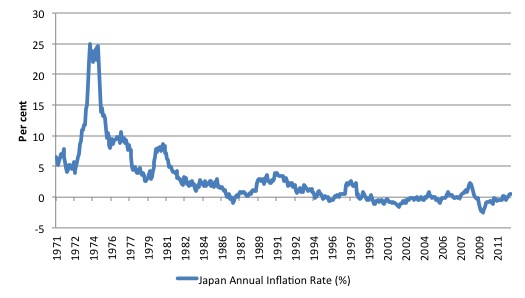
An interesting though experiment would be to investigate what you expect to happen against what happened in Japan, which had basically flat inflation from 1992 to present: http://bilbo.economicoutlook.net/blog/wp-content/uploads/201...
Re:What is energy, actually? (2011) by zozbot234 on Friday November 29, 2019 @07:53AM (#21664039)
Investors demand growth as part of a risk vs. return tradeoff. There's probably quite a bit of "waste" involved in pursuing excessively-risky opportunities that have not shown profitability, simply to obtain a shorter time-to-market than competitors. OTOH the social returns from this activity could still be positive if it means that a broader variety of opportunities is being pursued at any given time.
Re:What is energy, actually? (2011) by nickik on Friday November 29, 2019 @08:09AM (#21664119)
> 1. Corporations desperately pursue continuous growth, even when they're already profitable, and do so at the expense of the environment, employee welfare and sometimes, the rule of law.

And sometimes its to the benefit of the environment, the employees and its in accordance with the rule of law.

> 4. Investors need to invest money in instruments with a certain minimum ROI because if they don't, inflation will erode their savings.

Inflation are low and predictable in the West. And investors would want to make money no matter what the inflation is.

> 6. The end result is a sort of "Red Queen" effect where everyone is forced to compete harder and harder just to maintain his/her existing standard of living.

That really isn't a logical conclusion.

> 8. Therefore, we should focus on curbing inflation to curb the pace of overwhelming growth, and thereby restore some measure of social justice.

I would recommend to you to really get into economics. You are making a lot of assumptions that really don't hold up.

Re:What is energy, actually? (2011) by coldtea on Friday November 29, 2019 @08:11AM (#21664127)
>And sometimes its to the benefit of the environment, the employees and its in accordance with the rule of law.

Yes. Sometimes lottery is also the right investment: in the 1/10000000 of cases where you win...

Re:What is energy, actually? (2011) by nickik on Friday November 29, 2019 @11:07AM (#21665129)
Do yourself a favor and go down the list of every major industrial process and compare its waste stream and environmental impact, its pretty evident that the majority these process are more efficient and less wasteful.

Companies make thins more efficient, and thus they impact the environment less.

Re:What is energy, actually? (2011) by coldtea on Friday November 29, 2019 @01:07PM (#21665852)
>Do yourself a favor and go down the list of every major industrial process and compare its waste stream and environmental impact, its pretty evident that the majority these process are more efficient and less wasteful.

Compared to what?

Surely not with not doing them at all...

Re:What is energy, actually? (2011) by gpanders on Friday November 29, 2019 @10:06AM (#21664788)
The companies that do exhibit social and environmental responsibility rarely make it into the news, since they don’t support the daily need for outrage or the narrative that Corporations Are Evil. It’s mere selection bias.
Re:What is energy, actually? (2011) by coldtea on Friday November 29, 2019 @01:06PM (#21665847)
>The companies that do exhibit social and environmental responsibility rarely make it into the news,

That's because they're either insignificantly small, or environmental theater (a la Apple).

Re:What is energy, actually? (2011) by worldsayshi on Friday November 29, 2019 @12:54PM (#21665778)
I think that there is a misconception about cause and effect when it comes to corporate greed.

We tend to think that all companies inevitably pursue monetary growth regardless of other costs. If you look at the average corporation that will likely not be true.

Big corporations tends to be greedy because that's how they got big. Not so greedy companies either don't grow or they get bought up by more greedy companies.

The majority of corporations may not agree with the philosophies of the big ones at all. But the big corporations eat more of the cake. One way to counteract this is to starve the bigger corporations of workforce.

Re:What is energy, actually? (2011) by justincormack on Friday November 29, 2019 @07:30AM (#21663944)
We already pretty much curbed inflation. The issue is that people still expect high returns and high interest rates, but these have fallen especially risk free rates, but also maybe returns on risky investments.
Re:What is energy, actually? (2011) by bg117 on Friday November 29, 2019 @07:59AM (#21664068)
An alternative would be to forming an co-operative unit that distributes wealth more evenly. More automation only leads to joblessness causing more inequality. Also natural resources are plundered more aggressively by few who become multi-billionaire causing more environmental degradation. Though, greed is necessary for development of society, concentration of wealth to a selected few does not bode well for society. Private profits or shareholder profits are better for society if business model evenly distributes it.
Re:What is energy, actually? (2011) by lazyjones on Friday November 29, 2019 @09:18AM (#21664517)
Corporations often need to grow just like countries (with their GDP, which normally leads to tax income growth) in order to outgrow their debt. They're also affected by inflation and the resulting increase in costs. Our whole economic system is driven by debts, if we want to stop growth, we should first learn to live with deflation and then see what happens if we make debt-financing investments and expenses/consumption hard or impossible.

Logically, this would never work if other countries don't do the same.

Re:What is energy, actually? (2011) by tekstar on Friday November 29, 2019 @09:56AM (#21664715)
I would like to bring another concept to this discussion, which is the cost of externalities.

https://en.m.wikipedia.org/wiki/Externality

How much corporate growth is directly the result of taking from the environment? Could a regulating body apply the true cost of corporate growth back to the corporations so it were no longer profitable to take from the environment for the sake of your bottom line?

Re:What is energy, actually? (2011) by mac01021 on Friday November 29, 2019 @09:51AM (#21664689)
It's a mistake to assume I'm looking for 0% inflation-adjusted-growth.

Assume there is no inflation. If I have invested $625,000 and I want to retire with the ability to spend $25,000 per year on food, housing, medical care, taxes, travel, and insurance, then I require 4% growth (or dividends!) for that to be sustainable.

Re:What is energy, actually? (2011) by mlthoughts2018 on Friday November 29, 2019 @07:32AM (#21663952)
Inflation may occur due to uncontrollable factors, like scarcity of resources as they are consumed at a basic rate. Increasing scarcity means everyone must now compete harder to get the same basic rate of consumption from the reduced resource pool size, regardless of whether corporations or investments or governments even existed at all.

Another source of inflation is increasing wage & benefit demands, especially from large middle or lower classes who want to afford to consume more because they value the greater consumption as an important part of life, a noble and intrinsically morally good goal of bettering one’s self through self-determined hard work such that the value of your labor and skill increases over time.

In direct response to large classes of workers demanding more pay & benefits, companies will raise their prices to pay for those increases, again totally regardless of whether a stock market exists.

I think really inflation is a side-effect of nature, and thinking along the lines of how to long-term control or remove it is counter-productive, compared with accepting that it is inevitable and then trying to come to terms with living in the future world that this implies.

Re:What is energy, actually? (2011) by pjc50 on Friday November 29, 2019 @07:59AM (#21664066)
Inflation is a side effect of monetary and fiscal policy; central banks are now quite good at adjusting interest rates to keep inflation in the 0-2% band.

> In direct response to large classes of workers demanding more pay & benefits, companies will raise their prices to pay for those increases, again totally regardless of whether a stock market exists.

How well this works is down to the "tightness" of the labour market. Central bank policy affects this: raise interest rates -> decrease investment -> increase unemployment above the "NAIRU" ("non-accelerating inflation rate of unemployment") -> workers are unable to demand pay increases as they may be replaced by eager cheaper workers from the pool of unemployed.

Re:What is energy, actually? (2011) by mlthoughts2018 on Friday November 29, 2019 @09:49AM (#21664679)
Even in a barter economy with no government, money system or central fiscal planning there can be inflation. Inflation is nothing more than sustained higher prices for the same amount of goods or service, no matter the cause. Prices could be denominated in fiat money, currency, bartered physical goods, time, whatever. Inflation could be localized to a cafeteria where kids are trading lunch items for the best desserts, or span the globe in ways that transcend any given government’s ability to use fiscal and monetary policy.

Inflation caused by Federal Reserve actions is just one (minor) type of inflation.

Re:What is energy, actually? (2011) by lonelappde on Friday November 29, 2019 @08:47AM (#21664316)
> quite good at adjusting interest rates

and manipulating measurements

Re:What is energy, actually? (2011) by SquishyPanda23 on Friday November 29, 2019 @10:24AM (#21664885)
I think the weak premise is 4.

Agents in economics are typically modeled as maximizing wealth or utility, which is different from 4, which says agents want wealth to be non-decreasing.

Re:What is energy, actually? (2011) by konschubert on Friday November 29, 2019 @08:44AM (#21664295)
4. Isn’t true.

Even at zero actual growth, you would have nominal growth that matches the inflation rate.

Inflation means that the prices of the products that the companies sell increase as well.

Inflation doesn’t matter

Re:What is energy, actually? (2011) by gpanders on Friday November 29, 2019 @10:02AM (#21664753)
It absolutely does matter, particularly for owners of debt (bonds). Inflation will eviscerate returns on bonds and all other fixed-income investments.
Re:What is energy, actually? (2011) by konschubert on Friday November 29, 2019 @12:48PM (#21665753)
Inflation is already priced into bonds. It doesn’t matter as long as it’s more or less predictable.
Re:What is energy, actually? (2011) by dustingetz on Friday November 29, 2019 @09:42AM (#21664649)
it’s a lot simpler than that. People need growth. Nobody wants a pay cut, you would be really unhappy and leave because it messes up your plans, you can’t make your mortgage payment, etc. The need for growth is universal at all scales and layers. Wealthy or poor, Society to cellular. BTW check out Macro Voices podcast.
Re:What is energy, actually? (2011) by Spooky23 on Friday November 29, 2019 @08:48AM (#21664324)
Most of these issues are ineffective regulatory systems.

Companies that don’t grow are either dying or turning into DMV.

Re:What is energy, actually? (2011) by trixie_ on Friday November 29, 2019 @03:38PM (#21666688)
Inflation ensures the status quo is never good enough. This drives technological progress to achieve better efficiencies. Good regulations provide the constraints of the game - maintain clear air / water /power etc...

What you call social justice in reality would cement the status quo and deincentivize technological progress. See the lack of innovation in socialist countries. Great at copying, bad at inventing.

Re:What is energy, actually? (2011) by Pfhreak on Friday November 29, 2019 @10:04AM (#21664772)
There's a book called Capital, by a guy named Karl Marx which explores this concept fairly deeply. I highly recommend "Reading Capital with David Harvey" which is a lecture series recorded this year that breaks it down and provides modern examples to illustrate the concepts.
Re:What is energy, actually? (2011) by kome on Friday November 29, 2019 @07:28AM (#21663939)
you re-discovered or independently discovered the basis marxism, sort of.
Re:What is energy, actually? (2011) by pjc50 on Friday November 29, 2019 @08:09AM (#21664118)
I guess you're being downvoted because of the M word, but you have a point; it's very similar to https://en.wikipedia.org/wiki/Tendency_of_the_rate_of_profit...
Re:What is energy, actually? (2011) by ezzzzz on Friday November 29, 2019 @11:54AM (#21665394)
Can somebody explain the stigma regarding Marx on HN? I mean, I get that this a forum for a VC firm but isn't it also a place for academic discussion? It's pretty hard to discuss things like income disparity, automation, etc without a mention.
Re:What is energy, actually? (2011) by pjc50 on Friday November 29, 2019 @02:48PM (#21666398)
HN is okish at academic discussion, despite the constant risk of "middlebrow dismissal" (as the moderation guidelines call it). But people aren't widely read in certain areas outside STEM.

The legitimate objections to Marx are that he's old - Marxist analysis is like Freudian analysis, there's a big risk of pretending that nothing has happened in the field for a century. And therefore he's not great on the influences of technology; he pre-dates the microchip and the internal combustion engine.

Less seriously, Marxists have a tendency to be annoying jargon-spouters (see Orwell on the subject), and there's a big contingent of fanatical anti-communists who will kick of at the merest mention of his name.

In my long list of round-tuit projects is "see what of Marx can be rescued from the Marxists".

Re:What is energy, actually? (2011) by ezzzzz on Friday November 29, 2019 @03:20PM (#21666599)
Thanks for a thoughtful answer.
Re:What is energy, actually? (2011) by TeMPOraL on Friday November 29, 2019 @12:56PM (#21665792)
It's not HN-specific, it's the general culture stigma against Marx bleeding through. And it's not entirely unjustified, because you definitely want to filter out low-effort, thoughtless Marxism.
Re:What is energy, actually? (2011) by dmix on Friday November 29, 2019 @12:54PM (#21665779)
Identifying problems != providing a better solution.

Everyone being equally poor hasn't worked in history yet.

Re:What is energy, actually? (2011) by seer on Friday November 29, 2019 @07:31AM (#21663949)
While that is all true, at least to me it sounds like the old explanation of why Communism failed - "It was indeed superior, but all the world had to agree so for it to work".

Say one country develops this utopia where everyone doesn't have to compete to survive, either companies or individuals.

Its neighbour though remains with the old Capitalist model. In a generation or two the struggling capitalist country could overtake the utopia one in production, wealth or even by force. Then you're back to square one.

Re:What is energy, actually? (2011) by hliyan on Friday November 29, 2019 @07:50AM (#21664024)
I'm merely suggesting that we maintain the money supply at a level that does not result in any inflation.
Re:What is energy, actually? (2011) by pjc50 on Friday November 29, 2019 @08:02AM (#21664085)
Per other comment: https://news.ycombinator.com/item?id=21664066 ; inflation is already near-zero, and this is controlled through interest rates rather than simple M0.
Re:What is energy, actually? (2011) by hliyan on Friday November 29, 2019 @08:15AM (#21664146)
I do agree with this, but what of pension plans? At 2% inflation, a fund of $10,000 will deplete to slightly over $6000 (inflation adjusted) in 20 years...
Re:What is energy, actually? (2011) by pjc50 on Friday November 29, 2019 @09:05AM (#21664434)
We're back to Picketty and "r > g" here; you're not holding the pension as cash, so you're making a return, so what rate is the return at? And how does the aggregate rate of return compare to the rate of growth in the economy?

Or are people seriously proposing having 0 GDP growth and 0% interest rates and 0% expected stockmarket returns? A strange world that's almost certainly unstable.

(There is a much broader question that if you expect a dollar to buy you a loaf of bread today, is it really reasonable to expect the same dollar to buy a loaf of bread in 40 years? And what level of stasis would be required to achieve that?)

Re:What is energy, actually? (2011) by koheripbal on Friday November 29, 2019 @08:04AM (#21664091)
The states goal of the Fed is to "maintain the rate as close to zero as possible while keeping it safely positive.".