It allows extraction of natural gas, which will have to be part of our energy mix for the foreseeable future. Natural gas plants not only emit less CO2 than the coal plants they replace, but can serve as peaker plants to back up renewables. We’re a long ways away from battery technology being able to serve that function. (The US is also not independent in terms of critical minerals needed for battery technology.)
Fracking also allows the US to be energy independent, and reduce its dependent on unstable middle eastern regimes. Thanks to fracking, the US has the most flexibility in its Middle East policy it has had in half a century.
Yes, but you kinda defeat the environmental/GHG purpose when you leak out (unburned) methane, which is an even worse GHG than CO2.
Methane isn’t good for reducing GHG emissions when the act of extracting it releases something much worse!
(Though of course an exact CBA depends on tabulating the relative amount of methane released per usable unit extracted, and its relative effectiveness as GHG ... to say nothing of the other harms of fracking.)
https://wattsupwiththat.com/2014/04/11/methane-the-irrelevan...
At the same time, it doesn't seem clear at all that methane is less harmful than CO2, so arguing that we're emitting less CO2 is only part of the story.
Take a look at some of the criminally low lease fees that have been charged to some drillers for public lands.
Is that an honest question?
It's used to extract a fossil fuel. That should answer your question in case you know the definition of "sustainable".
https://www.youtube.com/watch?v=SMsLEqjVbgA
And is known that had caused earthquakes in dense populated areas from Mediterranean coasts (see Castor Project) or US, so is a danger for infrastructures also
https://www.youtube.com/watch?v=F6PHVhjaNRI
And there is also this thing that I don't even have words for it.
https://www.youtube.com/watch?v=NvJAKVnK4qM
All for a source of gas that could last one or two years in many cases, and then is exhausted and left contaminated. But is heavily subsidised by taxes in many cases
Fracking is greedy monkey stuff. Is a nonsense from any human point of view in any historical period (past or future) to pay for deliberately allowing a few people poison your own drink water.
That is only true as long it is cheaper than nuclear. The usage of natural gas is a mix of economic and political choices, and depending on the country you can get a very different choices.
If we look at a map like https://www.electricitymap.org and imagine the carbon intensity to be a real economical costs then it would be a relative simple matter to determine how high those costs would need to be to make nuclear competitive against burning fossil fuels.
EG: When times of peak consumption out-paces the plant, it draws from battery system. When consumption is less than production, the batteries are recharged.
https://electricenergyonline.com/energy/magazine/1142/articl...
Ignoring the "it creates jobs and grows the economy" argument, the oil and gas companies basically bribe communities to allow it. The town of Erie has a gorgeous new high school and rec center, and it is almost entirely paid for by fracking revenues. One of their summer festivals is heavily subsidized by the same industry.
Given that most people think of only themselves, I am not remotely surprised that fracking bans or setbacks fail at a state level here.
If your idea of "being socially responsible and improving lives of people around" is giving kickbacks to the local school to the tune of 0.0001% of your profit... I don't want to be part of your society. These businesses are absolutely anything but socially responsible.
There are so many absolutely terrible things we could do which help us immensely in the short term yet ultimately lead to immense harm.
The two often go hand in hand.
Because people want to drive cars, fly on airplanes, make use of advanced materials, and have goods shipped across the world to their doorstep in a week among other things.
The oil industry exists because people want the quality of life the use of oil enables them to have. Until we have just as cost effective alternatives to all the things the use of oil lets us have it will continue to exist.
Another poster uses Erie, CO as an example how the oil industry are bad actors. The poster fails to mention Erie is a bedroom community full of people living in big new suburban houses and driving their vehicle (very likely an SUV) into Denver for work everyday
It would be like counting the number of explosions in a city including car engines and every bullet fired, firecrackers, car bombs, artillery shells, and every airdropped bomb or warhead equally.
The groundwater contamination and greenhouse gas releases are more significant reason why to disallow it.
- Natural Gas from fracking produces less CO2 and other pollutants than oil or coal alternatives
- It's produced domestically, so you don't fund Wahhabism or other oppressive regimes by buying it
- It's produced domestically, so you don't have to burn filthy bunker oil on oil tankers just to transport it to the US
- Fracking happens primarily on rural land, and pays royalties to individual landholders. Oil drilling in Saudi Arabia pays out only to the megacorp doing the drilling.
Almost like there are tradeoffs and costs to complicated decisions like energy policy. Obviously we'd all love to be in a post-carbon future with Nuclear / Wind / Solar grids, but in the short-term, I'd much rather have a LNG-based energy economy than a coal-based one, fracking and all.
Particularly the graph in the bottom left corner here: https://www.ipcc.ch/site/assets/uploads/sites/2/2019/02/SPM1...
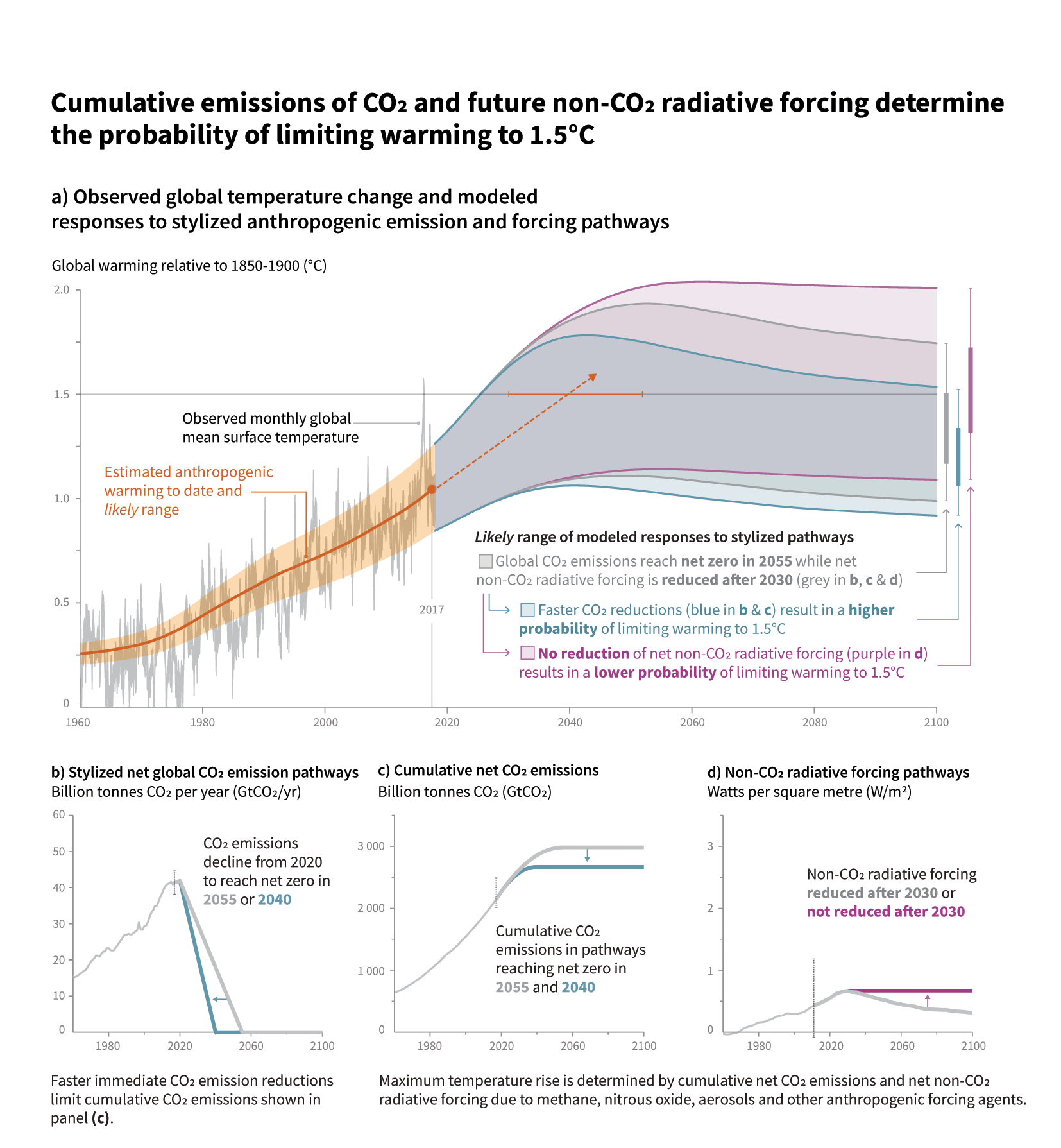
There is no more time left for the fracking/gas transition argument. While the argument is true in the abstract, and was true in a logistical sense 10 - 20 years ago, to continue to advance the argument after that report was published (which to be fair was only a year ago this week) is to be misinformed and spread misinformation.
We should have used nuclear and domestic gas to power the 00's and 201X's. We didn't. Its too late now. The remaining available carbon budget does not afford for a two-step transition. All investment in carbon emission producing generation needs to be replaced with investment in non-carbon-emitting generation, starting "in 2020" but honestly that's just politician talk. The real deadline is "fucking yesterday".
Should have. But we didn't. So we can either throw our hands up and give up, or continue and try to mitigate some of the damage.
Now GP has an important point here, forgetting which does a huge disservice to the climate problem mitigation efforts. Namely: our economy is dependent on fossil fuels right now, and until we transition to 100% renewables, it will be. You cannot just cut out fossil fuels, because that would collapse the economy, kill off most of the population, and forever stop any and all efforts at fixing the damage already done. And since our economy is growing, this means new fossil projects.
We absolutely still need to transition off the fossil fuels ASAP. But it's like with operating on a patient with very severe injuries: maintaining life support is more important than fixing the damage. Yes, you want to eventually get the patient off life support, but if you shut it down too early, you'll be trying to stitch up a cadaver.
Our economy is ~really~ dependent on fossil fuels. Eneregy is only part of the problem, there's also transportation. We live in a global economy predicated on cheap, oil-based shipping, and electric alternatives are very far off.
Abrupt and large scale transitions will be an economic shock, bt will not 'crash the economy and kill off most of the population' as you aver. The climatological models are far, far more robust than the economic models we use, and suggesting that an abrupt transition away from fossil fuels is going to kill off most of the population is simple scaremongering. If you actually believe this, then I would like to gently suggest that You've Been Had.
Abrupt enough will, and my point is that we can only go as abrupt as possible without crashing the economy, because crashing the economy is immediate game over (climate change is only a pressing problem because it might eventually break our economy through war and resource pressure).
> suggesting that an abrupt transition away from fossil fuels is going to kill off most of the population is simple scaremongering
Well, I'm looking at how the world works today - how we've concentrated most people in dense cities, and how those people (meaning, us) can be fed only through a highly mechanized and fossil-dependent infrastructure. Oh, and through electricity and supply chains and GPS too. And, we have nuclear weapons now. It's not a matter if an abrupt transition can kill most of the population, it's only a question of how abrupt can we go without that happening.
I can't tell you how big a shock the economy will survive, only that it has to survive, so whatever shock we apply it must be less than the lethal dose. Killing the economy is literally the game over, because climate change isn't about climate for climate's sake, but about climate not killing our economies and civilization through the pressure of increasing uninhabitability.
Fossil fuels is the most valubale resource we have and all modern life is heavily depending on it. There is currently no realistic alternatives to most of this.
What I should have said is this: economy is growing, and for now, it has to keep growing to even work. It's also dependent on fossil fuels and is using them up "just in time" - we don't have much in form of a buffer (or rather, the "buffer" is untapped sources, like ones exploited through fracking). As old sources get used up, new need to be tapped. We'll be able to stop tapping into new sources only when renewable/nuclear alternatives start growing faster than economy + drop in output of existing sources. Which might be somewhen in the future, but it's not now.
> The fact that you took it all the way to accusing me of trying to kill off most of the population is extremely rude.
I didn't accuse you of anything, you're projecting. I was only reminding everyone that the economy is not something you can just shut down and restart in a better form. Only gentle and incremental change is on the table.
> You are thinking in false extremes and stories, not numbers and graphs.
I can draw you the graphs if you like; the point is still that until we replace any given chunk of fossil fuel capacity, we have to keep that chunk running. Simple as that.
> willfully miss-frame the discussion. That is rather rude of you.
Sorry, that wasn't intentional. On the other hand, you've attacked me personally multiple times in your reply, which is that much ruder of you, and also against HN guidelines.
That's BS.
If you turn off the natural gas plants now, the economy shuts down whenever the wind stops blowing or the sun stops shining. The alternative energy storage you need to back up renewables simply doesn’t exist yet.
Yes, we needed to use nuclear back in the 1970s. We would be much better positioned today if we had done it. But the same type of environmentalists that want to ban fracking today are the folks who stymied nuclear uptake. We shouldn’t listen to them this time.
> The remaining available carbon budget does not afford for a two-step transition. All investment in carbon emission producing generation needs to be replaced with investment in non-carbon-emitting generation, starting "in 2020" but honestly that's just politician talk. The real deadline is "fucking yesterday".
First, this is a response to someone who suggested we ban fracking. We will need fracking for the foreseeable future to power natural gas peaker plants. So your response to me doesn’t really make sense in context if you’re not actually supporting a fracking ban.
Second, until we have replacement technology, we need to replace retiring coal plants with natural gas even as we invest in renewables. Renewables are, at this stage, not stand alone power. More renewables means we need more peaker plants capacity to balance it out. That means fracking will have to continue and even increase over the next 20-30 years as we shift to more renewables.
You either cannot read, or are not discussing in good faith. I honestly can't do more than be triple-redundant in my explicit phrasing.
People that make arguments like yours beg the question as to economic progress and standards of living. Standards of living should drop overall, but should normalize across the population. A smooth transition is not possible.
In any case, a non-smooth transition is not possible right now. Look at France which was paralyzed by “yellow vest” protests for a fuel tax increase until it was rolled back - the needed carbon taxes are far higher than that small tax increase. Right now the best scenario is to continue R&D and target promotion of sustainable energy, not attempt to reduce people’s standard of living which a democratic society will refuse to accept.
Other people here are asserting that an abrupt and urgent transition away from fossil fuels 'will crash the economy and kill off most of the population' (which I take to mean >50%) without offering any citations for that claim whatsoever.
So I guess it depends on what you mean by abrupt. I think we could certainly do something like add a $2/gallon tax on gas and diesel fuel without that happening, and it would reduce driving and emissions, but I would see the politicians who passed that law getting voted out at the next election as the people refuse to have their current standard of living lowered.
What we are already seeing is that we are trending away from a baseline scenario by electrifying transport, energy generation and energy storage. And it’s probably harder to predict politics than the climate but right now I only see that trend continuing. There are some unfortunate anti-nuclear steps being taken but eventually enough solar and wind will get online to replace them. Emissions in the USA have trended down thanks to fracking and coal being wiped out.
Sea levels will rise but new land in the arctic will open up for human habitation and agriculture. Wars and migration may certainly happen but we’ve had plenty of that in the last 200 years without the end of civilization.
That's the whole reason it has taken off -- you turn it on when prices are high, you turn it off when prices are low.
We aren't committing to 30 years of energy policy by fracking in the US. You're committing a to maybe a couple years to pay off the investment.
I'm all for continued and increased R&D funding, but the best case scenario for SMRs is they help us with the back half of the transition (2035 - 2050) not the front half (2020 - 2035).
Anything more optimist than that is simply denying the science (see ipcc report again).
Seriously someone just ban me from this dumb site, no one can read.
Predictions not panning out because they were mitigated in time doesn't mean the predictions were wrong.
Also FWIW, oil prices did skyrocket in 2000s.
They weren't "mitigated". Nobody took action based on those predictions in order to keep them from coming true. People just continued to improve technology and continued to have fewer children as their standard of living rose--trends that were just as observable when the predictions were made as the trends that the predictions were based on.
> oil prices did skyrocket in 2000s
Sort of, but then they came back down again:
https://www.macrotrends.net/1369/crude-oil-price-history-cha...
And the prediction I was referring to, more precisely, was that oil prices would skyrocket by 2000 and then would never come back down again but continue to rise.
In what way are these "the same people"? Members of the IPCC previously made predictions about mineral prices?
Because our political systems are catastrophically corrupt.
I'm not sure we have the time for the luxury of that sort of transition any more.
Not in the least. Dominionist and dispensationalist theology has had a huge influence on modern American evangelicals who in turn have a very significant influence on American politics.
I don't think anyone was suggesting that religion only influences the right-wing, but rather that dispensationalism and dominionism have a greater influence on politics than you're accounting for, and that those movements have a much greater influence on the right-wing than you're accounting for.
There is a growing movement within christianity that recognises this, and has thereby found a way to environmentalism along the right flank of politics. The pope is all in, and so are many protestant churches in Europe. It's mostly just US protestants/born-again reactionaries that continue to only read the unwritten parts of the bible that align with Ayn Rand.
https://en.wikipedia.org/wiki/2009–19_Oklahoma_earthquake_sw...

It's incomprehensible. That place needs to modernize and adapt but without petroleum and its trappings. It's had 35-50 years to adapt from these changes; why should I believe that petroleum will be this place's saviour again?
I grew up with pumpjacks operating down the street (their ambient background sound as natural as the crickets and katydids and cicadas). The smell of petroleum, too. It wasn't until I moved away and returned to see how unnatural this was.
Good question. Seems like a bunch of opportunists are taking advantage of irrational fears about nuclear power.
Yep. Oklahoma now has more earthquakes than California.
https://www.npr.org/2015/04/26/402413137/oklahoma-now-has-mo...
Why do we still allow fracking?