After WWII, the US imposed a constitution on Japan. Here's Article 21: "Freedom of assembly and association as well as speech, press and all other forms of expression are guaranteed. No censorship shall be maintained, nor shall the secrecy of any means of communication be violated."
All wiretapping was illegal in Japan until 1999.[1] Even today, it's very rare. 40 wiretaps in 2017.[2]
[1] https://www.iol.co.za/mercury/world/japan-passes-controversi...
[2] https://mainichi.jp/english/articles/20170217/p2a/00m/0na/01...
> All wiretapping was illegal in Japan until 1999.
So, at the end of the day constitution is just some document that holds no real power and can be violated once those in power are no longer interested honoring it.
And this is the primary reason for people to have encryption. It's not to protect from some random wannabe hackers, criminals or corporations (which the government can enforce laws against), it's to protect from the government itself. This is why media conversations sound weak and incoherent about encryption and privacy, they are afraid to talk about the biggest reason, don't want to openly and directly oppose the government and instead choose to entertain and dance around all those manufactured ideas.
The main point often raised around the right to bear arms is that, as currently interpreted in the US, it comes at a steep cost in homicides and suicides.
Encryption doesn't really have comparable collateral damage in society. There's the whole "but terrorists and pedophiles will hide behind encryption" argument, but even if you granted that and could measure the impact, there's little chance it would be anywhere near equivalent to 30 000 deaths annually.
So: a more nuanced version of this argument would point out that there's little to no harm from allowing widespread strong encryption, whereas there's widespread demonstrable harm from allowing widespread firearms.
To compound this, the reverse harms - lack of privacy / security on one hand, strict monopoly of force on the other - are hard to compare. Both have the potential harm of leading to unchecked tyranny, along with the potential benefit of maintaining national security and civil order; depending on which side of the debate you're on, the tendency is to downplay either the harm or the benefit and exaggerate the other.
Any reasoned comparison here ought to take into account that the tradeoffs are clearly different.
How does that square with Japanese censorship of pornography?
what decides which way their motivation swings, legally?
perhaps they, and others, shouldn't consider the lines between censored topics to be so vividly painted as 'indecent' or 'not'.
it's an issue that some of the most important law-shaping courts in the world have argued back and fourth about for years; the criteria for concluding what is or isn't indecent.
Then they can always find another way to make the same point.
>what decides which way their motivation swings, legally?
Society, courts, etc.
>it's an issue that some of the most important law-shaping courts in the world have argued back and fourth about for years; the criteria for concluding what is or isn't indecent.
Yes.
Making a political statement in certain way is itself a statement.
"But advocating it is still legal" would be no more valid an excuse than making displaying or depicting police misconduct illegal but nominally allowing advocacy against police misconduct. The point of censorship is enforced ignorance to maintain control.
Now they have to be more careful.
Are you sure you appreciate how many criminals got convicted because their phones have been tapped?
Does your stance against lawful surveillance also mean that law enforcement must never try to look into a suspect's seized phone or computer?
Interesting tactic.
But, ultimately, the security and safety of the American public is served best by actually using software and services that are safe and secure. When the Federal government works against that they are undermining the security of the American public.
It's not very complicated. The interests of the government do not align with the interests of the American public.
And if you really don't think surveillance should be completely outlawed, as it was in Japan for a time, then you don't have any basis for disagreeing with me.
Well, Jakuza could find 50000 ways to bypass the "police listening".
Tapping telephones had not really helped thwart Latin/Central American drug dealers (which got 10x as big and dangerous from when wiretapping was far more difficult).
Heck, in Italy, where the state could quite easily wiretap anybody, has a much bigger "Yakuza" style problem...
Plus, a state can always get warrants and tap when it's needed, e.g. for suspected or known Jakuza members, without having to do it for everybody...
Wait, but this sub-thread started with "all wiretapping was illegal" - so it was not only warrantles wiretapping that was illegal, if I understood it correctly.
Fun Fact: Central American cartels have indeed switched to communication channels that are harder to intercept. And boiling down such a complicated issue as cartel violence to a simple issue as phone surveillance is at best dishonest.
Well, if one can't use basic common sense, and instead believe that just because wiretapping was illegal, criminals the Yakuza casually talked in normal phones and didn't already use burner phones, code words, walkie talkies, etc, I don't know what is left to argue...
Which of these basic facts are you disputing?
Why won't you hand over your passwords if you have nothing to hide?
By all means, try. A warrant authorizes the attempt; it does not guarantee the outcome.
And both surveillance and the seizure of evidence are routinely the key to convicting criminals. Outlawing court-approved surveillance or even seizure of evidence makes basic laws, like against homicide, much less enforceable.
Well, they also liked that other policy, that suspected Yakuza members can't just be shot on sight -- but had to be arrested, go through trial, etc.
So?
Bad guys liking a policy and the policy being generally bad is not the same thing...
I did not imply anything with that statement but the pure and simple fact that the Jakuza has at least one big extra problem to deal with since police are actually allowed to tap their phones.
And you could also be more honest by saying that total privacy is more important to you than a significant portion of criminal convictions. I don't think that's a good tradeoff.
I seriously doubt it is a problem for them, much less "a big one". What kind of amateurs speak openly on their regular phones about covert action, whether it's legal or not to wiretap them? Besides the fact that the police could be listening in (illegally, but still routine in most of the world) to get useful tips (and use them, just without expecting to use the recordings in a trial), rival gangs could also listen in on their plans, and so on...
>And you could also be more honest by saying that total privacy is more important to you than a significant portion of criminal convictions
Considering that Japan is perhaps the safest countries in the world (and was for decades while wiretapping was not allowed), and the US and UK with dead easy access to wiretapping warrants and mass surveillance are of the worst western countries in regards of crime, I don't think there's that much to teach the Japanese with regards to getting more "criminal convictions"...
Sorry, but this is not a fact based argument any more. You are somehow trying to convince me that, despite all evidence and data, wiretaps are useless in prosecution of criminals. I'm not having that, anymore.
http://hakusyo1.moj.go.jp/en/61/image/image/h002003001001h.j...
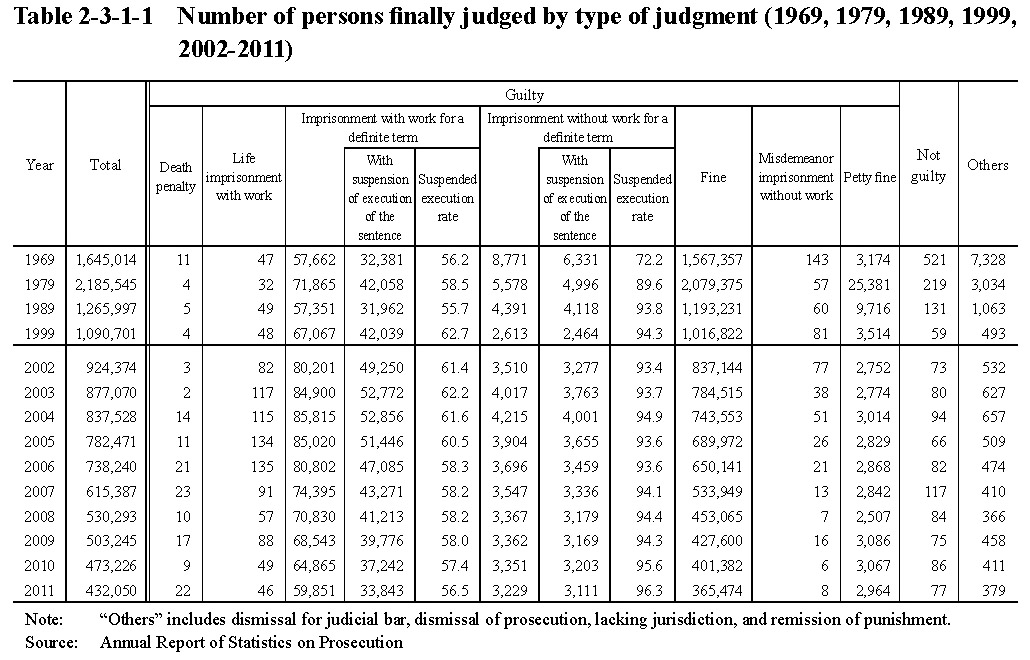
I point this out not because I disagree with your baseline position that privacy is valuable. I don't. I point this out because i believe that arguing for it on the basis that government feelings of entitlement are somehow less legitimate than the feeling of entitlement of non-governmental constituencies is not going to be an effective strategy because it's based on a false premise.
The constituency hasn't changed their views. The politician was still elected on the same platform. But they no longer serve the constituency.
I can well-understand the feeling that the government is a separate entity, and behaves differently.
It may be military lobbying; but even then it seems a little strange that absolutely no progress gets made on issues that seem to have a remarkable amount of support from what must be most voters. People voting for humanity or economic reasons would agree that endless overseas wars are a mistake - that catches most voters. Realistically it should even catch the imagination of the foreign policy people; power projection is one thing, but killing foreigners doesn't put America in a great place for the next generation.
It would almost be more helpful for politicians to honestly state why they keep flipping their positions rather than sending another smooth-talking politician in to see if they flip. Surely there must be some equilibrium where less people die but all the insiders are happy.
I would understand to a certain extent if the national intelligence briefing informs the politician of a dozen programs that are reliant on the premise and have prevented x number of attacks and so on.
But I've seen politicians flip completely after a single 20mins meeting. From fiercely against to fiercely for. For those cases, I've held my judgement, because I don't have a non-insane answer for why this happened, but everyone involved is presumably a somewhat-logical human being, and people don't let go of beliefs easily.
[0] https://i.imgur.com/xhYCQh4.mp4 (from https://www.nytimes.com/interactive/2019/10/06/opinion/incom...)
Lately, I've been thinking about what's happening in HK, and how the protesters were pulling down facial recognition towers. Without that, the social credit system is crippled (a bit). If enough people made it their business to take down a tower, here and there, with enough frequency, the govt would probably find a way around it but, still, that big, powerful government weakens when the right/wrong citizens get together.
And even when the govt says no masks are allowed, there are ways around that, too [1]
1 - https://www.reddit.com/r/specializedtools/comments/ddu3eh/ho...
I am not arguing that. I was explaining the process by which the feeling of entitlement arose. The argument for the legitimacy of privacy rights is one I assumed I didn't have to make at all in this venue. I suppose we could have that debate if you want, but I was not trying to make that case here.
If we assume as an axiom that privacy is a right, the question then becomes: how do we structure our governments and public institutions to protect those rights? And one answer to that is to be more intentional about which invasions of privacy we allow than perhaps we have been in the past. With the foreknowledge that governments and institutions will come to depend on any access they are given.
But you can't assume that. For everyone who thinks that privacy is a right you can find someone else who thinks that safety and security is a right. Neither of these follows from the laws of physics. Which one ends up being a right (or which one ends up being the more "fundamental" right that ends up trumping the other) is a function of what we as a society decide.
So you can't win this fight simply by standing up on a soap box and proclaiming that privacy is a right. You have to come up with an argument for why losing privacy is a greater evil than letting the bad guys get away.
It’s the governments duty to uphold that right whether they can read communications or not. A right to security absolutely does not mean no right to privacy. That’s a false dichotomy.
You can't strip away people's privacy without violating their safety and security in the process. These positions are not in conflict.
And "society" doesn't get to decide what is or is not a right. Individual people decide that for themselves.
In the end these possibilities are always given by voters, and they can only be taken away by voters.
In the end, decisions are taken by a republic. If this republic doesn't serve its constituency, there isn't much the constituency can do apart from waiting for the next term and then vote for the second most popular party.
This is well examplified by the fact that protests are still a thing in countries thought to be democracies. Historically, protests are a tool against dictatorships. If citizens had proper democratic agency, they would not have to disrupt their own country's economic activity in hopes to bend their leader's arm. It's a very inefficient and fuzzy decision-making mechanism.
That's why the proper term for the current popular government system is "democratic republic", not just "democracy". An actual democracy on the scale of a country would be way more complex than what we have now. It would probably be closer to the economic market in terms of complexity. We might get there one day, but calling our current systems "democracies" is proper newspeak.
In fact, it would be exactly the economic market. The ultimate form of democracy is 100% economic means ("vote with your wallet") and 0% political means (force).
There is not.
How likely is it that an anti-surveillance candidate also happens to satisfy more than 50% of voters on aspects other than surveillance?
Since surveillance is low on the list of priorities of most people, it's a rational choice for them to ignore the candidates' stance on surveillance while choosing their preferred candidate.
As such, the stance of republican leaders on low-interest, non identity-defining aspects like surveillance is mostly unaffected by democracy.
What do you think "constituency" means?
They also exist to serve themselves.
That is not their purpose but that is what ends up happening with most institutions.
For me it feels too easy to say "the government" has no legitimate interest in intercepting communications.
This isn't actually true, though. It may be essential to enforcing the law at the level we have come to expect. But that is sort of my point: whatever governments are given, they will come to depend on. Once a capability has been granted them, it can never be taken away.
For instance, let's say someone builds a mind-reading app, that records everyone's thoughts so we all have cool thought journals. Of course it needs to store these journals in the cloud, because why not? This will immediately be used by law enforcement to prosecute crimes. And why wouldn't it be? Everyone's thoughts are literally right there for the taking, sitting in an AWS datacenter somewhere. Once this becomes the norm, it'll quickly be made illegal not to journal your thoughts, using the exact same reasoning you just elaborated. It will have become essential to the enforcement of law that police have this tool. And the people saying that will be right - the removal of that tool will represent a degradation in law enforcement capability, no question about it.
We just have to decide which kind of society we want to live in. Sometimes the price of freedom is more crime. In a democratic society, it's up to us to choose how much of each.
This is a meme that keeps getting repeated by proponents of dragnet surveillance, but they're all palpably quiet after each terror event. Because it wasn't caught despite perpetrators already usually being persons of interest and subject to said dragnet surveillance.
We are far past the point of diminishing returns in terms of counter terrorism efficacy vs. surveillance cost and impact. 'Think of the children' and 'think of the terrorists' are quantifiable, provably, bullshit arguments.
There is a very real cost to widespread surveillance, including financial. You can't justify that cost with preventing maybe 1-10 deaths per year when the same marginal increase in healthcare resources would save 10k-100k per year.
The number of 1-10 deaths per year is completely ridiculous. And distorting the fact that law enforcement is not just about preventing terrorism. Can you count the number of cases where criminals have been convicted because of surveillance?
I don't think you'd like a world where criminals can evade any surveillance just by outlawing all of it. You don't even need to think about drug traffickers, terrorists or pedophiles. Just think about all the "unorganized"/private murderers that have been convicted partly because of telephone recordings or, yes, text messages.
There could be no verifiable data on how much is that. Maybe many, maybe none.
Yet the facts are: terrorism is not a huge threat. There are few terrorists, even fewer successful ones. It's three times more chances of getting killed by a lightning strike here in Europe, than by a terrorist.
Another fact is: the vast majority of people are good decent people, who behave well and not blowing up planes, shooting jews in synagogues etc.
Hence, the surveillance measures taken to "prevent terrorism" have costs vastly surpassing the benefits, since the majority is suffering for the sake of (allegedly) diminishing of already tiny numbers [1] [2].
Not to mention the increase of risk of waking up in a totalitarian state.
[1] http://www.europarl.europa.eu/news/en/headlines/security/201...
[2] http://www.europarl.europa.eu/news/en/headlines/society/2019...
On the other hand, we will suffer horribly under an authoritarian panopticon if it is able to come into existence.
Surveillance powers that are introduced to fight terrorism or child exploitation end up in the hands of local authorities for their war against fly-tipping and dog fouling.
https://www.theguardian.com/world/2016/dec/25/british-counci...
Unfortunately historical precedents shows this to be false -at least to an important degree- meaning this power will be abused and misused: FBI controversies abound[0], from covert operations on political groups (e.g. Martin Luther King) to more recent investigation into misconduct at the DOJ and FBI over its probe of Hillary Clinton's private email server; in the same vein 85.000 law enforcement officers have been investigated in the last decade for misconduct[1], as noteworthy the time the LAPD (Los Angeles Police) helped fuel the crack epidemic[2], or when the FBI mistakenly relied on wrongly classified DNA evidence[3] during 25 years (involving 268 cases), historically some of the strongest racism USA has seen was from the police itself when Harry Anslinger as head of the FBN created the war on marihuana specifically to target black people, famous for saying "This marijuana causes white women to seek sexual relations with Negroes, entertainers and any others."[4]
[0] https://en.wikipedia.org/wiki/List_of_FBI_controversies
[1] https://www.usatoday.com/in-depth/news/investigations/2019/0...
[2] https://www.globalresearch.ca/crack-and-the-contras-how-the-...
[3] https://www.businessinsider.com/people-may-have-been-wrongfu...
[4] https://timeline.com/harry-anslinger-racist-war-on-drugs-pri...
Transgressions about such limits don't somehow make it untrue that many criminal convictions in all sorts of areas are based upon entirely lawful surveillance. I don't think there is any solid argument society would be safer if all such surveillance was deemed illegal.
To allow digital surveillance is to allow the government into your head and our children's heads.
No.
It stops here.
The only benefit to an average user is that no Facebook employee can look at your text messages. Law enforcement agencies don't look at text messages of average users, and even in the collect-everything scenarios, they don't take notice of virtually anyone, on average.
It's really mostly the criminals that benefit disproportionally from default encryption in facebook messages.
From the perspective of US law, you might not want LEAs to read your text messages, but even if they could, they can't do anything about it even up to threatening them. Free speech in the US is pretty limitless, up to the point that such speech infringes on the rights of other people or endangers them.
There is no better way to define "criminal", despite all the shortcomings.
> Free speech in the US is pretty limitless, up to the point that such speech infringes on the rights of other people or endangers them.
The US Constitution explicitly makes calls to violence illegal.
Um, no it most certainly does not.
If an effect can be isolated to being caused by WhatsApp going dark that would help qualify how essential these warrants were to preventing and/or prosecuting crime.
It’s easy to bend statistics, but it would be better than nothing. Right now it feels like we have to take the government at their word when they say this is an important thing they need, with the only evidence for that either being “we used message warrant evidence in court so it must have been critical, right?” or “think of the children!”
The war on drugs and the war on terrorism did no net good. Saying we need to give up our freedom so the government can continue doing those things is naive at best.
The biggest problem (and my understanding is that it's much more widespread than the others we hear about) is the sharing of child abuse imagery.
I think these governments and the EFF are both being willfully blind asses here. Governments don't see that their people don't trust them to have sound morals (because of their shitty morals) and the EFF is so laser-focused on privacy that it wants to wave it's hand about child abuse as the lesser of two evils.
Someone needs to come up with a system that doesn't offer shelter to paedophiles, soon, or their going to lose the argument in the eyes of the public (and then legislatively).
I don't think it's possible to do both of these things, so I think we're ultimately going to lose the argument. Would be nice to be surprised though!
E2E encryption, for all it's many benefits, does allow bad people to do bad things with impunity. Turning a blind eye to that because we want the privacy benefits isn't going to fly forever, and the solution that non-tech-savvy legislators will come up with if nothing is done will invariably be much, much worse than anything we can think of.
I'm not for legislation against end-to-end encryption. But Facebook does have to answer those questions about its policy. They will also have to answer for cases, where predators go free because the texts to their victims can't be recovered...
No easy answers here!
The same is true here of private messaging. Governments got used to being able to read our messages. They have come to rely on it. And so now they want to make it illegal for us to keep them out.
I guess what i'm saying is: We ought to be extremely careful what we allow our governments to get used to doing. There is an argument to be made that the original sin here was allowing wiretaps at all, even when the medium was un-encrypted.