> All wiretapping was illegal in Japan until 1999.
So, at the end of the day constitution is just some document that holds no real power and can be violated once those in power are no longer interested honoring it.
And this is the primary reason for people to have encryption. It's not to protect from some random wannabe hackers, criminals or corporations (which the government can enforce laws against), it's to protect from the government itself. This is why media conversations sound weak and incoherent about encryption and privacy, they are afraid to talk about the biggest reason, don't want to openly and directly oppose the government and instead choose to entertain and dance around all those manufactured ideas.
The main point often raised around the right to bear arms is that, as currently interpreted in the US, it comes at a steep cost in homicides and suicides.
Encryption doesn't really have comparable collateral damage in society. There's the whole "but terrorists and pedophiles will hide behind encryption" argument, but even if you granted that and could measure the impact, there's little chance it would be anywhere near equivalent to 30 000 deaths annually.
So: a more nuanced version of this argument would point out that there's little to no harm from allowing widespread strong encryption, whereas there's widespread demonstrable harm from allowing widespread firearms.
To compound this, the reverse harms - lack of privacy / security on one hand, strict monopoly of force on the other - are hard to compare. Both have the potential harm of leading to unchecked tyranny, along with the potential benefit of maintaining national security and civil order; depending on which side of the debate you're on, the tendency is to downplay either the harm or the benefit and exaggerate the other.
Any reasoned comparison here ought to take into account that the tradeoffs are clearly different.
How does that square with Japanese censorship of pornography?
what decides which way their motivation swings, legally?
perhaps they, and others, shouldn't consider the lines between censored topics to be so vividly painted as 'indecent' or 'not'.
it's an issue that some of the most important law-shaping courts in the world have argued back and fourth about for years; the criteria for concluding what is or isn't indecent.
Then they can always find another way to make the same point.
>what decides which way their motivation swings, legally?
Society, courts, etc.
>it's an issue that some of the most important law-shaping courts in the world have argued back and fourth about for years; the criteria for concluding what is or isn't indecent.
Yes.
Making a political statement in certain way is itself a statement.
"But advocating it is still legal" would be no more valid an excuse than making displaying or depicting police misconduct illegal but nominally allowing advocacy against police misconduct. The point of censorship is enforced ignorance to maintain control.
Now they have to be more careful.
Are you sure you appreciate how many criminals got convicted because their phones have been tapped?
Does your stance against lawful surveillance also mean that law enforcement must never try to look into a suspect's seized phone or computer?
Interesting tactic.
But, ultimately, the security and safety of the American public is served best by actually using software and services that are safe and secure. When the Federal government works against that they are undermining the security of the American public.
It's not very complicated. The interests of the government do not align with the interests of the American public.
And if you really don't think surveillance should be completely outlawed, as it was in Japan for a time, then you don't have any basis for disagreeing with me.
Well, Jakuza could find 50000 ways to bypass the "police listening".
Tapping telephones had not really helped thwart Latin/Central American drug dealers (which got 10x as big and dangerous from when wiretapping was far more difficult).
Heck, in Italy, where the state could quite easily wiretap anybody, has a much bigger "Yakuza" style problem...
Plus, a state can always get warrants and tap when it's needed, e.g. for suspected or known Jakuza members, without having to do it for everybody...
Wait, but this sub-thread started with "all wiretapping was illegal" - so it was not only warrantles wiretapping that was illegal, if I understood it correctly.
Fun Fact: Central American cartels have indeed switched to communication channels that are harder to intercept. And boiling down such a complicated issue as cartel violence to a simple issue as phone surveillance is at best dishonest.
Well, if one can't use basic common sense, and instead believe that just because wiretapping was illegal, criminals the Yakuza casually talked in normal phones and didn't already use burner phones, code words, walkie talkies, etc, I don't know what is left to argue...
Which of these basic facts are you disputing?
Why won't you hand over your passwords if you have nothing to hide?
By all means, try. A warrant authorizes the attempt; it does not guarantee the outcome.
And both surveillance and the seizure of evidence are routinely the key to convicting criminals. Outlawing court-approved surveillance or even seizure of evidence makes basic laws, like against homicide, much less enforceable.
Well, they also liked that other policy, that suspected Yakuza members can't just be shot on sight -- but had to be arrested, go through trial, etc.
So?
Bad guys liking a policy and the policy being generally bad is not the same thing...
I did not imply anything with that statement but the pure and simple fact that the Jakuza has at least one big extra problem to deal with since police are actually allowed to tap their phones.
And you could also be more honest by saying that total privacy is more important to you than a significant portion of criminal convictions. I don't think that's a good tradeoff.
I seriously doubt it is a problem for them, much less "a big one". What kind of amateurs speak openly on their regular phones about covert action, whether it's legal or not to wiretap them? Besides the fact that the police could be listening in (illegally, but still routine in most of the world) to get useful tips (and use them, just without expecting to use the recordings in a trial), rival gangs could also listen in on their plans, and so on...
>And you could also be more honest by saying that total privacy is more important to you than a significant portion of criminal convictions
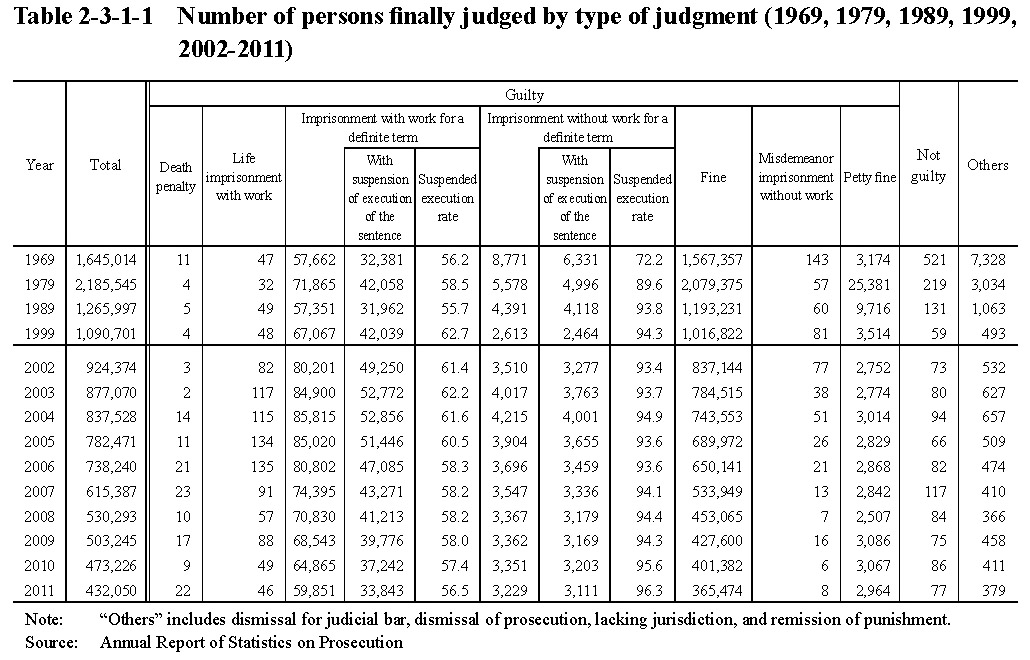
Considering that Japan is perhaps the safest countries in the world (and was for decades while wiretapping was not allowed), and the US and UK with dead easy access to wiretapping warrants and mass surveillance are of the worst western countries in regards of crime, I don't think there's that much to teach the Japanese with regards to getting more "criminal convictions"...
Sorry, but this is not a fact based argument any more. You are somehow trying to convince me that, despite all evidence and data, wiretaps are useless in prosecution of criminals. I'm not having that, anymore.
http://hakusyo1.moj.go.jp/en/61/image/image/h002003001001h.j...
After WWII, the US imposed a constitution on Japan. Here's Article 21: "Freedom of assembly and association as well as speech, press and all other forms of expression are guaranteed. No censorship shall be maintained, nor shall the secrecy of any means of communication be violated."
All wiretapping was illegal in Japan until 1999.[1] Even today, it's very rare. 40 wiretaps in 2017.[2]
[1] https://www.iol.co.za/mercury/world/japan-passes-controversi...
[2] https://mainichi.jp/english/articles/20170217/p2a/00m/0na/01...