It is not West VS China, it is mainly US VS China. EU and other Asian developed economies might disdain China ideologically, but I don't think they have the appetite to break the status quo this eagerly.
And it is nothing philosophical about it. It is geopolitical, and it is human nature. What you are saying are just intellectual seasoning, it may be necessary to intrigue the audience, but not for action.
China is a new world power that competes with US both militarily and economically. Post WWII, US had fought with Soviet/Japan on those fronts separately, but China looks like a combination of both, makes it even more threatening and hard to tolerate.
China already has a crypto Yuan, there is no reason they can't use a Binance style exchange for frictionless worldwide direct investment in their companies.
China: You want to boycott investing in our companies? We'll route around your whole financial system and help make it obsolete. See what happens to the US economy when banks can no longer collect 20% fees on a growing percentage of the world population's transactions.
Mainly they don't have the strength to break the status quo. Plus they don't want to jeopardise access to such a large market. It's a Faustian bargain they're beginning to regret.
China is going to rise, this cannot and should not be prevented. But allowing them to rise at your own country's expense is folly. America gets this.
Trump's actions feel dramatic, but mainly on the magnitude and fast aggression. Something is due to happen and the world needs to adapt to that new normal.
The US would have made far more progress against China if it had remained in the TPP.
On top of that I suspect that when the last stone is overturned we will find a bunch of ways in which the US president and his cronies profited from the wild gyrations of the stock market as a result of the trade war.
Allowing China to maintain its tyrannic regime is extremely dangerous for everybody in the long run.
The change doesn't need to be abrupt and it's possible to make some assurances for people currently in power.
Not that it worked so well with Russia, I know.
[1] https://www.zerohedge.com/sites/default/files/images/user330...

[2] https://www.cato.org/sites/cato.org/files/styles/pubs_2x/pub...
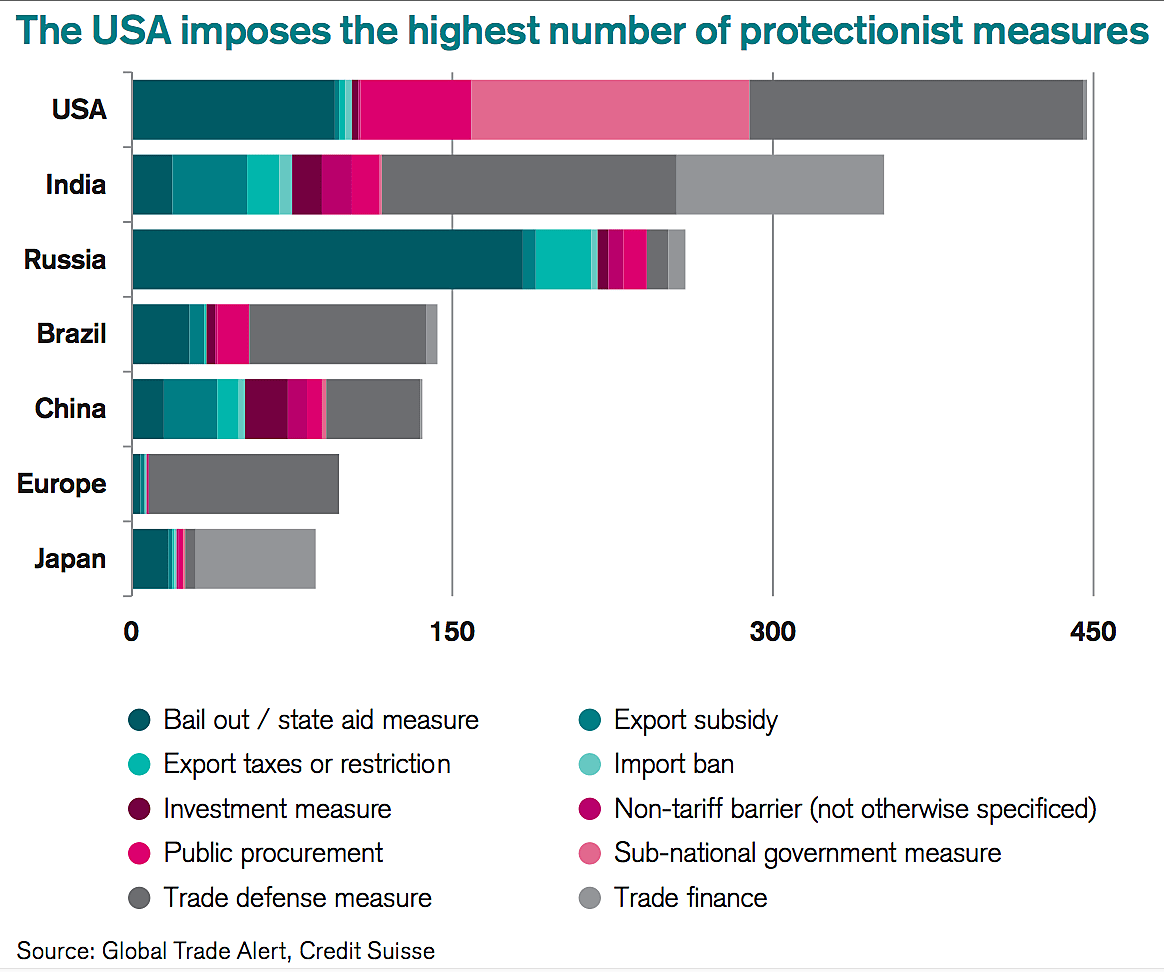
Does the US require foreign firms to have local partners? Routinely ignore foreign copyrights? Completely block all foreign information from reaching its people?
There are many studies that shows that racism is still present in US, in police,justice, work place
Now you give me the excuse for the racism then think maybe China may have their own excuses that you will not understand, then maybe think about school shootings tell me the excuses for why those happen ..then think maybe China has some excuses too for other shit.
IMO there are problems that don't have a simple solution, tell em the simple solution for the gun violence or racism in US. Is the same for China or other country, there is a large number of people in that country, they have a different culture, they have different values and you can't change them over night and some US values should probably be not exported.
At least in the US, victims are allowed to publicly protest and seek redress in the courts. Not so in China.
My points about racism is not to try to put an equality between the 2 countries, I want to show that there are issues that have no simple solution, you make a lay that from tomorrow all races are equal and it takes a few generations for the racism to completely disappear. As similar you can't have China embrace all Western values over night, it is not possible. it takes generations so you need to be patient.
I did not see your simple solutions for the US or China issues, do you have them? If there are no such solutions what do you want? An invasion or tariffs to bring down the firewall and magically fix the racism in China (while at the same time you have a racist leader)
I agree severity is hard to measure, but that's not a reason to ignore severity and compare something that's easy to measure but uninformative.
In the absence of numerical measures of severity, there's room for opinion. My opinion is that the Great Firewall or Chinese IP theft are more severe infractions than tariffs or protected industries.
Was Tibet the last place China invaded, that was more than 50 years ago though. It's true they haven't invaded any places people live, but they are taking over those atolls out in the ocean.
Every country has some protectionism (Canada and their milk farms for example), and everyone wants to help themselves. But the "proper" way to do this is trade off a few protectionistic choices against another countries and shake hands over it. China is of course the emerging great power and the us is handling it poorly at this moment. I advocate for the us to insist China stop doing the stealing by official decree, stop putting "holds"/prisoner-keeping on people at the border. If the us is able to get china to actually be a good citizen in terms of following international law, and we get back to mutually beneficial trade pacts, we'll all be okay and reduce the chance of war. I really think our insane period in the us with a nationalistic stooge will end, and we can back away from the edge of the abyss where we are now.
0. https://www.barrons.com/articles/international-postal-rates-...
Indeed it would be, though China hasn't been in a large shooting war since Korea largely because they were incapable of it. But as their military capabilities change, their shooting war track record may too.
They've shown that a nationalist nation can exploit the globalist system to its own profit, raising doubts about globalism itself and leading to the resurgence of nationalism.
1: https://ustr.gov/sites/default/files/2018-USTR-Report-to-Con...
did China had a say when the old rules were made?
Imagine how much faster this trade war would be over if all of China's top trading partners were involved rather than just the US.
The issue here is much less cultural that you might think.
China has been weak in the past couple of centuries and was thus on the receiving end. But as they grow stronger the rules will have to change to take them and their interests into account.
This obviously does not mean that we should cave in to everything. It means that they should have an equal say in the rules.
At the moment it's the US fighting China more than the West as a whole. It makes sense because it's US dominance that is under threat. The question is whether the US want to fight a losing battle or work constructively for the long term.
All the amazing gain and growth given to us by the free market worths nothing if it fuels oppression, if it raises barriers to entry to markets, if it pushes the whole economy toward monopolies and monopsonies, toward fragile centralization, and toward worse lives for the participants.
And no, it should be more cultural, not less. There are clever and efficient policy tools to manage healthy free markets. Allowing China, the US or anyone to make people forget/ignore these cultural foundations and all the achievements of good policy (as in political cooperation and economic competition; from the forming of the US itself from the individual original states to the contemporary EEA integration such as traditional/geographical origin protection and indication, Schengen border control union, emission quotas, common food and drug inspection standardization, etc.), just because some country is strong would be a folly of the greatest magnitude.
- China require companies to transfer all intellectual property to a venture owned 51% by Chinese before getting access to market
- people running joint ventures like clockwork open competing companies cutting western partners out
- China is a developed country that declare themselves as developing to skirt economic and environmental controls
- China has state owned companies that compete with western companies that they regularly subsidize to beat competition
Also on a softer end China is trying to spread its way of ruling their people to the west [2]. How long do you think you’d last under such a system before being “re-educated” like the Muslim Uighur or Confucian Falun Gong?
[1] https://ustr.gov/sites/default/files/2018-USTR-Report-to-Con... [2] Deceiving the Sky: Inside Communist China's Drive for Global Supremacy https://www.amazon.com/dp/1641770546/ref=cm_sw_r_cp_api_i_Da...
You're asking me to give up QoL/future income/whatever based on what? Their threat of violence? That's ridiculous, threaten them back and follow up on it if necessary.
You're missing one of the major points: freedom. The issue is not just weighing the utilitarian pros/cons of allowing diversity of thought. In the U.S. (and generally the west), the ability to think and do what you want is valued as an important individual right that each person is entitled to, regardless of whether it's good or bad for society as whole.
At one point in life I'd have agreed with you. Now I can't agree with this at all. Usually the West wants very specific kinds of freedom; the kinds which are useful for social control. The first amendment may remain in the US as a sort of residual idea from classical liberalism, but it seems not too many people actually want this.
I'm not sure the first amendment was ever really popular - Nazi's marching down a Jewish neighborhood, hippies burning the American flag, John Adams defending British soldiers involved in the Boston Massacre - freedom is often very unpopular. Just because something is unpopular doesn't mean it's not sacred.
Yes, I get that's the point, but it's consistent with my original point: the right to be disagreeable, whether an outsider or not, is an important freedom that's valued in the U.S., regardless of whether it's a net socioeconomic benefit or loss.
This is purely US vs China. Leave the rest of us out of your own mess please.
"Meng, 47, was arrested at Vancouver's airport on December 1 at the request of the United States, where she is charged with bank fraud and accused of misleading HSBC Holdings Plc about Huawei Technologies Co Ltd's business in Iran."
Do you think China is not going to exploit its economic power to achieve political goals?
Are you aware of China's political goals? Do you agree with them?
Just to name a few: censorship, take Taiwan, suppression of self-determination of minorities, gaining more territory in the East China Sea (island building) from its neighbors.
All great gains for the Chinese people.
[1] https://www.google.com/amp/s/www.nytimes.com/2019/09/25/worl...
[2] https://en.m.wikipedia.org/wiki/Persecution_of_Falun_Gong
[3] https://www.voanews.com/south-central-asia/tibetan-re-educat...
The real issue is that as China continues to grow economically, its military power grows as well and ultimately the US is no longer the dominant military power in the south china sea. Rhetorics about fair trade, democracy, freedom is just that, rhetorics; international politics is about raw power.
Europe has no military interest in the south china sea. And China does not pose a military threat to us. Therefore we are fine with China's continuous growth as it benifits us economically.
There are two main streams of human rights policy and action within the European Union. One is to protect the fundamental human rights for EU citizens, and the other is to promote human rights worldwide.
https://europa.eu/european-union/topics/human-rights_en
I don't see how that is compatible with the frequent violations of human rights in China. As an above commenter said: it seems to boil down to money.
Now, there may be nuance or whatever that I'm not aware of, but that actually sounds quite reasonable on the face of it. Why not require Chinese companies to meet US standards to be listed here? Maybe waivers were a type of corruption, even if well intended?
Human rights? They have started putting Uighurs, Buddhists and Falun Gong into re-education camps https://en.m.wikipedia.org/wiki/Persecution_of_Falun_Gong
Two previous points also counter the rule of law point, which is admittedly a western concept.
Anyways. We can chat about particular data points. But if you look at the broad picture over decades; you really have to be willfully blind to deny massive improvements that have happened.
Can always talk about data on the other points as well to see what they say.
It is inconvenient and unfortunate facts. I also wish they were not true.
I don't mean to impugn your research or the time you spent on your comment. But unfortunately that style of comment pattern-matches to the "list of pre-existing talking points brought in to further pre-existing agenda" genre, simply because the latter is so much more common in internet arguments of this nature. That's why I used the word "boilerplate", which obviously didn't apply to this case.
Like most others in polarizing discussions I sometimes fall into the trap of misinterpreting what the other say and therefore critiquing what I thought they said where more clarification would be good. Do you think that happened here?
I try to avoid the previously trap, and recognize it. With regards to providing informational links in this particular instance I don’t know how we can make progress across divides without providing links to why we have a different viewpoints, and engage in the other persons arguments and supporting evidence.
If you have any thoughts on how the inconsistencies between the parents claims and what seem to be the well published situation on the ground could be highlighted in a better way that would be helpful. Right now I am reading “how to have impossible conversations” by Bogossian and in general studying why my viewpoint opponents think what they think. Benjamin Boynces series on evergreen is incredibly interesting. Hopefully I’ll learn something good.
Cultural Revolution [1]
"In recent months, Germany, France, Britain, the European Union, Australia, Japan and Canada have all joined an unprecedented global backlash against Chinese capital, citing national security concerns. Dealmakers now wonder whether this dynamic will run its course or should be taken as a new normal."
https://www.scmp.com/business/banking-finance/article/216397...
If you think its ok to try and change other peoples rules to suit yourself instead of adampting to the rules of the area you enter then you are simply a bully.
- Should free markets/societies/cultural entities allow participation by all actors, even those which (in their own spaces) obviously don't play by the rules of the entered market/society/culture?
- Or, should entry into the entity be restricted to those that themselves (in their own space) follow the rules of the entered culture?
It seems to me that there are definite advantages and disadvantages to both approaches and it's probably something that game theorists have addressed. To use a convoluted, over-simplified metaphor of a playground:
- If we allow kids (that have different rules in their own playground) into our playground, we run the risk of their rules overcoming or having a negative effect on ours. We also enable them to play with us while having "bad" rules on their own playground - some of which might give them an (unfair) advantage over us on our own playground. However, we get the benefits of having more kids and toys to play with. And, maybe the kids will choose our rules (which we perceive as better) over their own.
- If we don't allow them into our playground, we have less kids and toys to play with. We also have no real direct influence on them - they can't see that our rules are better in person, and we can't threaten to kick them out of our playground if they aren't in it to begin with. However, we avoid the risk of having their rules overwhelm ours and we worry less about them having unfair advantages over us on our own playground.