News for hackers. Stuff that matters.
Re:The Browser Monopoly by basch on Wednesday August 21, 2019 @09:52AM (#20757129)
>Chrome introduced a lot of neat new features (Porn “Incognito Mode,” multithreaded memory changes, tabs and more).

Now chrome is getting credit for in private browsing and tabs? (Safari and Opera respectively. Phoenix/Firefox popularized them long before Chrome was a twinkle.)

>It is mind-boggling that basic tools like these are not yet standard features in browsers.

How long have browsers offered to save passwords? Seems like a lot of bad history in this article.

>The way existing password managers work, the vendor’s liability even if they are hacked is minimal. They don’t hold any passwords!

HUH? Yes they do.. They absolutely hold a copy of your password ... in the cloud.

>Sure, Chromium and the V8 engine are open-source, but they still belong to Google in a way that, say, TCP/IP or IMAP does not.

Im gonna feel really bad breaking the QUIC / HTTP/3 news. Cuz google totally wrote the new transport layer. They wrote the last one too (SPDY HTTP/2.) With this much market share, what google implements and forces the hands of the standards organizations.

>This is why Microsoft’s decision to kill Internet Explorer, once the leading portal to the web, and replace it with a Chromium-based successor says so much about its new direction as a company. I suspect that decision had more to do with clearly understanding Microsoft’s strengths and weaknesses than anything else.

Its primarily for two reasons. 1 is battery life, they want to embed blink into the os so programs dont need to bundle it (electron included.) 2 is because 99% of the web just targets blink now. I dont think you can credit "the move to ssas" alone with Microsoft finally abandoning IE derivatives.

Re:The Browser Monopoly by no_wizard on Wednesday August 21, 2019 @12:35PM (#20758875)
I agree with your points over all, but I'm still bitter and will take the time every time to sound my bitterness about the fact that Microsoft didn't back Firefox/servo (the rust implementation of their rendering engine)

Why am I bitter?

1. It hands a lot of power over to chromium, regardless of how much it gets forked by Microsoft.

2. It would have put some very talented engineers onto a Chrome competitor, which I always like to see

3. It would have been a huge boost to Rust, which if it ever will unseat c++/c as a systems language target, will need all the help it can get as a de facto standard (you can argue if this is worthwhile or just pie in the sky dreaming, I'll concede on that)

4. I just plain think we need a V8 alternative for a nodejs/electron like ecosystem, in my opinion servo could be that. I know they are doing node-chakra-core, but this could have taken it to a whole new level.

Competition is good, in another words. Even if all my assumptions are wrong, I'd love to see an alternative history where they were laid to bare.

Now, I will admit, I am actually happy to see that they are on Chromimum instead of yet another engine, and I see all the upsides of this move too, and will definitely take advantage of them (with Microsoft Edge being my favorite version of Chrome right now)

Re:The Browser Monopoly by bryanlarsen on Wednesday August 21, 2019 @04:12PM (#20761175)
I too believe this was a very short-sighted move on Microsoft's part. There might have been some very good short-term reasons for building off of Chromium rather than Firefox or servo, but long-term entrenching the Google monopoly is going to cost them big time.
Re:The Browser Monopoly by basch on Wednesday August 21, 2019 @05:48PM (#20762197)
It's almost gotta be a new guard of developers that though it was easier to force blink on the windows team, than abandon what they they grew up using.

Microsoft could have written any browser engine it wanted and then placed iOS/Safari like rules on other browsers, such as... "if you want us to allow your app to run in Battery Friendly mode, you must ONLY use our OS provided web engine."

Re:The Browser Monopoly by no_wizard on Wednesday August 21, 2019 @11:47PM (#20764472)
I think that behavior could get construed into a lawsuit though. It’s a little in bad faith with their anti trust history
Re:The Browser Monopoly by mtgx on Wednesday August 21, 2019 @01:04PM (#20759099)
Not to mention Microsoft's Windows team is already considering rewriting some Windows components in Rust to get rid of memory bugs:

https://msrc-blog.microsoft.com/2019/07/22/why-rust-for-safe...

I guess Microsoft was tired of losing the browser game, so it decided to back the winning worse this time. But I still believe it will be a mistake long-term, as Google will start controlling Chromium's direction with more of an iron fist.

I believe someone else mentioned in a previous HN comment about the ad-blocking API that it doesn't matter if Edge, Brave, or other Chromium-based browsers can "continue to support a Chromium API if Google wants to kill it", because in the end if their combined market share is tiny, most developers will stop supporting that API anyways.

I imagine the Chromium browsers will be going in the direction of Android, where "anyone can fork Android" but in practice you're dead in the market if you don't back Google's Android.

Re:The Browser Monopoly by pygy_ on Thursday August 22, 2019 @03:30AM (#20765528)
@mtgx your account has been shadowbanned you may want to contact YC to sort it out ([email protected]).
Re:The Browser Monopoly by Gaelan on Thursday August 22, 2019 @04:34AM (#20765901)
Huh? Their comment shows up fine for me.
Re:The Browser Monopoly by pygy_ on Thursday August 22, 2019 @09:44AM (#20767952)
I vouched for this one, which was [dead], but most of their comments made in the last 20 days are [dead], and so are all of their submissions since July.
Re:The Browser Monopoly by CoolGuySteve on Wednesday August 21, 2019 @11:42AM (#20758275)
Chrome had the nifty break away title bar tabs before anyone else.

But the major improvement that made everyone switch was process separation for each tab. One tab could crash while the others stayed functional and a security vulnerability in one tab would have a more difficult time compromising the others.

It's also one of the reasons Chome uses so much memory, they failed to keep optimizing their copy-on-write paging behaviour so that tabs would share more memory among themselves.

Nowadays Firefox has process separation for tabs AND it's not written by an advertising company, so I like it better.

Re:The Browser Monopoly by muststopmyths on Wednesday August 21, 2019 @12:52PM (#20759020)
But the major improvement that made everyone switch was process separation for each tab

Which IE8 had around the same time (It may have launched after Chrome, but in the contemporaneous betas, they both had the feature)

What made people switch was a combination of everything google did having the sheen of "cool" around it, and the fact that I.E development was slow and shoddy.

Re:The Browser Monopoly by olyjohn on Wednesday August 21, 2019 @01:33PM (#20759358)
My perspective on browser history is a little different. I've been following and using Firefox since before it was Firefox. At one point in time, I was working in a computer store. IE6 - 8 was letting ActiveX controls and other scripts run rampant, infecting people like crazy. 99% of our business was malware cleanup and removal due to IE. Once you explained to people what happened, they were appaled and were happy to switch to Firefox, despite many sites only working on IE at the time. THIS is what really triggered the migration away from IE. Firefox was taking off (look at the chart in the linked article), and was starting to dominate, well before Chrome ever became a thing. Those of us on Linux also had Konqueror, and it had a decent userbase as well.

I think that's when Google noticed that the IE monopoly was breaking, and they jumped onboard and took Konqueror's code and then launched their own browser. The same code that Apple used for Safari. So they basically came in on the hard work of Firefox and the KHTML team and took over the market by putting Chrome right on Google's homepage.

It's my opinion that Chrome didn't become popular because it was better, or because it was cool (no average user cares about that). It became popular by being right there on everybody's home page, right at the perfect time that people were catching on to the fact that IE had zero security.

Firefox broke the monopoly and freed us, and then Google and Apple came in and shat all over them.

Re:The Browser Monopoly by ahartmetz on Wednesday August 21, 2019 @02:07PM (#20759737)
Blink forked off from WebKit long after WebKit forked off from KHTML. Maybe you wanted to say that, but it reads more like Blink (Chrome engine) forked directly from KHTML.
Re:The Browser Monopoly by Agenttin on Wednesday August 21, 2019 @04:19PM (#20761246)
I seem to remember at the time Chrome was faster than FF.
Re:The Browser Monopoly by mda on Thursday August 22, 2019 @02:51AM (#20765345)
Way faster
Re:The Browser Monopoly by scarface74 on Wednesday August 21, 2019 @02:16PM (#20759868)
Chrome had the nifty break away title bar tabs before anyone else.

The first time I saw break away tabs in Safari for Windows in 2007. Before Chrome was introduced.

Re:The Browser Monopoly by basch on Wednesday August 21, 2019 @05:45PM (#20762174)
Werent safari 3 tabs below the bookmark bar? Safari tabs on top werent until 2009 I wanna say. I thought they quickly reverted it as well. Like Maybe it was just the safari 4 beta?
Re:The Browser Monopoly by scarface74 on Wednesday August 21, 2019 @08:03PM (#20763288)
Re:The Browser Monopoly by basch on Wednesday August 21, 2019 @08:57PM (#20763640)
I'm looking at the safari 3 screenshot and I don't see tabs in the title bar. I'm pretty sure it wasn't till safari 4 beta.

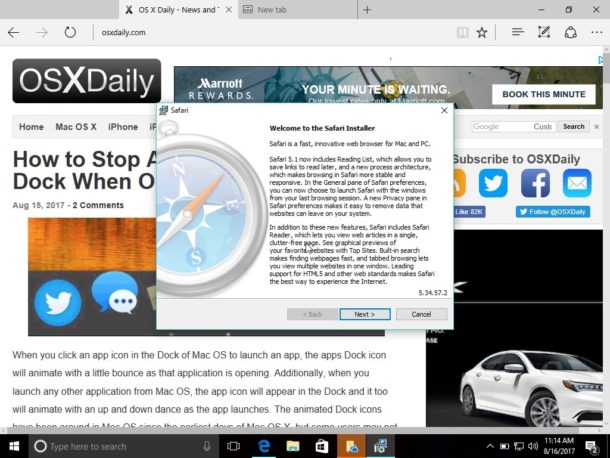
The safari 5 screenshot you have is EDGE with a safari installer in front of it.

Re:The Browser Monopoly by chappi42 on Wednesday August 21, 2019 @12:45PM (#20758962)
> the major improvement that made everyone switch was process separation for each tab

In addition I also consider the marketing reach and the success of Android as important. Fwiw I never switched completely to chrome and quite regularly got a hint to try out a better/optimised browser.

Re:The Browser Monopoly by dredmorbius on Friday August 23, 2019 @10:33PM (#20784829)
Is break-away different from gtk tear-off menus? Because that's ~1999 - 2001.

Process sep per tab was a Chrome feature. Unless you count Lynx and separate instances per browser page ;-)

Re:The Browser Monopoly by tialaramex on Wednesday August 21, 2019 @11:51AM (#20758400)
> Im gonna feel really bad breaking the QUIC / HTTP/3 news. Cuz google totally wrote the new transport layer. They wrote the last one too (SPDY HTTP/2.)

This would presumably be news to everybody involved.

Google's QUIC ("GQUIC") isn't very close to the IETF QUIC standard under development. The IETF went with TLS 1.3 as the cryptographic foundation (which didn't exist when Google built GQUIC) and most the details have changed considerably. You can definitely see a family resemblance, but for Google this was a proof of concept hack and for the QUIC WG they're building what is probably a successor to TCP. It's the difference between a five year old's doodle of a house and the plans you need to submit to get someone to approve it and then build the house.

The chairs are currently not Google employees (they work at Fastly and NetApp) and the editors on the main transport draft aren't Google either (Mozilla and Fastly). There are Google people in the room (such as Adam Langley of course) but there are people from the other browsers too.

Re:The Browser Monopoly by basch on Wednesday August 21, 2019 @11:53AM (#20758429)
Im more making the point, that if google doesnt implement a standard, it dies. Google has defacto control, even without running the show.

But fair enough, to say they wrote it all is a mischaracterization of events.

Re:The Browser Monopoly by guardian5x on Wednesday August 21, 2019 @10:19AM (#20757398)
According to https://en.wikipedia.org/wiki/Private_browsing Safari came first, but Chrome was before Opera or Firefox.
Re:The Browser Monopoly by jcranmer on Wednesday August 21, 2019 @11:21AM (#20758058)
The Firefox 3-4 era is the era of the interminably long betas for Firefox. The private browsing feature was committed to Firefox trunk on 2008-11-04, long before the 2009-06-30 release date given on that Wikipedia page. The bug for Firefox was filed 2004-06-28, long before Chrome was a thing.

(Bug: https://bugzilla.mozilla.org/show_bug.cgi?id=248970).

Re:The Browser Monopoly by basch on Wednesday August 21, 2019 @10:21AM (#20757421)
I credited it to Safari
Re:The Browser Monopoly by psychrometer on Wednesday August 21, 2019 @01:54PM (#20759582)
But you also said that Opera and Firefox had private browsing before Chrome which is not true.
Re:The Browser Monopoly by basch on Wednesday August 21, 2019 @05:41PM (#20762144)
>for in private browsing and tabs? (Safari and Opera respectively.

Respectively. Meaning private=safari, tabs=opera.

Re:The Browser Monopoly by abtinf on Wednesday August 21, 2019 @10:13AM (#20757341)
Regarding tabbed browers: they are ancient. I remember the first time I used tabs with a wrapper for IE 4 or 5 back in the mid-90s. I think it was called NetCaptor or NetRaptor or something. It was magical. Of course, back then, no one knew anything about the privacy implications of something like that.
Re:The Browser Monopoly by basch on Wednesday August 21, 2019 @10:14AM (#20757350)
Apparently InternetWorks and Netcaptor came before Opera. I shouldnt be so cocky.

https://www.quora.com/What-is-the-history-of-tabbed-browsing

Re:The Browser Monopoly by abtinf on Wednesday August 21, 2019 @10:34AM (#20757588)
> I shouldnt be so cocky.

Off-topic, but I don't think its about being cocky. For me, the most difficult thing to keep in mind about information technology is that it is entirely a construct of the human mind and we haven't yet devised methods to validate it against reality.

We see things as they are now and think "well, of course it has to be that way." That kind of view is true in a lot of fields--a rocket ship has a certain design because it must have a certain design. You can't put the engines on perpendicular to the ship or the fuel storage under the rocket exhaust.

But you can do that kind of thing with computers and might not even know it. I started to get a sense of this a couple years ago, when I first learned about the works of Ted Nelson and his contemporaries. Ted is critical of things like the modern hyperlink which, at first, seemed to me like criticizing the ocean. He even disapproves of the word "computer".

The idea that computing can and should be fundamentally reinvented has been the most exciting discovery of my life.

Re:The Browser Monopoly by TeMPOraL on Wednesday August 21, 2019 @11:32AM (#20758174)
> The idea that computing can and should be fundamentally reinvented has been the most exciting discovery of my life.

This was one of the more depressing discoveries of mine.

"Reinvention" works by the main stream of this industry having knowledge half-life on the order of decade or less. Instead of building on top of prior work, we keep reinventing the old stuff; sometimes better, but usually very poorly - I attribute this to bad incentives. In the 70s they had time to think about what they're actually doing. In 2010s we have constant race to the market, and "move fast and break things" culture, which leads to layers of crappy abstractions that keeps relative performance of our software on the level of 1980s while delivering little usability on top.

Re:The Browser Monopoly by The_rationalist on Wednesday August 21, 2019 @10:40AM (#20757656)
The idea that computing can and should be fundamentally reinvented has been the most exciting discovery of my life. Sorry but you hype me but don't deliver. This seems fascinating but is far too vague to be actionable, could you exemplify what are computing reinvention?
Re:The Browser Monopoly by dkersten on Wednesday August 21, 2019 @10:26AM (#20757491)
Its fine, its a minor mistake compared to those the article is making.
Re:The Browser Monopoly by NikkiA on Wednesday August 21, 2019 @09:22PM (#20763769)
I think iCab also had tabs right from the start (so '99)
Re:The Browser Monopoly by zvrba on Wednesday August 21, 2019 @11:36AM (#20758213)
> Im gonna feel really bad breaking the QUIC / HTTP/3 news.

According to this research article [1], QUIC is unfair towards TCP and consumes more than twice its fair share of bottleneck bandwidth.

[1] [PDF] https://conferences.sigcomm.org/imc/2017/papers/imc17-final3...

Re:The Browser Monopoly by csande17 on Wednesday August 21, 2019 @11:38AM (#20758229)
That's the whole point, isn't it? Google wants web sites to load more quickly without needing to reduce the size or number of resources they send. Consuming more bandwidth seems like the only way to square that circle.
Re:The Browser Monopoly by scarface74 on Wednesday August 21, 2019 @02:13PM (#20759826)
Now chrome is getting credit for in private browsing and tabs? (Safari and Opera respectively. Phoenix/Firefox popularized them long before Chrome was a twinkle.)

Just for reference

https://en.wikipedia.org/wiki/Private_browsing

It was available for 3 years in Safari before it became available in Chrome and four years before Firefox.

Re:The Browser Monopoly by basch on Sunday August 25, 2019 @06:31PM (#20796042)
that is what I said. Private tabs ..> safari ..> respectively.
Re:The Browser Monopoly by kmlx on Wednesday August 21, 2019 @11:48AM (#20758355)
>Chief among these would be a low-cost, independent email service focused on privacy

i think the author is a bit confused about this:

1. every email provider in existence scans emails for spam purposes. if they don't, they lose market share since their product becomes unusable.

2. gmail stopped scanning emails for ad purposes a while ago.

Re:The Browser Monopoly by jsutton on Wednesday August 21, 2019 @10:36AM (#20757609)
Password managers don't hold your password in plaintext, so the liability there only exists if you don't think the latest encryption methods are enough.
Re:The Browser Monopoly by basch on Wednesday August 21, 2019 @10:47AM (#20757724)
Thats not true. Theres other ways into your account besides breaking encryption. Off the top of my head, a brick to my head and the use of my thumbprint would do it.

Unlike how a normal service is normally supposed to store my password (hashed, but with no copy of the original password anywhere, EVENT THE LOGS) the password manager DOES retain a plain text copy of a password, not JUST a hashed derivative.

Re:The Browser Monopoly by deadbunny on Wednesday August 21, 2019 @11:17AM (#20758014)
> Off the top of my head, a brick to my head and the use of my thumbprint would do it.

Maybe don't use 1FA for your passwords?

Re:The Browser Monopoly by NikkiA on Wednesday August 21, 2019 @09:17PM (#20763738)
It's possible that the author meant 'multi-threaded memory changes, and multi-threaded tabs' rather than 'tabs' alone. And it's true that chrome DID introduce threaded tabs afaik.
Re:The Browser Monopoly by albits on Wednesday August 21, 2019 @10:18AM (#20757388)
Regarding saving password in browser, the author probably means an encrypted password manager such as KeePass or 1Password, and not the current implementation which does not have a master password
Re:The Browser Monopoly by basch on Wednesday August 21, 2019 @10:23AM (#20757450)
Firefox has a master password that encrypts the data. I dont use it, but doesnt a Sync account also sync the passwords between instances of your browser?

https://support.mozilla.org/en-US/kb/use-master-password-pro...

That said, can you still copy the profile to a new computer and have it autofill? Physical access to data on a hard drive is often end of game, unlike cloud only hosted stuff that streams. Im guessing you cant copy a firefox profile with lastpass or 1pass or dashlane and have the new computer start autofilling without reentering the master password?

Firefox also has Firefox Lockbox now for storing passwords in the cloud.

Re:The Browser Monopoly by gibspaulding on Wednesday August 21, 2019 @11:04AM (#20757888)
Yes, Firefox Sync will sync the passwords between browser instances. It also offers the option to use a master password.

I've been using it without any issues for several years now.

Re:The Browser Monopoly by jmkni on Wednesday August 21, 2019 @10:55AM (#20757806)
I've noticed Safari on iOS offering to generate a password and store it when I register for new sites recently. It works pretty well (until I'm on Windows and need the password).
Re:The Browser Monopoly by shawnz on Wednesday August 21, 2019 @12:56PM (#20759035)
Chrome indeed also uses a master password and keeps saved passwords encrypted end to end, just like 1Password, LastPass and Firefox Sync.
Re:The Browser Monopoly by dekhn on Wednesday August 21, 2019 @10:31AM (#20757547)
chrome on linux and mac both request that I provide a master password before I can access my passwords. IIUC.