First, the skin (and skull and clothing .. etc.) does act as a barrier, which is why the graph that is shown in the article is flawed (this is mentioned). It shows absorption of microwave radiation in the grey matter of the brain, but it doesn't account for the skin and skull that blocks it.
There are two major effects of radiation: ionization (think X-ray imaging) and heating (think microwave oven). Ionization is irrelevant for 5G, because the frequency is way too low. Heating, on the other hand, happens at many frequencies. For example, a microwave oven is at ~2.4 GHz, just like Wi-Fi (which can also operate at 5 GHz).
That said, the heating is dependent on how much power is transmitted and how well it is absorbed by the skin. For example, a low-power source (Wi-Fi antenna) doesn't fry your skin like a microwave oven because a) the power is too low and b) it mostly reflects off the surface of the skin.
The power levels that 5G needs to operate at are quite low and the reflection off the skin is quite high. This is summarized nicely in the reference I gave in another comment here [1].
To answer your specific questions:
> So am I to understand 5G causes merely skin cancer, not brain cancer? Or is non-ionizing radiation safe regardless of shielding?
The ionization effect is not present due to low frequency (see above), the heating effect should be considered, but is minimal (see reference). The authors of [1] note specifically that the skin area is safe, but the eyes may be more vulnerable if the devices operate at large power and are close-by. So, this is not dangerous for consumers but may be dangerous for workers near antennas. However, the radiation level must be very high, and the distance very short. In my reading of the paper, it is not a danger for commercial telecom applications.
> Would it be too much to ask for blasting a few thousand rats with 5G?
That is not my field of expertise..
Otherwise yes, I'm aware that 5G is non-ionizing, and produces negligible heating, which doesn't leave many straight-forward ways it could affect biology (maybe EM fields adversely affect protein folding?). For those you pretty much need experimental studies, but looks like they've been conducted, and turned up nothing.
But no one expresses concern about visible light causing damage from localised heating or the EM fields of it disrupting protein folding (hold a torch up to your hand - your body is quite translucent to visible light).
Why not? The energy needed to affect that is lower than ionization energy, so they could.
And I'm not "reacting" to anything. 60 GHz radiation is sufficiently different from sunlight that it might plausibly have a different effect on us (such as by interacting with some low-energy absorption peak of a protein that visible light does not interact with due to its higher energy, or by penetrating deeper into tissue than visible light can).
It turns out studies show it is not harmful. But they conducted actual studies to show that - they didn't dismiss it outright "because sunlight".
[1] https://upload.wikimedia.org/wikipedia/commons/0/0d/Effectiv...
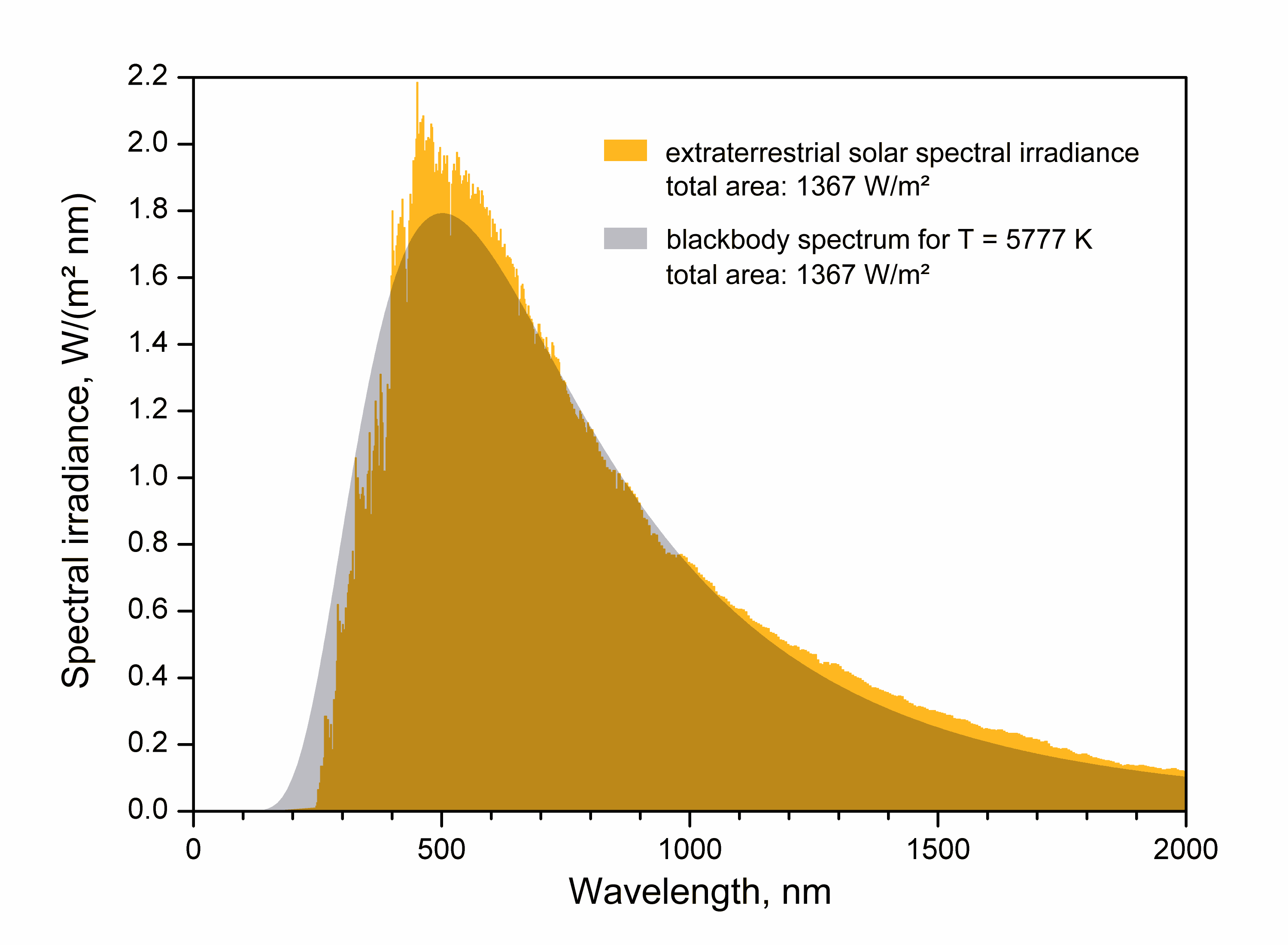
But, suppose the sun did interfere - how would you filter this out? Due to the black-body nature of the source, the amplitude would be stable, but the phase wouldn't be - you'd get entirely uncorrelated white noise, right? How can you filter that?
edit: to add to this, the capacity C ("throughput") of the communications channel is linear with bandwidth B (in Hertz) but only logarithmic (log_2) with noise power N. This was derived by Shannon (https://en.wikipedia.org/wiki/Shannon%E2%80%93Hartley_theore...) and in equation form:
C = B*log_2(1+S/N)
C = B
C = 10*B*log_2(1 + 1/10) = 1.38*B
There have been no studies showing 5G to be safe, because there have been no studies on 5G.
Lower powers don't seem to have significant effects, and if so, likely more of a metabolic nature than of a cancer nature. Getting an inflammation seems possible, but cancer-inducing powers cause thermal sensations/damage before you get cancer.
So am I to understand 5G causes merely skin cancer, not brain cancer? Or is non-ionizing radiation safe regardless of shielding? I wish they had written this article better, because as it stands, it's a mess. If it wasn't for the mention that there was no increase in cancer observed as cell-phones gained popularity (which is at frequencies lower than 5G), it would be entirely unpersuasive.
Would it be too much to ask for blasting a few thousand rats with 5G?
Edit: Skimming https://ieeexplore.ieee.org/abstract/document/7032050 linked by itcrowd, I got the vague impression that biological tests were done roughly as I'd hope. It would be nice if the Times article devoted more ink to studies showing 5G to be safe, instead of 95% focusing on how the claims that it is dangerous are shaky, and barely mentioning studies proving its safety.