Why not? The energy needed to affect that is lower than ionization energy, so they could.
And I'm not "reacting" to anything. 60 GHz radiation is sufficiently different from sunlight that it might plausibly have a different effect on us (such as by interacting with some low-energy absorption peak of a protein that visible light does not interact with due to its higher energy, or by penetrating deeper into tissue than visible light can).
It turns out studies show it is not harmful. But they conducted actual studies to show that - they didn't dismiss it outright "because sunlight".
[1] https://upload.wikimedia.org/wikipedia/commons/0/0d/Effectiv...
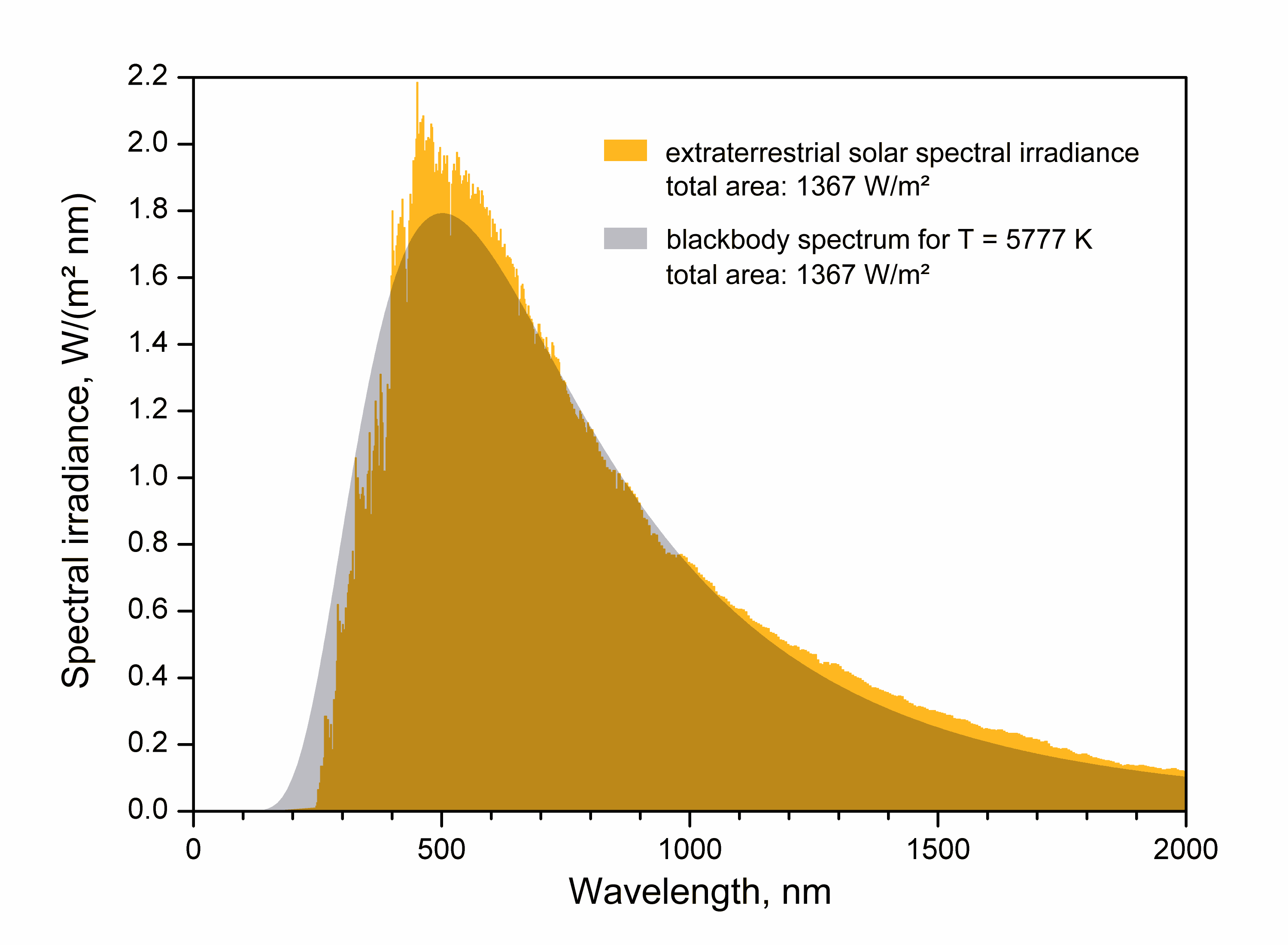
But, suppose the sun did interfere - how would you filter this out? Due to the black-body nature of the source, the amplitude would be stable, but the phase wouldn't be - you'd get entirely uncorrelated white noise, right? How can you filter that?
edit: to add to this, the capacity C ("throughput") of the communications channel is linear with bandwidth B (in Hertz) but only logarithmic (log_2) with noise power N. This was derived by Shannon (https://en.wikipedia.org/wiki/Shannon%E2%80%93Hartley_theore...) and in equation form:
C = B*log_2(1+S/N)
C = B
C = 10*B*log_2(1 + 1/10) = 1.38*B
But no one expresses concern about visible light causing damage from localised heating or the EM fields of it disrupting protein folding (hold a torch up to your hand - your body is quite translucent to visible light).