Re:Inaccurate chart led to unwarranted fears of 5G wireless ...
by deogeo on Wednesday July 17, 2019 @10:55AM
(#20460122)
Surely it's a different narrow frequency range? Otherwise sunlight would act as a signal jammer, a source of noise that drowned out our wireless signals?
[ Parent
| on HN ]
Re:Inaccurate chart led to unwarranted fears of 5G wireless ...
by itcrowd on Wednesday July 17, 2019 @11:27AM
(#20460479)
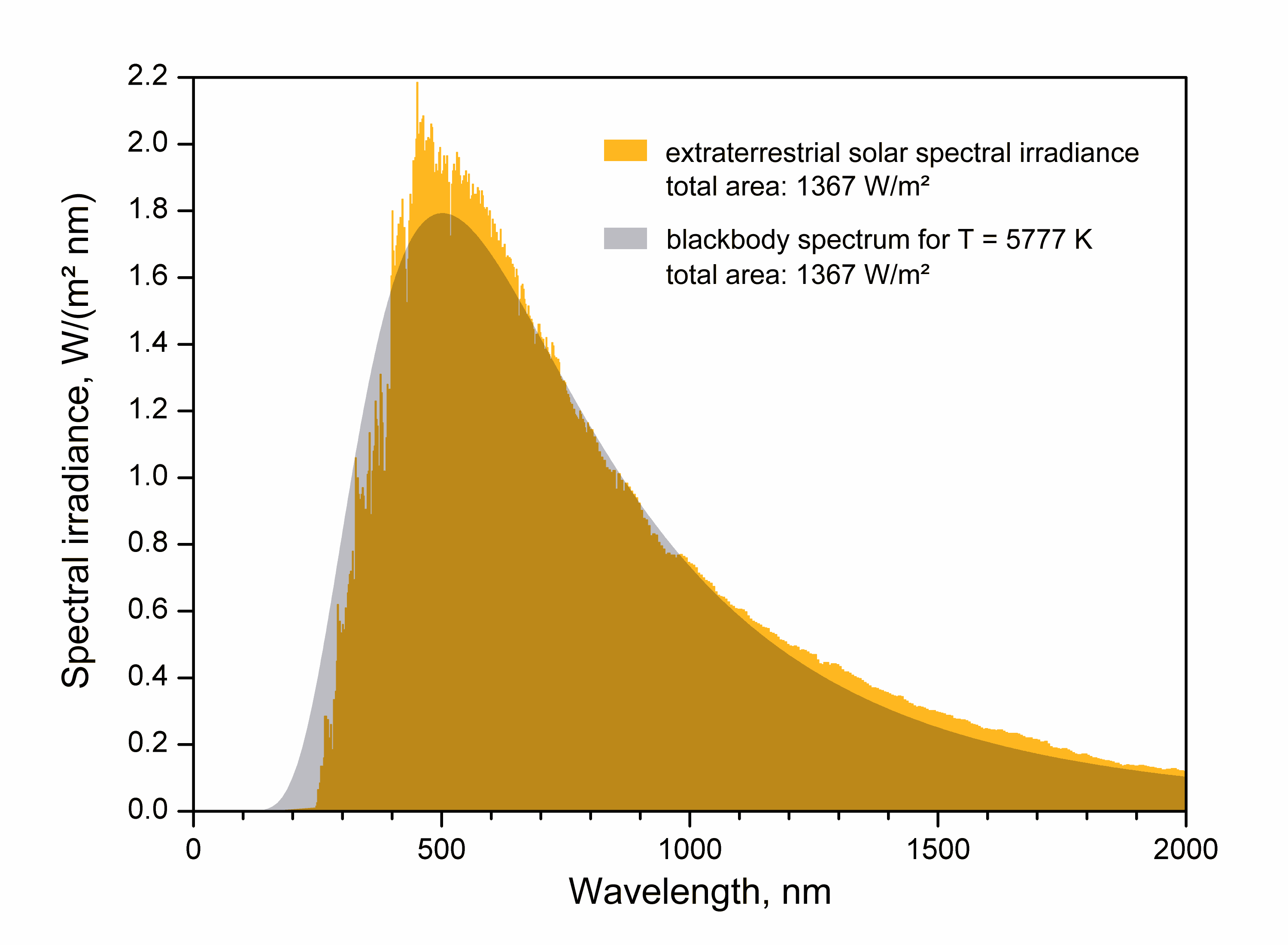
Indeed, the radiation coming from the sun in the visible spectrum is much larger than the microwave radiation coming off it [1]. Note: the microwave spectrum ends at ~300 GHz or 1 mm wavelength, that is 1 million nanometers, so the scale on the x-axis is wayyy too short in the image. The actual value is very, very low.
[1] https://upload.wikimedia.org/wikipedia/commons/0/0d/Effectiv...
Re:Inaccurate chart led to unwarranted fears of 5G wireless ...
by Dylan16807 on Wednesday July 17, 2019 @04:38PM
(#20463735)
You can filter out a stable amount pretty easily but oops I just checked the blackbody math again and an exponent flipped when I changed one of the ranges while everything else stayed almost the same, I screwed up and ignore everything I said.
Re:Inaccurate chart led to unwarranted fears of 5G wireless ...
by deogeo on Wednesday July 17, 2019 @05:38PM
(#20464328)
Hehe, happens :)
But, suppose the sun did interfere - how would you filter this out? Due to the black-body nature of the source, the amplitude would be stable, but the phase wouldn't be - you'd get entirely uncorrelated white noise, right? How can you filter that?
Re:Inaccurate chart led to unwarranted fears of 5G wireless ...
by itcrowd on Thursday July 18, 2019 @11:00AM
(#20470513)
Good question. A good but short answer is given on Wikipedia (https://en.wikipedia.org/wiki/Matched_filter#Matched_filter_...). Any undergraduate textbook on digital signal processing should have details on this topic.
edit: to add to this, the capacity C ("throughput") of the communications channel is linear with bandwidth B (in Hertz) but only logarithmic (log_2) with noise power N. This was derived by Shannon (https://en.wikipedia.org/wiki/Shannon%E2%80%93Hartley_theore...) and in equation form:
C = B*log_2(1+S/N)
C = B
C = 10*B*log_2(1 + 1/10) = 1.38*B
Re:Inaccurate chart led to unwarranted fears of 5G wireless ...
by Dylan16807 on Wednesday July 17, 2019 @09:48PM
(#20465944)
I've never really looked into how the encoding is typically done on those bands. You don't need a lot of bits per Hz when you have 14GHz of space, so nothing particularly elaborate with phase is strictly necessary. But yes it would definitely hurt speeds, and you have a good point in that it's something to consider as a sanity check!