News for hackers. Stuff that matters.
Re:How iOS 13 redraws your eyes so you're looking at the camera by viraptor on Wednesday July 03, 2019 @07:56AM (#20343454)
It looks like there's a toggle https://twitter.com/flyosity/status/1146136279647772673

But yes, it crosses the line where it's no longer a camera (as a feature, it does not capture reality)

Re:How iOS 13 redraws your eyes so you're looking at the camera by sjwright on Wednesday July 03, 2019 @08:14AM (#20343581)
What is truth?

When the person on the other end of the call is looking at the image of me on their screen, the physical truth is that they're looking away from the camera, but the emotional truth is that their eyes are looking at me.

When I'm chatting with loved ones, which truth is more important? Physical truth, or emotional truth?

Consider for a moment that an offset front-facing camera might be just as serious a distortion of truth.

Re:How iOS 13 redraws your eyes so you're looking at the camera by viraptor on Wednesday July 03, 2019 @08:28AM (#20343666)
You've lost me at "emotional truth". The camera captures a specific scene. The result is processed to correct for lens distortions / colour / lighting issues. But none of those changes the content.

I don't think an offset camera is distorting anything. It captures the image it's expected to capture.

Re:How iOS 13 redraws your eyes so you're looking at the camera by LocalH on Wednesday July 03, 2019 @08:31AM (#20343696)
But it doesn't capture the image the user expects it to capture - when on a Facetime call, they expect (or at least want, if they think about it at all) to be looking directly at the other parties to the call. All this is doing is correcting for that, hence "emotional truth". Reality is always shaped by our emotions and our mental state, and thus there is merit to the idea that a representation of reality that isn't 100% physically accurate can still be closer to what we perceive as reality.
Re:How iOS 13 redraws your eyes so you're looking at the camera by viraptor on Wednesday July 03, 2019 @08:42AM (#20343774)
I see where you're going, but I disagree with the "emotional truth" idea. It crosses the line for me: fixing eyes is on the same level as a gender swap or cat face filter. It modifies content and meaning and I'm against this being normalised in normal communication.
Re:How iOS 13 redraws your eyes so you're looking at the camera by sjwright on Wednesday July 03, 2019 @08:45AM (#20343799)
I don't see how the eye correction is any less of a "modification of content and meaning" than the use of an offset camera angle which it's correcting for. Just because the offset angle is currently a technical necessity and an "analogue" distortion, doesn't make it any less of a manipulation.
Re:How iOS 13 redraws your eyes so you're looking at the camera by viraptor on Wednesday July 03, 2019 @08:53AM (#20343861)
> doesn't make it any less of a manipulation.

I think we've got a fundamental disagreement here. We'll just have to agree to disagree :-)

Re:How iOS 13 redraws your eyes so you're looking at the camera by sjwright on Wednesday July 03, 2019 @09:02AM (#20343912)
In an effort to be more agreeable, I really do understand where you're coming from. I'm just openly wondering if there is a technology bias at play making stuff we're already accustomed to and which feels normal to us (e.g. cameras with rectilinear lenses capturing images from arbitrary angles) feel less manipulative than stuff which is new and technically sophisticated.
Re:How iOS 13 redraws your eyes so you're looking at the camera by brootstrap on Wednesday July 03, 2019 @12:10PM (#20345616)
what up SJ. I have to comment on you again my friend. Why are you so passionate about this eyeball re-drawing technology? Do you video call your family and friends all the time because you live far away?

Reading these conversations i'm going a bit crazy as you try to rationalize why this eyeball redrawing business is a good and necessary tech. I think it's complete trash. Is this the tech that makes apple worth billions of dollars?

Not trying to stir shit up with you. just generally curious as I have an extremely opposite viewpoint. I am 28, prime millenial love to use apps and phone age. I am a huge nerd and geek (clearly as we are commenting on HN lol). I have literally never face-timed anyone except when other people are doing it and I am nearby.

Re:How iOS 13 redraws your eyes so you're looking at the camera by sjwright on Wednesday July 03, 2019 @12:44PM (#20346037)
I first used a Macintosh 512k when I was around 5 years old. I had my own PC by the time I was 18 (a dual celeron 300A at one point) and I now spend my days doing programming and web development.

I’m now 38 and I’ve seen my two year old son’s face light up when he sees his mum through the phone screen.

My wife’s parents are on the other side of the planet and their intercontinental video chats connect them to our family.

I love science, math, philosophy and photography. I should care about pixel perfect truth. But to me the value of FaceTime is entirely emotional. I say that when my wife looks into my eyes, I want to see her eyes looking at mine. The fact that this isn’t how it works now is because of optical distortion. While this isn’t a true holistic fix for the underlying distortion—that would be amazing—it looks like a neat solution.

I’ve not seen it live and I’ll reserve final judgment till then. If it’s even slightly noticeable I’ll absolutely hate it. But if I can see no sign of trickery when staring into my wife’s eyes, it might just make the world a happier place, even if only a tiny bit.

Re:How iOS 13 redraws your eyes so you're looking at the camera by InterimNew on Wednesday July 03, 2019 @01:21PM (#20346396)
Here's another anecdote to help satiate your curiosity: I'm a 27 year old software developer, lifelong nerd and all around hacker, and I love FaceTime to the point where it's inclusion in the iPhone is a defining feature of my experience with the product.

After relocating for college and again for work, I have family across four timezones and friends even farther abroad. In my experience, nothing short of a flight bridges that distance better than video calling. I can see my mother's eyes light up when we haven't spoken in a while, my younger brother can hold up his latest pair of sneakers to the camera while he geeks out about them, and watching my best friend's new puppy bounce around his apartment is much more interesting than hearing it bark in the background.

I'll probably make a FaceTime call 3-4 times a week, which from observation and casual conversation appears to be a similar frequency to the rest of my friend group (mostly coastal millennials, largely Bay Area + NYC, ages 24-31).

With regards to the eye repositioning I agree with the grandparent poster. All captured images are reproductions of reality, and if I were to place this one on a spectrum between corrective glass elements for lens distortion and cat-person filters I would say it's much closer to the former. In my opinion the correction captures the intent of the user, and I feel that's truthful enough.

Re:How iOS 13 redraws your eyes so you're looking at the camera by LocalH on Wednesday July 03, 2019 @08:52AM (#20343851)
Fair enough, I disagree with your premise but I respect your viewpoint nonetheless. I do feel that we should be vigilant at monitoring which such usages we are comfortable with - while I might be comfortable with this being used for something innocuous like eye offset correction, I would oppose its use for something more nefarious.
Re:How iOS 13 redraws your eyes so you're looking at the camera by eridius on Wednesday July 03, 2019 @07:49PM (#20350187)
It's not modifying content and meaning, it's preserving content and meaning. When you're on FaceTime, the image you're seeing is not captured from where your eyes are presented on the screen, it's captured from somewhere above. This is a technical defect and it means that when the person you're talking with looks you in the eye, you don't see that. This is correcting that flaw and makes it so when the person you're talking with looks you in the eye on their end, you see that on your end too.

This is more akin to doing a white balance adjustment, such that you see what the scene is expected to look like rather than the raw data captured by the camera, it's just correcting for camera location instead of exposure.

Another way to think about it is this is a software fix for a hardware limitation. In an ideal world we'd fix the hardware limitation, remove the software fix, and your experience would be unchanged (or actually, even better, because of the lack of distortion on stuff crossing your eyes).

Re:How iOS 13 redraws your eyes so you're looking at the camera by rayiner on Wednesday July 03, 2019 @09:58AM (#20344300)
The camera doesn’t capture a “scene.” It’s all just electrical impulses on a CCD. You the perform extensive processing to turn those impulses into something approximating that someone might see. It doesn’t seem a big stretch to, while you’re at it, interpret the signals in a way that reflects where the person would actually be looking.

“Emotional truth” is the wrong phrase. It’s the actual truth—the person on the other side is looking at your eyes.

The real issue is that the processing isn’t sophisticated enough. Instead of just moving the eyes, it should calculate what the camera would show if it were located in the screen.

Re:How iOS 13 redraws your eyes so you're looking at the camera by gok on Wednesday July 03, 2019 @06:29PM (#20349573)
minor nit: Almost no camera use CCDs any more.
Re:How iOS 13 redraws your eyes so you're looking at the camera by merpnderp on Wednesday July 03, 2019 @08:34AM (#20343718)
Maybe instead of emotional truth, how about the actual truth is that most people are actually looking the other person dead in the eye, as is appropriate for engaging with people. This camera magic just makes that more clear.
Re:How iOS 13 redraws your eyes so you're looking at the camera by sjwright on Wednesday July 03, 2019 @08:49AM (#20343827)
The offset camera position also "changes the content" just as surely as this new process which compensates for it.
Re:How iOS 13 redraws your eyes so you're looking at the camera by RodoBobJon on Wednesday July 03, 2019 @11:32AM (#20345161)
Yes, but FaceTime is not attempting to be a camera; it is attempting to simulate a face-to-face conversation. That it uses a camera is an implementation detail. The fact that the distance between the camera and the face on the screen makes it look as though the person you are conversing with isn't quite looking at you is an implementation detail leaking out of the intended abstraction.
Re:How iOS 13 redraws your eyes so you're looking at the camera by jrochkind1 on Wednesday July 03, 2019 @08:21AM (#20343626)
No camera "captures reality", ask any experienced photographer.

But yeah, I think it's creepy too.

Re:How iOS 13 redraws your eyes so you're looking at the camera by viraptor on Wednesday July 03, 2019 @08:35AM (#20343721)
It captures reality. It doesn't capture the image you see with your eyes, it distorts shapes, it messes with light, etc. But it captures the light coming in. So far we called any post-processing which changes that reality either a filter/effect or a bug. Eyes correction is as much reality as deepfakes.
Re:How iOS 13 redraws your eyes so you're looking at the camera by mcphage on Wednesday July 03, 2019 @09:47AM (#20344216)
> Eyes correction is as much reality as deepfakes.

I think you're making 2 mistakes:

- first, thinking that the line is between what we think of as normal camera usage, and eye correction & deep fakes. But the image that we see now is already a result of image correction—white balance, exposure, lens adjustments, and and more secret processing that we don't even get told about.

- second, that it's a hard line. The possibilities aren't "no adjustment whatsoever" and "deepfakes". It's a gradient; there are minor adjustments (like white balance), moderate adjustments (like eye correction), and even greater adjustments (like deep fakes). It's not a hard line line at all. Eye correction is much closer to reality than deep fakes, and a lack of eye correction is closer to reality still.

Re:How iOS 13 redraws your eyes so you're looking at the camera by cgriswald on Wednesday July 03, 2019 @08:59AM (#20343897)
It doesn’t capture reality. Our own eyes don’t even do that. We don’t even know what “reality” is because we only experience it through our the filters of our mind.

CCDs are just stupid light buckets and the reality of them is, at best, a spreadsheet showing those counts. Everything beyond that is a choice someone made to present things a certain way.

And everything before the photograph is taken is that way too. Framing, exposure time, time of day, choice of subject... etc. all influence the “reality” captured in the photograph.

Half the reason you probably think they capture reality in the sense you mean is because photographers not shooting for Instagram generally try very hard to make it appear that way. But... they don’t.

Re:How iOS 13 redraws your eyes so you're looking at the camera by rangibaby on Wednesday July 03, 2019 @08:44AM (#20343794)
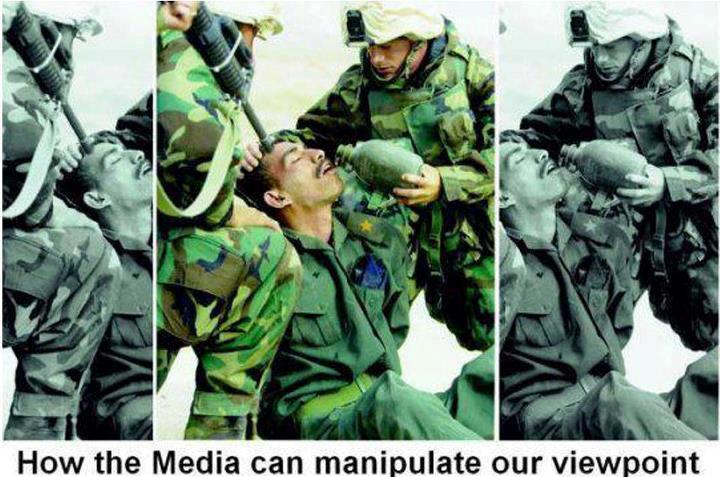
On a technical level every photographic print or even SOOC jpeg has some level of image processing applied to it during development, whether analog or digital.

On an artistic level: https://toinformistoinfluence.files.wordpress.com/2012/06/19...
Re:How iOS 13 redraws your eyes so you're looking at the camera by LocalH on Wednesday July 03, 2019 @08:47AM (#20343819)
I see no philosophical difference between adjusting in-camera settings (aperture, focus, white balance) and this. In both cases, you're modifying the "feel" of the image (in fact, with preprocessing, you're generally affecting the image in a wholesale manner).

Digital cameras don't "capture reality", either. They scan the image over a small period of time, same as your average display in reverse. It's essentially a really fast time lapse, on the pixel level. Arguably, that's as much "not reality" as what Apple is doing here.

I mean, I guess I understand the idea of "capturing reality as close as possible". I just don't see much merit in caring too much outside of an academic context. This isn't deepfakery. This is shifting eyes to provide the much needed feedback of eye contact while on a video call.

Re:How iOS 13 redraws your eyes so you're looking at the camera by drdeca on Wednesday July 03, 2019 @10:16AM (#20344455)
There is certainly something about reality that cameras reflect, namely, that looking at the images they produce results in an approximation of seeing what one would see if one’s eye was where the camera was.

I suppose that goes without saying, seeing as that is sorta what cameras are (well.. many cameras. The central examples of cameras. IR cameras don’t quite have this property, but you know what I mean.), but sometimes it is “necessary to state tautologies” (though this isn’t a tautology exactly).

A linear representation of a group needn’t distinguish between every pair of group elements for me to say that it “captures” some aspect of the group.

Re:How iOS 13 redraws your eyes so you're looking at the camera by jrochkind1 on Wednesday July 03, 2019 @10:15AM (#20344452)
"But it captures the light coming in. So far we called any post-processing which changes that reality either a filter/effect or a bug."

No, even analog photography, choices in developing certainly effect how the "light coming in" turns into a picture. As well as the particular camera used, and it's settings (aperture, ISO, shutter speed), and the film chosen.

The choices the digital photography system makes are no less choices with effects on the "captured light" than the ones made after you get bits out of the camera. They're just choices made by the engineers who designed the digital camera. There is no single 'true' way to "capture light".

> When a photographer chooses a particular brand or type of film, he’s already deciding what kind of reality he wants to show. Different types of film show reality and colors differently. Photographers pick film based on what they want the result to look like. Film photography never ever showed reality, not even close.

https://www.theworldaheadofus.com/blog/photography-does-not-...

> But despite the presumption of veracity that gives all photographs authority, interest, seductiveness, the work that photographers do is no generic exception to the usually shady commerce between art and truth. Even when photographers are most concerned with mirroring reality, they are still haunted by tacit imperatives of taste and conscience… Although there is a sense in which the camera does indeed capture reality, not just interpret it, photographs are as much an interpretation of the world as paintings and drawings are. Those occasions when the taking of photographs is relatively undiscriminating, promiscuous, or self-effacing do not lessen the didacticism of the whole enterprise. This very passivity -- and ubiquity -- of the photographic record is photography's "message," its aggression.

http://www.susansontag.com/SusanSontag/books/onPhotographyEx...

But I don't actually disagree that there is something new going on lately with new kinds of digital processing. I don't think it's "all the same" exactly, we definitely have new techniques of altering and manipulating photos that give us SO MUCH more power than we had before, that I think it's reasonable to say it's a new thing.

But the original photographs never "captured reality" without intervention or manipulation. A photo is necessarily an intervention and a manipulation, in a variety of different ways. A photo never truly "captured reality" in an objective sense, it always depended on the photographer's choices, and the details of the technology used, in ways that mattered for what was perceived in the photo. But yeah, we have whole new orders of magnitude of it available, I'd agree.

Re:How iOS 13 redraws your eyes so you're looking at the camera by gok on Wednesday July 03, 2019 @09:18AM (#20344018)
Do you have the same complaint about automatic red-eye elimination?
Re:How iOS 13 redraws your eyes so you're looking at the camera by sshanky on Wednesday July 03, 2019 @11:52AM (#20345375)
Red-eye is induced by the flash and was never part of the reality being captured.
Re:How iOS 13 redraws your eyes so you're looking at the camera by chillacy on Wednesday July 03, 2019 @04:54PM (#20348681)
1. Engineering constraint: the camera is not as sensitive to light as humans

2. Workaround: it emits a flash which creates an undesirable side effect

3. Fix: we clean up in software

Is like?

1. Engineering constraint: The camera can't be positioned behind the LCD panel the user is actually looking at

2. Workaround: it's placed 1 inch above which creates an undesirable side effect

3. Fix: we clean it up in software

---

In both cases we get closer to where we'd be if the engineering constraint did not exist.

Re:How iOS 13 redraws your eyes so you're looking at the camera by estebank on Wednesday July 03, 2019 @01:31PM (#20346487)
What is your opinion on the selfie wide angle correction Android does for faces? https://people.csail.mit.edu/yichangshih/wide_angle_portrait...
Re:How iOS 13 redraws your eyes so you're looking at the camera by jasonmp85 on Wednesday July 03, 2019 @12:45PM (#20346047)
> But yes, it crosses the line where it's no longer a camera (as a feature, it does not capture reality)

This is incredibly funny.

Re:How iOS 13 redraws your eyes so you're looking at the camera by LocalH on Wednesday July 03, 2019 @08:16AM (#20343594)
Reality perception is subjective. Thus there is no true way to "capture reality".