I think you're making 2 mistakes:
- first, thinking that the line is between what we think of as normal camera usage, and eye correction & deep fakes. But the image that we see now is already a result of image correction—white balance, exposure, lens adjustments, and and more secret processing that we don't even get told about.
- second, that it's a hard line. The possibilities aren't "no adjustment whatsoever" and "deepfakes". It's a gradient; there are minor adjustments (like white balance), moderate adjustments (like eye correction), and even greater adjustments (like deep fakes). It's not a hard line line at all. Eye correction is much closer to reality than deep fakes, and a lack of eye correction is closer to reality still.
CCDs are just stupid light buckets and the reality of them is, at best, a spreadsheet showing those counts. Everything beyond that is a choice someone made to present things a certain way.
And everything before the photograph is taken is that way too. Framing, exposure time, time of day, choice of subject... etc. all influence the “reality” captured in the photograph.
Half the reason you probably think they capture reality in the sense you mean is because photographers not shooting for Instagram generally try very hard to make it appear that way. But... they don’t.
On an artistic level: https://toinformistoinfluence.files.wordpress.com/2012/06/19...
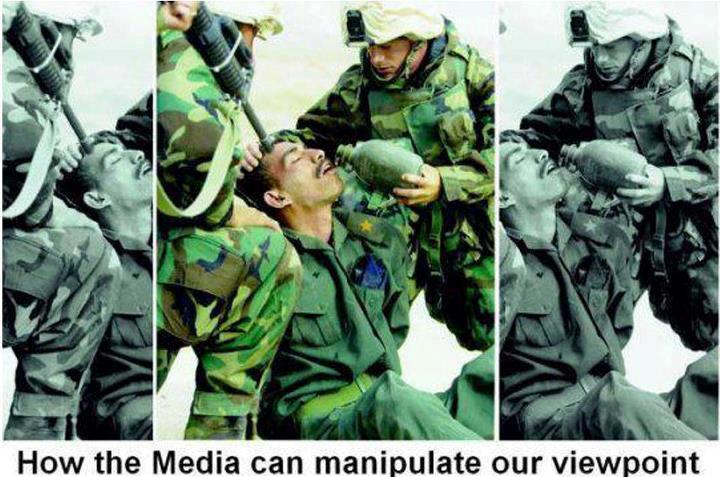
Digital cameras don't "capture reality", either. They scan the image over a small period of time, same as your average display in reverse. It's essentially a really fast time lapse, on the pixel level. Arguably, that's as much "not reality" as what Apple is doing here.
I mean, I guess I understand the idea of "capturing reality as close as possible". I just don't see much merit in caring too much outside of an academic context. This isn't deepfakery. This is shifting eyes to provide the much needed feedback of eye contact while on a video call.
I suppose that goes without saying, seeing as that is sorta what cameras are (well.. many cameras. The central examples of cameras. IR cameras don’t quite have this property, but you know what I mean.), but sometimes it is “necessary to state tautologies” (though this isn’t a tautology exactly).
A linear representation of a group needn’t distinguish between every pair of group elements for me to say that it “captures” some aspect of the group.
No, even analog photography, choices in developing certainly effect how the "light coming in" turns into a picture. As well as the particular camera used, and it's settings (aperture, ISO, shutter speed), and the film chosen.
The choices the digital photography system makes are no less choices with effects on the "captured light" than the ones made after you get bits out of the camera. They're just choices made by the engineers who designed the digital camera. There is no single 'true' way to "capture light".
> When a photographer chooses a particular brand or type of film, he’s already deciding what kind of reality he wants to show. Different types of film show reality and colors differently. Photographers pick film based on what they want the result to look like. Film photography never ever showed reality, not even close.
https://www.theworldaheadofus.com/blog/photography-does-not-...
> But despite the presumption of veracity that gives all photographs authority, interest, seductiveness, the work that photographers do is no generic exception to the usually shady commerce between art and truth. Even when photographers are most concerned with mirroring reality, they are still haunted by tacit imperatives of taste and conscience… Although there is a sense in which the camera does indeed capture reality, not just interpret it, photographs are as much an interpretation of the world as paintings and drawings are. Those occasions when the taking of photographs is relatively undiscriminating, promiscuous, or self-effacing do not lessen the didacticism of the whole enterprise. This very passivity -- and ubiquity -- of the photographic record is photography's "message," its aggression.
http://www.susansontag.com/SusanSontag/books/onPhotographyEx...
But I don't actually disagree that there is something new going on lately with new kinds of digital processing. I don't think it's "all the same" exactly, we definitely have new techniques of altering and manipulating photos that give us SO MUCH more power than we had before, that I think it's reasonable to say it's a new thing.
But the original photographs never "captured reality" without intervention or manipulation. A photo is necessarily an intervention and a manipulation, in a variety of different ways. A photo never truly "captured reality" in an objective sense, it always depended on the photographer's choices, and the details of the technology used, in ways that mattered for what was perceived in the photo. But yeah, we have whole new orders of magnitude of it available, I'd agree.