Imagine the reverse: a deflationary currency, which becomes more valuable over time. You would have little choice but to hold on to your wealth to avoid missing out on the gains. Why would you spend your money building a business or hiring workers? That would be a losing proposition compared to keeping a bank account which grows if it just sits there. Deflationary circumstances were, in fact, what precipitated the great depression.
2% is a gentle nudge to participate in the economy.
This is addressed and elucidated in the linked article.
This describes the U.S. dollar from 1870-1890, but this was hardly a time of economic and technological stagnation:
https://en.wikipedia.org/wiki/The_Great_Deflation
https://en.wikipedia.org/wiki/Second_Industrial_Revolution
Far from people holding on to their wealth to avoid missing out on the gains, they invested it heavily to avoid missing out on even bigger gains from being part of the technological revolution happening around them. Deflation was then a consequence (rather than a cause) of the economic growth that followed: with a constant money supply but more goods available for purchase, the price per good steadily fell.
But you still have some people hoarding currency because some people have different levels of risk tolerance. One person is willing to build a factory at great risk because there is even greater reward. Another person says give me the steady returns from hoarding deflationary currency.
Getting rid of those returns pushes that person back into the market, requiring them to do something productive with their money instead of just sitting on it. Which is all the more important when there are many productive things to do with it. So the deflation caused growth to be less than it would have, e.g. 15% instead of 20% (in real terms), even if it wasn't enough to turn negative. But it was still a reduction.
And what happens when the economy is only growing at a normal pace and you introduce a deflationary currency?
The gold-backed dollars of 1873 suffered this attack in two waves. The first was the Free Silver movement of 1892 [2], which sought to allow free coinage of silver currency as a way to create inflation and lower debt burdens for poor farmers who were being exploited by the Northeast's industrial-financial establishment (sound familiar?). This ultimately failed, although it did manage to inspire The Wizard of Oz [3].
The second was the steady inflation of Federal Reserve Notes (i.e. the dollar) from 1914 onwards. This culminated in EO 6102 [4], which made it a crime to privately own significant quantities of gold. Someone who faithfully hoarded gold coins from 1873 onwards would've done great until 1900, okay until WW1 ended, found themselves in the odd position of having money that was worth more on the black market than as legal tender (much like American Eagle gold coins have a face value of $50 today but a market value of about $1200), and then been forced to turn in their gold coins for their face value (effectively confiscating their assets at a loss) in 1933.
[1] https://en.wikipedia.org/wiki/Gresham%27s_law
[2] https://en.wikipedia.org/wiki/Free_silver
[3] https://en.wikipedia.org/wiki/Political_interpretations_of_T...
(This, too, is addressed in the linked article).
I think that Bitcoin already has failed as a currency, outside of black markets. However, that won't stop it from having value: gold failed as a currency in 1933, but is currently worth $1300/oz. I think we'll see another 1-2 Bitcoin bubbles, each with peaks significantly higher than the rest as Bitcoin are taken out of circulation, until it finally falls to Gresham's Law.
I also think that conditions are extremely ripe for a currency crisis in the U.S. dollar within the next 5-10 years. There is a market now for a new currency, as evidenced by the ~3700 contenders (just in crypto alone, not counting in-game currencies for video games or mobile payment networks) launched within the last 2 years. I suspect the eventual winner will be an inflationary cryptocurrency that solves the scaling issues and has a pretty (and fast) UI. Could be Ethereum if they get their act together with Casper, or could be something yet-to-be-invented.
Yes, because gold is a commodity, not a currency.
In fact, if you treat gold as a metal with utility similar to copper, but scale the price of copper proportionally to gold's scarcity, you get a price that is very in line with the actual current price of gold. Since copper's value comes almost entirely from its utility as a metal, this suggests that something similar is true of gold.
That aside, comparing bitcoin to gold makes bitcoin look bad in multiple ways: The analogy is not good, and even if it were good, that would still be a bad thing. The linked article talks about this.
> I suspect the eventual winner will be an inflationary cryptocurrency
Almost certainly impossible. Proper active currency management requires anticipating the public's reaction to the management. Even if an algorithm could do that (in other words, a strong AI which is at least as good as people at understanding human psychology), if the algorithm were public, the public could/would use the algorithm to anticipate changes in currency policy, and that knowledge of the future would change what they do with their money, specifically in the direction of instability. So an open algorithm (a fundamental philosophy of crypto) is fundamentally at odds with the very notion of an actively managed money supply. The linked article talks about this too.
Isn't the bitcoin block reward a form of inflation? Of course the block reward shrinks over time and eventually only transaction fees will be used to pay miners but there is no reason this has to happen. If the block reward instead increased by 2% every year inflation could last forever.
To maintain fixed inflation, the supply would have to be actively managed (and I assumed that's what was meant).
Why?
> There is a market now for a new currency, as evidenced by the ~3700 contenders (just in crypto alone, not counting in-game currencies for video games or mobile payment networks) launched within the last 2 years.
That is a stretch. Almost none of these currencies are legal tender, anywhere. There is a lot of scams, pump 'n dump, in this world.
I do agree there are valid purposes. Though those are not necessarily legal.
The black market and international market for example. Something like Monero can be used for sketchy business. It can be used to avoid taxes, to pay for drugs, and to get rid of a weak currency.
For me, a European utilizing EUR and staying in legal waters, no it isn't interesting...
1. Rising indebtedness, both private and public, and concentrated asset ownership. Debtors have an incentive to favor money creation and inflation because it reduces the value of their debt in real terms; creditors have an incentive to favor the opposite. When a small number of creditors hold the loans of a large number of debtors, or when the government itself is a major debtor, there are significant democratic pressures toward monetizing the debt. (Berkshire Hathaway annual reports talked extensively about this in the late 90s and early 2000s and still sometimes do, though Buffett believes this will happen through gradual inflation rather than a crisis.) We've already seen some of this with the political pressures on Janet Yellen and Jerome Powell this tightening cycle.
2. A large injection of money through QE that has so far stayed in capital markets and not made its way to every-day transactions. One of the great mysteries of the 2010s is why the large increase in the money supply did not cause inflation. My explanation for that is that it did - but only in asset markets, like stocks, unicorn startups, CA real estate, Bitcoin, etc, because that is what the people who had money chose to buy with it. This is viewed as wealth inequality rather than inflation. If you fix the wealth inequality - either by government redistribution or by rich people finally choosing to consume rather than invest - you will get the inflation, and may get it very rapidly.
3. Historical perspective: once inflation pressures start, they are very difficult to control, and usually result in a feedback cycle where expectations of future inflation cause people to get rid of their cash more quickly, which makes the velocity of money rise, which makes inflation even worse.
4. General loss of trust in institutions, particularly the financial industry, the government, and the Federal Reserve. Obama's actions in 2009 basically saved us from a total financial meltdown. It did so at the cost of trust - there's now a widespread (and not entirely unjustified) belief that the system is rigged against the common person, because when they make dumb financial decisions they're on the hook for it but when Wall Street makes dumb financial decisions the government bails them out.
5. Greater information awareness - thanks to the Internet - and also the rise of filter bubbles, again thanks to the Internet. The former exacerbates the loss of trust in institutions. The latter allows people who have lost trust in existing institutions to start forming their own, and to recruit other people towards their point of view. Together, they create competition where hegemony previously reigned.
6. The rise of potential technological alternatives. Bitcoin sucks as a currency - it takes 11 minutes to confirm a transaction, the UI is bad, fraudsters and scammers abound, and the network is limited to ~7 TPS. However, all of the elements of a functioning currency are there. People do trust it to maintain its value - 10 years in and people have lost individual Bitcoins through failing to secure their private key or entrusting them to the wrong exchange, but the network itself has never been compromised or rewritten. It's possible (though clunky) to transfer value with it. It's possible to maintain stable identities and records of ownership. Efficiency and ease-of-use can be fixed, and the fundamentals are there.
7. The potential need, in the near future, for computers to act as economic agents on their own behalf without human intervention. Services like Ethereum, Iota, Golem, and Filecoin are fascinating here. It may be that cryptocurrencies end up being foremost for machines to transact in and only incidentally for humans.
If you want to look at the total timespan of human economic history, the only economic systems that have proven stable over millenia are feudalism and slavery. Democratic capitalism (and particularly post-WW2 democratic capitalism in America, which is even more of an outlier) is a comparative blip on the timeline. We don't live in the 1300s, though; we live in 2019, and so it's worth considering how our present time differs from previous epochs and how it might share similarities with some.
Incidences of short-term (1-2 year) periods of deflation have been common, and strongly associated with recessions either concurrently or within roughly 18 months. That link is uncontroversial. Over the long term (10+ years) the connection seems a lot more tenuous, though. The monetary contraction and subsequent recession of 1921 was followed by the Roaring Twenties. Volcker's recession in 81-82 was followed by robust growth throughout the 80s and 90s. Ireland's deflationary episode in 2009 was followed by a return to growth. The U.S. periodically had deflationary episodes and sharp recessions throughout the 1800s, but economic growth was quite strong over the century as a whole.
Actually, looking at those incidents is a strong argument for dynamism and technological determinism. Deflation was a large problem in periods where there was no up-and-coming growth industry to absorb surplus labor and liquidated capital. It was a non-event when there were growth opportunities where these factors could be re-deployed. The lack of growth wasn't caused by deflation, it was caused by overly rigid mature industries and an inability to find new ways of doing things that are worth investing in.
Whether it is a bug or a feature depends on whether it favours you or not. Anyone who owns assets and pays wages would think it is Christmas every day of the year. If nothing changes, they draw ahead without needing to do anything.
> Imagine the reverse: a deflationary currency, which becomes more valuable over time. You would have little choice but ...
No, I'd do exactly what I do now and invest the money in things that grow faster than the value of the currency. Nobody would care that the currency is deflating at 2% p.a. if there is 5% to make in the stock market.
The value of having a consistent measuring stick to figure out what is going on without constantly having to twiddle numbers for inflation would be a remarkable boon.
> Why would you spend your money building a business or hiring workers?
That one is an easy one, because people generally value present consumption and would give you money in exchange for goods and services. As a business owner you have a chance of ending up with more money than you started with.
Reading between the lines, "it means your money is going to go to fund the activities of the rich". Perhaps we shouldn't be surprised that the delta between the working class's wages and productivity has been increasing since the Nixon shock.
You are essentially communicating the same thing that the crypto nerds are saying, just from a different angle. The individual pays the 2% "nudge", and crypto people don't prefer paying that, and that's why they use crypto. Whether it is good for society or not is irrelevant in the individuals context.
Only if you a) keep your money in cash under your mattress and b) aren't also benefiting from having your debts reduced by inflation.
It's very simplistic to say that (low, predictable) inflation hurts individuals.
This affects poorest members of society disproportionately because they don’t have spare capital to allocate in order to offset their loss from inflation. They just pay higher prices.
Because the $10 mil in stocks also appreciated by the roughly 7% average annual S&P 500 returns, meaning the rich person's wealth still increased 5% after 2% inflation.
The $10,000 in a current account earned 0.5%, making the poor person 1.5% poorer after inflation.
It's a textbook case of 'the rich getting richer, and the poor getting poorer'.
The poor do not have the flexibility to allocate their capital to higher yield assets that allow them to 'escape' inflation.
I am not advocating a fringe position. In fact, the first three papers I found investigating this issue came to the same conclusion: inflation actually increases poverty:
[1] "Inflation and the Poor" https://www.jstor.org/stable/2673879?seq=1#page_scan_tab_con...
[2] "Poverty, inflation and economic growth: empirical evidence from Pakistan" https://mpra.ub.uni-muenchen.de/34290/1/MPRA_paper_34290.pdf
[3] "Has Inflation Hurt the Poor? Regional Analysis in the Philippines" https://www.adb.org/sites/default/files/publication/28370/wp...
Those without without debt are also losing, less than those with debt, but still losing.
Only people winning are the people with enough spare capital to 'participate'
Hurting might be the wrong term. Analogy would be something like having some bonus card which gives you 2% off for every purchase. Some people obsess about having that kind of card, but most people wouldn't care, because it is only 2%. Obviously the 2% difference isn't "hurting" most people, more like very small tax.
Btw there are cashback credit cards which give back something like 0,5% to 1%, I wonder how popular those are...
I think that's what the child poster meant by bug. It's artificial and still: Why?
Mankind came to what it is 99.9% of time without artificial devaluation.
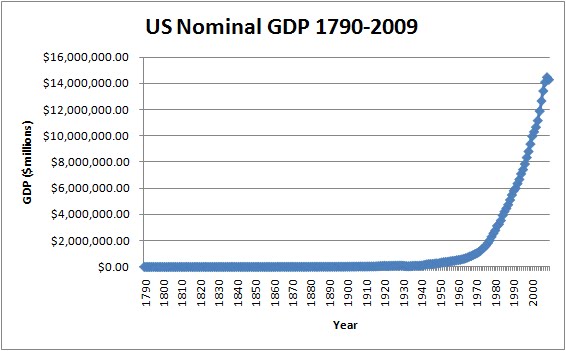
Because productivity was practically constant for this 99.9% of human history. Therefore the monetary base could be practically constant, too. With the industrial revolution, growth became obviously exponential.
Have a look at the following graph (nominal GDP):
http://3.bp.blogspot.com/_VO-2HbQsbSU/S9BbLF6MxBI/AAAAAAAAAR...
Or this one (real gdp):
https://ourworldindata.org/uploads/2013/11/GDP-per-capita-in...
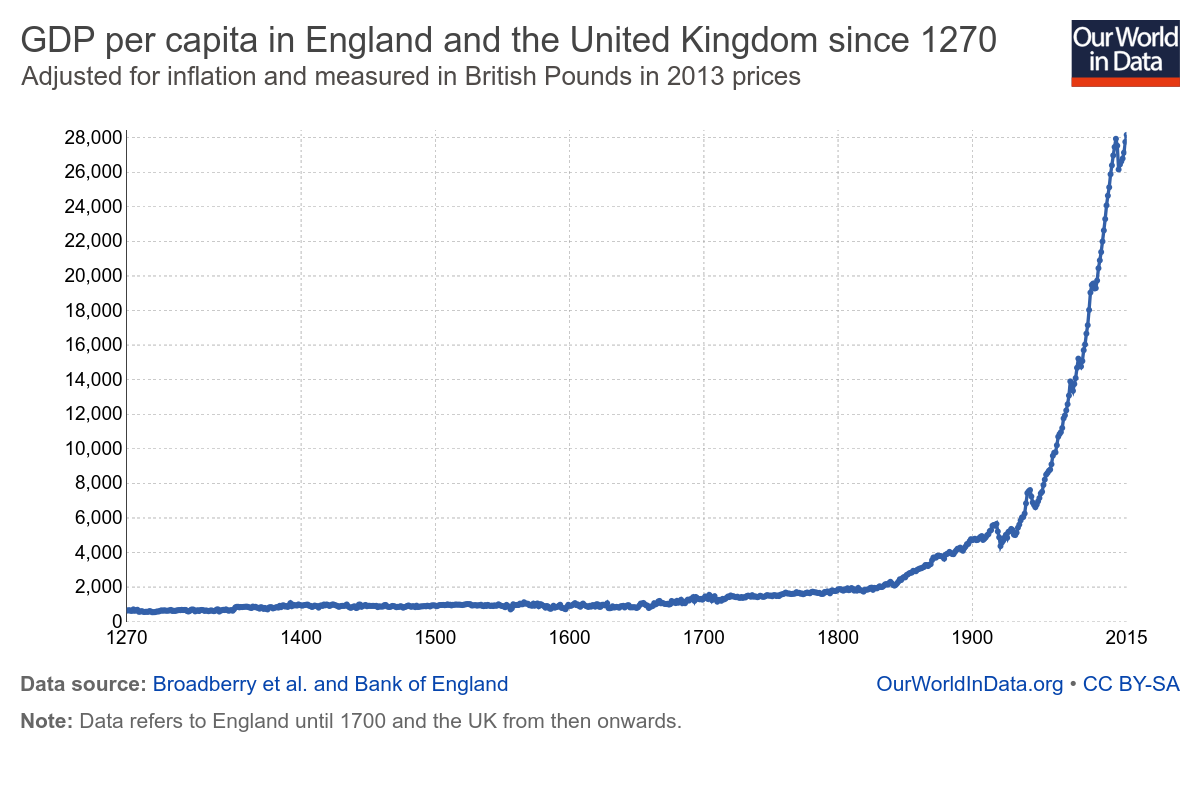
Inflation means the value of money stays coupled to the changes in GDP, just as in the millenia you apparently value for exactly this constant money <> gdp relationship.
Mankind came to what it is 99.999% of time without antibiotics too.
Arguments like this are rarely constructive.
It makes sense, really. Why should finding a old penny under the floorboards, nearly worthless when it was minted, make you rich?
With inflation those who get a 2% pay raise stay where they are and those who have wealth lose some and are incentivized to turn it into income which eventually becomes a pay raise.
With deflation people are incentivized to turn their income into wealth which means less pay raises. Meanwhile those who have wealth gain some without doing anything.
I expect most people on HN wouldn't really struggle with that, but that is because this is a forum infested with scientists, engineers, businesspersons and financiers. Most people won't be able to grasp that being paid $100/hr 5 years ago and $105/hr today means they have taken a pay cut. They would struggle to correctly calculate what the break-even rate would be.
Currency doesn't measure wealth consistently, and makes a terrible measuring stick. That is a great analogy to take literally - most of the developed world cuts 2% off our monetary measuring stick per annum as a matter of policy. or people who aren't unusually interested in maths and finance (ie, most people) that is highly confusing, because they set their expectations then think that somehow they are getting ahead if they get a 1-2% pay raise.