Well, there's your problem right there. Expecting three figures for a single season of anything is just pure madness.
Yes, this means if a show lasted more than 5 to 7 seasons I expect a discount on the remastered version!
How many people bought an entire season for that price is another matter, but that was the asking price.
  US release: Jan 95
  UK VHS release: Jun 95
  UK TV release: Sep 96
http://www.ex-astris-scientia.org/observations/tng-r-changes...
1) Throw the top/bottom parts of the frame away
2) Stretch the frame
Neither is acceptable.
Japanese DVDs/Blu Rays for Anime sell for upwards of $40 and usually only include around 4 episodes.
"What if we go over budget?"
"Does this mean they 'own' any rights to the remaster?"
It's possible ML could help with a lot of that, but the budget just isn't there.
While it was shot on film, the effects weren't, each has to be created again, not just the external scenes like the Defiant shooting something, but scenes like Odo morphing
Here's a comparison picture of the DVD vs film quality though
https://i.kinja-img.com/gawker-media/image/upload/rlppv8gs4m...
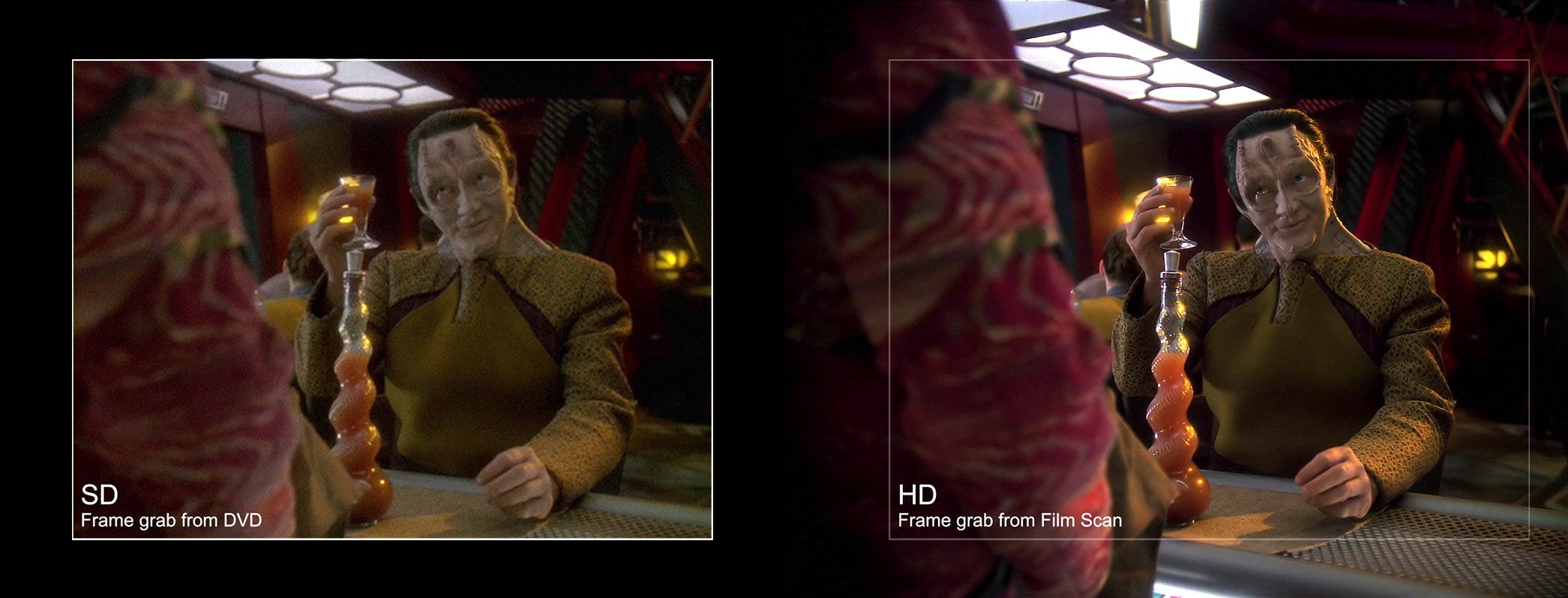
[edit]
On second thought, considering the shirts that Jake wore on the show, it's probably better for the world that we don't have the higher vibrancy film version.,,
Remember that those who do a lot of video call NTSC "Never The Same Color"
The technician over at the film lab would receive the film every day and run it through the development solution. As the image formed on the film, he kept saying to himself, ‘My God, this woman is green!’ And so he kept correcting the film developing process in order to turn her back to normal skin color again!
"Imagine everyone’s surprise, upon viewing the developed film the next day, to find the actress’ face just as normally pink skinned as ever! There was no trace of green."
The problem is they'd devolve into various camps bickering about the "right" way to do it, creating their own mini standards bodies, and forming a massive internal bureaucracy of tribalism.
It seems the more passionate a group of people is about something, the more convinced they are that they know the right way to do things.
This is Star Trek we are talking about. Their fans are dead serious.
(I bought individual TNG remaster seasons as they came out specifically to support the remaster effort.)
It means they charged at a level where sales volume times net (after variable costs) price per unit was insufficient to cover fixed costs.
But whether that's because they charged too much (variable costs for the disc sets were a small fraction of the price; it's quite possible they would make more profit with higher volume and lower price), too little (maybe the people willing to pay as much as was charged would have paid even more), or either would have worked and they priced in an unprofitable valley, or neither would have worked is speculation.
It makes sense to price high to get maximum returns from the users who must have it now, and then catch everyone else later with lower priced offerings.
It makes cultural, or creative, sense to release the footage at cost and let people remix and use it for whatever purposes.
The profit for the show was already made, it should be public domain by now.
I'd guess from a studio's POV the trade-off is between spending money updating an ancient show in the hope of making a little cash now and a little more from residuals, and making new shows which are more or less guaranteed to bring a profit.
But that aside, I'm not sure there's any way to make something like Star Trek public domain. Never mind the studio - the actors, writers, and producers will still be relying on residuals for continuing income.
And even if that weren't true - what exactly do you make public domain? You can't just hand out the original unedited film stock to anyone who asks for it. How about the scores for the music? Or the audio mix files? Or the EDL? Or the various revisions of the scripts? Props? Set carpentry - if there's any left? Wiring?
Reality: very few elements are digital files that can be copied/shared, even if you wanted to allow the public to copy/share them.
The situation is that the studio could do work on the footage to make it releasable, then sell the processed footage for profit.
The argument is that the processing of the footage makes it too expensive to do this, the studio might make a loss.
So, all the IPR, releases and such need to be in order for it to be possible to release the processed footage.
It's possible there is contractual obligation preventing release of rushes and other unfinalised footage, but it seems highly unlikely. I'd imagine the studio have rights to publish anything, thus enabling "making of" and "blooper reel" type videos.
So, if it's possible to arrange the IPR for the processed footage, then it's close to certainty that there's no IPR limitation on releasing the unprocessed footage.
Meaning finances are the only remaining issue.
Sure, the studio may not want to spend the money up front to arrange release of the footage; but that is likely to be primarily to avoid fan works based on the footage from competing with their own outputs.
>You can't just hand out the original unedited film stock to anyone who asks for it. //
You could hand it to an archive for digitisation and give them rights to sell it at cost. Or, burn it. Or leave it in a canister to degrade until it's unusable.
>How about the scores for the music? Or the audio mix files? Or the EDL? Or the various revisions of the scripts? Props? Set carpentry - if there's any left? Wiring? //
Well, IPR aside, why not. If you're paying to keep the set in storage, why not give it away and save your storage costs and get on with making new sets that are going to be used?
Primarily however, we the demos should be taking the question of what to do with unneeded IPR away from the studios. Make copyright terms shorter to match patent terms.
IAE, I can understand the reasons something upscaled is all we’re ever likely to see of DS9 or Voyager. Primarily that as soon as CGI became the dominant effects technology, the frequency of use went way up, and all those scenes would require non-trivial reconstruction.
As I noted in another comment, many of the effects artists from DS9 and Voyager have their original meshes and scene files, and some have posted insanely high resolution files on their blogs. It would be a frustrating effort to gather all of this, but arguably, CBS already owns the works in question, so compensation for retrieving these would be minimal probably, and the quality of the work done for the series was more than adequate if re-rendered in HD.
When I saw the submission title I was actually hoping re-creating the out of shot image data is what the ML was being used to do.
Some TV networks have aired a 16:9 version of TNG (as well as an upscaled Voyager and DS9) but they just zoomed and cropped. There wasn't anything smart going on.
Once they have manually scanned all those pieces, surely they can let machine learning edit together each episode again?
Then try to color balance (when the original information isn't there),
If you get ML to do that, congratulations, you'll make a fortune in the production industry.
No, we've long had the technology to solve most of this. Clip correspondence is content based image retrieval across a database of keyframes. Matching framing and position is an image registration problem (feature correspondence). Color balance seems like an almost trivial problem if you've solved the other ones, because the information _is_ there -- just modify each channel to match the histogram in the lower resolution image [1]
The challenge is that earlier stages in the pipeline need to be robust to inexact matches, and we don't want to rely on absolute color or pixel position. But I don't think that should be insurmountable for a slightly creative implementor - use local variation in color, gradient descriptors, pull in the motion vectors for an additional channel, etc...
Sure, you could go down the deep learning path by trying to reduce scenes to bags of labeled objects and semantic actions but that's bringing a water cannon to a squirt gun fight, which only makes sense if Google is giving you a free water cannon.
I'd probably try it if I really thought there was a fortune to be made here, but it's such a niche application. When something hasn't been done yet, there's usually a good economic reason, unfortunately.
1. First Google result for "histogram matching color balance": https://blog.mapbox.com/color-balancing-imagery-with-histogr...
Of course, the quality won't be as good as something done by a professional, but the question is that since we don't have a HD DS9, whether the version produced by an automated system is noticeably better than what we have.
If you're aiming for network TV quality you can probably do an episode for $5k though.
Of course that's from scratch. The trouble is that using the original video as your source will have lost a lot of data, and that means making a lot of judgement calls about what the scene is meant to be doing, so you're not much nearer.
Where, precisely, did that number come from? It doesn't happen to include marketing, does it?
"Essentially, for the HD release of Star Trek, all people had to do was scan each episode. For The Next Generation, they would have to scan all those original pieces of film and then edit together each episode again, themselves. It’s more difficult, more expensive, and much more time-consuming.
"Unfortunately, it wasn’t actually worth it. Sales of the extravagant TNG remaster—original retail price $118 for just season one—failed to reach CBS and Paramount’s expectations. A similar process would have to be done for both DS9 and Voyager—and would actually be even harder."
https://io9.gizmodo.com/the-detailed-depressing-reason-deep-...