3JPLW
Re:Julia 1.6 Highlights
on Thursday March 25, 2021 @05:51PM (#26585900)
Is your home folder on a network drive?
Re:Julia and the satellite Amazonia-1 (2020)
on Thursday March 25, 2021 @04:09PM (#26584780)
That same format string is used in multiple places, and unfortunately I don't think the text engine they expose to us is smart enough to do the ordinal 1st 2nd 3rd thing.
Edit: oh, we can do that. Changed experimentally.
Re:Julia 1.6 Highlights
on Thursday March 25, 2021 @03:07PM (#26584114)
The problem is a minor placement issue for the `@simd` macro: https://github.com/kostya/benchmarks/pull/317
Re:Julia and the satellite Amazonia-1 (2020)
on Thursday March 25, 2021 @11:37AM (#26581569)
As an administrator at Julia's discourse, I'd be really curious if this was the reason. Discourse's default "short date" format is super problematic. By default, they display something from 5 days ago as `Mar 20` and something from a year ago as `Mar '20`. We've changed that to have the year+ old posts display as `Mar 2020`, but maybe we should also change the recent display to be something different; maybe `20 Mar`? The UI doesn't give us too much space, unfortunately.
Re:Julia 1.6 Highlights
on Thursday March 25, 2021 @10:57AM (#26581071)
The feature I'm most excited about is the parallel — and automatic — precompilation. Combined with the iterative latency improvements, Julia 1.6 has far fewer coffee breaks.
Re:“Is Parallel Programming Hard, and, If So, What Can You Do About It...
on Tuesday March 23, 2021 @09:38AM (#26554806)
A thread from 2020 (v2 RC 1): https://news.ycombinator.com/item?id=22030928
2015: https://news.ycombinator.com/item?id=9315152
Re:U.S. senators reintroduce bill to make daylight saving time permanent
on Wednesday March 10, 2021 @04:42PM (#26416645)
Benefits are highly regional. Where I live, the current latest sunrise is 8:06 am on December 5. I can't imagine a sunrise after 9am being very fun.
Re:An open-source AirPlay mirroring server for the Raspberry Pi
on Thursday February 04, 2021 @05:16PM (#26030431)
Yeah, you (used to?) be able to do multi-room audio with the original Airplay, but it was only supported from Macs. iOS did not support it.
Re:Weave.jl – Scientific Reports Using Julia
on Thursday February 04, 2021 @02:45PM (#26028998)
Lots of the sciml.ai packages and documentation use Weave — you can look there for some examples. Here's one:
Re:If memristors act like neurons, put them in neural networks
on Thursday January 28, 2021 @12:15PM (#25945092)
I encourage folks to actually read the linked article instead of basing their commentary on the shoddy title.
https://www.nature.com/articles/s41928-020-00523-3
Abstract:
> Resistive memory technologies could be used to create intelligent systems that learn locally at the edge. However, current approaches typically use learning algorithms that cannot be reconciled with the intrinsic non-idealities of resistive memory, particularly cycle-to-cycle variability. Here, we report a machine learning scheme that exploits memristor variability to implement Markov chain Monte Carlo sampling in a fabricated array of 16,384 devices configured as a Bayesian machine learning model. We apply the approach experimentally to carry out malignant tissue recognition and heart arrhythmia detection tasks, and, using a calibrated simulator, address the cartpole reinforcement learning task. Our approach demonstrates robustness to device degradation at ten million endurance cycles, and, based on circuit and system-level simulations, the total energy required to train the models is estimated to be on the order of microjoules, which is notably lower than in complementary metal– oxide–semiconductor (CMOS)-based approaches.
Re:Again on 0-based vs. 1-based indexing
on Wednesday January 20, 2021 @09:23AM (#25846742)
> No, it mostly affects execution time.
Citation needed. Yes, the -1 appears in the source code. It might even appear in the intermediate representation. It'll even show up in the assembly for multidimensional arrays (but it'll all get folded into a single `mov` assembly for vectors).
But I dare you to actually demonstrate a performance difference. Compared to a memory access, a `dec` is free.
Re:Rust 2021 Roadmap
on Friday December 18, 2020 @01:07PM (#25469981)
Or how about just waiting until it gets merged and officially adopted?
Re:Super-spreading wedding demonstrates Covid-19 risk posed by holiday...
on Monday November 23, 2020 @03:44PM (#25191592)
From that study:
> Limitations: ... no assessment of whether masks could decrease disease transmission from mask wearers to others.
This has always been the main motivation for mask wearing, but the study you cite didn't attempt to answer it.
Re:2020 Mac Mini – Putting Apple Silicon M1 To The Test
on Tuesday November 17, 2020 @11:51AM (#25125967)
Yeah, but this is a laptop chip at ~20W. Of course it's not going to compete with a 16-core 120W monster.
Getting 1/4 of the performance with 1/4 of the (high perf) cores and 1/6 of the power is very impressive.
Re:Super-spreading wedding demonstrates Covid-19 risk posed by holiday...
on Friday November 13, 2020 @03:52PM (#25087340)
Poor response, as pandemic safety 101 would prevent this:
- wash your hands
- wear a mask
- practice social distancing
- avoid extended periods indoors with non-household members
https://www.cdc.gov/coronavirus/2019-ncov/prevent-getting-si...
Re:Super-spreading wedding demonstrates Covid-19 risk posed by holiday...
on Friday November 13, 2020 @03:44PM (#25087247)
It's not just about protecting you, though. It's also about protecting our limited healthcare resources.
Every year I get the flu shot to protect me, you, and our shared healthcare.
Re:Super-spreading wedding demonstrates Covid-19 risk posed by holiday...
on Friday November 13, 2020 @02:25PM (#25086321)
I'm not "free" to ignore stop signs, stop lights, and speed limits. They impact my freedom to drive as I'd wish -- because otherwise I might hurt you.
I'm not "free" to start cooking commercially out of my home kitchen without inspections and licensing. This impacts my ability to earn an income -- because otherwise I might make you sick.
It's public health risk mitigation. We do it all the time.
Re:Super-spreading wedding demonstrates Covid-19 risk posed by holiday...
on Friday November 13, 2020 @12:22PM (#25084705)
This is a good resource for thinking around limiting transmission risks:
https://english.elpais.com/society/2020-10-28/a-room-a-bar-a...
Re:Super-spreading wedding demonstrates Covid-19 risk posed by holiday...
on Friday November 13, 2020 @12:15PM (#25084568)
This is why speed limits are prudent.
This is why masks and gathering limits are prudent.
Re:Will R Work on Apple Silicon?
on Wednesday November 11, 2020 @12:12PM (#25060257)
Some of the NaN-handling issues are unique, but the compiler availability itself is still a problem.
https://twitter.com/StefanKarpinski/status/12929837172128931...
Since then, GCC has stepped up with this out-of-tree build, but it's still not 100% to my knowledge.
Re:Apple unveils M1, its first system-on-a-chip for portable Mac compu...
on Tuesday November 10, 2020 @05:11PM (#25052725)
Which is likely why there are some "7 core" GPU M1 chips.
Re:When X-Rays were used at the Shoe Store
on Tuesday November 03, 2020 @09:04AM (#24979717)
Especially given this:
> That 1948 study of 43 machines in Detroit showed ranges from 16 to 75 roentgens per minute. In 1946, the American Standards Association had issued a safety code for industrial use of X-rays, limiting exposure to 0.1 R per day.
I'd be curious how much a typical modern dental x-ray emits, but we no longer measure in roentgens these days as we have better measures of the actual dose (sieverts).
Re:When X-Rays were used at the Shoe Store
on Tuesday November 03, 2020 @08:52AM (#24979631)
The proper shoe shouldn't reinforce bad running habits. If you got pushed that way by a one-on-one shoe fitting, you certainly did get "conned."
As someone who has had only one professional running shoe fitting in my life, I found it invaluable. They were able to immediately identify where my stride was going wrong. They advised me not just on the shoe, but on improving my gait. I bought one full-price shoe once, then was able to buy similar shoes on sale/clearance. Following the fitting (and guidance), I've not had the same knee pain since.
YMMV, but it's not all cons. It's a middle-ground between nothing and a full-fledged sports therapy.
Re:The unreasonable effectiveness of the Julia programming language
on Friday October 09, 2020 @11:40AM (#24730977)
BinaryBuilder/BinaryProvider are 100% functional and have been deployed and working for a long time now. The timeframes for individual packages to move to using them instead of ad-hoc build scripts, however, varies. It's generally very quick to do this, but complicated chains of binary dependencies can be a pain.
Re:The unreasonable effectiveness of the Julia programming language
on Friday October 09, 2020 @10:31AM (#24730242)
> I wish they package a standalone Julia IDE
That's precisely what Julia Computing's JuliaPro is. https://juliacomputing.com/products/juliapro
(Full disclosure, I am employed by Julia Computing)
Re:Intel Launches 11th Gen Core Tiger Lake
on Wednesday September 02, 2020 @03:56PM (#24357298)
> it's still shared
Right, that was really my main question: besides the labeling (which is of course approximate), the positioning sure looks like each core would have its own "favorite" section of the cache. And being shared, it seems like this could make for some interesting performance behaviors.
Ah, interesting, this topology was introduced with Sandy Bridge. I'm just out of date: https://www.anandtech.com/show/3922/intels-sandy-bridge-arch...
Re:Intel Launches 11th Gen Core Tiger Lake
on Wednesday September 02, 2020 @03:28PM (#24356974)
I'm talking about this image:
https://images.anandtech.com/doci/16063/474551355-Intel-Blue...

I don't see any coherent fabric blocks — what looks like large cache sections to my eyes are entirely inside the "Core" blocks. Maybe they're just not drawn correctly. Here are some much older i7s, for example:
https://www.cs.uaf.edu/2009/fall/cs441/proj1/russell/images/...
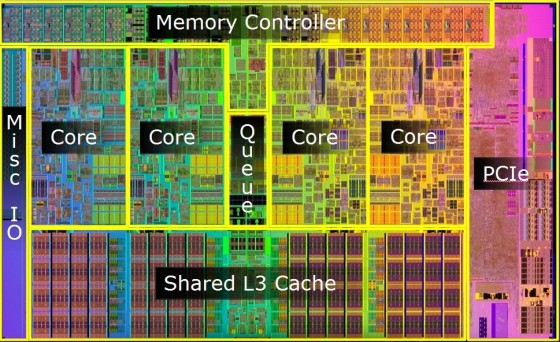
https://www.notebookcheck.net/fileadmin/_migrated/pics/Core_...

Re:Intel Launches 11th Gen Core Tiger Lake
on Wednesday September 02, 2020 @01:51PM (#24355802)
The chip image surprised me: where's the L3 cache? On previous generations, L3 cache was a significant amount of real estate. Is it no longer shared between cores?
Re:Possible detection of a black hole with a mass thought to be imposs...
on Wednesday September 02, 2020 @10:52AM (#24353837)
Yes, that was this event.