News for hackers. Stuff that matters.
Re:USB Type-C to Become More Secure with Authentication Stan... by geofft on Wednesday January 02, 2019 @04:16PM (#18810276)
I do want to be able to plug into public USB PD outlets, other people's chargers, etc. confidently, and there is a legitimate security problem there. Even though it's wired and physically adjacent it isn't necessarily trusted. But that can be done without DRM.
Re:USB Type-C to Become More Secure with Authentication Stan... by warent on Wednesday January 02, 2019 @04:18PM (#18810300)
Even with some kind of authentication that doesn't change the fact that public USB outlets can still be rigged to fry your machine. The likelihood of it is probably incredibly small but I personally still wouldn't use public USB outlets.
Re:USB Type-C to Become More Secure with Authentication Stan... by marcosdumay on Wednesday January 02, 2019 @04:25PM (#18810379)
I can trust a public outlet to not fry my phone. That is simple, if my phone stays functional I'm good, and if it gets fried I take some real world measures (go to small causes court, make a denounce to some government agency) to get compensation.

The real problem on public outlets is with data attacks, not power. If I can set my phone to ignore all the data at the first hardware level, and it is a simple enough level that no attack is viable (that second one being a large "if"), then there is no large problem anymore.

Re:USB Type-C to Become More Secure with Authentication Stan... by warent on Wednesday January 02, 2019 @05:18PM (#18810853)
> That is simple, if my phone stays functional I'm good, and if it gets fried I take some real world measures (go to small causes court, make a denounce to some government agency) to get compensation.

This is much easier said than done (in the US at least.)

First, you'd be looking at at least a year of going back and forth in small claims court and by the end of it still have no guarantee of winning. Even if you did win, there's no guarantee the judge would award you the full amount to pay for your fried device.

It almost certainly would not pay your time at the courthouse though; you can ask the judge for punitive but you cannot include legal expenses in small claims court demands.

In the end you would still be out hundreds or thousands of dollars and numerous hours of your time. That's why to me the tiny benefit of using a public USB outlet is just not remotely worth the risk of such a nightmarish hassle.

Re:USB Type-C to Become More Secure with Authentication Stan... by VectorLock on Wednesday January 02, 2019 @06:16PM (#18811288)
This is the same thing as just plugging into a regular power outlet. You don't know if the thing you're expecting to provide 110v is actually giving you 10,000v.

Then again if things were really bad or malicious you could end up losing your life like Sheryl Aldeguer.

Re:USB Type-C to Become More Secure with Authentication Stan... by userbinator on Wednesday January 02, 2019 @06:32PM (#18811396)
The real problem on public outlets is with data attacks, not power. If I can set my phone to ignore all the data at the first hardware level, and it is a simple enough level that no attack is viable (that second one being a large "if"), then there is no large problem anymore.

My old no-name Android phone (not USB C) has such an option, and searching around it seems to be a reasonably common feature, although not present on all devices. It looks similar to this (mine has the same typo, "USB fuctions"):

https://farm8.staticflickr.com/7485/16035739946_51d110ea40.j...
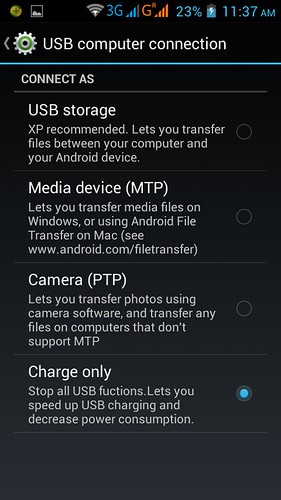
In charge-only mode it doesn't even enumerate as a USB device when plugged into a computer with an active USB controller, so I suspect no attacks (besides physical ones like overvolting as others here have mentioned) are possible in this mode --- the USB controller on the device is completely disabled.

Re:USB Type-C to Become More Secure with Authentication Stan... by ardy42 on Thursday January 03, 2019 @12:29AM (#18813042)
>> If I can set my phone to ignore all the data at the first hardware level, and it is a simple enough level that no attack is viable (that second one being a large "if"), then there is no large problem anymore.

> My old no-name Android phone (not USB C) has such an option, and searching around it seems to be a reasonably common feature, although not present on all devices.

I use one of these. The nice thing about the newer versions is that you can verify the impossibility of a data connection through easy physical inspection.

https://www.amazon.com/PortaPow-3rd-Data-Blocker-Pack/dp/B00...

Re:USB Type-C to Become More Secure with Authentication Stan... by geofft on Thursday January 03, 2019 @09:15AM (#18815197)
The problem with that is you also block the pins needed to negotiate power delivery over USB C, so you're limited to 10 W (5 V * 2 A). Laptops that use USB C for charging use C and not micro-B precisely because they need more power than that.
Re:USB Type-C to Become More Secure with Authentication Stan... by close04 on Thursday January 03, 2019 @08:19AM (#18814815)
The generic (unofficial?) name for such a device is a USB condom.
Re:USB Type-C to Become More Secure with Authentication Stan... by geofft on Wednesday January 02, 2019 @06:51PM (#18811514)
Isn't that the wrong direction? My concern is not so much that my phone will show up to an attacker as a storage device, which can generally be restricted or be set to require pairing - my concern is that the attacker will show up to my phone (or laptop) as an accessory, in particular as a keyboard and mouse and perhaps an external display, at which point they can click through any permission or pairing prompts the OS might try to show.
Re:USB Type-C to Become More Secure with Authentication Stan... by kwhitefoot on Monday January 07, 2019 @06:31AM (#18844394)
Definitely!

If my Moto G5+ is locked then it seems that plugging in a keyboard behaves pretty much like plugging a keyboard into a desktop or laptop computer except that it doesn't respond to c-a-del.

I can unlock from the external keyboard by pressing the windows key and then typing my pin number but the multimedia keys and print screen on the keyboard work even with the screen locked.

I would rather that it didn't do any of that until I give permission on the mobile itself.

Re:USB Type-C to Become More Secure with Authentication Stan... by karmakaze on Wednesday January 02, 2019 @05:00PM (#18810690)
Power-only USB cables offer good data protection, or just set your device in such a mode.
Re:USB Type-C to Become More Secure with Authentication Stan... by geofft on Wednesday January 02, 2019 @05:14PM (#18810808)
No such devices exist with USB Power Delivery support, I believe. (I believe you cannot make a passive adapter as you could for 5V, 2A-or-less plain USB A/B power connections; you have to speak the USB protocol and register as a device before you can switch to more than 5V or draw more than 2A. And plenty of people want more than 10W power.)

I also don't believe any OSes offer a mode where they negotiate power delivery and not data, though I'd love to be wrong - that would be 90% of my proposal. It wouldn't let you authenticate individual devices, but it would let you go back to having a single port that's just a charging port.

Re:USB Type-C to Become More Secure with Authentication Stan... by cesarb on Wednesday January 02, 2019 @06:06PM (#18811223)
> you have to speak the USB protocol and register as a device before you can switch to more than 5V or draw more than 2A.

It depends on which "USB protocol" you're talking about. With USB-C, there are five separate data buses on the plug, each running its own protocol. There is the traditional USB 2.0 bus (half-duplex differential pair), a pair of differential dual simplex buses (normally USB 3.0/3.1/3.2, can also be used for alternate protocols like DisplayPort), a pair of sideband wires (used only by alternate protocols), and the Configuration Channel. All configuration of the other data buses and of the main power bus is done through the Configuration Channel, in simple cases through resistor values, in more complex cases through the USB-PD protocol.

So yeah, you have to speak the "USB protocol" to switch to more than 5V or more than 3A, but the "USB protocol" you have to speak is not the traditional USB 2.0 or USB 3.x protocol, but instead the completely separate USB-PD protocol, which runs on its own dedicated set of wires. I doubt you can show up as a pen drive full of malware through the USB-PD protocol, but I don't doubt that cutting the other buses (keeping only the Configuration Channel/VCONN and the main power bus) will still work to deliver power, even at higher voltages and/or currents.

The reason this isn't standardized (as far as I know, a "charging-only" plug is only allowed as a captive cable on a non-charger) is for compatibility: if your device doesn't understand USB-PD, it might not charge at a full speed unless it sees a short on the USB 2.0 bus (Battery Charging specification), and doing that short on an adapter would allow a device to draw too much power from a non-charger.

Re:USB Type-C to Become More Secure with Authentication Stan... by gumby on Wednesday January 02, 2019 @05:22PM (#18810890)
You can buy type c condoms that do all the negotiation but block data to and from the cable.
Re:USB Type-C to Become More Secure with Authentication Stan... by geofft on Thursday January 03, 2019 @09:16AM (#18815205)
Do you have a link to such an item? All I have found is devices that lower you to USB A-style 10 W charging.
Re:USB Type-C to Become More Secure with Authentication Stan... by anticensor on Wednesday January 02, 2019 @05:15PM (#18810821)
18V, 5A would be a shock hazard.
Re:USB Type-C to Become More Secure with Authentication Stan... by semi-extrinsic on Wednesday January 02, 2019 @06:21PM (#18811323)
DC voltages below 50 V are considered "safe" in normal indoor conditions. It's often referred to as "extra low voltage", as opposed to "low voltage" (50 V - 1000 V) and "high voltage" ( > 1000 V).

If you want to verify the safety of 18 V: ever touch both poles of a 9V battery with your fingers? You can't feel anything. Go ahead and try two in series, you still won't feel it.

Re:USB Type-C to Become More Secure with Authentication Stan... by naikrovek on Wednesday January 02, 2019 @09:12PM (#18812252)
Really? I can feel 4 volts between my finger and thumb. Isn't painful or anything, but I can tell when a lipo battery is charged vs. discharged.
Re:USB Type-C to Become More Secure with Authentication Stan... by xxs on Thursday January 03, 2019 @03:39AM (#18813708)
You can feel lower voltages if you fingers are injured, or if you... lick them.

As kids (6-9y) we used to test the voltages of 3R12 (4.5v) by touching the poles with tongue, a sharp bites - the battery was good.

Re:USB Type-C to Become More Secure with Authentication Stan... by Maskawanian on Wednesday January 02, 2019 @10:45PM (#18812650)
Yes, here is a good video about this: https://www.youtube.com/watch?v=ZxBF7WC0TQk
Re:USB Type-C to Become More Secure with Authentication Stan... by userbinator on Wednesday January 02, 2019 @06:22PM (#18811329)
That's roughly the voltage that laptop AC adapters output, and they do so continuously without needing any special negotiation/signaling.

(Even those from manufacturers that try to lock this down using an EEPROM, e.g. Dell, still output their voltage like the others, but the laptop might not want to charge from an "unofficial" power source.)

Re:USB Type-C to Become More Secure with Authentication Stan... by XMPPwocky on Wednesday January 02, 2019 @05:51PM (#18811120)
If you stick it in your mouth or something, maybe. Or if you're soaking wet and have a terrible heart. Otherwise, nobody's getting hurt off 18v.
Re:USB Type-C to Become More Secure with Authentication Stan... by xxs on Thursday January 03, 2019 @03:36AM (#18813692)
Laptops tend to be 19V and you can hold them with both hands wet w/o any risk (it's DC, so even better).

If you lick them it'd be quite unpleasant but that's that.

Voltage below (roughly) 36 are safe.

Re:USB Type-C to Become More Secure with Authentication Stan... by gsich on Wednesday January 02, 2019 @05:59PM (#18811179)
No. Skin resistance is at least around 100k Ohm at that voltage.
Re:USB Type-C to Become More Secure with Authentication Stan... by basementcat on Wednesday January 02, 2019 @07:59PM (#18811906)
The shock hazard is the 5A, not necessarily the 18V.
Re:USB Type-C to Become More Secure with Authentication Stan... by XMPPwocky on Wednesday January 02, 2019 @09:32PM (#18812344)
Well, no. If 5A flows through you from hand-to-hand, sustained for longer than an instant, you're probably dead. But I've touched live power supply terminals for something rated for 20A without a second thought.

And if there's a 10kV differential between your left and your right hand, sustained for longer than an instant... You're probably dead. But I've touched a 10kV power supply (not on purpose, this one), and...still here.

So! What gives?

Well. Place a 0.1 ohm resistor across that power supply. 18V across 0.1 ohms will produce a current of 180A. This will dissipate more than 3kW in the resistor, and it will very rapidly disassemble itself. But that doesn't happen!

Okay, now put a 10 megaohm resistor across that power supply. It's 5A, right? So 5A across 1 megaohm will produce a voltage of 5000kV. This will dissipate 25 megawatts, and destroy the resistor even faster. This also doesn't happen!

In fact, what will happen in the first case is that 5A, not 180A flows (assuming the PSU doesn't detect the apparent short and shut down entirely.). But Ohm's law says that if 18V is placed across a 0.1 ohm resistor, 180A must flow!

Ah, but 18V isn't placed across the resistor. Instead, as current draw approaches the 5A limit, the power supply starts dropping the voltage. No more than 5A will flow, even if that means the voltage must be decreased.

And 5A won't flow through the 1 megaohm resistor, either. Instead, no more than 18V will be placed across the load, even if that means the current must decrease.

So, the power supply won't kill you UNLESS your skin resistance is low enough that 18V causes a lethal (very roughly roughly 1A) current to flow through you. Luckily, humans have a fairly high skin resistance, at least when we're dry, and 18V is fine.

It's not the volts that kill you, it's the amps which the volts are directly related to. 10kV across your body, sustained for a bit, will kill you dead, modulo some sort of miracle. 10kV at 1mA across your body ... is impossible. If you touch a 10kV, 1mA supply- the voltage will drop so that only 1mA flows.

It's not the voltage limit on the power supply that kills you. It's not the current limit on the power supply that kills you. Both need to be high enough to do you in.

Re:USB Type-C to Become More Secure with Authentication Stan... by fb03 on Thursday January 03, 2019 @06:23AM (#18814358)
Extremely interesting explanation. Thank you man.

I would like to peruse your electronic skills for another quite unrelated question that has been hovering my head for quite a while.

I know that normal USB (1,2) devices charge using the provided 5V rail off the USB connection. And I've read somewhere else that coming from a PC motherboard or other regulated (standardized) USB outlet, the port will provide about 500mA.

What would happen if i took a ATX PSU and rigged usb ports directly (at the correct power pins) to the psu's 5V rails?

Would I fry any devices plugged in? Or..

Would any plugged devices limit their intake and I'd be left with a 'super quick charger' which can charge any device at the maximum amount of power that the device can receive power? those 5V rails usually output at 30A+ and stuff.

thank you again, and hope you can shed some light into this long doubt of mine (I always 'dreamed' of creating some atx-frankstein psu which i could use for electronic experiments but also fit some usb ports in it).

o/

Re:USB Type-C to Become More Secure with Authentication Stan... by Kirby64 on Thursday January 03, 2019 @11:45AM (#18816477)
EE/CE here: In order if your questions...

1. Assuming you hooked the 5V to the USB 5V and the GND to the USB GND pins, nothing bad would happen.

2. Nothing would get fried

3. Plugged in devices would respond according to how they're designed. Most cell phones will limit current and only draw 500mA if they don't have any other signalling to test otherwise. Some will slowly ramp current until their own internal limits if voltage drop isn't too bad. Some 'dumb' devices will pull as much current as they 'want' or need. You won't be able to push 30A into any device because there are almost no USB devices that 'want' that much current. Even really poor behaving devices (outside of outright broken ones) will probably only draw 3-5A max. Technically this is non-compliant, since there are defined USB specifications for how USB ports should be connected.

If you wanted to make a 5V 'mega USB' charger, here's all you'd need to do: Take your 5V, many amp power supply and connect all USB-A ports you want to it, with a constraint that number of USB ports should be total amperage divided by 2.5. E.g. if you had a 10A supply, only use 4 USB ports. Short the D+ and D- pins together on the connector. 5V should be connected to your large 5V rail, GND should be connected to ground.

That's it. You've just made a 'DCP' (Dedicated charging port) device. By USB standards any device connected can pull up to 1.5A; in practice they'll usually pull 2.1A or more if they can.

Re:USB Type-C to Become More Secure with Authentication Stan... by fb03 on Thursday January 03, 2019 @12:47PM (#18817156)
THANK YOU! that's what i needed to know.

knowing shit about electronics, i was worried there would be 'too much current' and that i could fry something :-)

have a good one, man o/

Re:USB Type-C to Become More Secure with Authentication Stan... by geofft on Wednesday January 02, 2019 @04:33PM (#18810458)
Don't we have technologies for that like fuses?

In particular, people seem to use untrusted AC power outlets all the time without their devices being fried. The motivations of an attacker who wants to fry devices (mere lulz) and the motivation of an attacker who wants to break into working devices silently are very different; it makes sense to expect more of the latter, and to define the latter and not the former as within your threat model.

Re:USB Type-C to Become More Secure with Authentication Stan... by cesarb on Wednesday January 02, 2019 @04:59PM (#18810672)
A fuse protects against overcurrent. It does nothing against overvoltage, or worse, reverse polarity (which was what fried Benson Leung's device). USB-C has a maximum of 20V, and that's only when negotiated by both devices; many devices will only expect 5V. If an untrusted low-quality power supply fails, it can put the full line voltage (alternating from -110V to 110V or more) into the USB cable. Protecting against that would add a lot of bulk and cost to a device. AC powered devices, on the other hand, already have to deal with the full line voltage (which includes negative voltages) all the time, so there's no extra cost for them.
Re:USB Type-C to Become More Secure with Authentication Stan... by justrobert on Wednesday January 02, 2019 @05:08PM (#18810762)
The solution I use and many others is to only charge a usb battery in public, and you use that battery to charge your devices.

That works well to solve all the issues with public power ports.

Re:USB Type-C to Become More Secure with Authentication Stan... by zzzcpan on Wednesday January 02, 2019 @05:02PM (#18810702)
Fuses and input protection in general can't save your device from a malicious attacker connecting say a powerful taser into a usb port.
Re:USB Type-C to Become More Secure with Authentication Stan... by geofft on Wednesday January 02, 2019 @05:15PM (#18810819)
I mean, they also can't solve a malicious attacker connecting a powerful taser above a USB port and trying to maim whoever uses the port. What's your threat model again?
Re:USB Type-C to Become More Secure with Authentication Stan... by zzzcpan on Wednesday January 02, 2019 @05:21PM (#18810883)
Obviously. I mean that you can't protect the device from malicious power and usb outlets. And for non-malicious things the device should already have input protection, otherwise it's unsafe to use if it doesn't when plugged in and unsafe leaving it plugged in unattended (you can die from electrocution or it can cause fire).
Re:USB Type-C to Become More Secure with Authentication Stan... by Waterluvian on Wednesday January 02, 2019 @11:01PM (#18812711)
Is this a real problem or a razors in apples problem?
Re:USB Type-C to Become More Secure with Authentication Stan... by yuubi on Thursday January 03, 2019 @02:20AM (#18813472)
A real problem for some is that standardizing power adapters interferes with the sale of original manufacturers' adapters. The authentication mechanism looks to be designed to fix this revenue leak.
Re:USB Type-C to Become More Secure with Authentication Stan... by TheCoelacanth on Wednesday January 02, 2019 @08:07PM (#18811959)
Why would anyone do that? If you just want to vandalize things and have the physical access necessary to install a USB outlet, there are much easier ways to do that. Data attacks are much more realistic because the attacker can gain something beyond just causing destruction.
Re:USB Type-C to Become More Secure with Authentication Stan... by JohnFen on Wednesday January 02, 2019 @06:37PM (#18811435)
> that doesn't change the fact that public USB outlets can still be rigged to fry your machine.

That is true, but not something that I'm overly fussed about. I'd much rather have my USB port fried than to suffer an intrusion.

Re:USB Type-C to Become More Secure with Authentication Stan... by jdblair on Wednesday January 02, 2019 @09:01PM (#18812192)
I am also suspicious of public usb charging ports. That's why I prefer to use my AC power adapter. Not only do I make sure to get full USB-C power capacity, I know nobody can hack my phone because the AC port has no data channel.
Re:USB Type-C to Become More Secure with Authentication Stan... by JohnFen on Wednesday January 02, 2019 @05:47PM (#18811094)
I don't know squat about USB C (I don't have any equipment that uses it yet), but with A & B, my solution to this problem is simple -- I use charging-only cables that don't pass the data lines through.
Re:USB Type-C to Become More Secure with Authentication Stan... by geofft on Wednesday January 02, 2019 @07:03PM (#18811589)
USB C has a power delivery spec that permits increasing voltage above 5V; in order to do that you need to negotiate what each side (and the cable, too, I think) supports before increasing voltage. That's how laptops that use much more than 10 W can use USB C as their charging port.
Re:USB Type-C to Become More Secure with Authentication Stan... by JohnFen on Wednesday January 02, 2019 @07:06PM (#18811609)
But that's only for high voltage charging, right? You can still get 5V without negotiation, if I understand correctly. If so, that's a tradeoff I would be perfectly fine with.
Re:USB Type-C to Become More Secure with Authentication Stan... by akerl_ on Thursday January 03, 2019 @01:01AM (#18813182)
USB-C is being used to power things where 5V is not remotely sufficient. So while for some devices (cell phones, largely) 5V is a plausible tradeoff, I don't really see a world where many MacBook / Chromebook / etc users opt for 5V max charging power.
Re:USB Type-C to Become More Secure with Authentication Stan... by JohnFen on Thursday January 03, 2019 @01:10PM (#18817437)
Fair enough, but I was really just talking about safety when using public charging points, which implies smaller devices. Also, I was really talking about what I find acceptable. Other people's mileage may vary.
Re:USB Type-C to Become More Secure with Authentication Stan... by jjoonathan on Wednesday January 02, 2019 @05:53PM (#18811139)
Yeah, but BigCo can't charge you $20 for that no-data-passthrough cable.
Re:USB Type-C to Become More Secure with Authentication Stan... by abrowne on Wednesday January 02, 2019 @06:46PM (#18811482)
Doesn't USB require the data connection to allow it to negotiate higher than the base power level?
Re:USB Type-C to Become More Secure with Authentication Stan... by floatingatoll on Wednesday January 02, 2019 @04:18PM (#18810301)
How?
Re:USB Type-C to Become More Secure with Authentication Stan... by geofft on Wednesday January 02, 2019 @04:30PM (#18810431)
As described in my comment above: enable power delivery without data delivery by default.
Re:USB Type-C to Become More Secure with Authentication Stan... by floatingatoll on Wednesday January 02, 2019 @04:39PM (#18810499)
Counterfeit and/or unsafe USB power delivery cables are a fire hazard today, whether or not a data channel is negotiated. How does disabling data delivery improve the safety of a PD-only USB connection over a physically unsafe cable?

This crypto-signature approach is already used by the Apple MFi program, which has made it difficult-to-impossible to sell counterfeit and/or unsafe Lightning devices.

Re:USB Type-C to Become More Secure with Authentication Stan... by geofft on Wednesday January 02, 2019 @05:07PM (#18810747)
I think we have completely unrelated threat models. I'm worried about malicious USB ports / devices trying to steal my data or at least make me have a bad day. If someone is trying to set a device on fire, authentication won't help. They just need to fail authentication and use that as the bomb's trigger.

You're worried, I think, about poor-quality devices that aren't malicious, just incompetent - or poor-quality cables. (I'm already willing to carry my own cable - I already carry a USB-A data blocker around, but USB-C data blockers don't seem to exist.) I think that can be solved without cryptographic authentication, with the standard approach of having a certification organization like UL or the USB-IF themselves investigate cable/charger production and test them. It seems the major problem here is with Amazon listing cables without showing whether they have certifications (or checking whether certifications are forged), and that's a general Amazon problem with poor-quality hardware and counterfeits.

This article is talking about autorun, Stuxnet, etc. so I think they're focusing on the latter. If the USB-IF wanted to use digital signatures to authenticate cables I'd be more on board, but if they do that, they should just be authenticating cables, not devices. (A cable, I believe, can be engineered to just cut the circuits if a device tries to pass too much voltage, or is wired backwards, or something.)

Re:USB Type-C to Become More Secure with Authentication Stan... by gumby on Wednesday January 02, 2019 @05:30PM (#18810961)
> USB-C data blockers don't seem to exist.

They do -- I carry one one of my employees made in our lab. Search for "usb-c condom" or "usb-c data blocker" and you will find several offered for sale.

Re:USB Type-C to Become More Secure with Authentication Stan... by geofft on Thursday January 03, 2019 @09:19AM (#18815229)
The ones I've seen work by severing all of the data pins, limiting you to the old 5 V * 2 A limit. Have you seen any data blockeds that support the power delivery spec and are suitable for devices that need over 10 W (larger laptops, the Switch, etc.)?
Re:USB Type-C to Become More Secure with Authentication Stan... by gumby on Thursday January 03, 2019 @03:20PM (#18818911)
I have one that negotiates power delivery on both ends. But I don’t believe it was manufactured commercially — it’s just a bare board with no housing. I’ll ask the guy who made it if he’d publish the design files.
Re:USB Type-C to Become More Secure with Authentication Stan... by Spooky23 on Wednesday January 02, 2019 @05:52PM (#18811130)
There’s a whole spectrum of bad actors.

Incompetence is scarier than malicious actors imo, and expecting users to carry USB condoms around seems like a bad idea.

Re:USB Type-C to Become More Secure with Authentication Stan... by floatingatoll on Wednesday January 02, 2019 @06:45PM (#18811479)
I assume USB-IF wants all uses of the word USB with respect to any hardware - including cables - to be backed by a DigiCert signature, and all other uses to be rejected by non-developer-mode devices so their enforcement success rate improves versus generic knockoffs that can’t easily be sued.
Re:USB Type-C to Become More Secure with Authentication Stan... by userbinator on Wednesday January 02, 2019 @06:23PM (#18811339)
difficult-to-impossible

Apparently not according to the Chinese, who made the first clone (based on an 8051 microcontroller IIRC) within months of the official release. They're still in an ongoing cat-and-mouse game with Apple.

Re:USB Type-C to Become More Secure with Authentication Stan... by floatingatoll on Wednesday January 02, 2019 @06:40PM (#18811451)
Difficult-or-impossible to bring to market for sale to all iPhone users worldwide, not difficult to reverse engineer on a bench.

By controlling issuance of permission to use the connector, Apple is able to prohibit non-compliant products from becoming widespread worldwide. (And even China just last month declared their intent to make IP enforcement viable, which further strengthens Apple’s position with respect to MFi.)

The USB folks appear to believe that if they introduce a similar licensing arrangement for USB, they’ll be able to refuse licenses to unsafe implementations to deny them access to the worldwide USB market. MFi still works today, so I certainly don’t blame them for trying.

Re:USB Type-C to Become More Secure with Authentication Stan... by geofft on Wednesday January 02, 2019 @07:05PM (#18811603)
That means they don't need cryptography for this, right?
Re:USB Type-C to Become More Secure with Authentication Stan... by floatingatoll on Wednesday January 02, 2019 @07:36PM (#18811791)
That is not a meaning I would have derived from my reply. You’re welcome to construct a scenario explaining what you mean, but the question alone offers no guidance on what you’re thinking to permit me to construct a reply.
Re:USB Type-C to Become More Secure with Authentication Stan... by geofft on Thursday January 03, 2019 @09:21AM (#18815246)
You've argued that legal protections, including China's stronger IP stance, means that USB-IF can be confident about cracking down on counterfeiting, and that it doesn't matter that the connector is east to reverse-engineer. If so, how is a cryptographic authentication scheme as described in the article (including authentication of devices, not just connectors and cables) relevant, let alone useful? How does it help anti-counterfeiting and why are the legal mechanisms by themselves insufficient?
Re:USB Type-C to Become More Secure with Authentication Stan... by floatingatoll on Monday January 07, 2019 @12:31PM (#18847461)
I'm not planning to follow up further on this thread, sorry. If you are able to define an anti-counterfeiting mechanism that does not depend on cryptographic signatures, you could probably corner a billion dollar market. I encourage doing so, but have no further assistance to offer you.