This is much easier said than done (in the US at least.)
First, you'd be looking at at least a year of going back and forth in small claims court and by the end of it still have no guarantee of winning. Even if you did win, there's no guarantee the judge would award you the full amount to pay for your fried device.
It almost certainly would not pay your time at the courthouse though; you can ask the judge for punitive but you cannot include legal expenses in small claims court demands.
In the end you would still be out hundreds or thousands of dollars and numerous hours of your time. That's why to me the tiny benefit of using a public USB outlet is just not remotely worth the risk of such a nightmarish hassle.
Then again if things were really bad or malicious you could end up losing your life like Sheryl Aldeguer.
My old no-name Android phone (not USB C) has such an option, and searching around it seems to be a reasonably common feature, although not present on all devices. It looks similar to this (mine has the same typo, "USB fuctions"):
https://farm8.staticflickr.com/7485/16035739946_51d110ea40.j...
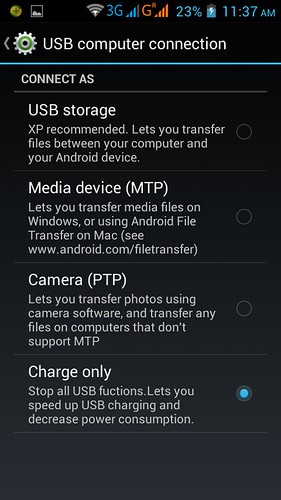
In charge-only mode it doesn't even enumerate as a USB device when plugged into a computer with an active USB controller, so I suspect no attacks (besides physical ones like overvolting as others here have mentioned) are possible in this mode --- the USB controller on the device is completely disabled.
> My old no-name Android phone (not USB C) has such an option, and searching around it seems to be a reasonably common feature, although not present on all devices.
I use one of these. The nice thing about the newer versions is that you can verify the impossibility of a data connection through easy physical inspection.
https://www.amazon.com/PortaPow-3rd-Data-Blocker-Pack/dp/B00...
If my Moto G5+ is locked then it seems that plugging in a keyboard behaves pretty much like plugging a keyboard into a desktop or laptop computer except that it doesn't respond to c-a-del.
I can unlock from the external keyboard by pressing the windows key and then typing my pin number but the multimedia keys and print screen on the keyboard work even with the screen locked.
I would rather that it didn't do any of that until I give permission on the mobile itself.
I also don't believe any OSes offer a mode where they negotiate power delivery and not data, though I'd love to be wrong - that would be 90% of my proposal. It wouldn't let you authenticate individual devices, but it would let you go back to having a single port that's just a charging port.
It depends on which "USB protocol" you're talking about. With USB-C, there are five separate data buses on the plug, each running its own protocol. There is the traditional USB 2.0 bus (half-duplex differential pair), a pair of differential dual simplex buses (normally USB 3.0/3.1/3.2, can also be used for alternate protocols like DisplayPort), a pair of sideband wires (used only by alternate protocols), and the Configuration Channel. All configuration of the other data buses and of the main power bus is done through the Configuration Channel, in simple cases through resistor values, in more complex cases through the USB-PD protocol.
So yeah, you have to speak the "USB protocol" to switch to more than 5V or more than 3A, but the "USB protocol" you have to speak is not the traditional USB 2.0 or USB 3.x protocol, but instead the completely separate USB-PD protocol, which runs on its own dedicated set of wires. I doubt you can show up as a pen drive full of malware through the USB-PD protocol, but I don't doubt that cutting the other buses (keeping only the Configuration Channel/VCONN and the main power bus) will still work to deliver power, even at higher voltages and/or currents.
The reason this isn't standardized (as far as I know, a "charging-only" plug is only allowed as a captive cable on a non-charger) is for compatibility: if your device doesn't understand USB-PD, it might not charge at a full speed unless it sees a short on the USB 2.0 bus (Battery Charging specification), and doing that short on an adapter would allow a device to draw too much power from a non-charger.
If you want to verify the safety of 18 V: ever touch both poles of a 9V battery with your fingers? You can't feel anything. Go ahead and try two in series, you still won't feel it.
As kids (6-9y) we used to test the voltages of 3R12 (4.5v) by touching the poles with tongue, a sharp bites - the battery was good.
(Even those from manufacturers that try to lock this down using an EEPROM, e.g. Dell, still output their voltage like the others, but the laptop might not want to charge from an "unofficial" power source.)
If you lick them it'd be quite unpleasant but that's that.
Voltage below (roughly) 36 are safe.
And if there's a 10kV differential between your left and your right hand, sustained for longer than an instant... You're probably dead. But I've touched a 10kV power supply (not on purpose, this one), and...still here.
So! What gives?
Well. Place a 0.1 ohm resistor across that power supply. 18V across 0.1 ohms will produce a current of 180A. This will dissipate more than 3kW in the resistor, and it will very rapidly disassemble itself. But that doesn't happen!
Okay, now put a 10 megaohm resistor across that power supply. It's 5A, right? So 5A across 1 megaohm will produce a voltage of 5000kV. This will dissipate 25 megawatts, and destroy the resistor even faster. This also doesn't happen!
In fact, what will happen in the first case is that 5A, not 180A flows (assuming the PSU doesn't detect the apparent short and shut down entirely.). But Ohm's law says that if 18V is placed across a 0.1 ohm resistor, 180A must flow!
Ah, but 18V isn't placed across the resistor. Instead, as current draw approaches the 5A limit, the power supply starts dropping the voltage. No more than 5A will flow, even if that means the voltage must be decreased.
And 5A won't flow through the 1 megaohm resistor, either. Instead, no more than 18V will be placed across the load, even if that means the current must decrease.
So, the power supply won't kill you UNLESS your skin resistance is low enough that 18V causes a lethal (very roughly roughly 1A) current to flow through you. Luckily, humans have a fairly high skin resistance, at least when we're dry, and 18V is fine.
It's not the volts that kill you, it's the amps which the volts are directly related to. 10kV across your body, sustained for a bit, will kill you dead, modulo some sort of miracle. 10kV at 1mA across your body ... is impossible. If you touch a 10kV, 1mA supply- the voltage will drop so that only 1mA flows.
It's not the voltage limit on the power supply that kills you. It's not the current limit on the power supply that kills you. Both need to be high enough to do you in.
I would like to peruse your electronic skills for another quite unrelated question that has been hovering my head for quite a while.
I know that normal USB (1,2) devices charge using the provided 5V rail off the USB connection. And I've read somewhere else that coming from a PC motherboard or other regulated (standardized) USB outlet, the port will provide about 500mA.
What would happen if i took a ATX PSU and rigged usb ports directly (at the correct power pins) to the psu's 5V rails?
Would I fry any devices plugged in? Or..
Would any plugged devices limit their intake and I'd be left with a 'super quick charger' which can charge any device at the maximum amount of power that the device can receive power? those 5V rails usually output at 30A+ and stuff.
thank you again, and hope you can shed some light into this long doubt of mine (I always 'dreamed' of creating some atx-frankstein psu which i could use for electronic experiments but also fit some usb ports in it).
o/
1. Assuming you hooked the 5V to the USB 5V and the GND to the USB GND pins, nothing bad would happen.
2. Nothing would get fried
3. Plugged in devices would respond according to how they're designed. Most cell phones will limit current and only draw 500mA if they don't have any other signalling to test otherwise. Some will slowly ramp current until their own internal limits if voltage drop isn't too bad. Some 'dumb' devices will pull as much current as they 'want' or need. You won't be able to push 30A into any device because there are almost no USB devices that 'want' that much current. Even really poor behaving devices (outside of outright broken ones) will probably only draw 3-5A max. Technically this is non-compliant, since there are defined USB specifications for how USB ports should be connected.
If you wanted to make a 5V 'mega USB' charger, here's all you'd need to do: Take your 5V, many amp power supply and connect all USB-A ports you want to it, with a constraint that number of USB ports should be total amperage divided by 2.5. E.g. if you had a 10A supply, only use 4 USB ports. Short the D+ and D- pins together on the connector. 5V should be connected to your large 5V rail, GND should be connected to ground.
That's it. You've just made a 'DCP' (Dedicated charging port) device. By USB standards any device connected can pull up to 1.5A; in practice they'll usually pull 2.1A or more if they can.
The real problem on public outlets is with data attacks, not power. If I can set my phone to ignore all the data at the first hardware level, and it is a simple enough level that no attack is viable (that second one being a large "if"), then there is no large problem anymore.