The government is on the hook for the old population and the poor population: the 2 most expensive subsets. Yet private insurance still isn't affordable despite only having to cover the lower-risk chunk of the pop. It's insane.
First, US insurance companies are often pseudo non-profits, with profit caps. [1]
Second, another model is Medicare Advantage where beneficiaries can choose a private entity to administer their Medicare plan.
Third, most commercial insurance in the US is not actually underwritten by insurance co's, but by "self-funded" employers. In this case, the insurance company is merely a third-party administrator (TPA) for the employee plans, using XYZ's bank account (and trying to save them money, offer health incentive programs, etc., to secure repeat business). Most companies with more than, say, 500 employees operate this way, though usually you won't even know this is the case.
---
Finally, if by
> do we want to provide universal access to healthcare?
you mean "do we want everyone to have healthcare?", the answer is an easy "yes". We want universal access to housing, healthcare, employment, etc.
But if the question is "do we want the government to use taxes to ensure that everyone has healthcare?", the answer is far more divided. There's a lot of interesting examples elsewhere. But as you've mentioned, the US government has already dipped its toe into those waters with the VA, and I don't think it's been perceived as a success.
[1] http://thehealthcareblog.com/blog/2012/02/04/does-obamacare-...
All numbers I've seen have been far higher than that.
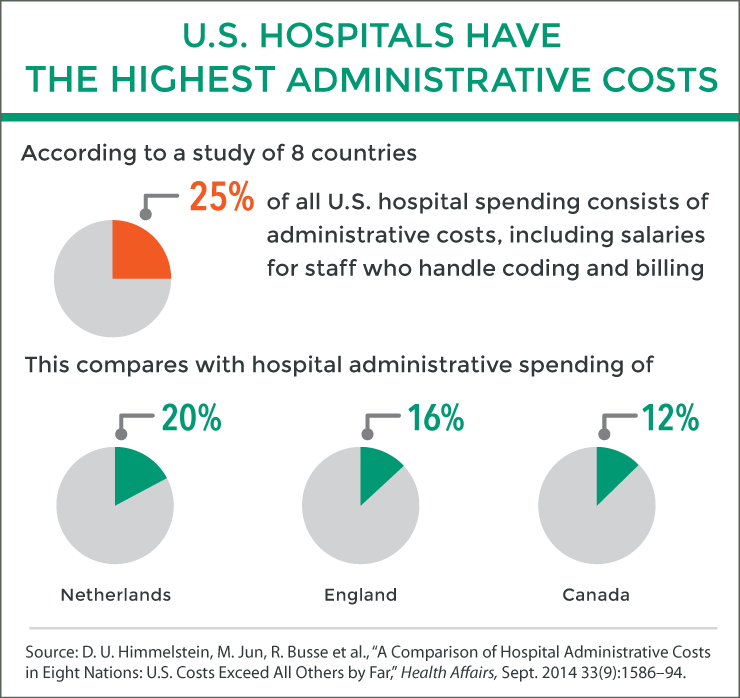
* Canada 12%
* Britain 16%
* Netherlands 20%
https://www.commonwealthfund.org/sites/default/files/___medi...
In 2016 there were 770,000 people who were bankrupted due to medical costs.
Around 45,000 people a year die from a lack of health insurance.
In every country that has universal coverage reform has started with a push to ask a basic moral and ethical question: should we consider healthcare a basic human right?
In the U.S. we pay 18% of our GDP on healthcare, yet we rank ~ 37th in terms of death due to preventable causes, and 31st in terms of overall life expectancy. If you look at how healthcare works in other countries there are many different systems but what they all have in common is a commitment to provide access to healthcare for all citizens. There are different mixes of private and public, and we have already implemented most of them to some degree:
There are 4 main systems 1. Beveridge (public health care providers and insurance rolled into one, like the NHS in UK): The VA and healthcare systems used for native americans use this system
2. National health insurance (private healthcare providers and public insurance funded by the government, like Canada's system): Medicare was copied from the Canadian system (even the name!).
3. Bismarck Model: (private healthcare providers and mostly private insurance, along with an individual mandate and heavy regulation of insurance companies: this is used in Germany and Japan). Obamacare was an incomplete attempt to move more towards this model.
4 Out of pocket model: (fully private: a non-system used by most poor countries in the world). This is what the uninsured fall back on.
The main piece that is missing is we haven't committed to scaling either systems 1, 2 or 3 in order to provide universal access to healthcare and so we have an incredibly fragmented and complex system with soaring costs. American for-profit insurance companies are bloated by ~20% administration fees whereas in most countries they are non-profit entities with 5% or less.
To back up and sum it all up the fundamental question we need to ask ourselves is: do we want to provide universal access to healthcare?