The issue for me is the co-opting of public space for private enterprise in the least considerate way possible. People leave these scooters like litter in parks, sidewalks, and lakes.
You could object that this is an overly precious perspective, but I would counter that similar startups (ZipCar most notably) have solved this by contemplating the logistical implications from the get go.
I personally would not object the assigning some percentage of parking spots in neighborhoods as designated parking for shares, and would hope such a contract will emerge.
I certainly understand the dockless advantage here, but the result for those of us who don't use them is garbage some random company feels entitled to clutter up the sidewalks with.
Especially "the result for those of us who don't use them is garbage some random company(and individuals) feels entitled to clutter up the sidewalks(streets) with".
Also, what does private enterprises have to do with any of this? If anything I think there's a stronger argument the other way. Things that are owned by and only benefit a single person (e.g. driving my car and then leaving it parked on the street all day) is a worse use of space than things that are useful to many people (e.g. a Zipcar that gets frequent use, or, yes, scooters).
I hope you can recognize that your stated arguments here are not very honest, and that what you're actually saying is "I like privately owned cars so I want cities to prioritize them over other modes of transportation like scooters".
For thousands of years it was normal for children to play in the street, for people to stop and converse, etc.
Then drivers turned up, said "move or I will kill you", and weirdly we decided the streets were for cars. It grates when people say that people walking have any less right to stand in the middle of the street because they're not wearing a car.
This was the result of a concerted PR campaign. https://www.citylab.com/transportation/2012/04/invention-jay...
Do the people look out of place here? http://static.libsyn.com/p/assets/c/c/3/a/cc3a56fafeaa6119/S...
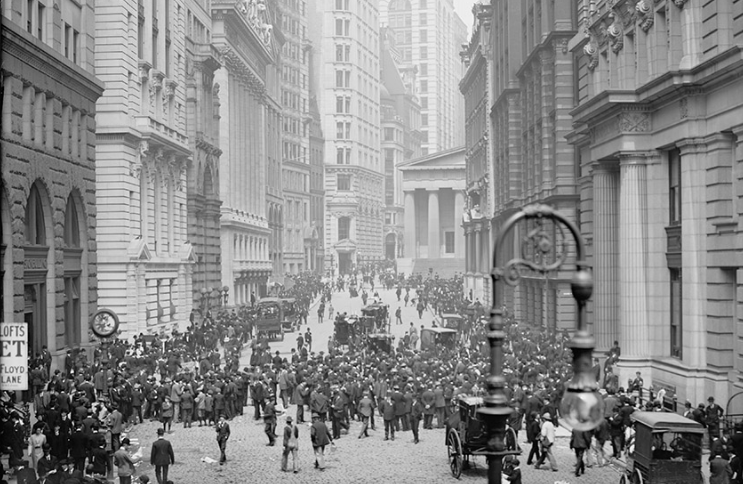
Perhaps we should take some space from cars (really, from people who happen to be in cars) and give it back to people.
Here’s an example that Santa Monica is trying: https://www.10news.com/news/santa-monica-creates-parking-spa...
I have a lot of problems with a) companies seizing arbitrary amounts of public space for private businesses, b) venture-funded litter cluttering the streets, and c) novice scooter riders with no training turned loose on sidewalks I am trying to walk and not die on.
And I also have a lot of left-over ire for scofflaw companies. Yes, Uber got away with it. But no, would-be titans, that's not permission for you guys. It was a one-time trick.
In a lot of places in West Los Angeles, you are having to step around them constantly if you walk down the street. People literally just drop them in the middle of the sidewalk, because there is no incentive for them to not do that.
This means that everyone who doesn't use the service has to suffer.
Take two parking spots in each block. Put beacons on the corners or some kind of signaling tape around the whole thing. Only let users drop off rides inside that spot. Bonus points for having non-locking racks to help organize.
People get to litter their car on the side of my road, often in the bike lane for free and everyone walks around like it's okay. It's not. Neither are the scooters on the sidewalk. We know how to solve both problems. Parking spots for dockless transit and banning cars from transit and pedestrian rich neighborhoods.
[edit] I removed a line saying I was annoyed that people kept complaining the scooter parking situation. Those complaints point out a very real problem with scooter deployments and that we have a solution for it that is difficult to get passed doesn't make the complaint less valid.
Cities should simply impound any scooter not properly parked and charge $200 to get it back. Since solving the parking problem is so easy, this will push Bird/Lime into finally solving it.
Fundamentally the problem is that car-owners currently receive an enormous subsidy in the form of cheap or free street parking and they jealously guard that privilege, even in supposedly progressive cities like San Francisco.
[0] https://en.wikipedia.org/wiki/Geary_Bus_Rapid_Transit [1] https://www.thebaycitybeacon.com/politics/dude-where-s-my-bi...
People who park cars believe in an inherent first claim to all roadside space above other users and they are extremely aggressive in their resistance to even the slightest loss.
Would you care to list any city and meeting date in which you have observed this? I'd like to pull the tape and see.
Whenever there is talk of changes to street parking, businesses are outraged at the removal of convenience for their customers. (In most cases, I think they're actually upset at the loss of convenience for their own parking.)
That's true, but then said cities would lose the prestige of being a part of Silicon Valley innovation.
We need the parking laws for scooters.
In fact, I would argue that part of the negotiation that cities ought to do with Bird and Lime and others like it is to make any deploy conditional on the passage of and adherence to scooter parking laws.
You and I have very different definitions of "large." I'd call this "very minor."
It also depends on the comparison group. I mean, look at these astounding photos of mammoth, abandoned dockless vehicles: https://slate.com/business/2018/04/astounding-photos-capture....
Cities will, over time, reallocate a small amount of the space currently devoted to very large dockless vehicles to small dockless vehicles and thus solve the problem.
We have NONE of this for scooters.
We need these same rules for scooters that we have for cars.
Obviously the rules are going to be different because the vehicles are different and are used differently, but the rules will still have the same basic form: you are allowed to park in these areas, for this amount of time, for this much money.
Instead the scooter companies should charge for not leaving the scooter in a proper parking spot.
For me, extremely dangerous means high risk of death or grievous body harm. Something like 100 micromorts per exposure. I want to ensure I'm not underrating this.
Yes, I call this extremely dangerous, because death could result.
Is it likely? No. Is it possible? Yes.
A few years ago a 20 something year old girl was walking in SF and was hit by a bicycle, knocked to the ground and hit her head. She died at the scene. (She was in the crosswalk and the rider was charged with something, I forget.) So, it does happen.
If I don't want the risk for skydiving, I won't do it. I won't, btw.
Base jumping? No thanks.
Walking 1+ hour/day on sidewalks: I've told you I've had 10+ close calls. There is nothing I can do to mitigate this risk.
I see what you're trying to do, but you're coming off a little dickish.
More unsafe than walking. Is walking down the street with these vehicles around you less safe than running a marathon? Or around taking a road-trip across America? Or back-country camping?
Any meeting point here will do.
My risk of harm while walking to/from work increased orders of magnitude, through no change in my own behavior.
I'm starting to feel like I'm being trolled, because I think you know exactly what I just said.
Also: it's a fun exercise to go back in time and look at all the laws sponsored by automotive & oil companies to create today's car culture (case in point: streetcars). I assure you: there was a lot of protectionism & it wasn't always about the consumer.
It's an entirely new mode of transportation; there are lots of fun things to try as we refactor our world. That's what startups do.
If it's a shared resource like a Bird scooter then there's no moral quandary about "touching other people's stuff" that would make sense for an actual person's property.
The company doesn't care, there's no-one that even can care.
The cars are parked in designated spots on the road, with all sorts of rules about how long and how much you have to pay for the spot. In Santa Monica, pretty much every available parking spot has a meter that means you have to pay to park there, and are limited in how long you can park there.
Now, we can have all sorts of public policy debates about how much of a city's public space should be dedicated to parking spots, but at least the public had a say in the policy and at least there IS a policy.
We just need rules around where you can park the scooters and for how long, and how much you have to pay to use the public space to park your scooter.
The actual basis of your complaint is that you like parking, but you don't like scooters being put wherever.
I think it is a bit unfair to say we have democratically decided to let scooters park everywhere simply by the fact that we haven't yet passed any laws about where they can park; the law is slow to move, and the scooter parking issue is pretty new. Before Bird and Lime, there were not enough scooters around to be a big enough problem where we needed a law. Now we do, but the law is slow to change.
In the mean time, it is pretty annoying.
Dumping private property on public lands, and expecting the citizens to respect what amounts to abandoned property is absurd.
This is a level 100 class of "Tragedy of the commons". And with enough scooters, the very act of going somewhere on a scooter will be blocked by corporate trash.... Err, limes and birds.
Besides, dumping private property on public land is what parking cars is. I'm comfortable outlawing this if we outlaw all street parking as well.
This is disingenuous. It ignores all the externalities of car friendly cities that you're taking for granted. Busy streets are wider with more lanes, crosswalks are more inconvenient and take longer to cross. Half of the width of narrow streets is dominated by parking, not to mention all of the unsightly lots and parking garages.
Scooters don't cost millions/billions in real estate for parking. They can't use and don't require expensive freeway onramps. They don't cause massive congestion and the corresponding drop in local air quality. All in all I think if you want to compare externalities, scooters win by far over cars, and it's not even close.
Personally, I usually wear a helmet, but if I happen to not have mine with me it won't stop me from taking a bike or scooter.
Having good situational awareness of surrounding cars, pedestrians, and other road users as well as stationary obstacles ahead of you provides much more safety than a helmet.
Here's a good look at that for anyone interested: https://www.youtube.com/watch?v=RWhMEkMtLy0
It's pretty clear that there is a growing demand for ways to get around other than driving yourself. Lyft and Uber are great for covering distances, but have their issues. In busy metro areas it can often be quicker to walk than it is to drive if you're only going a mile and traffic is bad. On the flip side, in more suburban areas the nearest Uber or Lyft can often be 10+ minutes away.
These bikes and scooters fill that "too long to walk, too short to Lyft" gap perfectly as well as being a great for getting from a public transit stop to a destination.
I don't think they have all the kinks worked out yet. I often see them left in stupid places and there are safety issues for sure, but I really do think they are a step in the right direction.
Walking a mile or two is easy, healthy and does not take very long.
- I live in a 570ft studio so storage space is limited. We have bike storage in my building, but it's $15 a month.
- If I go somewhere and bring the bike with me, I have to bring it back. If it starts raining, I can't just choose to leave the bike and take an Uber home.
- If I'm on a bike and I meet up with people that aren't, coordinating travel is a huge pain in the ass.
- I travel a lot and have been in 4 major cities this week. Having a bike at home helps there, but doesn't solve any problems in the other cities. Sharing services are great for visitors.
- Living in a major city, bike theft is a huge problem. By using shared bikes, I don't have to worry about that.
- On top of it all, Lime/Bird is just cheaper. I really only use one once every week or two. I've probably spent less that $30 this year on Lime/Bird. Even if I got a bike for free and it never needed any maintenance a decent U lock would cost more than that.
So yeah, I could own a bike, but these are more convenient and cheaper, so why would I?
- I live in a 570ft studio so storage space is limited. We have bike storage in my building, but it's $15 a month.
Hang the bike up with a hook.
- If I go somewhere and bring the bike with me, I have to bring it back. If it starts raining, I can't just choose to leave the bike and take an Uber home.
They make clothes specifically to be worn in the rain. Getting a little wet won't hurt ya.
- I travel a lot and have been in 4 major cities this week. Having a bike at home helps there, but doesn't solve any problems in the other cities. Sharing services are great for visitors.
That, I agree! Goodness, that's a lot of traveling.
- Living in a major city, bike theft is a huge problem. By using shared bikes, I don't have to worry about that.
I must be lucky, because I've never had a bike stolen.
- On top of it all, Lime/Bird is just cheaper. I really only use one once every week or two. I've probably spent less that $30 this year on Lime/Bird. Even if I got a bike for free and it never needed any maintenance a decent U lock would cost more than that.
I guess I see the costs saving are from not owning a car. Haha, and I guess, not really needed a gym membership!
My original plan was a mix of walking and the bus, but now it's more walking and transportation sharing services (Uber/Lyft, Car2Go, and Lime).
Also, I'd like to give a rebuttal to a few of your answers.
> Hang the bike up with a hook.
I'm not saying I can't do that, but it would definitely be inconvenient. A mix of small elevators, an odd apartment layout (only one wall we could put a hook on), and a girlfriend who is picky about the decorations in our apartment makes that idea less than ideal.
> They make clothes specifically to be worn in the rain. Getting a little wet won't hurt ya.
You are right, but you still run into the issue of needing to plan ahead. If I leave my house on bike and it's sunny but it starts to rain later I'm going to get soaked. As you said, that won't kill me, but if I'm going from a bar to a party at a friends house, it would suck to show up soaked. Having the option to go from point A to B on bike and then B to C in a Lyft is a nice option to have.
> That, I agree! Goodness, that's a lot of traveling.
Hahaha agree with you there, I'm exhausted. This isn't my norm though, just had a friends birthday, a family event, and work travel happen to be back to back to back.
Just to kind of wrap my point up, I'm not trying to petition against people owning bikes. There are a lot of people who it makes sense for and if Bird/Lime weren't a thing, I would probably be one of them.
If I had no other options, I could definitely make it work, but for me, it's more convenient and less expensive to rent one when I need it.
And as someone else mentioned, flat tires are a pain, checking/maintaining brakes are a pain...I can afford to have someone else do it, but that's still way more of a hassle than just booping a bike on the sidewalk.
Hang it from a hook.
And as someone else mentioned, flat tires are a pain, checking/maintaining brakes are a pain...I can afford to have someone else do it, but that's still way more of a hassle than just booping a bike on the sidewalk.
Squeeze the tire to see if it's holding air, squeeze the brake lever to see if it's stopping the wheel, then go! Not too difficult. Flat tires aren't too common these days. Wheels can be tubeless these days, even.
I feel safer on one of these too; the acceleration can be handy in emergency situations where you'd otherwise be barely up to speed on a bike, in the wrong gear, etc.
With these scooters, you can take public transportation (keep in mind some systems don't allow bikes on their transit systems) to somewhere, then solve the last mile problem.
https://en.wikipedia.org/wiki/Last_mile_(transportation)
Not to mention $200+ to own a bike may not seem like a lot to you, but could be a lot to someone with low income. The capex cost can be prohibitive.
Compared to a car, it's very cheap.
Flat tires... hmm: I average about one a year, maybe. It's not the biggest deal.
Are flat tires really that big of a barrier to entry?
Perhaps we should differentiate here between bike ownership and these bike/scooter share approaches. Scooters also have flat tires.
Compare ownership to a shared scooter or bike service, where these costs are in effect shared amongst everyone. If your scooter breaks down, you can leave it and seek other forms of transportation.
That leaves parking, acknowledged and your risk of having the bike stolen is totally dependent upon where you are and what facilities are provided. Many work places are seeing the benefit of fit staff and are providing bike cages in the corporate carpark. Same with shower facilities so you dont stink the office out.
There are many excuses you can use against bike use, but most of them boil down to it being something you are not used to doing and to do it you need to change your habbits.
Amusingly, they're forbidden from using all roadways including the green bicycle paths on the sides of roads. They must be ridden on the footpath, or on dedicated bikeways that aren't on roads. I don't understand why this is the case.
The helmet thing is currently tackled by having a helmet on each scooter. I haven't seen any go missing yet but I've also not ridden one myself, though I both live and work inside the proximity for using them.
People I've talked to who've used them have found them fun and convenient. Friends have used them to get to work faster than walking when running late. Others have gone out on the weekend to just sight-see and enjoy the weather, which I think is a positive change vs. sitting inside. I think they're a net positive, but there's some downsides that I think can be addressed.
edit: For additional context, we have a bike share system in Brisbane too (called CityCycle) which is tied to our transit card system. I see it getting some use, but it seems like the scooters are far more popular (at least right now). With our CityCycle system, you pay a ongoing membership fee ($5/mo) plus usage fees (after the first 30 minutes), though there's also a day pass ($2/day) rather than ongoing membership. This makes it a bit harder to start using or sporadically use compared to the scooters. Additionally, you have to return them to dedicated rack locations rather than just park them anywhere. Lastly, they're somehow more dorky than a lime-green scooter, given that they have bright yellow plastic and ads on them.
I wanted to like them when I was visiting from Europe to STL but I couldn't:
- They require a helmet. I don't have a helmet and I'm not gonna buy one for a 5 day trip. Most people do not wear helmets but if police stops me I can hardly point at other people disobeying the same rule. - They require a drivers license. I last drove a car half a decade ago or so so I tend to use my driver's license at home, especially on trips abroad. - Using the scooters on streets in STL feels a bit scary. I commute to work by bike every day but we have cycle lanes and drivers who are used to seeing cyclists everywhere so it is a rather safe environment.
I saw one pulled out of the Brisbane River the other day too.
Freedom is complicated when you don't live in a silo.
I'm not convinced. By that logic, we should also ban unhealthy foods, limit how many calories each person can eat, and mandate them to exercise for n hours per week. I'm sure that some of those will have a higher ROI than putting on helmets.
>In death (lack of taxes)
so we should ban emigration then? it has the exact same effects from a tax perspective.
In countries where there's public healthcare, the burden of it on the public purse is a very real consideration where trade-offs must be made in varying ways. One of these ways is to tax things that contribute to higher loads on the spending of those public policies. Australia's tobacco laws are a key example of this.
To make it worse, people who don't wear a helmet aren't the best riders either and thus more likely to be involved in an accident.
As for helmet laws, they have unintended consequences, such as fewer people riding bikes. Resulting in more cars/pollution and less exercise, less healthy population.
A car driver has insurance to some level--a bicyclist or scooter user probably doesn't.
The issue is that in the US, we don't have universal healthcare which would make this discussion moot.
Society shouldn't have to spend any money on medical bills stemming from not wearing proper protection while riding any vehicle and injuries are usually very serious. Not sure how it works in the US but here in the EU society does basically cover those bills.
I personally love these scooters. I'm living in Australia now where we don't have them. But last month I took a 3 week road trip from LAX to DC and back so I could hit cities I hadn't been to before. And in many of these cities, I used a Bird to get around. These scooters opened up so much more of these cities for me than I could have seen if I just walked every where.
I think they provide real value to a city, for tourists to get around, and for citizens for the last mile and to complement other forms of transport. We just need for these scooter companies to be less like Uber and actually work with the cities to come up with reasonable regulations (in particular insisting on all riders wearing helmets)