http://www.3fidi.com/wp-content/uploads/2012/11/60_people_bi...

http://www.citymetric.com/sites/default/files/images/car%20b... And rail mass transit is even denser!

Show 60 cars at 45 mph vs 60 bikers at 15 mph for a better density view.
https://bicycledutch.files.wordpress.com/2013/03/amsterdam.j...
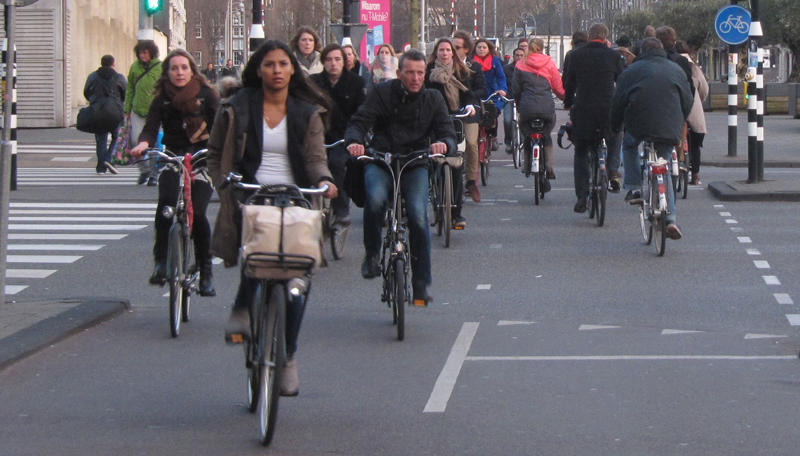
In my experiece they absolutely do, but it is rare to see a big pack together.
Objects moving 3x faster can be 1/3 as dense and have the same overall throughput.
(You can argue that people don't usually leave sufficient space to stop, but I will point out that self-driving cars, which prompted this discussion, are going to be following those basic safety rules)
Your complaint is that cars lower density as speed increases, which is true, but you're still looking at this too narrowly. Consider the bus.
The point is that these comparisons leave out all but one aspect.
As you describe, people may buy self driving cars and use the self-driving feature to drive them more often. Wealthy folks and people in rural areas are almost certain to take this route.
Others predict that people won't buy cars at all and will instead rent them from ride services, who in turn may promote ride sharing on an unprecedented scale. Poor folks, for whom a car is a major expense, are almost certain to take this route, as well as city dwellers.
Personally, I think we may see traffic increase in some areas and substantially decrease in others. I suspect the largest source of traffic -- the commute -- will shrink considerably as networks of reasonably dense self-driving vanpools and small busses pop up.
>> reasonably dense self-driving vanpools and small busses pop up.
Utopia much?
However, it's not like paying a driver $100/day to drive a minibus around to pick people up and drop them off is likely the reason that isn't a widespread service today. So someone would need to explain to me why self-driving changes that equation.
Quite rational reasons for why a driverless taxi won't work.
sandworm101 mentioned "People own cars for irrational reasons". I wanted to add some rational reasons for owning a car, beyond what RightMillennial wrote.
Many people don't have a car and don't need a car. The point is that there are reasons for owning a car beyond 'irrational' things like fashion and coolness.
That said, I agree that habits can change. Car-pooling was probably more common at one point than it is now. On the other hand, a lot of people seem to favor Uber because they don't want to deal with public transit even when it's available.
I think people avoid public transit because it is necessarily slow due to the multiple stops. They may also avoid it because it is too accessible. Sharing a vehicle with other commuting professionals is a vastly different experience than what you'll find on most public transit.
Consolidate taxi/minibus/event bus/medical&elderly ride/mass transit into a pool of vehicles available 24/7 with resources for surge times/maintenance/cleaning etc, and this will become the norm easily enough.
Then it's just a question of who operates and at what cost?
[1] https://www.theverge.com/2018/3/12/17109708/via-arlington-te...
Dynamic routes based on individual demand, grouping together a small number of people into a quick access people carrier. E.g I want to go right across town, you have a shorter journey that roughly overlaps my route, the vehicle will deviate slightly to pick you up.
The second thing to consider is the opportunity for mass-transit level control of autotaxi fleets (or all cars in a glorious future where everything is awesome(tm)). Optimsing the merging and cross traffic flows beyond what traffic lights do today.
And rail transit is a whole other beast. Do you know how much higher a volume of people can be carried by a subway than by even the most efficient bus route running buses bumper-to-bumper (let alone private vehicles)? (The unwillingness of politicians to acknowledge this is one of the reasons the L train shutdown in Brooklyn next year is going to be such a shit show.)
If for instance people in a given community want to start traveling to a different part of a city they either have to create new rail routes or people have to take long inconvenient trips.
Ha! Apparently you haven't used Northern in the UK. Nice! (chuckle)
I don't think it's really about nicety, but about capacity.
A subway train can carry up to 1'000 passengers, depending on length and construction. You can have frequencies of a train every 90 seconds (example: line C in Prague, during rush hour). So you can transport up to 40'000 people per hour in each direction.
Buses, while certainly much better than private vehicles, can never match that capacity. Alas, they're much cheaper and certainly more flexible.
True, but not very useful. The #1 Bus line in Boston takes a route that a trolley once took. And before that it was a horse drawn railcar. And before that it was a 10 seat omnibus carriage route. Same route for a mighty long time.
Perhaps there's not a lot of overlap between people who take Uber a lot and people who willingly step into a bus of any kind.
It’s an interesting case of doublethink to suggest that the programs are unwelcome but also lead to gentrification. Apparently a lot of people do like transit :)
Besides, if we are just on the cusp of having self-driving cars we should be able to deploy self-driving trains right now and reap all the benefits of autonomous transport immediately.
Self-driving (GoA4) trains are close to 40 years old: https://en.wikipedia.org/wiki/Kobe_New_Transit https://en.wikipedia.org/wiki/Lille_Metro
https://en.wikipedia.org/wiki/List_of_automated_urban_metro_...
Should have had these for a while now.
You'd need to have some very smart, and tough public policy in place, though, to constrain robotaxis to instances where they provide maximal societal benefit. It will more likely be a free for all that makes traffic worse, not better, because that's just the way these things tend to go.
Public transit also helps out those who cannot afford alternative forms on transit. I don't see self-driving tech replacing transportation for low-income people, unless we move away from personal vehicle ownership.
What about an automated subway? It's just a box on a track, with the state of all the trains in the track known, self driving would almost be overkill for subways/trams/trains.
It's still public transport. There's no need to hold off the development on both ends.
Trains move more people more efficiently and cheaply. That should remain the case even as driverless cars become popular, at least for another generation - maybe two.
I think it would be a shame to put off important projects on the basis of something that may never happen. I'm sure it would keep the Koch brothers happy though.
"Vaporware is often announced months or years before its purported release, with few details about its development being released. Developers have been accused of intentionally promoting vaporware to keep customers from switching to competing products that offer more features."
If you got rid of all powered transport there would be plenty of unused capacity. But many trips would no longer be feasible. Adding public transport helps enormously, but only along popular routes. Self driving cars may not have the density (though, if used exclusively, they could well be an order of magnitude more dense than ordinary cars) but they have the ability to take the most efficient route, and take you there comfortably with significant luggage. That makes trips possible that public transport can't serve.
While the ride-hailing self-driving cars will be a great boon to those not wanting to drive, saving parking and potentially preventing accidents, I do believe SDC's will come in waves starting from the SW USA and California before spreading to the rest of the country/world. In these areas, public transit will likely be less useful, since for instance in Tucson, AZ, the city is massively spread out and busses would simply incur a much greater time-cost due to their non-personalized route.
Moving forward, as SDC's become more % of the fleet in urban/suburban areas (still won't be in rural areas for another 5-10 years or more), you will probably see more variety of SDC's. Instead of having a 50 person bus, you can have a 5-7 person SD shuttle/minivan (think Waymo Chrsyler Pacifica) that will take 5 people with similar routes to the same place.
Once SDC is highly penetrant in terms of %, I'd expect a great prolfieration of electric scooters, electric pedal-assist bikes, regular bikes, pedestrians, and all sorts of non-vehicular transport. I myself would ride a bike to work if not for the very low-skill drivers I encounter daily in my commute. This happens to be in an urban area with very poor bike infrastructure and very large hills. SDCs + electric bikes would solve these two issues, IMO, and they are probably ~10-15 years out in my location.
When I'm sitting at home or in my cube, my car is not out cruising the streets.
Couple this with idiotic fantasy projects (like monorails that go nowhere - the self-driving car of the mid-aughts!), and you have a self-fulfilling prophecy.
It's like investing in traditional cargo ships right as containerization started happening. Or investing in horse related infrastructure when the automotive was first being released.
This seems relatively sensible to me. Address near term issues - small fixes. And not fund huge projects that may become obsolete before they're finished.
I guess the question is -- how quickly will self driving cars be deployed, and how will they effect the areas. Will self driving cars completely replace buses?