News for hackers. Stuff that matters.
Re:Introducing Multi-Leg Options Strategies by melling on Wednesday June 13, 2018 @10:24AM (#17303328)
“Multi-leg options strategies have been one of the most frequently requested features by options investors on Robinhood. With multi-leg, you can trade Level 3 strategies such as iron condors, straddles, strangles, call and put debit spreads, and call and put credit spreads more efficiently, invest at a lower risk, and with less capital requirements. ”

I’ve never traded options. Have any non-traders here effectively used any of the above mentioned strategies? If so, how do you learn to use these techniques?

Re:Introducing Multi-Leg Options Strategies by bunderbunder on Wednesday June 13, 2018 @12:03PM (#17304321)
My layman's take on this: If you really do think you can make money at this, you'd be silly to waste your time mucking about with a retail options platform. Go get a job as a trader instead.

You'll have to go through quite a bit of training and apprenticeship and suchlike first. That's a good thing. It will get you access to higher quality information than is available as an outsider (those in the know don't dilute the earning power of their best knowledge by just giving it away). Possibly even better yet, you'll be getting paid to learn it instead of expending your own resources and free time.

Once that's done and you're set loose as a full-fledged professional trader, you'll quickly have a pretty enormous amount of capital to work with. You'll only get to take home a small cut of what you're able to earn with that money, but the total size of that cut is still going to dwarf what you can make just playing with your own money.

Re:Introducing Multi-Leg Options Strategies by rjdagost on Wednesday June 13, 2018 @12:33PM (#17304626)
That is just not true. One of your primary advantages as a retail trader is that your positions (being much smaller) don't move the market anywhere near as much as if you're a big institutional investor. So you can pursue strategies that are off limits to institutional investors. Options on small cap companies tend to be illiquid and traded in small quantities, so they often won't be touched by big money. This presents an opportunity for retail investors.
Re:Introducing Multi-Leg Options Strategies by mrfredward on Wednesday June 13, 2018 @02:47PM (#17305927)
It's true that being small is an advantage, but there's something else to consider: Long-term investing is a positive sum game--companies grow and return money to investors, so most investors make money over time. Short-term trading is not like this, it's zero sum. Every quick profit comes at someone else's expense. As they say in poker, if you don't know who the fool at the table is...

...it's probably the guy trading on an app he downloaded 5 minutes ago, whose brokerage doesn't even let him use limit orders.

Re:Introducing Multi-Leg Options Strategies by bunderbunder on Wednesday June 13, 2018 @05:19PM (#17307039)
Well, sometimes it's going to be that little guy, but not always. You can also, for example, try to skim off the moves of big institutional players, whose activity frequently moves prices, by trying to get in there and be the one who reaps the benefit of that price shift. The ultimate seller maybe gets a little bit less than they might have, and the ultimate buyer maybe pays a little bit less, and there's maybe a small gap in between those prices that reflects the trader's take.

I do agree that there can be nooks and crannies with ample room for small players on the equity options market. I'm just not convinced that someone who thinks they have the skills (and guts) to reap a reliable reward in that space should be going straight to Robinhood without at least submitting an application to Citadel first.

Re:Introducing Multi-Leg Options Strategies by zaccus on Wednesday June 13, 2018 @02:27PM (#17305773)
Can one just go out and get a job as a trader, with no related (formal) education, experience, contacts, etc?
Re:Introducing Multi-Leg Options Strategies by koolba on Wednesday June 13, 2018 @10:30AM (#17303387)
Multi-leg option strategies are designed to constrain the total risk exposure and possible profit of a combination of trades.

One of the simplest example is to sell a call at $X and purchase one at $X+N[1]. The purchased call is insurance against being on the hook for an unknown rise in the prices of security (which would then be exercised against your sold call). The "bet" in this case is that the rise in the price of the stock during the period of the spread is not going to rise above $X by more than the price difference of the two options.

All the rest of the fancy names are combinations of buying or selling these types of combinations. The names come a combination of the desired result (ex: "strangle") or the shape of the profit graph (ex: "condor").

Do a lot of reading before dipping your toes into options trading. On the one hand it's arguably less risky than regular equities as you "know" what you're risking. On the other hand it's very easy to get wiped out as well. Something as stupid as not closing your our spreads before expiration can destroy your account if they get exercised.

[1]: https://en.wikipedia.org/wiki/Bear_spread#Bear_call_spread

Re:Introducing Multi-Leg Options Strategies by ryandrake on Wednesday June 13, 2018 @11:35AM (#17304054)
Honestly these tools remind me of all the “systems” gamblers are constantly coming up with, thinking they can beat the casino in the long term. Complete with the goofy names and cottage industry of books, experts and courses teaching you the system.
Re:Introducing Multi-Leg Options Strategies by throwawaymath on Wednesday June 13, 2018 @01:54PM (#17305473)
There is a cottage industry of people selling trainings and courses for trading options. As you'd expect, this tends to attract many of the same people as the older day trading training industry. If you visit /r/options or /r/algotrading you'll see plenty of this spam in action. Instead of learning options theory from first principles, these courses focus on rote memorization of common patterns (e.g. "what is an iron condor"). Naturally the market is efficient enough that such a brittle understanding of derivatives and market dynamics is not consistently profitable.

The people in the know (those who actually beat the market) don't teach other people how to trade, because giving away information is strictly less profitable than trading on it yourself (or on behalf of your firm). They also very rarely trade their own capital, and typically work within funds. This sets up a dynamic where it's extraordinarily difficult to learn the "proper" principles of derivatives trading in a sound framework of market microstructure unless you join a firm, because all public information on the subject is almost definitionally misleading. The next best thing is to learn from established textbooks, but surprise, very few people want to read three - five textbooks with advanced mathematics instead of watching a few webinars on "the greeks."

Re:Introducing Multi-Leg Options Strategies by jonknee on Wednesday June 13, 2018 @11:42AM (#17304131)
It's just different ways of describing risk/reward. Unlike a casino you can take either side of the contract.
Re:Introducing Multi-Leg Options Strategies by ryandrake on Wednesday June 13, 2018 @12:09PM (#17304373)
It’s more like poker in the casino. There are at least three sides: player A (you), player B (your counterparty), and the casino (Wall St.). It’s zero sum between A and B, but the casino always takes their cut. +EV for the casino means -EV for the players on average
Re:Introducing Multi-Leg Options Strategies by function_seven on Wednesday June 13, 2018 @12:22PM (#17304530)
Yeah, I always visualize large ask/bid spreads as the "rake".
Re:Introducing Multi-Leg Options Strategies by radiusvector on Wednesday June 13, 2018 @11:49AM (#17304197)
How can you "wipe out" your account if you don't close a spread? AFAIK Robinhood does not allow for naked calls/puts or selling strangles without a collateral upfront.
Re:Introducing Multi-Leg Options Strategies by koolba on Wednesday June 13, 2018 @12:33PM (#17304627)
If you don't close a spread prior to it expiring then it's possible for a execution of the option by the counter party. In that situation you can be forced to either provide the securities (if you sold calls) or forced to buy the stock (if you sold puts). As it happens at the expiration of the option you no longer have the option to exercise the other half of your spread.

As the margin required for a spread is substantially less than the full price of the security (which is the whole point of the spread), you can end up in a situation where you're forced to buy more stock than the total liquidation value of your portfolio. Plus this happens at the close on a Friday (as that's when option expiration happens) so you can't liquidate the stock until Monday morning and you're at the mercy of the opening price. If the quantity of options sold is large enough and the price moves against you far enough, you can get completely wiped out.

It's your responsibility to close out your spreads prior to close. FYI, this situation can happen even if they're out of the money as the counter party to the worthless option could still choose to exercise it.

Re:Introducing Multi-Leg Options Strategies by radiusvector on Wednesday June 13, 2018 @12:54PM (#17304844)
Could you give me a concrete example?

To me, it sounds like you are describing a naked short call, or a short put.

It is not a spread. By definition, spreads have limited risk, and limited rewards.

The four main types of spreads. Take a look at the PNL diagrams. It is limited risk. https://www.optionseducation.org/strategies_advanced_concept... https://www.optionseducation.org/strategies_advanced_concept... https://www.optionseducation.org/strategies_advanced_concept... https://www.optionseducation.org/strategies_advanced_concept...

Re:Introducing Multi-Leg Options Strategies by koolba on Wednesday June 13, 2018 @01:05PM (#17304976)
Read this article: http://tastytradenetwork.squarespace.com/tt/blog/options-ass...

The situation I’m describing is when the sold option expires in the money but the purchased cover does not. It won’t automatically execute and you’re left with essentially a naked short.

Re:Introducing Multi-Leg Options Strategies by throwawayad7d9f on Wednesday June 13, 2018 @11:53AM (#17304239)
Yep! Mainly call/put spreads but also iron condors.

The basic idea of options is that you think the price is going to be somewhere within a certain period of time and you place a bet saying so. If you bet right, you make money, if you bet wrong, you lose it.

The different strategies give you different ways of targeting prices. For example a call debit spread is essentially "I think the price will be below $X in Y days", an Iron Condor is "I think the price will be between $X and $Y in Z days" and a straddle is "I think the price will move by $X in either direction in Y days".

The different strategies also have different profit/loss curves. For example selling a call option has unlimited loss potential (the stock could theoretically soar 1000x before the option expires) while selling a call spread has defined loss potential.

The process for me is basically find somewhere where the option is typically priced higher than it's worth and sell spreads. Sometimes this is year round, sometimes around earnings.

Re:Introducing Multi-Leg Options Strategies by whatok on Wednesday June 13, 2018 @12:05PM (#17304338)
99% of people who make consistent money trading options have little to no view of the price of the underlying.
Re:Introducing Multi-Leg Options Strategies by throwawaymath on Wednesday June 13, 2018 @02:02PM (#17305547)
It's a serious pet peeve of mine when people use arbitrary statistics instead of just saying "most" or "almost all." What's the point of quantifying something if it's made up?

That said...yes, most profitable options trading (especially on intraday time resolutions) is focused on volatility and pricing inefficiency, not forecasting the directional movement of the underlying price.

Re:Introducing Multi-Leg Options Strategies by kuwze on Wednesday June 13, 2018 @11:28AM (#17303997)
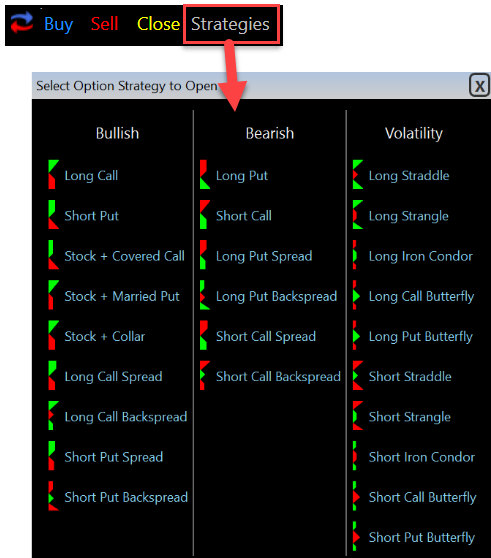
TC2000 has a really great visual representation of various option payoffs[0]; remembering their names is next to impossible for me. The only thing it's missing are futures and a good depth of market view like NinjaTrader.

[0]: https://www.tc2000.com/CMS_Static/Uploads/526553716D662F/201...
Re:Introducing Multi-Leg Options Strategies by super996 on Wednesday June 13, 2018 @12:37PM (#17304657)
Read Option Pricing and Volatility, by Sheldon Natenburg. This is the bible for option trading. As a former member of the now defunct AMEX, every trader from here to Chicago is familiar with this book.
Re:Introducing Multi-Leg Options Strategies by bcheung on Wednesday June 13, 2018 @05:12PM (#17306990)
Options greatly expand the universe of possibilities when it comes to investing in markets. You can make money if a stock goes up, if it goes down, and even if it doesn't go anywhere at all.

Options can be used to increase leverage and they can also be used to decrease risk.

You can use options to change the risk / reward profile in non-linear ways. Meaning you can do things like, I'll sacrifice a little bit of my upside to reduce the risk on the downside (and vice versa).

You can also design positions such that if the stock goes up a little bit I make money much easier but if it goes up a lot I don't get as big of a win.

One of the best books on the subject I know of is "Option Investing as a Strategic Investment". It is sufficiently technical and yet approachable as well. It goes from introductory basic theory to complex multi-legged strategies.

Me personally I don't touch the market at all any more and choose to invest in real estate. I can't speak to the current option trading environment. I used to trade options in the past and didn't see anything significant from it. No catastrophic loses, no big wins. I don't know what the landscape looks like now with more algo type trading.

Re:Introducing Multi-Leg Options Strategies by jnwatson on Wednesday June 13, 2018 @10:38AM (#17303477)
Books. This is definitely an area where book study is important. You must learn the “Greeks” as most of the different strategies are tradeoffs among those variables. It isn’t hard if you remember your multivariate calculus.

The biggest issue I had back when I played is commission. If this is commission free, that’s a whole new ballgame.

Re:Introducing Multi-Leg Options Strategies by bertjk on Wednesday June 13, 2018 @11:07AM (#17303774)
Though if we are talking multi-leg options, bid/ask spreads are likely significant too.
Re:Introducing Multi-Leg Options Strategies by wycy on Wednesday June 13, 2018 @10:53AM (#17303623)
Investopedia has good resources for understanding the various types of options spreads. They have nice cartoon graphs that illustrate what happens in each one. For example, the page on the iron condor[0] or the straddle[1].

[0] https://www.investopedia.com/terms/i/ironcondor.asp

[1] https://www.investopedia.com/terms/s/straddle.asp

Re:Introducing Multi-Leg Options Strategies by cascom on Wednesday June 13, 2018 @11:28AM (#17303996)
Check out the Options Clearing Corporation https://www.theocc.com/education/options/
Re:Introducing Multi-Leg Options Strategies by clairity on Wednesday June 13, 2018 @12:41PM (#17304697)
these are for the advanced gamblers on the market, once you get bored of regular equities trading (short and long), and basic put and call options. they’re names for various combinations of the aforementioned basic trades.

they don’t actually give you a real advantage, because that only comes from (insider) information. rather, they’re designed to increase your investment/involvement and prolong the gambling time (and enjoyment possibly).

Re:Introducing Multi-Leg Options Strategies by mikec3010 on Wednesday June 13, 2018 @03:23PM (#17306171)
As I get older, the more I agree with this sentiment. Before the stock market, businesses made money for the owners. Stocks allowed anyone to share ownership of businesses, who thereby benefited from the influx of capital. An investor could put his money away with long term gains if the company made money. And by diversifying he could shield himself from the ones that didn't.

What tangible value do options actually bring anyone besides gambling? Oh they allow shareholders to rent out their shares, or allow you to structure sales before/after the fiscal year? Big deal.

All it does is create a market for pseudo science middle men/rent seekers who sell "vehicles" that many use to try to get rich quick.

All this does is divert funds from markets that are actually tied to something useful like legitimate businesses that sell products or services

Re:Introducing Multi-Leg Options Strategies by clairity on Wednesday June 13, 2018 @04:12PM (#17306532)
agreed, the legitimate uses of these financial tools (as you noted) are dwarfed by the actions of rent seekers.

let's support creators (of all stripes) over rent seekers. there's no need to reward a person for simple ownership over some capital or good. rewards should go to those who wield them effectively by making something useful out of it. it's trickier to do than it sounds, but absolutely worth the effort.

Re:Introducing Multi-Leg Options Strategies by mikec3010 on Wednesday June 13, 2018 @04:55PM (#17306860)
Also forgot the biggest reason: "they allow you to buy and sell volatility".

Ok, but volatility isn't an asset. So this must be the original "synthetic asset", long before all the other exotics came on the scene.

On one hand, why should I care what other people do with their money. But what worries me is that with normal markets, assets have intrinsic value: corn, oil, securities. They're all things people want. The market can always assume this is true, but with synthetic "assets" like trading volatility, it's not true and that creates a market built on a false pretense.

Re:Introducing Multi-Leg Options Strategies by durkie on Wednesday June 13, 2018 @10:26AM (#17303346)
you have a few ways:

* a paper trading account, where you can experiment with trading strategies without risking real money

* reading about the strategies and their payoff scheme, eg: http://www.theoptionsguide.com/long-straddle.aspx

Re:Introducing Multi-Leg Options Strategies by thro1237 on Wednesday June 13, 2018 @10:31AM (#17303401)
Thanks -- Is there some software (mostly free) where I can model these strategies and understand the payoffs, etc?
Re:Introducing Multi-Leg Options Strategies by durkie on Wednesday June 13, 2018 @11:23AM (#17303942)
http://www.optionsprofitcalculator.com/ seems to be kind of popular, but it's not the most intuitive to use. I think of this as something that many brokerages offer...
Re:Introducing Multi-Leg Options Strategies by jonknee on Wednesday June 13, 2018 @11:20AM (#17303904)
This is a pretty clean list of all the common strategies along with charts showing their P/L:

http://www.theoptionsguide.com/option-trading-strategies.asp...

Re:Introducing Multi-Leg Options Strategies by deltateam on Wednesday June 13, 2018 @11:19AM (#17303894)
I personally liked the Bible of Options Strategies that I read 10 years ago.

I loved trading butterflies on Thursday-Friday. Butterflies are a form of debit spread.

Re:Introducing Multi-Leg Options Strategies by thisisit on Wednesday June 13, 2018 @12:31PM (#17304603)
> I’ve never traded options.

Then please stay away from multi leg options stuff because it gets even more complicated.

Re:Introducing Multi-Leg Options Strategies by bcheung on Wednesday June 13, 2018 @05:16PM (#17307018)
Agreed. Learn the basics first before doing anything advanced. At a minimum, know what trading "naked" means and don't do it unless you REALLY know what you are doing.
Re:Introducing Multi-Leg Options Strategies by paulie_a on Wednesday June 13, 2018 @10:27AM (#17303354)
Learn by doing. what could go wrong?
Re:Introducing Multi-Leg Options Strategies by deltateam on Wednesday June 13, 2018 @11:21AM (#17303927)
Its the best way. What happens is that you lose money. This is the best way to enjoy your privilege in society, capital loss deductions aren't bad.

Better yet, if you want to REALLY amplify your socioeconomic privilege, you can turn capital losses into Net Operating Losses and deduct the entire thing as an income expense. Do this by forming an LLC and sending a Section 475 election to the IRS before April. This is specific for traders doing short term strategies in the equity and equity options market.

You will then lose your money experimenting with options and the government will pay you back, from taxes you sent them in prior years, current and future years.

Re:Introducing Multi-Leg Options Strategies by nimish on Wednesday June 13, 2018 @04:04PM (#17306456)
Leverage.
Re:Introducing Multi-Leg Options Strategies by anoncoward111 on Wednesday June 13, 2018 @11:13AM (#17303834)
Multi leg options sound weird on paper but aren't too hard to understand when explained properly.

An option is a bet on the future price of a stock. If you think that Stock XYZ will go from $15 today to $20 next month, you can buy an option that will reflect your prediction.

A multi-leg option allows you to bet on the "magnitude" of a stock's price change, rather than the "direction".

For example: "Tesla reports earnings next month. They're either gonna be REALLY good, or REALLY bad. So let me buy a multi-leg option that predicts a 10% price jump either up or down". You'll make money whether Tesla goes up 10% or down 10%. You'll lose a ton of money if Tesla remains roughly the same price.

Re:Introducing Multi-Leg Options Strategies by jonknee on Wednesday June 13, 2018 @11:18AM (#17303886)
> A multi-leg option allows you to bet on the "magnitude" of a stock's price change, rather than the "direction".

Or simply define risk/reward (spreads and the like). That's especially useful if you want to sell premium and not risk getting killed.

Re:Introducing Multi-Leg Options Strategies by wdn on Wednesday June 13, 2018 @12:18PM (#17304489)
Actually, it doesn't work like that.

If a stock is volatile, as TSLA is, the out of money (OTM) options will take that into consideration and the premium for it will be very very high.

A OTM straddle options trade probably a very bad choice. Like you said, if TSLA don't make a big move, you will lose. Even if they do make a big move, you will still lose because you are opening a trade on both directions.

My personal opinion on options is this: 1. Find stocks that move 2. Buy in the motion options 3. Expiration at least 6 weeks away, prefer to be longer. If price move into your target, great, take profit early.

Re:Introducing Multi-Leg Options Strategies by anoncoward111 on Wednesday June 13, 2018 @01:59PM (#17305522)
I mean, sure, I agree. I was merely describing a type of multi leg option.

The premium on a 10% move option wouldn't be as high as you think. There's a lot of risk/reward here.

You'll pay a really high premium if your prediction is 'i think it will go up 2% in the next 9 months" :)

Re:Introducing Multi-Leg Options Strategies by bcheung on Wednesday June 13, 2018 @05:15PM (#17307010)
That's just one approach. There's no right or wrong answer. You can also find stocks that you don't think will move at all, or that will only trade within a narrow channel and design calendar trades around it.
Re:Introducing Multi-Leg Options Strategies by hhmc on Wednesday June 13, 2018 @01:19PM (#17305134)
I suspect you meant to type "2. Buy in the money options"
Re:Introducing Multi-Leg Options Strategies by erpellan on Sunday June 17, 2018 @03:39AM (#17331333)
Given the context, wouldn't 'out of the money' options make more sense? You win big if the price goes into the money.