Is it really a problem that families aren’t together? Previously (with some hold outs) there wasn’t much choice and families had to stay together due to issues around control through money, religion and social pressures. Go back further (hopefully, though this is still pretty grim in many areas) and domestic violence was also legal. “Breakdown” of families is a considerably better option than what was previously available.
> the increased polarization and technology-driven personal atomization in the current mileau
I don’t understand what this means, could you give an example?
if you care about the epidemic of loneliness, the negative medical consequences of social isolation, and the demographic sustainability of developed countries, yes.
Marriage in and of itself isn’t shown to automatically increase happiness; most folks reported having maintained their baseline mood after the wedding
Maybe this is just old definitions needing to be updated, but “family” in the traditional mom-dad-kids all visit grandma and the like, isn’t essential to the species.
Socializing is, but not the traditional structures
Apparently yes. But it's one of those issues modern culture has blinders on.
http://bigthink.com/ideafeed/scientists-think-loneliness-is-...
https://hbr.org/cover-story/2017/09/work-and-the-loneliness-...
http://www.bbc.com/news/av/world-us-canada-42031799/why-an-e...
https://www.usatoday.com/story/news/nation-now/2018/01/29/17...
https://www.nytimes.com/2017/10/26/us/opioid-crisis-public-h...
https://www.amazon.com/Haven-Heartless-World-Norton-Paperbac...
There's some trend to have huge issues, felt and experienced by tens of millions, studied by tons of different groups, admitted by experts, pointed at by tons of different statistics, etc, and people wanting to have some definitive "this is the final 100% statistical proof with n confidence" on it, or else it doesn't exist.
It's more lalala hands in the ears denial than actual science. Same thing for the environmental change deniers.
In contrast, neurotically wringing our figurative hands about imagined problems like the link between vaccines and autism, the link between video games and school shootings, or disintegration of traditional values in modern times; all without hard science backing it up; will continue to fail to convince all but the most blinded.
And whether the problem is "new" or a few decades old is really irrelevant.
Why should we think it's not tens of thousands of years old?
Because we weren't born yesterday, and we now how it was in the 80s and 70s, compared to the 60s and 50s and 40s...
http://blog.fusedgrid.ca/wp-content/uploads/2015/03/VKM-Fata...
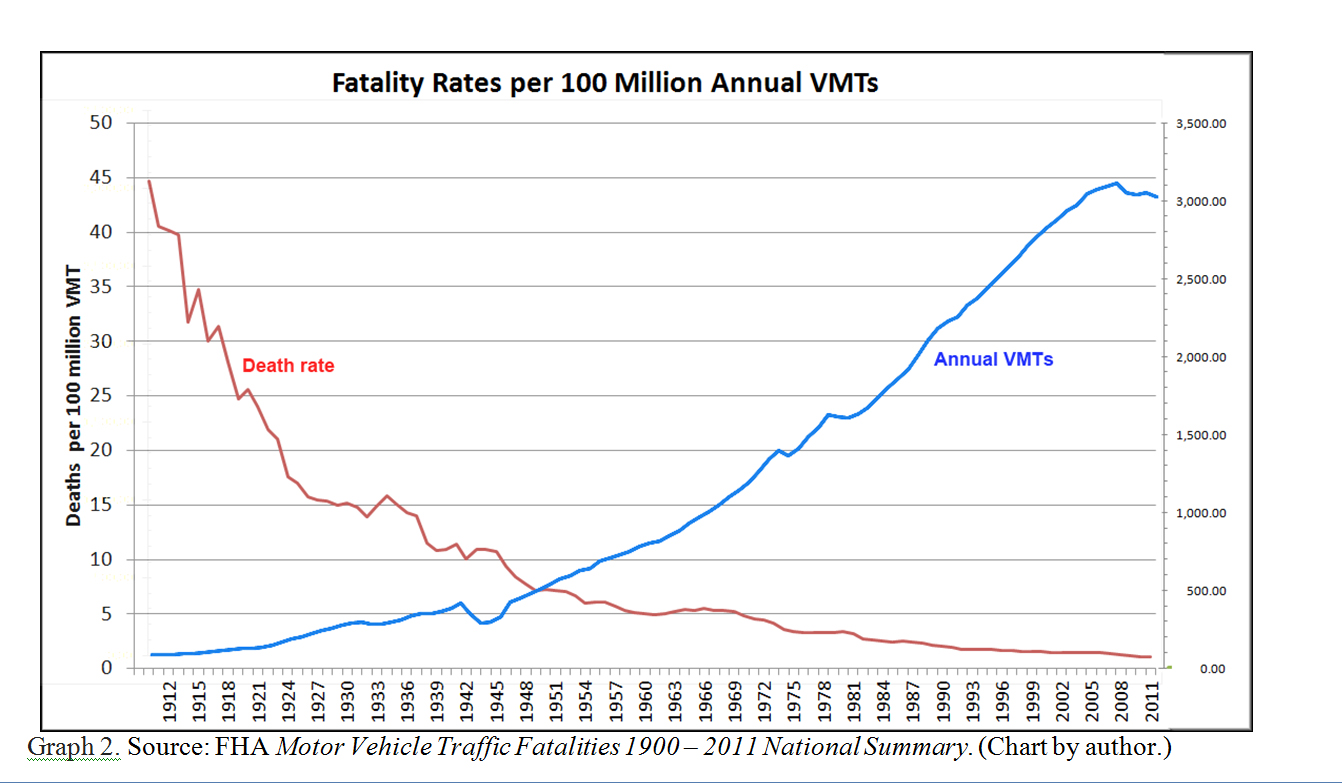
I guess engineering-related safety regulations actually work.
Half the reduction occurred from 1912 to about 1922, the first decade of large-scale auto use. Bt 1940, it halved again. The next halving gets you to the eary 1970s.
The present rate looks to be about 1 death per 100 million vehicle miles travelled (VMT), or roughly 1/5 the rate in 1970.
My main takeaway is diminishing marginal returns, and a fairly consistent trend of halving the rate every 20 years or so, after the first decade.
Overall accident instances tend to scale with miles driven, which are a pro-cyclical economic factor. That is: as economic activity increases, people drive more, for both commuting and recreation.
https://www.cdc.gov/motorvehiclesafety/distracted_driving/in...
https://www.nytimes.com/2018/02/22/opinion/steven-pinker-rad...
Pinker avoids addressing the social breakdown of families and the increased polarization and technology-driven personal atomization in the current mileau, whose undertow underlies a lot of the big issues today.
Otherwise, an admiral figure from the elite academy.