News for hackers. Stuff that matters.
Re:Once seniors are too old to drive, our transportation sys... by tabeth on Monday January 22, 2018 @07:07PM (#16209484)
I always get an inkling that buses (like Bolt/Mega/PeterPan) + the existing highway + roads are superior and more scalable than any other type of transportation, dollar for dollar.

Why do people push for rail? Self-driving cars obviously can enhance this (the bus idea), but I suspect they will create even more traffic if we insist on having 5 passenger cars be 75% empty. Buses are great because demand can be reallocated easily.

Imagine a place like New York, where buses can go out to the suburbs and bring people into the city and the evening and morning (say, 50% of the fleet), and during the day 90% of the fleet stays in the city doing intra-city transportation.

Rail doesn't have this flexibility.

EDIT: Rail definitely has its place, but you almost never hear anyone starting a bus project. Just curious to why there's relatively little mention of buses in the public transportation (new project) realm.

I imagine perfected public transportation would involve linking between self driving cars on the square mile level, buses on the square deca mile (is that a thing?), rail for a hundred mile radius and obviously planes thereon.

Re:Once seniors are too old to drive, our transportation sys... by mschuster91 on Monday January 22, 2018 @07:39PM (#16209703)
> Why do people push for rail?

Because well-done High Speed Rail (HSR) is a blast over long distances. Certainly for city/metro areas a combination of light rail + buses as a web is the best option (light rail having the advantage of running emissions free), but the longer the distances are the better HSR is. The new ICE line Munich-Berlin with 4h one-way is so fast that it's actually threatening flight.

Also, traveling long distances by bus is really bad. Cramped seats, cramped everything.

Re:Once seniors are too old to drive, our transportation sys... by jschwartzi on Tuesday January 23, 2018 @09:52AM (#16213961)
I can attest to how awesome rail is. I recently took the shinkansen from Tokyo station to Sendai in Japan, and it turned an 8-hour car trip into a two hour train ride.

The seats were as large as business-class airplane seats.

It would likely have taken much longer by bus because of all the stops and transfers.

Re:Once seniors are too old to drive, our transportation sys... by adrianN on Tuesday January 23, 2018 @12:02AM (#16211150)
There are electric buses that run emission free. They have the additional benefit of not needing extremely expensive new infrastructure for starting a new line. I think they would work much better in low density settings like American suburbia.
Re:Once seniors are too old to drive, our transportation sys... by majewsky on Tuesday January 23, 2018 @03:32AM (#16211939)
> They have the additional benefit of not needing extremely expensive new infrastructure for starting a new line.

Only because of the sunk cost of building all those interstates. At some point, you're going to need to repair or rebuild them.

Which makes me wonder: What is the cost of a new kilometer of rail vs. a new kilometer of highway? And which one is cheaper to maintain? I don't have any intuition there.

Re:Once seniors are too old to drive, our transportation sys... by jseliger on Monday January 22, 2018 @07:45PM (#16209746)
Why do people push for rail

Visit Japan (or these days China) and you will understand.

This reminds me of people who say, "What's the big deal about electric bikes?" Ride one and you'll know.

See what Japan and China are doing WRT rail and you'll know.

Re:Once seniors are too old to drive, our transportation sys... by lgas on Monday January 22, 2018 @08:03PM (#16209875)
Given the difficulty and expense associated with going to Japan, perhaps you could describe it to us here using words.
Re:Once seniors are too old to drive, our transportation sys... by gbhn on Monday January 22, 2018 @08:52PM (#16210189)
I visited Japan a few years ago. There are regular extremely fast trains going between large cities and smaller ones. I estimated that the passenger capacity of trains stopping at one smallish city was equivalent to like 3x the passenger capacity of a major metropolitan airport in the US. From a big hub it's probably 10x that (maybe more).

The trains run very frequently, with reasonable fares. It looked to be completely sensible and fast to live in an outlying city and take the train into a larger one for work, whereas the idea of catching a commuter flight from a smaller outlying city into a major metro area in the US (or likely anywhere) is almost completely untenable -- too expensive, too time consuming, too irregular, and too much hassle.

Re:Once seniors are too old to drive, our transportation sys... by dragontamer on Monday January 22, 2018 @08:30PM (#16210055)
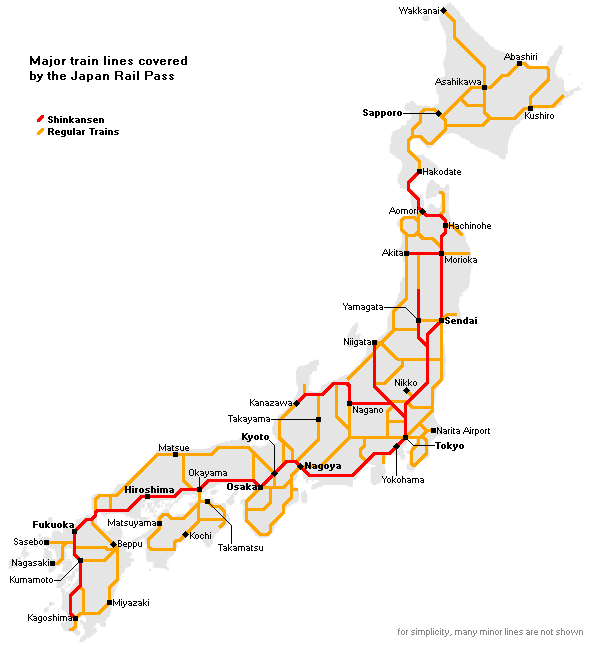
You pretty much can get anywhere in Japan using rail / subway alone.

https://www.japan-guide.com/g17/2361_01.png
Subway maps cover cities to insane details.
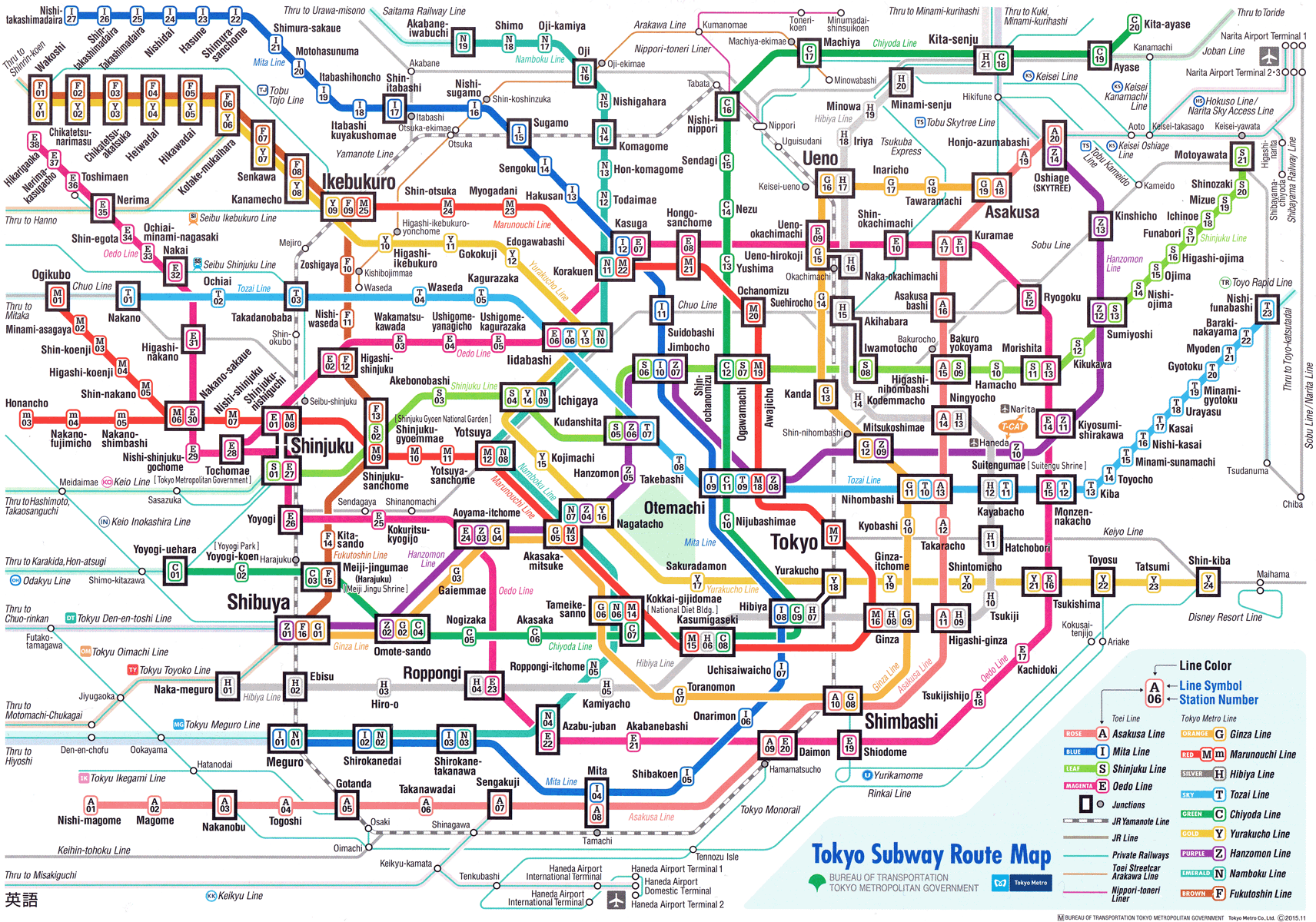
https://bento.com/pix/subway/tokyo_subway_1700.gif

Re:Once seniors are too old to drive, our transportation sys... by tzakrajs on Monday January 22, 2018 @08:56PM (#16210216)
Also the Yamanote line (circles inside Tokyo, goes thru Shinjuku and all other major wards) stops at each stop once every ~3 minutes during the day. It is incredible.
Re:Once seniors are too old to drive, our transportation sys... by seanmcdirmid on Monday January 22, 2018 @08:55PM (#16210209)
The same isn't so true for China. While they have HSR inter-city down, they don't have the same developed smaller branch lines that Japan does.
Re:Once seniors are too old to drive, our transportation sys... by osdiab on Tuesday January 23, 2018 @09:33PM (#16219869)
Quickly changing though. Shanghai intends to add on another 7 or 8 lines in the next 7 years for instance, with the intention of having everywhere in the inner rings within half a kilometer of a station. Change is the constant there.

And at least for the able bodied, bike shares pretty much make up for it in the short term.

Re:Once seniors are too old to drive, our transportation sys... by MarkSweep on Monday January 22, 2018 @09:35PM (#16210470)
This map covers the whole Kantō area and shows all the train lines you can use a Suica card on:

PDF: http://www.jreast.co.jp/e/routemaps/pdf/RouteMap_majorrailsu...

Re:Once seniors are too old to drive, our transportation sys... by rpearl on Monday January 22, 2018 @10:43PM (#16210796)
That's not even the entire train network, just the Tokyo municipal-run subway system I believe.
Re:Once seniors are too old to drive, our transportation sys... by Sophistifunk on Monday January 22, 2018 @09:32PM (#16210446)
Their public transit system is great, and you pay for it with rechargeable cards that can also be used for all sorts of other shit in vending machines and retail locations.

And unless you're (statistically) fairly short and thin for a westerner, you won't fit in anything.

But hot-damn does looking out the window at Fujisan while doing 300km/h do a good job at distracting you from having your knees around your ears.

Re:Once seniors are too old to drive, our transportation sys... by adrianN on Tuesday January 23, 2018 @12:03AM (#16211157)
I'm statistically fairly long for a westerner and I fit into Shinkansen seats better than in ICE seats.
Re:Once seniors are too old to drive, our transportation sys... by mikekchar on Monday January 22, 2018 @10:44PM (#16210805)
I live in Japan and actually live in rural enough area that there is no train. Well, there was a train until 1968 when the bus company convinced the fishermen that the reduced fish stocks were due to the train scaring away the fish (not over fishing, of course!). Now there are no fish and no train :-(

Before I extol the virtues of the train system in Japan, there is one thing that you have to understand first. It is expensive compared to transit services in many North American cities. As far as I know, it's not subsidised by government, so you have to pay the full cost. The main rail system is owned by Japan Rail, but they are operated by individual companies -- each with a monopoly in their own area. Additionally, there are "private" train companies that both own the lines and run the trains. If you live in a very rural area (and it wasn't screwed over by the bus companies), you will almost certainly be using these private lines. If you want to go to a big city, it usually means that you have to transfer. Luckily the payment options are almost completely harmonised -- at least on the regional level. You can get pre-paid cards that work for all the companies in your region (with a very few exceptions).

I live in Shizuoka prefecture. To take the bus a distance of about 30 km it costs about $10 US (also not subsidised). To take the train, it's a bit cheaper (about $7). If you take intercity busses, the relationship switches. A 200 km bus trip costs about $30, while the train will cost about $50. However, the intercity busses only travel about 4 times a day, while the trains come every 15 minutes.

The main difference between the train and the bus is convenience and speed. The trains are quite fast. I often travel to Hamamatsu city from Kanaya city by train. Due to circumstances, my wife goes by car. I beat her every single time -- sometimes by hours. By car, there are lots of unexpected events: accidents, traffic jams, etc. On the train, there are very few -- really just suicide attempts and I haven't seen one in our area for years.

In Japan the trains are on time. Very, very, very occasionally the train will be 1 minute late. Once a year it will be 2 or more minutes late. Seriously, if the train is not on the platform 30 seconds before the scheduled departure time, people are looking at their watches in disbelief.

Part of this is because the trains are set up so that freight is generally able to pass and be passed. On private, rural lines, there is never any freight (though the trains often carry mail). Also the trains are all in good shape. I've literally never been on a train in Japan that broke down. When I lived just outside of London, the trains would break down every week at least. One of the other main points is that theft in Japan is virtually unheard of. When I lived in the UK, I heard that one of the reasons the signalling constantly broke down is because people would steal the copper cables for scrap. Culturally, this just doesn't happen in Japan, so it's a consideration you have to keep in mind if you want to emulate Japan's success with trains.

While my wife has a car, I don't like using it. If we go anywhere, it's usually by bus and then by train. It's only if we need a car at the other end that we use the car (for example, when we go to Hamamatsu, my wife takes the car so that she can take her mother shopping, etc). Because there is no train where I live, I end up always taking the bus.

Even though Japan is a country where punctuality is almost taken for granted, busses are not punctual. They suffer from the same problems that happen everywhere -- busses are really hard to predict. Sometimes the road is clear, and sometimes it is not. The busses usually end up being virtually randomly timed by the time they end up in the middle of their route. I almost always miss my connection at the train station. Because the bus comes every hour or so, it means I usually have to plan very carefully to ensure that I arrive on time. Often I end up arriving an hour early just to make sure I get there on time.

Before I got married, I went out socially a lot more. I discovered that even though the train station is 20 km away, it was faster (and more predictable) for me to ride my bike there, take a bath at the nearby hot springs and then go to the city by train than it was to simply take the bus there directly. This is where I got my love of cycling (and hot springs!).

As I alluded to earlier, a lot of the reason that Japanese trains work is due to Japanese culture. For example, companies that get a monopoly will rip you off, but only by so much. They truly have a sense of social responsibility. The UK moved from a national rail system to something similar to what Japan has and from what I can tell, it completely broke their rail system (I'll probably get some argument about that). However, from my perspective, it's pretty clear that rail is simply easier to make work well than busses. It doesn't necessarily follow that any area building a rail system will make one that works well (I come from Canada and though I love trains I am never going to give any more money to Via. Ever.)

Re:Once seniors are too old to drive, our transportation sys... by innocenat on Tuesday January 23, 2018 @07:13AM (#16212944)
> In Japan the trains are on time. Very, very, very occasionally the train will be 1 minute late. Once a year it will be 2 or more minutes late. Seriously, if the train is not on the platform 30 seconds before the scheduled departure time, people are looking at their watches in disbelief.

You should try one in the Western Japan. My daily commute on Hankyu line during rush hour is generally 2-3 minutes late every day that I usually plan for it to be late. And JR West is not faring very better either. But we do look at our watches, the departure board, and back at our watches in disbelief, yes.

Re:Once seniors are too old to drive, our transportation sys... by usrusr on Tuesday January 23, 2018 @05:03AM (#16212286)
> For example, companies that get a monopoly will rip you off, but only by so much.

Sounds like a rare victory of the good over its old nemesis, the perfect. I believe that a social environment that can pull this off will have a clear edge in many different ways, e.g. government can work so much better when it can be trusted that power abuse, if it happens, won't be excessive. Much better than pretend-saints who really aren't.

Re:Once seniors are too old to drive, our transportation sys... by ForRealsies on Tuesday January 23, 2018 @09:41AM (#16213850)
Does empathy seem to thrive in smaller, homogeneous communities(ex. Japan, Nordic countries)?
Re:Once seniors are too old to drive, our transportation sys... by usrusr on Tuesday January 23, 2018 @10:14AM (#16214171)
I'd lean towards narrowing that question down to is it the explanation or is it just a confounding factor?

Optimism mandates that it should hopefully be the latter. It doesn't take much imagination to assume that celebration of ruthless, "take everything you can" types could (in theory) also be minimized in larger, now mixed communities.

Re:Once seniors are too old to drive, our transportation sys... by lozenge on Tuesday January 23, 2018 @06:46PM (#16219025)
When you are driving, you're, well, driving. Most of your mental capacity is on the task at hand. The remaining capacity drifts from subject to subject with nothing to anchor it - no note taking, very limited communicating. Your basic needs (mental rest, hydration, toilet) are pushed to a rest stop schedule. Every stop sign, right on red, or on ramp is a new negotiation. Even choosing your music is a big task leading you to settle for the radio.

In a train you're simply transported sitting down. You can text, have a face to face conversation, look out the window, go to the toilet, buy reasonably priced drinks, read or work as you fancy. The occasional change between trains is a stronger punctuation in your journey than your car leaving the freeway, and still only requires a few minutes of cursory attention every now and then.

Edit: I didn't even mention the timing aspect! In Japan you could get the same train every day and arrive on time every day. Commute on the roads and you will always be wondering when exactly you will get to work/home and what you will do with the little random slither of spare or lost time. Of course, the accelerator pedal is right there so you always have the option to drive a bit more aggressively, so you will consider it every now and then, rather than thinking about something more meaningful to your life.

Re:Once seniors are too old to drive, our transportation sys... by osdiab on Tuesday January 23, 2018 @09:24PM (#16219831)
China's system has one major leg up over Japan's, which is that it's still pretty cost effective and has become faster and potentially more thorough in the years to come (China is a much bigger country, so building out a thorough system is commensurately harder, but the East Coast and some major cities inland are already built out). That said if you're a tourist in Japan you can just get a JR pass and do it unlimited for a low cost—that doesn't apply to locals though, where Shinkansen is often more expensive than flying.

I was living in China for the last 6 months, you can just show up to the station without plans usually and book a high speed train ride 5 minutes before you go, where you'll be whisked from Xi'an to Beijing, a 13+ hour, 1,000km drive (about the distance from Boston to Cleveland), in 4.5 hours, with huge, comfortable seats, panoramic views of the countryside flying by at incredible speeds, and almost nothing will change your expected arrival (traffic? forget it, delays? pretty rare). You get clean restrooms and food and almost no time wasted at security, no worries about checked baggage limits and fees, and the ability to rebook for 10-20 minutes from now if you miss your train, all of this for less than $80?

Imagine if you could on an afternoon you decide that you want to go to Miami from Charlotte, and you can just casually get up and be there by dinnertime without going broke? It's terrific.

Or if you're more into regional transit, you can go from Suzhou to Shanghai, a 2 hour drive, within 30 minutes for like $5 without planning, similar routes which expand access to Shanghai within an hour's reach of over 120 million people.

It allows you to live in a small, isolated city in the countryside, yet be served by the huge scale airports and business of a megacity, with only a small fee and short time on a comfortable train where you can work, read, meditate, rest, or whatever it is you want to do. It expands your possibilities and brings equality of access in ways you wouldn't realize until you are a part of it.

In comparison with buses, for longer distance it definitely makes sense. For travel within cities, higher reliability (eschewing traffic and potential for accidents), very high capacity, comfort (no abrupt stopping and going, for modern systems at least; also less likely to experience motion sickness, which makes reading, etc easier), speed (think express trains in NYC or being able to cut through very busy places), and from some people's perspectives, increased property values, are all good reasons for it. But it is true, you get 80% of the way there with buses probably.

Re:Once seniors are too old to drive, our transportation sys... by corpMaverick on Tuesday January 23, 2018 @10:17AM (#16214190)
haha. Just yesterday, somebody said. "git is just another version control system. Not need to change away from svn" Fair comment if have used git. But it is silly if you haven't.
Re:Once seniors are too old to drive, our transportation sys... by closeparen on Monday January 22, 2018 @08:08PM (#16209907)
Bus service in a population center without dedicated right of way is horribly slow. You can dedicate some right of way to buses (BRT, for Bus Rapid Transit) but for any large passenger volume, the economics of trains become similar or better.

Flexibility is a disadvantage - you shouldn’t plan your life around a bus route remaining high-quality or even extant, because the planners could revoke it at any time.

Re:Once seniors are too old to drive, our transportation sys... by kalleboo on Monday January 22, 2018 @09:04PM (#16210264)
> Flexibility is a disadvantage

This is what I was going to say. A rail line encourages development and densification around the rail line. Being "x minutes away from the train station" is a selling point for apartments and it can even create whole new commuting suburbs. At least this is how it works in Europe/Asia

Re:Once seniors are too old to drive, our transportation sys... by labster on Tuesday January 23, 2018 @12:18AM (#16211220)
It's starting to work that way in Los Angeles too. It's a beautiful thing to behold, rail development in the city of cars.
Re:Once seniors are too old to drive, our transportation sys... by ImaCake on Tuesday January 23, 2018 @12:21AM (#16211232)
They recently changed the bus routes in my city (in Australia) and we are feeling the deleterious effects of such a change. My bus commute has become slightly better, but my partners has become very inconvienient, so now she drives to work.

If my city had good trains or trams we could have just chosen to live on a difficult-to-move tram line and forever removed ourselves from being 2 more cars on the road.

Re:Once seniors are too old to drive, our transportation sys... by Johnny555 on Monday January 22, 2018 @07:25PM (#16209621)
That depends how many people you need to move and how often you need to move them.

Rail has a high capital cost, but lower operating cost due to the fact that a single engineer (and maybe a conductor) can run a 2000 passenger train while a bus driver carries 50 - 100 people so you only need about 1/20th the number of operators.

Another drawback of buses on the road is that unless they have dedicated lanes, they are stuck in the same traffic as cars.

BRT kind of blurs the gap between the two.

Re:Once seniors are too old to drive, our transportation sys... by Pxtl on Monday January 22, 2018 @08:50PM (#16210177)
BRT in the English speaking world is hamstrung by the BRT creep as drivers demand their lanes back.

In Latin America, BRT is proven out as a cost-effective approach to mass transit.

Rail mainly offers comfort, a small incremental improvement in speed, lower manpower costs for drivers (offset by the massive capital costs) and greener running.

Comfort and speed should not be underestimated. There's a reason middle class people avoid buses.

Re:Once seniors are too old to drive, our transportation sys... by tbihl on Monday January 22, 2018 @09:46PM (#16210529)
Buses are great for getting people to the train, but probably only provided that the bus is a no- or low-cost addition to the train pass or fare. And middle class people will absolutely take buses that come reliably and frequently, especially once you get a plurality of them to feel comfortable together. Just like gentrifying a neighborhood.
Re:Once seniors are too old to drive, our transportation sys... by tabeth on Monday January 22, 2018 @07:26PM (#16209636)
These are excellent points, but I reckon boring tunnels, dedicated lanes and self driving can mitigate the disadvantages you mention.
Re:Once seniors are too old to drive, our transportation sys... by innocenat on Monday January 22, 2018 @07:48PM (#16209770)
Steel-on-Steel rail are generally also most energy efficient compared to rubber-tyred vehicle.

And IIRC, one of the most expensive part of rail building is the dedicated right of way, so if you are also doing that for self driving vehicle then might as well as go for rail (if there's demand, that is)

Re:Once seniors are too old to drive, our transportation sys... by Balero on Monday January 22, 2018 @07:46PM (#16209754)
> Boring tunnles

>> high capital cost

Apart from this one?

Re:Once seniors are too old to drive, our transportation sys... by adrianN on Tuesday January 23, 2018 @12:07AM (#16211174)
Are you sure that the operating costs are lower? Buses share the infrastructure maintenance costs with all other road users, whereas train infrastructure is extremely expensive and the maintenance has to be paid for by the train companies alone.
Re:Once seniors are too old to drive, our transportation sys... by flukus on Monday January 22, 2018 @07:59PM (#16209842)
One reason is permanence. A bus route can change easily, a dedicated bus lane can become an everyone lane with a coat of paint. A rail line is much harder to change, for me this was a big factor in deciding where to buy an apartment.

> Rail doesn't have this flexibility.

Because trying to maximize the utilized capacity creates worse outcomes. If there is only service every 30 minutes at a slow time of day then less people will use it because it's less convenient, so demand slows more and services are cut further, etc.

Induced demand (https://en.wikipedia.org/wiki/Induced_demand) operates on public transport as well as roads.

Re:Once seniors are too old to drive, our transportation sys... by NLips on Tuesday January 23, 2018 @06:06AM (#16212578)
Also see the Beeching cuts [0] in the UK, where closing rural and low-use railway lines led to decreased use of the high-use more profitable lines, making them less (or not) profitable!

https://en.wikipedia.org/wiki/Beeching_cuts

Re:Once seniors are too old to drive, our transportation sys... by btrettel on Monday January 22, 2018 @07:28PM (#16209653)
Rail is faster and more comfortable than buses in my experience. The comfort is more than just less bumps in the road and less starting and stopping. Some trains even have bathrooms. The bathrooms on the (US) MARC commuter trains I've taken are considerably better than those on flights or Amtrak, for example. Buses usually have no such amenities, and when they do I'm told the bathrooms generally are disgusting.
Re:Once seniors are too old to drive, our transportation sys... by ghaff on Monday January 22, 2018 @07:46PM (#16209753)
In the US, for the most part, inter-city buses (in particular) are almost exclusively transportation for those who can't afford anything else. People lining up for a Megabus in NYC without any sort of covered waiting area aren't there because they prefer it to Amtrak or flying. And the Port Authority may not be the worst bus terminal on the planet but it's pretty awful.
Re:Once seniors are too old to drive, our transportation sys... by tbihl on Monday January 22, 2018 @09:49PM (#16210557)
People in the Northeast would also be well-served in these discussions by knowing that Amtrak falls into that same description in other areas of the country, especially the Southeast: where everyone smokes and drinks from brown bags, the shared rail means lots of stops, and stopping for hours because of a stalled car on the tracks is entirely too common.
Re:Once seniors are too old to drive, our transportation sys... by jessaustin on Monday January 22, 2018 @07:42PM (#16209717)
The best part about the restroom on Greyhound is when it fills up and then every time the bus goes around a corner it sloshes over. Pretty soon there is raw sewage streaming down the aisle.

Good times!

Re:Once seniors are too old to drive, our transportation sys... by tabeth on Monday January 22, 2018 @07:50PM (#16209783)
I can relate to this. One has to wonder how much of this is inherent to buses as a transportation mode vs the fact that it's normally the cheap option.
Re:Once seniors are too old to drive, our transportation sys... by ghaff on Monday January 22, 2018 @08:02PM (#16209866)
It's a mixture of both. I have taken a "luxury" bus to NYC with leather seats, WiFi, etc. It was fine although I still prefer Acela. (Prices were similar.)
Re:Once seniors are too old to drive, our transportation sys... by analog31 on Monday January 22, 2018 @08:02PM (#16209872)
I've visited Switzerland a few times, and they have an excellent system that combines trains and buses. The buses fan out from the train stations, and the schedules are all coordinated.

Public transit is one of the reasons why my family enjoys traveling in Europe.

Re:Once seniors are too old to drive, our transportation sys... by davidw on Monday January 22, 2018 @08:13PM (#16209942)
Italy is the same way (albeit not so on-time as the Swiss). There are train stations which are always fairly near both orange "long distance" busses that visit smaller towns not served by trains. The train station is also near a blue, city bus station in reasonably sized cities. It makes it fairly easy to figure out.
Re:Once seniors are too old to drive, our transportation sys... by haberman on Monday January 22, 2018 @08:16PM (#16209967)
When traffic grinds to a halt, rail is the only thing that moves at a normal pace, because it has dedicated right-of-way.

You can create bus lanes. But if you're talking about "going out to the suburbs", then eventually you're going to get stuck in the same traffic as everyone else. You still have to compete for the same intersections, and you're probably going to end up in places that don't have dedicated bus lanes.

Re:Once seniors are too old to drive, our transportation sys... by aardvark291 on Monday January 22, 2018 @07:24PM (#16209613)
In many ex-soviet bloc countries (e.g. the Baltics) and other countries with sort of 2nd-world level of development (Greece), railroads are terrible (either due to lack of infrastructure of inability of the government to maintain it) but bus service is excellent (easy to rapidly improve road quality with a new government, easy for private companies to spin up bus service).
Re:Once seniors are too old to drive, our transportation sys... by toddmorey on Monday January 22, 2018 @08:19PM (#16209989)
Rail can arrive and depart at predictable times. That’s insanely important in a transportation system. Buses (at least those without dedicated right of way) are dependent on traffic conditions. I’ve regularly had to wait 45 mins or more for a delayed bus.
Re:Once seniors are too old to drive, our transportation sys... by echlebek on Monday January 22, 2018 @09:44PM (#16210518)
Rail has far better bandwidth. Buses will never be able to match it.

That doesn't mean that buses aren't useful too. You need both.

Re:Once seniors are too old to drive, our transportation sys... by chc on Monday January 22, 2018 @07:11PM (#16209507)
I think the advantage of rail over buses is that rail is faster.
Re:Once seniors are too old to drive, our transportation sys... by tabeth on Monday January 22, 2018 @07:19PM (#16209562)
In theory, sure. In practice, they don't go any faster a car is capable of [1]

[1] https://ggwash.org/view/4524/average-schedule-speed-how-does...

Re:Once seniors are too old to drive, our transportation sys... by tim333 on Tuesday January 23, 2018 @12:04AM (#16211159)
In practice for the route I use most, Harpenden - Kings Cross London: Train 25min, Car 1hr -1.5hr depending on traffic. Regular local busses 2.5 hrs maybe but I've never done that and no one does. The train does 90 mph (max) and the express ones stop once. By car, many many stops.

I theory sure you could drive your porsche at 150mph down some superroad that doesn't exist.

Re:Once seniors are too old to drive, our transportation sys... by melling on Monday January 22, 2018 @08:00PM (#16209852)
You’re saying that a car on the highway is faster than a subway in midtown Manhattan?

How fast can you drive a car in Manhattan?

And you probably don’t realize this, but modern trains go about 200 mph. They just don’t go that fast in the United States.

China managed to build about 18,000 miles of these trains in about 10 years.

Re:Once seniors are too old to drive, our transportation sys... by burfog on Tuesday January 23, 2018 @03:18AM (#16211880)
Modern cars go about 200 mph as well. This happens in Germany.

So, that really doesn't favor the trains. Both trains and cars could theoretically they could go faster in the United States.

Re:Once seniors are too old to drive, our transportation sys... by Symbiote on Tuesday January 23, 2018 @04:01AM (#16212041)
This doesn't actually happen in Germany at any time you'd otherwise take the train to our from work. The road is too busy.

Additionally, driving that fast is stressful and dangerous.

Re:Once seniors are too old to drive, our transportation sys... by llukas on Monday January 22, 2018 @07:25PM (#16209628)
So you compare average speed (that includes all stops) with max speed of a car...?
Re:Once seniors are too old to drive, our transportation sys... by tabeth on Monday January 22, 2018 @07:28PM (#16209654)
Well, yeah. The MTA in particular apparently has a 55mph max speed (same link). A car can compete. Keep in mind I'm not counting traffic, but obviously is (currently) a huge advantage for a train. I'm talking more about greenfield projects.
Re:Once seniors are too old to drive, our transportation sys... by tych0 on Monday January 22, 2018 @07:37PM (#16209689)
Ok, so if we ignore one of the major advantages of trains, trains aren't competitive?
Re:Once seniors are too old to drive, our transportation sys... by chc on Monday January 22, 2018 @07:26PM (#16209629)
I don't think "how fast a car is capable of going" is the relevant comparison in speed of transport via rail vs. bus.
Re:Once seniors are too old to drive, our transportation sys... by tabeth on Monday January 22, 2018 @08:57PM (#16210221)
I used bus and car interchangeably there as per the link the top speed of the fastest rapid transit was 80 miles per hour. Even a school bus has a 70mph top speed.

Of course, I'm aware that things are much faster (literally) outside the US, but the OP was referencing the US.

Re:Once seniors are too old to drive, our transportation sys... by goerz on Monday January 22, 2018 @07:29PM (#16209659)
The train between Washington DC and New York City is (slightly) faster door-to-door than driving, without going particularly fast. It’s at least two hours faster than taking the bus. In addition, it’s infinitely more comfortable than either driving or the bus. Weekend commuting would be pretty stressful without it.
Re:Once seniors are too old to drive, our transportation sys... by btrettel on Monday January 22, 2018 @07:36PM (#16209678)
Worth noting that this depends a lot on the type of service. The DC area MARC commuter train is definitely faster than driving to DC from where my parents live. The train schedule says 96 minutes, compared against 90 to 150 minutes driving according to Google Maps if one leaves at the same time as the typical train I'd take from there. This neglects other factors of course like the comfort of sitting on a train vs. driving in heavy traffic.
Re:Once seniors are too old to drive, our transportation sys... by goerz on Monday January 22, 2018 @07:51PM (#16209786)
My impression is (for the US) that trains are the optimal way to connect major cities, while buses are good for connecting smaller cities. Ideally, of course, one would have a dense rail network connecting even small towns, as Germany does, but that's never going to happen in the US.
Re:Once seniors are too old to drive, our transportation sys... by ghaff on Monday January 22, 2018 @08:13PM (#16209941)
>optimal way to connect major cities

Major cities that are relatively close together. The Northeast Corridor works pretty well for the most part--at least the two ends of it do. The whole thing is a full day and probably costs more than a couple hour flight.

Various city pairs also work but anything longer haul has to be for the experience (or avoiding flying) even if everything goes according to schedule. NY to Chicago is about 20 hours for example. (And would be very hard to make fast because of the Appalachian Mountains.)

Re:Once seniors are too old to drive, our transportation sys... by wbl on Tuesday January 23, 2018 @12:06AM (#16211173)
We can go straight through them if we have to. Chicago to NYC is 800 miles, and at speeds the Nanjing to Jinan line hits daily that is about 4-5 hours.
Re:Once seniors are too old to drive, our transportation sys... by goerz on Monday January 22, 2018 @08:49PM (#16210172)
Sure, at some point the distances are just too great and flying is the only option
Re:Once seniors are too old to drive, our transportation sys... by sampo on Tuesday January 23, 2018 @01:44AM (#16211535)
5 hours in train is probably nicer than a 5 hour flight trip (1h to go to airport, 1h in the airport, 2h flight, 1h from airport to destination).
Re:Once seniors are too old to drive, our transportation sys... by Johnny555 on Monday January 22, 2018 @07:28PM (#16209650)
Depends on the traffic and the train -- during rush hour, a Caltrain express train from San Francisco to San Jose is almost always faster than driving. It can take 90 - 120 minutes to drive during commute hours (at 4:30pm, Google says 90 minutes), versus 65 minutes by train.
Re:Once seniors are too old to drive, our transportation sys... by tabeth on Monday January 22, 2018 @07:36PM (#16209680)
I don't disagree that a train is better in many situations. I'm more curious about situations where a city is prepared to make a 1B+ capital expenditure. For example boring a tunnel for a train vs. a dedicated bus lane on the highway + exit.
Re:Once seniors are too old to drive, our transportation sys... by sampo on Tuesday January 23, 2018 @01:49AM (#16211558)
One train can have a capacity of 1000 people. If you run these at 3 minutes interval, you have a throughput of 20,000 people per hour.

One bus takes less than 100 people, and you cannot run 200 buses per hour. Actually about 20 buses per hour is pretty much at the upper limits.

These are rough numbers, but if you need to move more than 2000 people per hour, trains can have the capacity but buses don't.

Re:Once seniors are too old to drive, our transportation sys... by Johnny555 on Monday January 22, 2018 @11:53PM (#16211103)
Is that dedicated lane cheaper? In many cities that are facing a traffic crunch, they've already made all of the "easy" road improvements -- for example, 101 in the SF Bay Area is pretty much all built in to the center median, so adding new lanes means adding outside lanes (which requires rebuilding every bridge and intersection).

It'd be cheaper, of course, to take an existing lane and convert it to a bus-only lane, but that's politically infeasible.

Re:Once seniors are too old to drive, our transportation sys... by acchow on Monday January 22, 2018 @08:16PM (#16209968)
Bus Rapid Transit is actually expanding rapidly. Even public-transit-anemic San Francisco has a BRT line under construction on Van Ness.
Re:Once seniors are too old to drive, our transportation sys... by RomanPushkin on Monday January 22, 2018 @08:50PM (#16210173)
Hi from packed like hell bart car
Re:Once seniors are too old to drive, our transportation sys... by binthere on Monday January 22, 2018 @08:08PM (#16209909)
With buses you would still have traffic problems even if in theory it would help reduce traffic. As long as we have humans driving vehicles, there will traffic. Realistically, this won't change any time soon (probably never).

It is much faster to get from point A to point B with rail (metro, for example) than a bus.

Re:Once seniors are too old to drive, our transportation sys... by twobyfour on Tuesday January 23, 2018 @07:36AM (#16213072)
Because rail never has to sit in traffic.

Also, someone did a calculation that for buses to carry the same volume of passengers and NYC's L train alone when it's shut down for repairs, you would need to run them essentially bumper to bumper during rush hour.

Re:Once seniors are too old to drive, our transportation sys... by wahern on Tuesday January 23, 2018 @12:56AM (#16211347)
Like others say, buses are slow, but that misses the point of the article.

Seniors can't or won't walk very far. While buses are more flexible than rail in this regard, neither work for seniors in suburbia. Suburbia is incompatible with mass transit. Seniors want to be able to board and alight within 2 or 3 blocks of their terminus, maximum. Until we get automated cars, the only way to achieve that economically is with density.

I often tell people that San Francisco is the perfect place for seniors.[1] Bus stops are usually a maximum of 3 blocks apart, sometimes only 2 or 1. And there are enough bus lines that there's at least one bus stop within a 2 block radius for the vast majority of residences, and often multiple stops for multiple lines within 2 blocks. In other words, you can pretty much get from any place to another other place without walking more than a few smallish blocks. Whenever MUNI tries to reduce the number of stops, irate and politically powerful senior citizens flood the hearings.

I used to live on a particularly maddening segment of the 3-Jackson line that literally had 4 regular stops on 2 blocks (5 stops in 3 blocks): https://www.sfmta.com/routes/3-jackson Not coincidentally that stretch had two large housing projects--one exclusively for seniors and another predominantly for seniors--directly on the bus line, plus a population that skewed older more generally. The 3-Jackson line has at least 1 stop for most every block; the line averages about 1 stop per block! (I counted 29 stops in 31 blocks inbound.)

For this and many other reasons, San Francisco is an amazing place for senior citizens, rich or poor. (There's a ridiculous number of senior housing and community centers, mostly invisible to people not in the know.[2]) But the mass transit system sucks for working commuters because the system is biased towards the needs of the elderly.

[1] And I mean it. I cajoled my mother to move here in 2011. She finally sold her car last year. For awhile she worked at a community center that provided free lunches to seniors, where several very wealthy seniors from Marin commuted into the city to eat alongside and converse with very poor seniors, simply because they wanted and needed the company.

[2] Interestingly, San Francisco is (or was) being sued by HUD for racial discrimination. The supposedly most liberal large city in the country had a housing system that segregated people by ethnicity--senior housing projects tended to be Russian, Chinese, Latino, black, white, etc. Except for black areas, this was pretty much self-segregation. I don't know the extent to which the city perpetuated it, but they didn't seem to try to do anything to change it. (There's a waitlist system for senior housing and the seniors, at least, seemed to assume that people of the appropriate ethnicity were bumped, depending on the neighborhood. But I think mostly it simply had to do that seniors--and people generally--find their way to public assistance through their social networks, and different social networks will tend to channel people to particular programs and outlets.)

Re:Once seniors are too old to drive, our transportation sys... by burfog on Tuesday January 23, 2018 @02:55AM (#16211802)
I have a grandmother in San Francisco. It only works OK for her because she has a daughter with a car. Taking public transportation isn't something she could seriously consider.

I think a lot of people here are imagining themselves as "seniors" without really picturing what that is like. It isn't just like being a 30-year-old male, but with wrinkles and free time.

Going up those hills is something the young take for granted. The elderly have painful joints, weak muscles, bad eyesight, slow reactions, and poor balance. I just try to imagine my grandmother going up a hill, maybe with a walker... and I mostly can't.

Invulnerability to crime is something that young males often take for granted. My grandmother would be such easy pickings. She can't run and she can't fight. She could very quietly scream after the crime had happened, but only if she doesn't fall down and get knocked out cold.

Many have poor control of core body temperature. They are in danger if the weather changes.

Many are not strong enough to carry very much. Typically you bring stuff with you when you go places. The point is often to go shopping, and of course you'd want to bring a purse. This is not something that everyone can reliably do.

Re:Once seniors are too old to drive, our transportation sys... by snrplfth on Tuesday January 23, 2018 @03:00PM (#16217055)
The impression I'm getting from this and other comments is that San Francisco is basically a bunch of small mountains where people get mugged.

I live in a pretty flat city, but there's so much transit in the inner city (<8 minute frequencies most of the day) that seniors just take it everywhere. It's safe, it's warm, there's room for grocery carts, there's special seating for the mobility-impaired....maybe it's just implementation.

Re:Once seniors are too old to drive, our transportation sys... by WalterBright on Monday January 22, 2018 @09:07PM (#16210282)
The Berlin intracity rail system is outstanding. I used it extensively there.
[dead]
Re:Once seniors are too old to drive, our transportation sys... by tabeth on Monday January 22, 2018 @07:15PM (#16209534)
Err, it's just an idea. y'know, an inkling, a suspicion, impression, etc.
[dead]
Re:Once seniors are too old to drive, our transportation sys... by tabeth on Monday January 22, 2018 @07:24PM (#16209602)
> Oh, but you think that's enough to found policy recommendations on? If it's just an inkling with no data to back it up, maybe keep it to yourself?

Oh, wow. You sound like you're not having a good day :(. hopefully it gets better!

Re:Once seniors are too old to drive, our transportation sys... by joe5150 on Monday January 22, 2018 @07:24PM (#16209616)
My inkling is that this is not a policy paper but a forum. I may be wrong!
Re:Once seniors are too old to drive, our transportation sys... by ionised on Tuesday January 23, 2018 @06:07AM (#16212583)
I have an inkling that you need a time out.