Personally I feel this whole comparison between the 2 situations highlights the cultural differences: consensus seeking anglo-saxons, conflict/imposition-driven Hispanics/Latins. (non-hispanic latin here)
Totally agree. Yet, the 70s were different times. Getting out of a dictatorship and moving into a democratic state takes a lot of compromises on all sides. Back then, there was the sense of urgency to agree on common terms, for the time being, to allow the country and the people to transition into a modern democracy.
It's been 40 years now. Times change, the world changes, people change. A constitution is a very important document for a country, yet it should not be used as a license to oppress people.
Many Catalonians requested to change some parts of the constitution to better represent Catalonia's cultural and political differences, as compared to Spain. Yet Spain would not even consider talking about anything that challenges the status quo.
We will see where this is heading.
There are legal ways to change a constitution. In all cases, it starts by changing public opinion.
Having said that, the US is a beast very different from Spain, affording its states far more autonomy than the norm.
That referendum was restricted to two options, what the UK government wanted and what they thought was too extreme a position to win. By excluding the middle way option, which polling suggested would win they hoped to get their own position rubber stamped.
The fact that it came so close us a testament to how badly they played their hand.
See also Brexit.
I'm not trying to be provocative, just trying to understand what else could Scotland get without going full-on independent?
In practice, some of this has happened, but perhaps not as much as would've been if the debate were more public.
popularly known as Devo-max.
Technically both sides were proposing more powers, it was a difference of degree in what was being offered. At the last minute more power was offered when it seemed like full independence had a chance of winning.
The wording of the question was decided by the Scottish Parliament and reviewed for intelligibility by the Electoral Commission, an independent body.
https://en.wikipedia.org/wiki/Edinburgh_Agreement_(2012)
It was openly known that the nationalists wanted the option, and the unionists didn't. Perhaps it was negotiated away for something else the nationalists wanted, but still the point stands, they wanted it, and didn't get it.
Since 1977, Catalans had participated in 35 free elections, and in 3 referendums. The Catalans have their own government, and there are politicians born in Catalonia successfully in the Spanish Parliament, and in the European Parliament.
Where you don't see freedom?
If someone wants to change the Spanish Constitution, there's a legal way to do it.
Yes, is exactly like that.
Last year the catalan goverment spent 5 millions euro (stolen) from taxes of all spaniards in a similar "referendum" show. Money used against the interests of the same people that give it. Instead to pay schools and hospitals they bought cardboard urns, candies and fireworks and make a wonderful theater full of passion, and drama. Do we understand the meaning of the term "diversion of public founds and prevarication"?
This year trying the same dirty trick again and take the freedom that all spaniards have by law to decide about their country.
And of course they are the "victims" in a world that do not understand their uniqueness and fantasy extravaganza.
https://elpais.com/elpais/2014/10/10/opinion/1412946101_9911...
The problem here in Spain/Catalonia is that Catalonian politicians only want Catalonians to vote. I feel that, being a Spanish citizen of legal age, I have the same right to vote on whether I want a part of my country to separate from it. But they won't let us vote, so, why should "we" let them vote? (Also, as per the constitution, it is illegal)
Would you let, let's say, France vote on your general elections to chose the next MP? Would you let a stranger choose the colour of the walls for your living room?
Only Catalans can decide their own fate. It's up to them and no one else whether they stay or leave. I don't care which side wins but there must be a vote.
Only Scotland voted on their referendum, as agreed by the whole United Kingdom. USA did not allow southern states secede, Germany did not allow Bavaria secede, etc.
The same was true of the Scottish referendum. And the Quebec referendums.
I'm not really for or against anything here, but it doesn't make any sense to have everyone vote in a secession referendum. It should be a referendum among the people attempting to secede.
I could see there being a universal referendum on the wording of the referendum and the terms of secession though.
If a son or daughter of legal age wants to move out of their parents' house, does the rest of the family get to stop them from moving?
Do you honestly believe this is a logical demand? If so, what % of "pro-independence" of Spanish census would be enough for you, 51% of whole Spain?
New York people can't wake up some day, like a single man, and decide that Texans (or Floridians, or afroamericans), can not enter in the state anymore, their basic rights are expired and they have 48 hours to quit the place leaving its properties behind. Some people would point to the fair "self-determination right" from Newyorkers. Some even would shamelesly call this situation democracy, but it isn't. Would be a huge scam. NY are only a small part of the people that are USA citizens, and the other people have the f*ing right to express their opinion about that. No matter how peculiar, colorful, or different than other places is the city.
In the same way Barcelona can not wake up some day and decide that people from Sevilla aren't allowed anymore to decide about the future of Barcelona and must quit the place. Unless of course we would aim to happily nuke the basic rights of 39 millions of citizen that are non-catalonian spaniards (to improve the chances for the 1-2 million of people than want Catalonia out of Spain). Is also a scam. Is a riged game. Democracy is the rule of the majority, and this constant actitude of I'm holier than thou so I must be allowed to speak but you can't is incredibly upsetting.
Think that has nothing to do with a part of an state voting their secession and not the whole country.
A question to all of the people that say that the whole country should vote.
What would you do if more than 70% of the population of a part of the state would be independent? Allow them the independence and start the negotiations or don't allow>
So if one of each ten people voted for "yes to A", and the other nine people voted for "no to A". What should happen in a democratic system?.
Well, the idea here is that you has the freedom to choose among two nice options: "yes to A" and "repeat the process until yes to A is achieved" or "start negociations to circumnavigate what people really wanted". But this is not a dictatorship, of course; we are a democratic modern society unlike the spaniards, those savages.
And talking about semi-naked savages, this reminds me that extra-nice 2008 campaign launched by Catalonian independentists: "support a spanish child with more money from Catalonia". It seems that this is how they see the other spaniards. Nice image. It isn't?.
http://img.rtve.es/imagenes/apadrina-nino-extremeno/12174362...
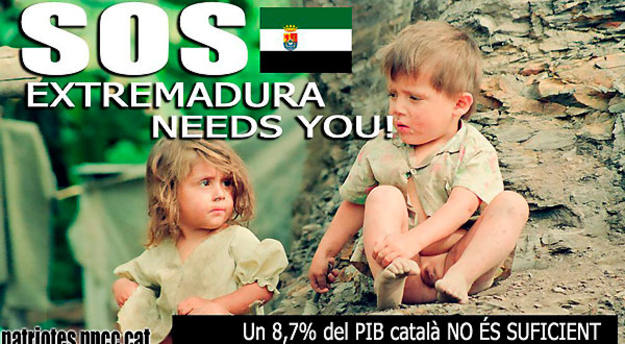
Because poor children is a perfectly fine theme to make some good laughs (They are poor, ha-haa!).
To finish, and taking in mind several harassments and repeated BS like this in the last decade, I think that a lot of people in Spain would vote enthusiastically about sending this people out of Spain, even better, why not to Mars?, to build the New Castelldefells and live their futuristic utopia happy forever in the red planet.
If a 70% of the population of a territory (and I'm not talking about Catalonia, because there is no majority for independence) wants to secede, what the State should do?
I did, and have provided a very clear answer to the question in fact.
What the government of a country should do if a group of people declare themselves on sedition, start refusing to pay taxes, wants to steal all public resources, harass and drive out of the place the people that think different, take their properties and piss generously on the constitutional rights of the majority of the citizens?
Enforce the law, obviously
"But, but, I want to ignore and twist the law in my benefit!. I should be allowed to do it, because I'm special!, my mom told me!"
You can violate the laws everytime that you want, as long as you accept the consequences, and repair the damage caused to other members of the society.
I'm asking what happens if in a part of a territory the vast majority of population doesn't want to be part of that country.
If you want to talk of Catalonia, I can ask what the Central Government can do when 82% of the population (and this includes half of people that wants independence and half of people that doesn't want independence) would defend a LEGAL and proper done referendum.
The answer to your deliberately ambiguous question is the same. Enforce the law.
> What if a lot of people do not want to remain in this country?
They will pack, leave and try to migrate and be accepted under the umbrella of other countries typically. It is happening a lot in the last decades, by good (and sad) reasons.
> What if the majority of people would hate their country (but want to remain in it).
They could use the tools specified in the law to change the bad parts and improve their country democratically. As they are a majority, they are probably doing this yet since years. They must have in mind still that there are international laws and treaties.
> What would happen if 100% of USA demand the independence from themselves and require to be called "Pantsdemonium, the land of the pants-free" from now on?
Just a change of name (and interesting parties, like the national day of the duck and so). On the other hand, if you can't stand to be in the same room with yourself, go to see a doctor as soon as possible.
> and if it was the 90%?
A change of name plus a 10% of people driven off their own country, typically by violent means, if we study the human history.
> and if it was the 85.45342%?
the same... and more people in exodus.
My question is not ambiguous.
And looking at your "hate", I think that you prefer what happened in Jugoslavia and not what happened in Czechoslovakia
Lets face it the lead up to both referendums were based on packs of lies (on both sides probably - but it can only be proven for the winning sides).
In the Spanish case, there's only one part, so a nice analogy here is body amputation.
This isn't really true. You can get arrested for "offensive" social media posts in the UK.
http://metro.co.uk/2017/08/01/man-who-filmed-dog-doing-nazi-...
What's funny is that the original youtube video is still up.
Edit: Might as well include the video. https://www.youtube.com/watch?v=SYslEzHbpus
The rule of law applies also to politicians.
People forget, democracy is a process, it doesn't just stop some time in the past.
And Spanish people supported the Constitution with their vote on a large scale.
EDIT: I should reword my question. What part of it you believe is false? Or is it all of it?
> Historians of the Spanish Civil War concur that the death toll of the White Terror (~58 000–400,000), because of its extent and duration,[12][12][13][14][1][2] was greater than the death toll of the Red Terror (38,000 – ~172,344 ).[15][16][17] The political repression of the White Terror was formal policy of the Nationalist forces during the Spanish Civil War, and of the government of Gen. Franco until 1945 — six years after the war's end in 1939.[18][19] In 2015, the government of Spain refused Spanish historians access to the pertinent government archives, open to foreign historians, which would allow determining the physical whereabouts and political fate of victims of the White Terror.[20]
> The main goal of the White Terror was to terrify the civil population who opposed the coup,[88][89][90] eliminate the supporters of the Second Spanish Republic and the militants of the leftist parties,[91][92][93] and because of this, some historians have considered the White Terror a genocide.[94][95] In fact, one of the leaders of the coup, General Emilio Mola said:[96]
> "It is necessary to spread terror. We have to create the impression of mastery eliminating without scruples or hesitation all those who do not think as we do. There can be no cowardice. If we hesitate one moment and fail to proceed with the greatest determination, we will not win. Anyone who helps or hides a Communist or a supporter of the Popular Front will be shot."
You're just lying.
https://es.wikipedia.org/wiki/Refer%C3%A9ndum_para_la_ratifi...
Using the constitution as some sort of shield / holy bible that can't ever possibly be changed IS what show the weakness of Spanish democracy.
In the end, governments are there to serve their people. They don't make sense as entities on their own. They represent a group of people who chooses to be represented by their government. If the government attacks the people and refuses to hear to what people have to say, you need to resort to not following the dogma.
Politics is the art of the possible. Right now, this is not possible and pushing for it is not constructive.
If a sufficient number of people in a geopolitical area wish to govern themselves, broadly, it should be seriously considered by any ethical government.
The circumstances matter. I can't draft a workflow for "ethical independence" on a Friday morning on HN. I can say there is a difference between self-determination and the desire for liberty vs. mass murder, conquering territory and waging guerrilla warfare against multiple nations.
When defining a right, you must show who is the subject of that right.
Anyway, when that site states "All peoples have the right to self-determination" Is there a minimum number of people to aim for 'this right'? V.g. if 259 persons in Els Hostalets de Balenya say the want 'the right to self-determination', are they a nation from then?
As to when you stop with the right of self-determination, in the case of Catalonia, from a cultural, language, and historical point of view, there's enough reasons for a referendum to be held (given the discontent of the population). There's a similar situation with Quebec, for example. As far as I know, there's nothing about New York --language, history, or culture-- that would warrant a referendum, and there's certainly no reason for you as an individual to do so (you don't even have the basic political institutions).
The so-called "right to self-determination" doesn't exist in the Spanish Constitution, nor in the International Law, nor in Comparative Law.
https://elpais.com/elpais/2014/10/10/opinion/1412946101_9911...
Freedom is Slavery,
Ignorance is Strength,
Trying to organize a Referendum is Antidemocratic.
What people can't do is play outside the Law in a Democracy.
Changing how when the two main parties are against this change?
That argument is just an excuse.
Articles of the Estatut d'Autonomia where denunced by present the ruling part declared invalid by the TC but that same party wrote carbon copies of them in other Estatutes it say how the situation can change.
If you state "that same party wrote carbon copies of them in other Estatutes" you have to give us sources.
For those HN readers that might not know, a decade ago Catalonia tried to pass something known as the Estatut, which would give us more rights and more power (similar to what the Basque country has had for a long time). Needless to say, it didn't pass because the big parties opposed to it. One of the two important political parties in Spain (the Popular party) went as far as going around Spain collecting signatures (four million) to get rid of the Estatut. And that's part of the story of how the pro-independence movement gained as much traction as it has right now.
The right of a part of a country to secede is not recognized by most constitutions around the world, and it is certainly not a "principle of democracy".
You want to change the constitution that rules your country, you get 2/3 of the votes of the parliament behind your vote and the constitution changes (or whatever rule your constitution has to allow a change). The whole point of a constitution is to have a stable body of law.
The Estatut went further than giving you something similar to what the Basque country has. It was ruled out because it was deemed incompatible with the constitution. This is exactly the same process any other country with a constitution follows.
As for the "rights" that you are not enjoying, the only one I hear repeatedly is one: collect and distribute your own taxes, because you pay more taxes than what is reinvested in Catalonia (of course this happens in roughly half of the country).
If New York asked to secede from the United States because they were oh so tired of paying more in taxes than the average in the US and receiving less than what they bring to the table (which is true for the vast majority of "rich" states) we will all see through the bullshit of the argument.
If you want to follow that argument, when do you stop? is it right for my city to secede because we do not want to support the poor in rural areas around us? (this is not a retorical question, some big cities have historically done that, and many of them today are tax havens). Can I as an individual decide to not pay my taxes because I pay more than what I receive?
Exactly what other right is missing in Catalonia?
The Spanish constitution won't change because it's in their best interest to not do so, which is why this illegal referendum is being created. If they wanted the Estatut to pass, they would have passed; they didn't pass it because the rest of the Spanish communities would have been affected by it from an economical point of view (suddenly a chunk of money that was going to the other communities stays in Catalonia. Guess who's gonna be unhappy).
As to when you stop with the right of self-determination, in the case of Catalonia, from a cultural, language, and historical point of view, there's enough reasons for a referendum to be held (given the discontent of the population). There's a similar situation with Quebec, for example. As far as I know, there's nothing about New York --language, history, or culture-- that would warrant a referendum, and there's certainly no reason for you as an individual to do so (you don't even have the basic political institutions).
As for the cultural, language and historical I see absolutely no basis for this referendum. Cultural wise I have never, ever, see the slightless difference between catalonians and people for the rest of Spain. What will be the difference between someone that lives in Tarragona and someone from Valencia? Of course it's all a smooth change, and the farther away you go the more small changes you get, but I have seen much deeper differences between people living in cities vs rural areas (even when they are close to each other).
In any case, these differences are (to me) smaller than the differences between a New Yorker and a Texan.
Historically Catalonia has never been a separate, independent country, and you have to go pretty far away to get a substantially different Spain to what you have today.
Catalonia has a different language, that roughly 60% of their inhabitants do not speak, and that is shared by some of the inhabitants of the spanish states (Comunidad Valenciana and Balears).
If your point is that Catalonia people should be allowed to secede because they have a differenciate culture / language (let's ignore for a second all the catalans that do not speak catalan), why don't they call to vote in catalonia, comunidad valenciana and balears, all together? Because they will very clearly lose the vote.
In polls there are a huge number of catalans descendants from andalusia n "inmigrants" that are also for the independence. Why is it so? Because the reason argued again and again during years has been only one: taxes. Not "culture".
BTW, they wanted the Estatut to pass (it passed in congress), but you needed more than 1/2 the votes, you needed 2/3. If the Estatut had nothing against the Constitution, it will be law by now.
I have never lived in Texas nor NYC, so I can't really say much about it. I believe that Catalonia is large enough to warrant a referendum if enough people want it, especially given that so many people disagree with the treatment they are receiving from Spain. I accept the argument that we might not be different enough, but it's not the main reason a referendum should be held, in my opinion, and I'm not aware of many people from Valencia or Balears who want to leave Spain. At which point a region of a country has the right to secede? Or you are implying that no region from no country should ever have that right?
But what is more worrisome is that it ignores the rights of the other group. What about the Spanish, not from Catalonia, that have interests in Catalonia, be it companies, properties, families or even just cultural links? Shouldn't they have an opinion on the matter?
Unsurprisingly yes, and that's precisely what the Constitution says. And that's the supreme law, and I have not seen any other reasonable country where a subset of it is claiming so freely to withdraw the Constitution because they don't like it, even when there are very clear paths to change it.
It Catalonia wants to vote, go to Parliament and ask for a referendum of all Spaniards (that's legal). It's that simple.
I bet you are all for dialog, good arguments, better talk than fight... /s
Say the guy with 682 points.

I can't downvote. If it's not because of the points, it's because of something else.
Because it seems to me that these people are asking to vote.
The irony is that many who support the independence of Catalonia are against independence of current EU member states and fail to see the inherent dangers in the centralization of power (many such dangers exemplified by this very article and listed by you).
Many of modern so called democracies though referendums are not the best way to solve these issues. Read up on how it worked for the Ancient Greeks or how the American constitution fathers talk about “direct democracy”.
Then think how it worked out for Brexit. It’s nothign new: ancient Greeks also got fired up by propaganda and later regretted their own decisions. Socrates came up with his “government of the fit” watching his contemporaries claim for bad things only to regret it when it was too late.
Essentially: a referendum is like saying “every single citizen has enough information and vision to do whatever is best for the country”. I find that pretty optimistic to say the least.
I personally prefer a referendum.
I’m saying that representative parliament works, and there’s a way to solve this using this worldwide system. Direct democracy is not what we have, America’s founders considered it “anarchy” as a matter of fact. Read up.
Always? You should be sure to inform the Swiss, who've been operating under the mistaken assumption that direct democracy in their cantons was functioning just fine.
Then, climb in your time machine and alert the New Englanders that their town halls were actually ruinous disasters. Then go further back and mock the ancient Athenians for starting this whole democracy debacle by running a stable government for 200 years.
Now compare that with the Spanish government. Banning a referendum, raiding political parties and Catalonian government offices, arresting government officials, flirting with far-right politics, de-facto suspending the Catalonian autonomy and basically abandoning any democratic dialog.
Now, there is no going back. I wish the best of luck to my friends in Catalonia. Shall they be allowed to express their desire to leave or stay in Spain in peace. I wish no one to get hurt during these turbulent weeks.