I think part of the point is to find a avocation that is not stressful, you enjoy, and can do a long time. That may be worth more than money.
This is usually related to the kind of job you are doing.
My mother was cleaning schools and that is a killer for the back. Being retired, she takes long walks and keeps herself active and healthy.
But when I was studying I saw quite old teachers still active, and happy. But that's a different kind of job with different effects on your health.
> I think part of the point is to find a [a]vocation that is not stressful, you enjoy, and can do a long time.
I agree. If you are lucky enough to get a job that fulfills you, then continuing working can be a good thing. That's why we can't just delay retirement age, but we need to take into account personal circumstances.
A not stressful and enjoyable work also helps you to keep your good health for longer, so you get in better shape to old age.
One of the best professions I can think of retiring in is probably academia... I've worked/studied/socialized with professors very much older than me, and they seem to continue to enjoy teaching/talking to students despite their age.
In 25 years they'll still have 25-30 years of work left in their lives, and by then most of them won't have received any significant reschooling, and they will still be competing in a tech world, where 10 years ago there wasn't a thing called smartphones.
Some of them will do just fine. I know a lot of old programmers, but I also know a lot of former older IT employees who are spending their 60ies in the unemployment lines.
Moral of the story: Be an Engineer, not a Programmer. Be Valuable, not Replaceable.
If you don't care about having a wife or kids you can easily retire forever after 10-15 years of work in SV or NYC.
1. mrmoneymustache.com 2. earlyretirementextreme.com 3. gocurrycracker.com 4. madfientist.com 5. thepowerofthrift.com (I could go on for a while here)
It's not only perfectly possible, it's not particularly difficult.
In 10-15 years in SV/NY you can earn $1MM after tax + growth and then move to a lower COL city/town and take it easy.
I'm living in a studio, have a parking spot, walk to work and go out with my coworkers/friends after work.
What am I missing out on?
NYC is even worse - lop another thousand off and pay even more to live.
Then, if you invest $46k a year for 15 years at a real return of 4% you end up with ~$943k in present day dollars which is right around what the parent was saying.
Not to mention $140k total compensation is relatively low for a senior dev in SF/NYC, you will likely be making a lot more 10 years in.
You can definitely sock away enough even without a 4% rate of growth to put away $1MM of after-tax money in 10-15 years, if you're smart with your money.
I've worked in public service all my life and I took a master degree in business and leadership which was paid by my employeer. Which moved me from engineering to management.
When I see my old study buddies, who all work privately, none of them have gotten any form of reeducation and very few have kept up with the tech.
I'm sure most of them could learn the new buzzwords if they wanted to, but who would hire them until they do when you could simply pick a fresh candidate with newer CS knowledge, all the buzz and a lower pay requirement?
People switching careers at 40 or 50 aren't going to be established and have tenure after a few years in academia.
Mostly dealing with octogenarians+ whom I know; the more active you are (more so socially, as well as physically) the better off you are at living a long and healthy life. Having a routine like a job sets also seems to help human psyche. Your point about vocation that is not stressful, enjoyable, and is lasting satisfies all these requirements.
http://www.dailymail.co.uk/health/article-3563954/Retirement...
http://fortune.com/2016/05/03/retirement-living-longer/
https://www.theguardian.com/lifeandstyle/2016/may/02/early-e...
https://www.theguardian.com/lifeandstyle/2016/may/02/early-e...
https://www.wsj.com/articles/retiring-after-65-may-help-peop...
That's from both sides of the pond.
So there are upsides and down sides to work/retirement thing. The best you can do is academia or a retirement spent learning new things.
My dad retired at 55 as his health began to decline. He's still alive at 78, and there's no way he would have lived this long if he didn't retire when he did.
Retirement should be a focus for these types of activities. Things like tending a small garden, or playing with grandchildren.
My father is 65, my mother in law is 59, and my father in law is late 50s (my mother passed away recently at 59). All three of them must still work full time because they can't afford to retire, preventing them from helping with our 1 year old (causing us to have a limited support system, which I supplement with a part time nanny).
But heh, GDP!
Free treatment for everything. That does help a lot when you get old, starting with all the minor problems happening with an aging body, and concluding with the last few years where you could literally be kept alive despite a critical condition requiring constant care, all paid in full by the tax payer.
https://www.ft.com/content/78146114-15f5-11e7-80f4-13e067d50...
> Updated projections from the Institute and Faculty of Actuaries, based on death statistics from the Office for National Statistics, suggest that men aged 65 will now live another 22.2 years, down from 22.8 years in 2013. Women aged 65 will now live for a further 24.1 years, down from 25.1 years in 2013.
(Same reported also cited here http://www.independent.co.uk/news/uk/home-news/pensioners-uk... )
The analysis seems to focus on first order changes, not longer term second order changes so if there was an effect like you describe e.g. those born 80 years ago being much healthier than those born 60 years ago, their positive contribution might mask deeper problems.
The UK's ONA publishes various mortality related data sets here - https://www.ons.gov.uk/peoplepopulationandcommunity/birthsde... - might be an interesting side project for someone with time to spare...
Manufacturing, farming, fishing, etc were much more common industries for those who are now 85 than it is for those who are now 55.
There is a huge difference between retiring from manual labor at 60 after having worked from you were 15 and retirering from a desk job at 65 after having worked from you were 25.
Then take into account that they used to work Saturdays, that they used to work more hours per day, that fewer had recognized disabilities, that fewer received welfare, that they had much less vacation, that women had more pregnancies and that those of them that worked had shorter maternity leave.
The 'lucky' old had worked more and physically harder at 60 than we will have at 70.
A useful (though old) book on this subject:
The Overworked American: The Unexpected Decline Of Leisure – by Juliet Schor
Suppose you're 50. You probably know more people 10 years away from your own age than 40. So no surprise you see more people die at 60 than at 90, because you know more at 60 in the first place.
And of course there's always a survivorship bias in life expectancy numbers. Life expectancy for a currently-living baby-boomer is over 80, because the boomers who die under 70 are already dead and no longer pulling down the average.
30 years? I suspect you are overdramatizing that.
AFAIK people stop working at age 65 in Europe (its 67 in NL, was 65, and it was raised because of higher life expectancy). I think in Germany its higher. In Greece it was 55 IIRC, and that was one of the reasons of the crisis, but Greece was an outlier (and AFAIK they're raising it).
If we assume its 65 it still isn't as if people are becoming 95 on average.
So you need 2 points of data, and they contradict with my anecdotal evidence from my EU country.
Please provide your sources?
> I don't have anything to back it up mind you
Maybe we should start the debate once we do have the data.
https://data.oecd.org/healthstat/life-expectancy-at-65.htm
In most well-developed countries, life expectancy of women at 65 is around 22 remaining years. I.e. once you have reached the age of 65, on the average you live until the age of 87, give or take a couple of years depending on country. Longest lives in Japan and France.
So depending on retirement age, people spend well over 20 years in retirement on average, but as the previous commenter said, many of them will be in retirement for 30 years.
What?
With no wars, no shortage of food, with all the advancement in health care do you really expect to live less than my grandma, who's 94 and outlived three major world financial crisis and a world war?
One of the great ironies is how the abundance of food in the west is leading to obesity, heart disease and high blood pressure. Instead of people being unhealthy due to chronic, persistent malnutrition, people are unhealthy from carrying too much body fat.
Last I heard, nearly half of all Americans were overweight or obese. Have you ever noticed how few fat old people there are?
Some experts fear we might loose (some) antibiotics in the coming years. If that's going to happen then I am sure life expectancy will go down massively.
Yes I do. Your grandmother had a life expectancy of 58.5 years.
Source: http://u.demog.berkeley.edu/~andrew/1918/figure2.html
http://www.houstonchronicle.com/opinion/outlook/article/Why-...
https://www.washingtonpost.com/news/wonk/wp/2017/08/07/rural...
it's probably due to demographic changes more than defunding healthcare as such. If you have communities where there are no jobs, people move out, population diminishes, that also means that some services are shut down.
This happens also in my country (which is a North European welfare state with good pre- and postnatal care and very low child mortality): some people have to go quite far away for the check-ups.
It has in part to do with increased cost of healthcare, difficulty of having one family doctor offices, necessity of specialized services (all leading to an agglomeration effect, why you now see "healthcare cities" in more rural areas, where one city among a dozen has the only hospital and lots of other medical services available.) I'd also say that many hospitals are now parts of large chains that are "not-for-profit" in name only, while acting exactly like for profit entities.
While rural areas are typically shrinking, there is still a very large amount of people who live in rural areas in the US. It's the loss of their economic impact (and the above factors) that have made their medical services disappear.
But it's a complex issue and no one seems to have found a solution here in the US yet. But it's going to keep getting worse in the foreseeable future.
Though as a anti-government-healthcare conservative, I have to say, I do give shits.
That should give you pause.
I highly recommend studying the other side of an issue until you do understand it, even if you still don't agree with it.
In the case of NHS, wouldn't that be the tax payer?
Much of the developed world is having a population crisis. When pensions/government benefits were created in the early 20th century in the US, western europe and japan, they were experiencing population booms.
Take japan for example, which is similar to US/Western Europe.
https://en.wikipedia.org/wiki/File:Bdrates_of_Japan_since_19...

Japan seems to have maxed out and now they are dying quicker than they are being born.
https://upload.wikimedia.org/wikipedia/commons/thumb/c/c6/Po...
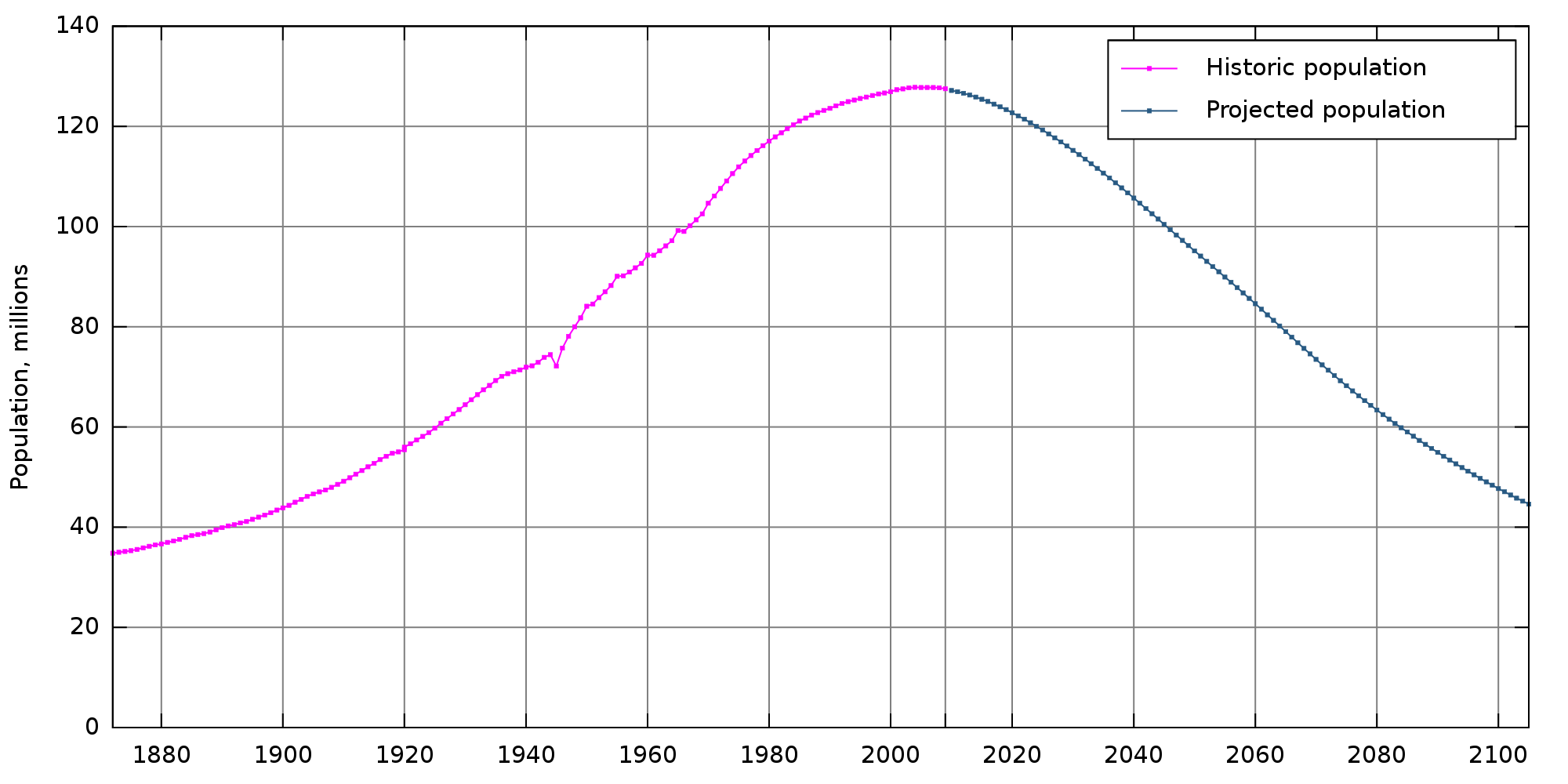
This is the same problem in most western europe countries. In the US, it's not as bad because of immigration, but if you only include native born americans ( non-immigrants ), our population demographics is even worse than japan. Native born americans stopped procreating at replacement levels since the late 1960s.
Unless Japan/Western Europe bring in millions of immigrants, they are going to be in for major problems because of their liabilities to retirees. A shrinking population can't hope to support the older generation. And the worst part is that if younger generation has to support the older generation, they will put off have kids because they simply can't afford them. Which in turn exacerbates the problem and it turns into a vicious cycle.
But immigration also has its own problems. So the industrialized world is caught between a rock and a hard place.
Even in the US, the pro-immigration policy is a stop-gap measure. The population can't grow forever.
Blackrock has an interesting paper on the overall trends.
https://www.blackrock.com/investing/retirement/blackrock-ret...
Retirees in the 2040's are going to see less resources-per-GDP dedicated to them than retirees in the 1980's for sure. But then they'll also have pervasive VR headsets and a plausible cure for cancer handy, so I'm guessing it'll be a wash.
Heard of the 1929 stock market "crash"? It was actually a dip in stock price by a mere 30%.
Time frames matter. The demographic change we're talking about is going to happen over the next 40 years, it's not like Black Tuesday.
To be fair not all of that is per-unit health costs increases; much of that is due to longer life expectancy.
When THAT lucky generation is gone, I think statisticians will realise that their children are /nowhere/ near as lucky, and I'm pretty sure the life expectancy number will fall off a cliff.
I don't have anything to back it up mind you, but raising the age of retirement, more stress related to job stability, whatever, you name it; it's just empirical but I've seen a lot of people in my environment die in their 60's -- many of them who had a perfectly 'sane' way of life. I know what you are thinking, many more people will die at 60 then will die at 90, but I'm still pretty sure there's some underlying pattern here.
Also, I do have a vague impression that making access to the NHS more difficult PLUS raising age of retirement EQUAL MOAR PROFITS for someone, somewhere.