News for hackers. Stuff that matters.
Re:Raising a Truly Bilingual Child by freyfogle on Saturday July 22, 2017 @04:48PM (#14829297)
It's interesting that the article starts with the line "True bilingualism is a relatively rare thing". That's probably the case in the US or English-speaking world, but definitely not the case in many other areas. I live in Catalonia, it is very normal for locals to be fully fluent in Catalan and Spanish, I've seen the same in the Basque region. Go to India and almost every person you meet at all levels of society speaks several languages.

In many parts of the world bilingualism is the norm.

I don't recall the exact book, but I remember reading a Jared Diamond book about societies in remote Papua New Guinea and meeting indigenous peoples who all spoke several different languages. If I recall correctly he argues that being monolingual is the historic oddity.

Re:Raising a Truly Bilingual Child by lomnakkus on Saturday July 22, 2017 @07:58PM (#14830120)
> It's interesting that the article starts with the line "True bilingualism is a relatively rare thing". That's probably the case in the US or English-speaking world, but definitely not the case in many other areas.

"True bilingualism is a relatively rare thing" is a truly bizarre statement for most of the world, I should think. FTR, I was raised "truly bilingual" -- I would go to kindergarten with kinds who spoke X, speak Y with my parents and immediate family, try to speak Y with the butcher until he told me he didn't understand X, then speak X, and be understood. (I think I was 5-7ish, so this is obviously from recollection by my parents.) I'm still fluent in X and Y, although one has suffered in pronunciation terms, but that's mostly through general atrophy from disuse, not because I can't do it, somehow.

I think the exception may be exactly those countries who have some-sort-of-English as their native language (UK/Canada/America/etc.) They can usually afford to not bother with the others.

... though I do think it's a massive shame in terms of general cultural deveolpment. Again, English-speakers don't have this, but the whole "grammtical gender" thing is a massive eye-opener[1], especially is you manage to learn several different languages that not only have different geners for specific things, but also have different numbers of genders. (E.g. Danish, outside of specific persons, has two genders. German and French have three genders -- which, tellingly, don't actually agree across various nouns.)

[1] Not to anything fundamental, just to how absurd language is as a construct.

Re:Raising a Truly Bilingual Child by KayEss on Sunday July 23, 2017 @02:12AM (#14831105)
> Danish, outside of specific persons, has two genders. German and French have three genders

Given that Norwegian and German have three I would expect Danish to also have three. French has two (le + la).

Re:Raising a Truly Bilingual Child by MattConfluence on Sunday July 23, 2017 @05:34AM (#14831542)
Danish (and Swedish) used to have three grammatical genders, but the feminine and masculine merged at some point: https://en.wikipedia.org/wiki/Gender_in_Danish_and_Swedish
Re:Raising a Truly Bilingual Child by KayEss on Monday July 24, 2017 @12:36AM (#14835909)
Ah. I'm a norwegian speaker, and didn't know that about the other two languages. Actually the norwegian dialect I speak also features a merged masculine and feminine, but it is non-standard.
Re:Raising a Truly Bilingual Child by lomnakkus on Sunday July 23, 2017 @08:05AM (#14831879)
Dammit, you're right that French does have two. Not sure why I flubbed that.

Danish indeed has "only" two genders, one too many for my taste.

Re:Raising a Truly Bilingual Child by Manishearth on Saturday July 22, 2017 @10:49PM (#14830659)
I was really taken aback by the first line.

For context, I'm trilingual (used to be bilingual).

I grew up near Boston. A quarter of the kids in my class were bilingual. I don't know how many had native proficiency in their non-English language, but I'm guessing most.

So I thought maybe "true" bilingualism was some hard to attain thing that none of us had. Nope, it just means "native proficiency". AIUI that's a relatively common thing, even in the US, at least in urban areas. And definitely in other countries.

There probably was some local skew in this sample set, but from what I can tell this is definitely not abnormal in cities.

The article seems to be mostly written in the context of unilingual parents who want a bilingual child.

Re:Raising a Truly Bilingual Child by GuiA on Saturday July 22, 2017 @11:19PM (#14830738)
> The article seems to be mostly written in the context of unilingual parents who want a bilingual child.

Yes. The core target audience of the article is likely unilingual families who will put their kid in French/Chinese/whatever classes to give them a leg up for Harvard admissions, 15 years later (or, in the NYTime's subtle language: "parents who want to give their kids a bilingual boost").

Obviously if the kid only speaks the language in the context of a classroom, true fluency will never be reached. In a realistic context, true multilingualism is very achievable, and not particularly exceptional throughout most of the world as many other commenters have pointed out.

Re:Raising a Truly Bilingual Child by pbhjpbhj on Sunday July 23, 2017 @04:28AM (#14831393)
>In a realistic context, true multilingualism is very achievable, and not particularly exceptional throughout most of the world as many other commenters have pointed out. //

Implicitly you appear to suggest multilingualism is easy to achieve in [almost] all contexts?

Where parents are monolingual, and the pervading culture is monolingual then there's little opportunity for immersion and few people from whom to learn.

Re:Raising a Truly Bilingual Child by macNchz on Sunday July 23, 2017 @12:40AM (#14830924)
I think what the article meant by 'truly' bilingual was someone not only fluent in speech but with equivalent vocabulary, grammar etc in two languages.

I'd guess that the kids you knew growing up were speaking english in school and another language at home, so they likely don't develop the vocabulary and grammar in their 'home' language that they might have if they were studying it every day in school. From the article regarding kids from bilingual homes who speak english in school: "... they didn’t go to school in Spanish, they don’t read books in Spanish, and when you actually measure the size of their vocabularies, or the grammar they understand, or the coherence of the narrative they produce, they are not as proficient as they are in English".

Re:Raising a Truly Bilingual Child by Manishearth on Sunday July 23, 2017 @01:14AM (#14831001)
Well, yeah, but the rest of the article doesn't seem to use that definition of "true" bilingual? Because it just talks about immersion with native speakers. Either the article didn't deliver as advertised -- had a hook about "true" bilingualism (whatever that is), and then went on to explain how to raise a "regular" bilingual child. Or the article really just meant "regular" bilingualism and wrong in stating that it is rare.

(Or perhaps I just have a very skewed sample set and even "regular" bilingualism is rare)

Idk. Overall this article didn't sit well with me, for more reason than one (https://news.ycombinator.com/item?id=14830685).

Re:Raising a Truly Bilingual Child by charlesism on Saturday July 22, 2017 @07:09PM (#14829932)
It depends on what one means by truly bilingual. In the context of this article, I took it to mean "no accent" and able to speak in one language as comfortably as the other.

Bilingual people are a dime a dozen, but it's fair to say truly bilingual people are pretty rare, and almost invariably learned both languages at a young age.

Re:Raising a Truly Bilingual Child by lucaspiller on Saturday July 22, 2017 @07:52PM (#14830097)
I'd argue that it again depends on the region - as GP said in some places it's very common to speak multiple languages.

I'm English and live in Lithuania now, and many of my Lithuanian friends can speak perfectly good English without an 'accent'. It's also not uncommon to speak a third language like Russian or Polish, especially if the family has their roots in that country.

These languages do have some shared sounds, but are definatly not just dialects of each other.

Re:Raising a Truly Bilingual Child by geomark on Saturday July 22, 2017 @10:54PM (#14830676)
A bit OT but the idea of no accent is kind of funny. My kid goes to an international school in Thailand. I hear my kid's classmates speak English with Australian, British, Canadian and northeastern American accents plus an accent we call "international school accent". I'm from California and of course I think I don't have an accent. Same as those kids and their parents. Yet I have a hard time understanding some of them.
Re:Raising a Truly Bilingual Child by vacri on Saturday July 22, 2017 @11:12PM (#14830722)
Well, you can't literally have no accent. I think that the GP means that there is no 'tell' that the people are eastern european when they speak.

In the UK itself, it's estimated that there's a different regional accent every 25 miles or so.

Re:Raising a Truly Bilingual Child by pbhjpbhj on Sunday July 23, 2017 @04:38AM (#14831418)
Occasionally I manage to do a "Henry Higgins" and detect a main accent and sub-accent; there are a lot of hints in dialect though, like what you call a bread roll ...
Re:Raising a Truly Bilingual Child by jfaucett on Saturday July 22, 2017 @06:07PM (#14829683)
As a US spanish speaker, saying Catalan is another language is kind of debateable at least IMHO and gets into the interesting difference between a dialect and a language, namely - a flag and an army :)

Still, though I think true bilingualism is extremely rare, If by "True" you mean being able to do anything you can in one language in the other language without any hiccups and word-searching and at the same speed and eloquence and precision in all possible situations and contexts.

I've studied at a university level in 3 different languages and am highly fluent in all of them, still there are a lot of contexts where I don't know the specific vocabulary in one particular language or might have problems finding the right word in one language because I'm getting interference from the other ones.

Also, I've known a lot of bi/tri/quad linguals in my life (whole family, extended family, friends, etc), and in my studies and I have yet to encounter even one truely bilingual person as I defined it above.

Re:Raising a Truly Bilingual Child by joeyspn on Saturday July 22, 2017 @06:16PM (#14829737)
> As a US spanish speaker, saying Catalan is another language is kind of debateable at least IMHO and gets into the interesting difference between a dialect and a language

A spaniard who doesn't speak catalan won't understand 95% of a normal convo... Catalan [0] is lexically as distant from the spanish as the Portuguese is [1]...

[0] https://en.wikipedia.org/wiki/Catalan_language

[1] https://elms.wordpress.com/2008/03/04/lexical-distance-among...

Re:Raising a Truly Bilingual Child by jfaucett on Saturday July 22, 2017 @06:39PM (#14829825)
> A spaniard who doesn't speak catalan won't understand 95% of a normal convo

I don't know if I'd go that far. I just youtubed catalan and would say I understood about 75-80% of what this guy is saying. [1]

Also, I mainly meant that statement ironically :) Catalan is its own language, its just funny to me that "dialect" is a negative term, language is not, and usually the big country with the military dictates which provinces speak a "language" and which ones are speaking a "dialect".

[1] https://www.youtube.com/watch?v=wdiVss0X6V0&feature=youtu.be

Re:Raising a Truly Bilingual Child by joeyspn on Saturday July 22, 2017 @06:51PM (#14829868)
Yeah that man speaks slowly what appears to be the variant of catalan spoken in France... I'm referring to something like this: https://www.youtube.com/watch?v=3-OXwRP5A9E

Spanish speakers will notice a lot of "familiar words", but most of the time it's difficult for them to extrapolate the meaning of what is being said.

Re:Raising a Truly Bilingual Child by ice109 on Saturday July 22, 2017 @10:48PM (#14830657)
I speak shit Spanish (very weak third language) and even I can get the gist of what they're talking about. I'll admit all the stuff around the rolling rs is very hard to make out though.
Re:Raising a Truly Bilingual Child by pbhjpbhj on Sunday July 23, 2017 @04:42AM (#14831420)
That kinda answered my question whether French and Spanish regions spoke the same Catalan.
Re:Raising a Truly Bilingual Child by paperpunk on Saturday July 22, 2017 @06:53PM (#14829877)
You described yourself in another comment as fluent in three languages – I wonder if you might be much more practised at figuring out things spoken in other languages than others.
Re:Raising a Truly Bilingual Child by p1esk on Saturday July 22, 2017 @06:29PM (#14829790)
Interesting, I thought Spanish and Portuguese are extremely similar, so that a native speaker of one should understand most of the other.
Re:Raising a Truly Bilingual Child by barry-cotter on Saturday July 22, 2017 @06:45PM (#14829853)
You were closer to being right than joeyspn. Portuguese, Spanish and Italian are more or less mutually intelligible. There's a lot of complex vocabulary and grammar that's different and plenty of simple stuff too but if you speak slowly you can communicate on day 0. French is further from mutual intelligibility but you still have an enormous leg up learning it if you speak any Western Romance language. Catalan is probably more similar to French than Spanish but it's still pretty easy for a Hispanophone to learn.
Re:Raising a Truly Bilingual Child by jaclaz on Sunday July 23, 2017 @10:41AM (#14832447)
>Portuguese, Spanish and Italian are more or less mutually intelligible.

And Romanian, with only some more difficulty.

The big problems I see (as an Italian) when speaking with people from France, Spain, Portugal and Romania is mostly about the pronounciation, admittedly I have studied a little bit of French (that makes the "slightly more distant" language on par with the others).

When it is written, I can usually understand like 90% or more of most text and there are "sinergies", i.e. there is a given word that is different from Italian but is very similar to another word in another of the Latin languages or that is actually directly or almost directly a Latin word.

The issue is with "false pairs", i.e.words that exist (or sound alike or almost alike) in two languages but that have completely different meanings.

Like, to mention a couple reknown ones, "burro" which is "butter" in Italian and "donkey/ass" in Spanish or the Spanish "aceite" which most Italians will instinctively translate into "aceto" (vinegar) while it means "oil".

Re:Raising a Truly Bilingual Child by joeyspn on Saturday July 22, 2017 @06:36PM (#14829811)
Yeah, that’s a common misconception, but the reality is different. Just because they’re in the same linguistic group (Romance-derived languages) doesn’t mean they’re the same.

It’s like saying that german, dutch and english (Germanic languages) are extremely similar… =)

Re:Raising a Truly Bilingual Child by jeeceebees on Saturday July 22, 2017 @09:23PM (#14830426)
German and Dutch are extremely similar. As a fluent Dutch speaker without any formal German lessons whatsoever I can read German pretty well. Speaking and understanding are more difficult, but I'd say most Dutch/Germans would be able to make smalltalk in a bar if they took it slow and used a lot of hand gestures.
Re:Raising a Truly Bilingual Child by vacri on Saturday July 22, 2017 @11:31PM (#14830756)
while English has germanic grammar, 40% of its words come from romance/french origins, so it really is a mongrel language. Word origins in english are roughly 30/30/25/15 french/latin/germanic/other, with more fancy words ('newspaper english'[1]) from romance and more daily words from germanic.

[1]https://youtu.be/2OynrY8JCDM?t=6m43s - interesting video overall

Re:Raising a Truly Bilingual Child by jfaucett on Saturday July 22, 2017 @06:46PM (#14829855)
In my experience Brasilian Portuguese is much easier to understand and I've actually been able to have conversations with Brasilian speakers where we knew about 80-90% of what the other person was saying.

But in Europe I've been sitting on trains directly next to Portuguese speakers and had a very difficult time even understanding say 40% of what they were talking about. It was as if in Portugal they just chew up the words and chop them all up, which makes it super difficult to understand. That wasn't the case with the Brasilians I've spoken too. With them I could actually have conversations and know what they were saying.

But thats just my personal experience.

Re:Raising a Truly Bilingual Child by jessaustin on Sunday July 23, 2017 @12:13AM (#14830867)
That seems like English? Anyone from any part of the English-speaking world can understand anyone else from any other part, except there are lots of people from England that none of us can understand.
Re:Raising a Truly Bilingual Child by Symbiote on Sunday July 23, 2017 @05:57AM (#14831584)
There are plenty of incomprehensible Americans and Australians etc, precepts you either don't interact with them (poor people?) or you are American / Australian, and don't realise that as a Brit I can have difficult understanding a strong Boston accent.

(I think. One of the characters in "Spotlight" was the most recent time I understood almost nothing.)

Re:Raising a Truly Bilingual Child by phillc73 on Sunday July 23, 2017 @07:46AM (#14831814)
Who is "us"? I'm not English, but lived there for more than 16 years. I think I understand most British regional English accents, including Welsh, Scottish and Northern Irish quite well.
Re:Raising a Truly Bilingual Child by DanBC on Sunday July 23, 2017 @07:48AM (#14831818)
> Anyone from any part of the English-speaking world can understand anyone else from any other part,

Try watching an English person ask an American (in the US) for water or where the herbs are.

Re:Raising a Truly Bilingual Child by jessaustin on Sunday July 23, 2017 @07:40PM (#14834962)
Yes my point was precisely that many people from England are incomprehensible.
Re:Raising a Truly Bilingual Child by croisillon on Saturday July 22, 2017 @06:39PM (#14829823)
The pronounciation is key here: the Portuguese language "swallows" the words, which makes it difficult to follow for a Spanish speaker; on the contrary Spanish (mainly) is easy to get for a Portuguese speaker.
Re:Raising a Truly Bilingual Child by saint_fiasco on Saturday July 22, 2017 @06:37PM (#14829818)
They diverged from a common language, so it's possible for a reader of one language to understand the written form of the other.

However the spoken form diverges much faster than the written form, to the point where it's completely impossible to have an oral conversation.

Re:Raising a Truly Bilingual Child by jknightco on Monday July 24, 2017 @01:54AM (#14836153)
Well that's just patently untrue. Catalan and Spanish are as different as Spanish and French, German and Dutch, or Norwegian and Swedish. The two are further apart, lexically, than Catalan and French. They use very different perifrastic tenses, the main one would confuse the hell out of an unaware Spanish speaker (conjugate "to go" + unconjugated verb == simple past in Spanish, e.g. "vaig naixer" == "nací" == "i was born"). Not to mention spelling and pronunciation rules are drastically different ("vaig" is pronounced "vatch").
Re:Raising a Truly Bilingual Child by kalleboo on Saturday July 22, 2017 @10:18PM (#14830568)
Yes by your definition I don't think true bilingualism exists.

Right now I live in a situation where I use English and a third language exclusively, and my native language has massively atrophied. If I can't even compare my native ability now with 2 years ago, how could anyone have an exactly matched ability in two languages at the same time in all possible situations and contexts?

Hence I reject your definition since it's useless. I just define true bilingualism as native-level fluency in two languages. There's enough variation in native fluency to give a healthy margin there.
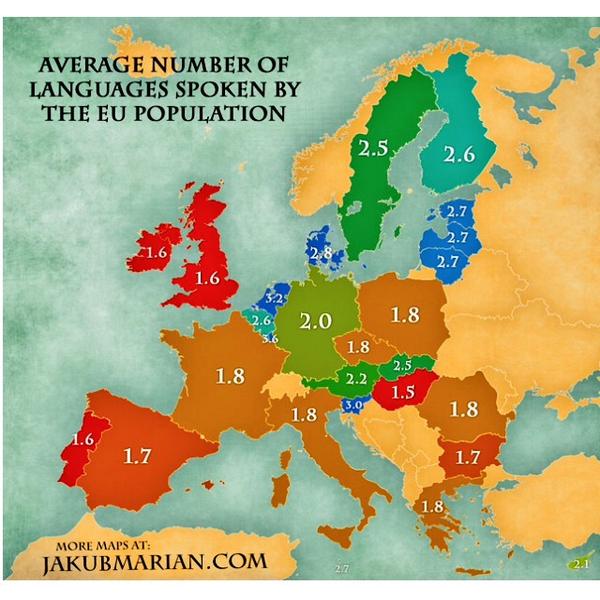
Re:Raising a Truly Bilingual Child by azernik on Saturday July 22, 2017 @06:27PM (#14829783)
Then how about Basque speakers, who almost all speak Spanish? Or Moroccans and Tunisian, whose urban educated populations usually code-switch between Arabic and French?
Re:Raising a Truly Bilingual Child by umanwizard on Sunday July 23, 2017 @04:43AM (#14831421)
If Catalan is the same language as Spanish then so are Portuguese, Italian, Occitan and several more.
Re:Raising a Truly Bilingual Child by anton69 on Sunday July 23, 2017 @03:05AM (#14831194)
Yes. I’m Latvian, born in the Soviet Union. Many of my generation grew up speaking Russian and the language of their country (Ukraine, Polish, Georgian, etc). Sure, I moved to the US when 10 but true bilingualism seems pretty normal to me. In my case speaking Russian with one parent and Latvian with the other.
Re:Raising a Truly Bilingual Child by rimliu on Sunday July 23, 2017 @08:45AM (#14831998)
Re:Raising a Truly Bilingual Child by bousaid on Saturday July 22, 2017 @06:05PM (#14829671)
In Tunisia everyone grows up learning French and Arabic. Additionally most learn English in school.
Re:Raising a Truly Bilingual Child by Tade0 on Saturday July 22, 2017 @06:24PM (#14829769)
I don't think it really counts if you speak two languages from the same group that are spoken in the same territory.
Re:Raising a Truly Bilingual Child by Manishearth on Saturday July 22, 2017 @10:47PM (#14830651)
Define "territory".

Does India count? China? Russia? Spain? France?

India has tons of mutually unintelligible languages. China does too (some call them dialects). Spain has multiple partially mutually intelligible languages -- and Basque is an isolate (and mutually unintelligible). IIRC Occitan and French are not that compatible either.

Re:Raising a Truly Bilingual Child by yaantc on Sunday July 23, 2017 @10:29AM (#14832398)
> IIRC Occitan and French are not that compatible either.

Maybe you're thinking about the Basque language instead? I'm from the south of France, Occitanie really. Occitan is certainly different from French, but not completely alien. It's a bit similar to Spanish in closeness. Basque on the other hand is very different and is an isolated language.

https://en.wikipedia.org/wiki/Basque_language

Re:Raising a Truly Bilingual Child by Manishearth on Sunday July 23, 2017 @02:03PM (#14833506)
I mentioned Basque, but Basque is in Spain.

No, I know that Occitan and French are not that different, but they're still pretty different. Like you say, similar to Spanish in closeness -- I would definitely consider them distinct languages that take effort to learn.

Re:Raising a Truly Bilingual Child by jknightco on Monday July 24, 2017 @01:56AM (#14836160)
The Basque Country extends past the Pyrenees into France, there are lots of Basque speakers in France. France has historically shut down use of its minority languages, however.
Re:Raising a Truly Bilingual Child by saint_fiasco on Saturday July 22, 2017 @06:40PM (#14829829)
Then consider not Spain, but its former colonies. In Paraguay, Bolivia, northern Argentina and some other countries it's common for people to speak two languages. The one native to the region and the one the conquistadores used.

In Africa it's the same thing, but the European language is more likely to be French than Spanish.

Re:Raising a Truly Bilingual Child by Tade0 on Saturday July 22, 2017 @07:33PM (#14830041)
Now that's bilingualism.
Re:Raising a Truly Bilingual Child by Ngunyan on Sunday July 23, 2017 @04:29AM (#14831399)
Following your logic, any person speaking any two languages from English, Dutch, Icelandic, German, Swedish, Norwegian, Danish and lives in Northern Europe (smaller in land area than India or China) are not bilingual.
Re:Raising a Truly Bilingual Child by Tade0 on Sunday July 23, 2017 @07:11PM (#14834863)
I was taught German in school and back when my memory of it was fresh I could, with some help, understand articles written in Norwegian, so yeah.

This sort of explains why Germans and Scandinavians in general are so proficient in english.