Fred Wilson makes a good point here - it's quite gut-wrenching to send someone a token that might have doubled in value if you had waited a week. And I would imagine the seller might not feel great either if they received a token that took a sharp drop in value upon receiving it.
Buying things is one of the main uses of currency, IMO, and you can't buy much with any cryptocurrency. I don't think that's likely to change - businesses take fiat currency instead of bitcoins or whatever because they have to pay taxes on their business, and those taxes must be paid in US dollars (or GBP or whatever). And if they don't, men with guns will come and arrest them. That's one of the great drivers of demand for dollars that bitcoin can't really compete with.
So where do cryptocurrencies provide value? Well, the main one is in areas where traditional, government-backed fiat currencies can't be used. In other words, mostly illicit cases - drugs, money laundering, etc. Otherwise, especially for those in nations with more developed financial infrastructure, there's no compelling reason to use bitcoin other than purely ideological motivations.
So you're right that cryptocurrencies do have value, it's just that the value is far more limited and based on illegal activity than most of its proponents will claim.
Most proponents believe that developing countries will be the biggest adopters of crytocurrencies, and drive their values higher. This makes sense as many of those countries already have volatile currencies that are difficult to trade on the open market at low volume. For this reason, USD and Euro are highly sought after for even low income individuals in many less stable countries. Anecdotally, I can offer that many Egyptians with any wealth at all try to hold some foreign currency. It's possible cryptos can replace that need.
Plus, the black market was valued at $10 trillion globally in 2011. If it had an official currency that currency would be worth quite a bit.
Put it this way: the black market does not rely on bitcoin in any substantive way. Bitcoin, however, depends on the black market for its existence.
So the black market has a combined value of $10 trillion, but bitcoin takes only a small, small slice of it because cash is just better. It's just that this small slice is bitcoin's bread and butter.
At what market size do people who have criticized it in the past as only for those things, admit that perhaps that categorization isn't reflected in actuality? 100 billion? 500 billion? One trillion? 10 trillion?
That's my point - bitcoin is most useful for those who wish to engage in illicit activity (this accounts for at least 10% of bitcoin's market size if not more [1][2][3]) and for those who have ideological reasons to support it.
Those who have ideological reasons to fear inflation and support bitcoin are primarily libertarians, who think of inflation as Satan incarnate and view it as worse than murder and only slightly better than outright theft. But that's hardly a consensus view. Beyond those two groups, bitcoin has no real use.
I'm not saying bitcoin is worthless, I'm saying that there's a natural peak to its valuation based on its limited use cases (see above). Maybe bitcoin will make significant inroads in developing countries, and maybe then those $100 billion+ valuations will become reality, but I doubt it.
[1] https://en.wikipedia.org/wiki/Silk_Road_(marketplace)#Sales [2] http://money.cnn.com/2016/04/15/technology/ransomware-cyber-... [3] https://bitcoin.stackexchange.com/questions/47942/what-perce... [4] http://www.ofnumbers.com/2015/04/22/the-flow-of-funds-on-the...
So by even your own figures 90% of people aren't using it for the use-case you seem to have an issue with.
Do you have anything to back up this assertion?
I'm going to contradict you here, and say that there is no reason to assume that.
Only idiots would use Bitcoin for black market purchases in the first place, there are better alternatives for the majority of purchases, and the biggest sources of black market are still happening with USD.
I'm not sure why it's even relevant since both currencies would function just fine if we magically removed all illicit activity.
Definitely. Tack ransomware onto that list too.
There's legitimate use cases too though which do present at least a few compelling cases - for example I've had large purchases outright refused because the seller thought there was a chance I was a credit card fraudster. Nothing says "the money is yours now" like a cryptographic proof of that. They straight up told me, even after I gave them proof of ID - "sorry, too risky, pay with bitcoin".
I've also been flagged by maxmind and similar anti-fraud tools before when I made VPS purchases over Tor. But because I paid in Bitcoin support was able to approve the transaction without a second thought - no more fraud risk could occur.
Of course - these types of purchases aren't that frequent - but they do occur.
That doesn't mean there aren't structural flaws in their design (mostly meant to enable their initial success) but I don't think you can make a cryptocurrency that can simultaneously attract interest while also not appreciating from that interest. In order to implement a coin payout algorithm capable of handling an influx of on-chain activity you basically tell your early adopters "hey, this is a new and unproven thing, but if it takes off the algorithm just devalues it anyway to keep it where it is at" so you don't even have the selfish self-gamble motive to profit off it and thus no reason to participate if it isn't already a successful means of exchange.
The tech is great though.
The other big use case is speculation - because their real-world value is so uncertain, they're easy to create, very hyped, and basically unregulated, the current crop of cryptocurrency tech is basically a bubble factory.
They're mostly used as speculative capital trading right now, and can't be compared to any traditional currency in terms of volatility. If the dollar was magically swapped for one of them in an instant, and we all carried on transacting with it like we did with the dollar it would be a different story.
Volatility isn't an inherent property of a currency. It's a function of market dynamics.
(I'm not an economist so excuse potentially poor terminology and I hope I'm conveying this well)
Cryptocurrencies have the latter 2 features sewn-up but there aren't a lot of hard-goods out there that are predominantly priced in crytocurrencies. . . until that happens their valuations will remain volatile.
Ask MtGox users what happened with their "currency"... and it's not even a big case in terms of amount of money gone.
The thing is, yesterday I sent USD from US bank to UK and received it in less than 30 seconds paying less than 1% in total on fees (including FX), using Transferwise. Coinbase wants to charge me 4% and will take its time...
A month ago I made a typo when making a transfer. The money bounced back in 3 days. Try sending BTC to your ETH wallet and see what happens.
The problem that cryptocurrencies solve can and is being solved because the technology is at that level now so it's possible. Yeah banks suck, we need new, better banks. Transfers suck, we need more like Transferwise.
Blockchain is a different story though...
Coinbase is FDIC insured and has insurance for Crypto holdings?
Don't use exchanges if you don't like them?
Of course, with bitcoin, ether, and fiat, you don't need a bank. You can always keep your money yourself. Except with bitcoin and ether the ability to secure your own money is much more attainable for average people.
On the flip side, a lot of people conflate trust in web exchanges or bitcoin banks with the stability of the currency itself. Isolated, you have a reason to trust bitcoin way more than any state actor - its math, codified, and nobody can erase it now. On the other hand, state actors have force of violence if anyone breaks the money. If someone breaks bitcoin with an exploit in the blockchain, you are screwed without recourse. At this point, with the amount of participation it has, the bitcoin protocol should be considered robust - but that also is what translates into its valuation. It is only worth so much because it is proven through its long years of use.
Clearly reality is not agreeing with this assessment? As an example of this counter-argumemt : bitcoin.
In a global economy of some 64 trillion, 42 billion (plus the gold and other precious metals, and many other "lack of faith" stores of wealth) is not even a drop in the bucket.
And even at that, you don't have to have no faith in established currencies to also use bitcoin. I personally don't think the banking system in power now will fail any time soon, but I also can recognize how valuable a cryptocurrency would be to replace it.
'Objective amount'? What it is is an amount, and growing, that feel exactly what you imply doesn't exist. There are clearly many people that have lost 'faith' in fiat currencies, or the central banks that manage them, or the economies behind them, or all of these things, to the tune of the market-cap of bitcoin. How more objective an amount can you get than that?
Eh, yeah, good luck with this. Maybe ask the citizens of Cyprus how trusting their government's promise to pay out in full on their bank accounts worked out.
The US banking system is now hugely concentrated, with a huge pile of leveraged derivatives bets being pyramided on top of depositor money. When this unravels in spectacular fashion, the choice will be to print a massive amount of new USD to paper over depositors' losses, or bail-ins. Either one will accelerate adoption of BTC to escape the depredations of fiat currencies controlled by gov't backed banking cartels.
https://bitconnect.co/bitcoin-news/254/bitcoin-millionaires-...
Or are you saying that quantitative easing consolidates wealth? How?
Or are you just inserting an unrelated complaint into the discussion?
It's like you're cheering on an arsonist because after the fire he lit that has burned down your house, he hands you a bucket of urine to help put the fire out.
1. Strawman. It is the concept of value itself that has been perverted through this process.
2. Because organisations (i.e. banks and the owners of their service channels) closer to the feed of treasuries suffer the least of the effects of monetary expansion.
3. I thought we were talking about inflation and bitcoin as a store of value?
Furthermore, I don't know how to make heads nor tails of the statement that the "concept of value itself" has been "perverted". Such a vague and sentimental notion could mean many different things.
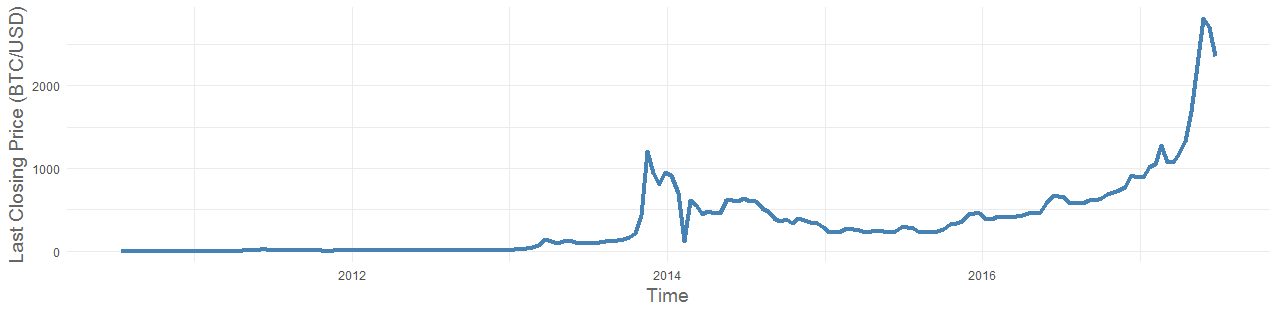
The criticism that our economic system aggregates wealth in the hands of a few is valid, but at least the dollar isn't suffering from deflation and extreme volatility, which is what makes it viable as a unit of account (unlike bitcoin). I wasn't considering bitcoins or dollars as stores of value, just as units for measuring value and devices for transmitting it. Maybe at some point bitcoin will overcome these problems, but for now, I'm rather glad a graph of the dollar's value looks nothing like the graph shown in the original comment.
> The US, UK, and Japan are all currently fighting deflation with QE policies, which seem to be working fairly well.
... and I said :
> If by working you mean rapidly transferring wealth into fewer sets of hands, yes.
... and then you said :
> Are you saying that avoiding deflation and volatility is what consolidates wealth?
I was talking about the effect of QE. That effect being the objective fact that money has transferred from people with less to people with more. You were inventing a strawman about the theory that if the people who were doing this didn't get what they wanted, we would have 'deflation and volatility'? Seen the house markets over the past 30 years? Looks pretty volatile to me, so it doesn't sound like whoever is making policy has their fingers on the pulse, do they? Sounds more like a marketing gimmick to me.
I had to write a paragraph of crap to answer a BS premise that had no relationship to the argument at hand. So. Strawman.
> Furthermore, I don't know how to make heads nor tails of the statement that the "concept of value itself" has been "perverted"
Maybe you got fixated on your strawman.
> but at least the dollar isn't suffering from deflation and extreme volatility
Yeah. Theft is much better. Here is a gun to your head. Give me what I want or I pull the trigger. But at least you don't have deflation and volatility. Remind me again... how many people went to prison for the GFC?
Are you saying you don't want to respond, but something forced you?
The saying, "It takes one to know one," seems appropriate here.
Coming out and saying that you "had to write a paragraph of crap to answer a BS premise" is a bit transparent, don't you think? It's a roundabout way of saying, "you're so stupid that I had some kind of moral duty to correct you, which is a waste of my time because I have better things to do." But... why would you call attention to the fact that you have better things to do than argue with me? Isn't that basically the same thing as admitting that you're bad at prioritizing your own time, that you feel compelled on some emotional level to debase yourself by talking with me?
Which brings me to an alternative strategy: if you think someone's wrong, ask questions. Maybe you'll learn something, maybe they'll learn something, and maybe it's just a misunderstanding.
Is this true? I've never been able to figure out how to turn my BTC back into GBP without submitting documentation for KYC laws. I never had to show Paypal my passport, and paypal sucks.
Bitcoin absolutely is valuable. Some people even take it as payment, making it a currency. And moving around that currency is way more transparent and unencumbered than moving any form of fiat. Currency exchange is wholly up to what you want to convert it into and what exchange you are working with. And if that ends up involving your government... people in other parts of the world don't have that limitation. You can't blame the tech if your society chooses to inhibit it (as your PM is trying to do right now...).
There is absolutely no inherent value and no transaction is denominated in bitcoins (you can pay in the number of bitcoins equivalent to a number of dollars, but nobody operating a real business wants a number of bitcoins for a good or service).
Why are you comparing it to visa? I have no intention of getting rid of my cc. My bank account on the other hand...
> There is absolutely no inherent value
Clearly the people who have assigned value by acquiring it would disagree with this, yes?
> and no transaction is denominated in bitcoins
That's just false. Almost all other cryptos are priced in bitcoin, which i think is the subject matter of this thread.
> nobody operating a real business wants a number of bitcoins for a good or service
Oh dear. No. If you think that service providers that are paid in bitcoin aren't keeping their bitcoin holdings you're kidding yourself. That may have been the case a few years ago, but today? There are services today that do exactly the opposite : take a wage and immediately convert into bitcoin and place it in your wallet.
I also wonder if this will ever be regulated (and if it even can, it seems like a cat-and-mouse game).
> They have no inherent worth,
They have inherent value as you need some foundation of the internet economy that's ideally not gov't controlled.