News for hackers. Stuff that matters.
Re:Analyzing Cryptocurrencies Using PostgreSQL by kweinber on Wednesday June 28, 2017 @01:24PM (#14656136)
$100 bills also have very little inherent value or worth. They are only useful because people are willing to trade them for goods and services, there is a regulated source of them, and it is clearly defined how to transact with them.

Cryptocurrencies have the latter 2 features sewn-up but there aren't a lot of hard-goods out there that are predominantly priced in crytocurrencies. . . until that happens their valuations will remain volatile.

Re:Analyzing Cryptocurrencies Using PostgreSQL by michalu on Wednesday June 28, 2017 @01:53PM (#14656475)
Yes, but when my bank fails, the government backing that paper will pay up the deposit up to €50k... if the government is strong well there you go...

Ask MtGox users what happened with their "currency"... and it's not even a big case in terms of amount of money gone.

The thing is, yesterday I sent USD from US bank to UK and received it in less than 30 seconds paying less than 1% in total on fees (including FX), using Transferwise. Coinbase wants to charge me 4% and will take its time...

A month ago I made a typo when making a transfer. The money bounced back in 3 days. Try sending BTC to your ETH wallet and see what happens.

The problem that cryptocurrencies solve can and is being solved because the technology is at that level now so it's possible. Yeah banks suck, we need new, better banks. Transfers suck, we need more like Transferwise.

Blockchain is a different story though...

Re:Analyzing Cryptocurrencies Using PostgreSQL by LMYahooTFY on Wednesday June 28, 2017 @02:58PM (#14657165)
MtGox was a central bank and possibly just a giant case of fraud that people fell for, how is it relevant?

Coinbase is FDIC insured and has insurance for Crypto holdings?

Don't use exchanges if you don't like them?

Re:Analyzing Cryptocurrencies Using PostgreSQL by AlexCoventry on Wednesday June 28, 2017 @11:23PM (#14660530)
Who insures coinbase's cryptocurrency?
Re:Analyzing Cryptocurrencies Using PostgreSQL by LMYahooTFY on Thursday June 29, 2017 @08:04AM (#14662527)
It's done through Lloyd's, so many different companies in a risk pool.
Re:Analyzing Cryptocurrencies Using PostgreSQL by DennisP on Wednesday June 28, 2017 @02:13PM (#14656711)
Ask the central bank of Bangladesh what happened with theirs.

http://thehackernews.com/2016/03/bank-hacking-malware.html

Re:Analyzing Cryptocurrencies Using PostgreSQL by zanny on Wednesday June 28, 2017 @03:31PM (#14657458)
The point isn't that having the central bank backing makes fiat infallible, it is that people will trust a private bank with the backing of a government controlling an economy on the scale of the US more than something without any guarantees at all.

Of course, with bitcoin, ether, and fiat, you don't need a bank. You can always keep your money yourself. Except with bitcoin and ether the ability to secure your own money is much more attainable for average people.

On the flip side, a lot of people conflate trust in web exchanges or bitcoin banks with the stability of the currency itself. Isolated, you have a reason to trust bitcoin way more than any state actor - its math, codified, and nobody can erase it now. On the other hand, state actors have force of violence if anyone breaks the money. If someone breaks bitcoin with an exploit in the blockchain, you are screwed without recourse. At this point, with the amount of participation it has, the bitcoin protocol should be considered robust - but that also is what translates into its valuation. It is only worth so much because it is proven through its long years of use.

Re:Analyzing Cryptocurrencies Using PostgreSQL by Frogolocalypse on Wednesday June 28, 2017 @06:14PM (#14658986)
> people will trust a private bank with the backing of a government

Clearly reality is not agreeing with this assessment? As an example of this counter-argumemt : bitcoin.

Re:Analyzing Cryptocurrencies Using PostgreSQL by zanny on Wednesday June 28, 2017 @06:33PM (#14659123)
Bitcoin is a 42B market. Thats a third the market cap of... McDonalds.

In a global economy of some 64 trillion, 42 billion (plus the gold and other precious metals, and many other "lack of faith" stores of wealth) is not even a drop in the bucket.

And even at that, you don't have to have no faith in established currencies to also use bitcoin. I personally don't think the banking system in power now will fail any time soon, but I also can recognize how valuable a cryptocurrency would be to replace it.

Re:Analyzing Cryptocurrencies Using PostgreSQL by Frogolocalypse on Wednesday June 28, 2017 @06:38PM (#14659162)
What does any of that to do with your argument that people won't do something that they clearly are doing?
Re:Analyzing Cryptocurrencies Using PostgreSQL by zanny on Wednesday June 28, 2017 @09:40PM (#14660117)
That the people developing bitcoin and the people investing in it can have faith in the currently popular monetary systems while also investing in bitcoin. The presence or popularity of bitcoin does not imply an objective amount of lost faith in fiat currencies.
Re:Analyzing Cryptocurrencies Using PostgreSQL by Frogolocalypse on Wednesday June 28, 2017 @09:49PM (#14660152)
> The presence or popularity of bitcoin does not imply an objective amount of lost faith in fiat currencies.

'Objective amount'? What it is is an amount, and growing, that feel exactly what you imply doesn't exist. There are clearly many people that have lost 'faith' in fiat currencies, or the central banks that manage them, or the economies behind them, or all of these things, to the tune of the market-cap of bitcoin. How more objective an amount can you get than that?

Re:Analyzing Cryptocurrencies Using PostgreSQL by AndrewBissell on Wednesday June 28, 2017 @02:15PM (#14656735)
> Yes, but when my bank fails, the government backing that paper will pay up the deposit up to €50k... if the government is strong well there you go...

Eh, yeah, good luck with this. Maybe ask the citizens of Cyprus how trusting their government's promise to pay out in full on their bank accounts worked out.

The US banking system is now hugely concentrated, with a huge pile of leveraged derivatives bets being pyramided on top of depositor money. When this unravels in spectacular fashion, the choice will be to print a massive amount of new USD to paper over depositors' losses, or bail-ins. Either one will accelerate adoption of BTC to escape the depredations of fiat currencies controlled by gov't backed banking cartels.
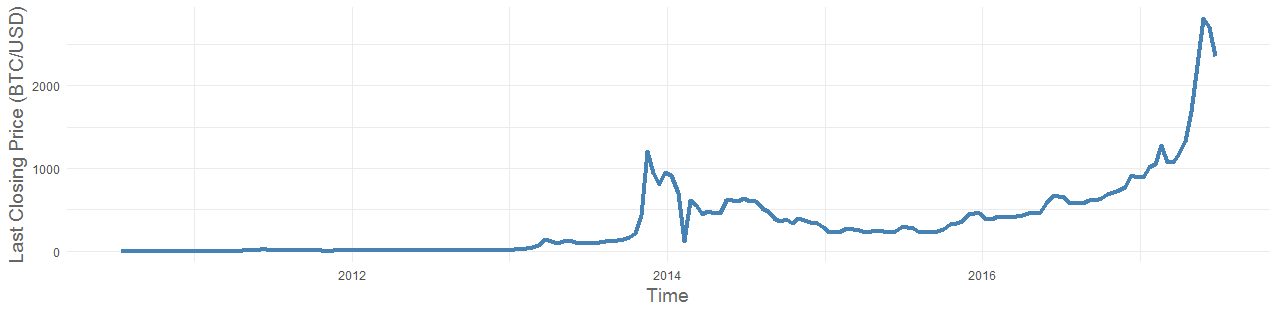
Re:Analyzing Cryptocurrencies Using PostgreSQL by overcast on Wednesday June 28, 2017 @01:52PM (#14656467)
The graph of the Dollar also doesn't look like this https://cdn-images-1.medium.com/max/1400/1*esoUPhcZiG3pEk1cz...
Re:Analyzing Cryptocurrencies Using PostgreSQL by klodolph on Wednesday June 28, 2017 @03:50PM (#14657612)
And it's a damn good thing, too. High volatility and deflation would be an unmitigated disaster. The US, UK, and Japan are all currently fighting deflation with QE policies, which seem to be working fairly well.
Re:Analyzing Cryptocurrencies Using PostgreSQL by Frogolocalypse on Wednesday June 28, 2017 @06:16PM (#14659002)
If by working you mean rapidly transferring wealth into fewer sets of hands, yes.
Re:Analyzing Cryptocurrencies Using PostgreSQL by overcast on Thursday June 29, 2017 @08:42AM (#14662753)
You mean like Bitcoin, where a relatively small number of people hold the majority of all mined Bitcoin in the world?

https://bitconnect.co/bitcoin-news/254/bitcoin-millionaires-...

https://bitcoinprivacy.net/richlist

Re:Analyzing Cryptocurrencies Using PostgreSQL by Frogolocalypse on Thursday June 29, 2017 @07:31PM (#14667672)
What does that have to do with quantitative easing and deflation?
Re:Analyzing Cryptocurrencies Using PostgreSQL by klodolph on Wednesday June 28, 2017 @10:45PM (#14660386)
Are you saying that avoiding deflation and volatility is what consolidates wealth? How?

Or are you saying that quantitative easing consolidates wealth? How?

Or are you just inserting an unrelated complaint into the discussion?

Re:Analyzing Cryptocurrencies Using PostgreSQL by Frogolocalypse on Wednesday June 28, 2017 @10:59PM (#14660440)
I think I'm being clear enough. There has been an objectively massive shift in wealth between low and middle income earners to wealthy asset accumulators over the past 30 years, and that has accelerated over the past 10. This solution you're lauding has been engineered by exactly those asset accumulators as a response to problems caused by exactly those asset accumulators.

It's like you're cheering on an arsonist because after the fire he lit that has burned down your house, he hands you a bucket of urine to help put the fire out.

Re:Analyzing Cryptocurrencies Using PostgreSQL by klodolph on Thursday June 29, 2017 @05:08AM (#14661777)
So, I don't understand what you were trying to say, and when I ask for clarification, you just double down instead of actually answering my questions? Come on, I just want to understand what your viewpoint is, but if you don't want me to understand your viewpoint, I guess that's your prerogative.
Re:Analyzing Cryptocurrencies Using PostgreSQL by Frogolocalypse on Thursday June 29, 2017 @05:32AM (#14661868)
Your questions :

1. Strawman. It is the concept of value itself that has been perverted through this process.

2. Because organisations (i.e. banks and the owners of their service channels) closer to the feed of treasuries suffer the least of the effects of monetary expansion.

3. I thought we were talking about inflation and bitcoin as a store of value?

Re:Analyzing Cryptocurrencies Using PostgreSQL by klodolph on Thursday June 29, 2017 @07:28AM (#14662319)
When the question is, "Are you saying X?", "Strawman" is a nonsensical answer. I wasn't asking rhetorical questions, I was asking questions because I didn't understand what argument you were making and I wanted clarification. That's pretty much the opposite of a strawman argument right there.

Furthermore, I don't know how to make heads nor tails of the statement that the "concept of value itself" has been "perverted". Such a vague and sentimental notion could mean many different things.

The criticism that our economic system aggregates wealth in the hands of a few is valid, but at least the dollar isn't suffering from deflation and extreme volatility, which is what makes it viable as a unit of account (unlike bitcoin). I wasn't considering bitcoins or dollars as stores of value, just as units for measuring value and devices for transmitting it. Maybe at some point bitcoin will overcome these problems, but for now, I'm rather glad a graph of the dollar's value looks nothing like the graph shown in the original comment.

Re:Analyzing Cryptocurrencies Using PostgreSQL by Frogolocalypse on Thursday June 29, 2017 @08:07AM (#14662547)
Let's bring ourselves back then to what was being stated. You said :

> The US, UK, and Japan are all currently fighting deflation with QE policies, which seem to be working fairly well.

... and I said :

> If by working you mean rapidly transferring wealth into fewer sets of hands, yes.

... and then you said :

> Are you saying that avoiding deflation and volatility is what consolidates wealth?

I was talking about the effect of QE. That effect being the objective fact that money has transferred from people with less to people with more. You were inventing a strawman about the theory that if the people who were doing this didn't get what they wanted, we would have 'deflation and volatility'? Seen the house markets over the past 30 years? Looks pretty volatile to me, so it doesn't sound like whoever is making policy has their fingers on the pulse, do they? Sounds more like a marketing gimmick to me.

I had to write a paragraph of crap to answer a BS premise that had no relationship to the argument at hand. So. Strawman.

> Furthermore, I don't know how to make heads nor tails of the statement that the "concept of value itself" has been "perverted"

Maybe you got fixated on your strawman.

> but at least the dollar isn't suffering from deflation and extreme volatility

Yeah. Theft is much better. Here is a gun to your head. Give me what I want or I pull the trigger. But at least you don't have deflation and volatility. Remind me again... how many people went to prison for the GFC?

Re:Analyzing Cryptocurrencies Using PostgreSQL by klodolph on Thursday June 29, 2017 @08:54AM (#14662852)
> I had to write a paragraph of crap to answer a BS premise that had no relationship to the argument at hand.

Are you saying you don't want to respond, but something forced you?

Re:Analyzing Cryptocurrencies Using PostgreSQL by Frogolocalypse on Thursday June 29, 2017 @05:29PM (#14666995)
What do you think?
Re:Analyzing Cryptocurrencies Using PostgreSQL by klodolph on Friday June 30, 2017 @03:44AM (#14669188)
I've certainly thrown my fair share of insults around on Hacker News. Petty? Yes. Wrong? Yes. I'm a slave to my baser emotions from time to time, and I won't excuse that. The general technique for insulting someone on HN is to be subtle and imply that they're stupid, to provoke them into getting angry and saying something stupid, or to throw indirect insults by describing their comments as "garbage", "crap", or whatever. I hope one day that I'll grow out of it, it's an awful habit.

The saying, "It takes one to know one," seems appropriate here.

Coming out and saying that you "had to write a paragraph of crap to answer a BS premise" is a bit transparent, don't you think? It's a roundabout way of saying, "you're so stupid that I had some kind of moral duty to correct you, which is a waste of my time because I have better things to do." But... why would you call attention to the fact that you have better things to do than argue with me? Isn't that basically the same thing as admitting that you're bad at prioritizing your own time, that you feel compelled on some emotional level to debase yourself by talking with me?

Which brings me to an alternative strategy: if you think someone's wrong, ask questions. Maybe you'll learn something, maybe they'll learn something, and maybe it's just a misunderstanding.

Re:Analyzing Cryptocurrencies Using PostgreSQL by AlexCoventry on Wednesday June 28, 2017 @11:21PM (#14660520)
The difference between a $100 bill and 0.04 BTC is that the IRS accepts the $100 bill as payment for taxes. Taxation is what creates the fundamental demand for national currency.