- Google Chrome for mobile doesn't allow add-ons so you can't install ad-blockers. (You can install browser extensions with Firefox for Android.)
- Google Chrome uses a dark pattern where the address bar tends to send users to the Google search results page instead of to their final destination (compare the behavior with Firefox's). That means that even if you have an ad-blocker, many users are likely to click on Google ads on the way to the destination site, even if they are blocked on the destination site.
- Android doesn't provide fine-grained permissions control or root access, so users can't block ads.
- Some of their content is designed to coerce users to buy restricted Android-based content-consumption devices. For example, you can't buy movies on YouTube and watch them HD in Google Chrome (at least on my computer). You have to buy another computer that doesn't have root access (an Android device) in order to consume the videos in HD. Once you're on the restricted device, it's harder to block ads.
- Google introduces projects like AMP that try to convince webmasters to restrict their monetization options and make it easier to appify the WWW. AMP even serves your content from Google's servers. The more control of the content they have from server-to-eyeball, the more options they have for stopping ad-blockers (and the worse it is for open technology).
One caveat here - Google devices are probably some of the most allowing of root access and full device ownership - easily unlocked bootloaders basically allow it to be a one button process.
Some manufacturers make you put your device on a shitlist with them before they'll give you a key to unlock the bootloader and root it - others, like Apple, won't allow you to at all.
Once you are rooted, you do have full ability to block everything and get fine-grained permission control via XPrivacy for example. Android devices are actually some of the best here mostly due to strong community support. You can't even get this control if you want it on many mobile devices these days.
However, what I'm trying to get at is that, for example on iOS you still can't block in-app non-Safari ads at all. On Android you can do that if you want to, and a lot more, you can also block specific connections, block device-specific identifiers, APN lists, accelerometers, wake state, etc - it's a better compromise for someone concerned about privacy than other platforms even with this considered right now.
Can you still brick it? Yes. Is it likely if you type the two commands as you're told to on the website? No.
Also, bricking doesn't just happen, if you understand what you're doing you'll be fine. That "some risk" isn't random, it's in the case that you do something incredibly stupid. Get a custom recovery on there as soon as possible and you can pretty much recover anything.
Did you hear about SafetyNet? https://koz.io/inside-safetynet/
On Android devices with unlocked bootloaders, a great amount of apps won't work.
Android Pay, Snapchat, Pokémon Go, etc.
Google has tried to fight rooting as much as possible.
So, yes, they can do something: blow fuses in the fucking system.
From what I've seen the only mention of such fuses on Google devices is one that enables secure boot from factory and forces you to run the unlock command as I mentioned to reflash your bootloader - nothing to do with safetynet or anything similar.
Let me know if I'm missing a device which does actually do this. Yes, it's theoretically possible, but requires sufficient crypto hardware and protection to make it significant and it'd be a significant shift in direction for Google to go this route currently in my opinion.
Of course a full safetynet emulation that would spoof the check as a different device would also be an option... but it'd be a pretty big undertaking, but one which I'm sure would happen if this ever became a remotely significant threat.
- Android apps like YouTube and Google News use a built-in browser frame to show navigated-to web pages, rather than opening them in an external browser. The built-in frame uses Chrome tech, without add-ons. They used to allow you to open links by default in an external browser, but not any more.
To block ads in Chrome Custom Tabs [1][2] you can either use Chromer [3] to change the custom tab provider to Brave [4] or use the article mode in Chromer.
[1] https://developer.chrome.com/multidevice/android/customtabs
[2] https://www.reddit.com/r/Android/comments/5ahlfq/dev_psa_chr...
[3] https://play.google.com/store/apps/details?id=arun.com.chrom...
[4] https://play.google.com/store/apps/details?id=com.brave.brow...
Now I just hope that Brave doesn't turn out to be too evil :S.
Before anyone chews me out, as this effectively renders many free apps equivalent to their premium (ad-free) counterparts, I usually pay for said premium versions to compensate their developers.
Using adaway or a pi-hole for that matter will not - they will only cause ad loading to fail (in some cases) - which sometimes results in frames showing errors on the page instead of a clean rendering of nothing with ad divs removed.
Personally I wind up using several methods - AdAway to kill most app ads, uBlock for web and Xposed to kill YouTube ads since the hosts-based methods seem to work rather poorly for them as their subdomains change all the time.
That's weird, I didn't get any Youtube ads in quite a long time, and only use AdAway.
Defense in depth.
It's called HDCP, and I believe it's a combination of your GPU, monitor and cable between it supporting it. Netflix and most other online streaming services do this too. It has nothing to do with root access.
And if a site decides to start combating the ad blockers, the adblock list providers will update their rules specifically for the site in question. Adblock users get upset whenever they see ads, and report them pretty quickly.
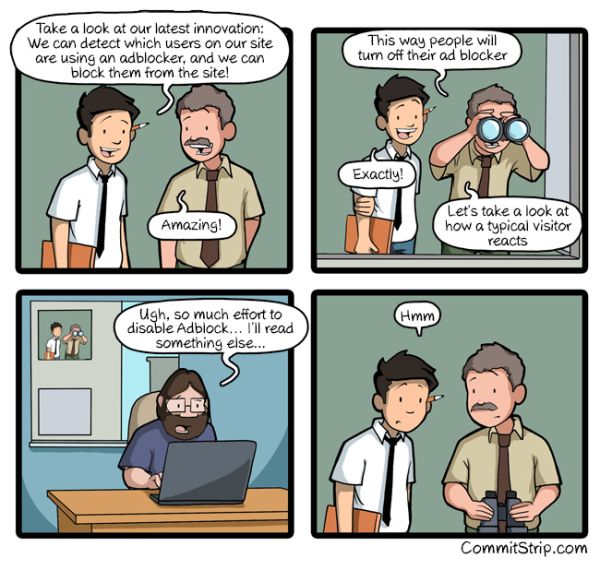
The business I work for tried blocking adblockers and after a bit of back and forth they trumped us by blocking all AJAX requests on our site. We gave in after that.
What "mistake?" That the developers couldn't foresee and block the exact elements against ad-blockers before they became real?
Reading the parent comment, it seems users are not opposed to reporting specific instances for the greater good. This is obviously more energy consuming than uninstalling, so where do you get the idea people will all of a sudden stop using an adblock because it failed to get passed one or two sites?
We're already seeing anti-ad-blocker-blockers being developed to remedy this problem. And if they don't come fast enough, users can just turn off their adblock for one page and be done with it.
Direct advertising is a dying legacy tactic. The most successful ads these days are the ones you can't tell are ads. They're also the stronger poison of the two.
You mention that native ads are gradually replacing direct ads as if it's a good thing. The good guys in the publishing industry go out of their way to prevents ads affecting content, they don't allow their writers/presenters etc to touch advertising and everything is clearly separate.
In the long term, ad blockers will just push out those people who are driven by ethics and you'll be left with the sleazy publications that are driven by PR. This is coming from someone who has dealt with PR agencies and constantly turned down proposals.
> The business I work for tried blocking adblockers and after a bit of back and forth they trumped us by blocking all AJAX requests on our site. We gave in after that.
I took this to mean that adblockers had to evolve and block AJAX on the website to make it accessible. Not, that they were hasty and disabled all functionality.
> You mention that native ads are gradually replacing direct ads as if it's a good thing.
On the contrary: "The most successful ads these days are the ones you can't tell are ads. They're also the stronger poison of the two."
> The good guys in the publishing industry go out of their way to prevents ads affecting content, they don't allow their writers/presenters etc to touch advertising and everything is clearly separate.
I didn't know this. However, I think it's a losing game. Consumers don't seem to care too much about the "good guys," unless a moral campaign is spear-headed (a la Tesla by The Oatmeal), only not seeing ads at all.
It's ironic really. We block ads so we're not influenced by them, but then we lower our guards and become susceptible to the indirect kind.
It's the natural order anyway. There will be those in the coming generations that will be like just like us. Except where we fought against direct ads, they will fight against the indirect. There've always been those unorganized who value critical analysis in all contexts, but their findings and ways never reach the public and make any impact.
Or maybe we've just made ourselves out to be sheep. As long as the coyotes aren't around, out of sight out of mind.
> In the long term, ad blockers will just push out those people who are driven by ethics and you'll be left with the sleazy publications that are driven by PR. This is coming from someone who has dealt with PR agencies and constantly turned down proposals.
As is with all things. You do not survive by being ethical, but by being the most adaptable, and sociopathy happens to be a great adaptation for sales.
I'm more interested in what happens next after the sleaze epoch. Will ads continue to become more and more manipulative then, finally after reaching too far, begin to wither and fade into the anals of history (albeit likely not as known as it should be, because of "out of sight out of mind."). Or will someone finally shake up this industry?
Other than that, they are essentially freeloaders and if a website has too many freeloaders it has to either get rid of them or convert them to something else. Or, I guess, the website could shut down completely.
Funny. Ads are consuming CPU time and electricity that I pay for in addition to my attention and time, and compromise my decision making. To me, any of those are infinitely more valuable than resources the website expends on serving ads or trying to.
Buzz. I block ads but I also post links to articles on social media that are then followed by people who do not block ads.
I have a couple of areas of focus where I am exceptionally knowledgeable and people who have anything more than a passing interest in those subjects check out links I post.
Or, I guess, the website could shut down completely.
The tragedy of the commons.
Just the same, if you have an adblocker installed it's unlikely you're the type of person who is going to be clicking on ads anyway. And PPC ads are much, much more prevalent than impression-based ads. So if someone is blocking your ads, you're not losing anything. You get paid when someone clicks an ad, and if they're going to the trouble of blocking all ads, they're not clicking anything anyway.
You create a system where they won't or can't visit your site, and your traffic decreases, which will have an effect on your ad rates.
You can have all the ads you want, but if people aren't visiting your site - and sharing links to it, talking about what they read there, recommending it to others - they're not going to get you much revenue.
Almost universally, it's not worth it.
I thought "hey, the Newsletter and Security Notices icons aren't clickable", opened a ticket, and found that the input and submit elements that should be under those icons were being blocked by disconnect.me :)
Who does that leave?
I don't have experience fighting ad blockers, though (I actually enjoy my ad blocker).
If Google did it, I doubt ad blockers would be able to block all ajax request on Google, or everyone would simply uninstall the extension.
The 5% (of which pretty much all of HN is a part of) can probably afford to pay for the cost of creating that content. The 95%, consisting of not just hourly wagers but also salaried folks generally can't afford to. The trade off is ad supported content.
So it's very unlikely to die off.
I guess, for network level ad blockers, I'm not seeing obvious advantages to a program written as an app vs a program written to run in a browser.
But in the end you probably won't win against someone who really hates ads. - and that's probably better for users as well as advertisers.
Sure, I believe that I am pretty much completely unaffected ads, but then so does almost everybody else.
Is it because you believe people use ad-blockers because they're impulsive and can't hold their gaze?
I mostly combat any ad influence on me by making a point to _not_ buy anything that is advertised. Works out pretty well for helping me keep my sanity and conscience a little.
This is in the same vein of inductive reasoning as "just snap out of your [insert mental illness/addiction/etc.]."
"People," in this context, isn't defined either. If however we were to say that by "people" you mean millennials, then you would be wrong.
But if you meant "the population at large" you would be correct.
Although, the second statement is tangential to the article at hand.
My second statement was highlighting how ones own opinion of oneself is not objective.
And I retorted that ones own view of oneself can not be extrapolated onto the population at large if it is not objective.
But I should have been clear, when I mean "second statement" I mean so inside my own post. Ex:
1st Statement: "People," in this context, isn't defined either. If however we were to say that by "people" you mean millennials, then you would be wrong."
2nd Statement: "But if you meant "the population at large" you would be correct."
Which was in defense of the tech-literate and the young, but after researching some more my statements were based on old information.
The only people that come to mind who are easily susceptible to ads are the old and tech-illiterate, i.e those who don't have much experience with ads. Though this is just conjecture.
It's like saying "sure, I think think that I'm smarter than everybody else, but then so does everybody else."
My point was that people should not take their own assessment of themselves as strong objective evidence about themselves.
Sure, you could whitelist www.google.com, mail.google.com, etc, but couldn't they keep ahead of you if they were ok with using their main domain? They could even start using www.google.com/ad-id
Currently domain-based filtering is probably too small a proportion of traffic to even care about, but as ease-of-use comes to the masses there may come a point where the pro-ad side will implement this.
This would require cooperation from the sending http stack, in this case the browser. I doubt that this is a viable option in this case.
What if the New York Times decided to host all ads themselves? nytimes.com/ad-42.jpg couldn't be distinguished from nytimes.com/todays-front-page-image.jpg
Obviously it's more likely for ad ad-provider like Google to do this, but even then, if there's new content from Google (say a blog post) I expect to be able to see it.
You could whitelist the search results page and nothing else.
Viewing a blog post is less important IMO.
www.google.com/dog-595984hdfh/
www.google.com/cat21/
* Security/Guidelines/Web Security - MozillaWiki || https://wiki.mozilla.org/Security/Guidelines/Web_Security#Co...
Mozilla makes a good tool to let you scan and report on this sort of thing for any site.
* Observatory by Mozilla :: Scan Results for news.ycombinator.com || https://observatory.mozilla.org/analyze.html?host=news.ycomb...
It is also my understanding that some of our boxes are here solely to proxy requests (either assets or websockets, which are increasingly popular in the field) to 3rd parties, to make sure it bypasses client side countermeasures.
IP (and BGP) are ultimately concensus realities.
AMP
Before that I would be bombarded by ads for every video and then in the middle of any video that ran more than 30 minutes.
I don't mind a few ads I get the concept but 95% of the ads were just two companies Wix and Grammarly over and over.
  youtube.com apis.google.com script allow
  youtube.com googlevideo.com * allow
  youtube.com gstatic.com * allow
  youtube.com s.ytimg.com script allow
youtube.com ytimg.com * allowCurrent browser-based blocking tech would be rendered useless, right?
(Pocket ... has multiple annoyances. It's better than the alternatives, so far as I've tried, but that is one hellaciously low-set bar.)
For instance, since browser-based ad blockers work from what I know by blocking known domain names, couldn't Google create random subdomains and serve the code from a different subdomain every day or even every few hours, as well as change the way their JavaScript and HTML looks?
Even something very expensive to run would be justified with all the money that advertising brings in.
If Google can create software that can tell what's in a picture, or if a person in a picture is happy or not, why can't they find a way to fool ad blockers..?