Airlines have jacked up the prices of comfortable berths people can sleep in on long haul journeys to almost 10x the price of shrinking torture chairs that most of us buy. For a long while business class and coach drew apart in price even as business got more luxurious with flat beds and fancy wines while coach seats in Boeing's newest, most advanced 787 jets are the narrowest trans-oceanic seats ever sold and Spirit/Frontier domestic seats don't even recline anymore.
But that difference was driven by corporate executive passengers whose employers were paying the 10x prices and getting tax breaks for doing so. Corporate sales is complicated and charging more can actually sell more units so the airlines carefully eliminated mid-priced options to force businesses to pay far more for the very profitable business class seats than their marginal cost.
And economic rationality has reasserted itself. Premium economy seating is now common on airlines outside the USA without such easily gamed large corporations to scam. The premium economy is similar in quality to old-fashioned business class seating at prices that middle class leisure travellers can afford. Mostly you can't buy it from the USA without paying a steep premium, but anyone flying to the USA from abroad has been able to for about a decade. Carriers refused to sell it at the same prices in the USA because running the game on corporate purchasing departments is so lucrative. For example, JAL and Cathay Pacific round trip fares between the Far East and USA in premium economy have been about $500-1000 more originating in the USA than in their home countries.
But Delta and American are now outfitting planes with premium economy because it's the most profitable use of space for carriers that have it and supporting the corporate business class sales inflation scam can't hold it back anymore. American is flying the new class on planes already. Even CX and JL prices are starting to rationalize.
So the key variable in airline discomfort has been American corporate purchasing culture irrationality and not the natural division of markets into tiers. Corporate purchasing irrationality and cartel pricing to exploit it are also the drivers of advance-purchase fares, last-minute price gouging, saturday night stay requirements, steep premiums for one-way fares, and lots of other paradoxical and nasty pricing strategies.
Maybe part of the problem is the tendency to hyperbolize.
So what happens with people of below average intelligence and physical ability? They're likely to suffer from lower earnings. Should a person of average height and on minimum wage subsidise a well-paid tall person?
In an ideal world, chairs would adjust so that everyone is comfortable and still allow the same number of people on the plane at the same price. However, in the real world, we probably have to accept that allocating comfort based on ability to pay, with a bit of flexibility on both sides, is the best outcome.
I assume it is ok though that a short well-paid person to subsidize a tall less-paid individual?
Most airlines that I've been on have started turning the exit row into a "non-first-class extra legroom" row. On a few occasions I've seen very tall people sitting there. And there's nothing wrong with building a range of legrooms into a plane. But I don't see why there should be some requirement that a costly good - legroom on a plane - be provided to more people than actually want to pay for it.
It costs a much larger premium than the space differential, it largely costs more due to price discrimination, because many fliers in business aren't the ones paying for their tickets. If you're talking about real first class (which can carry up to a 30-50x price premium on the economy rate), there's also very attentive service, nice champagne, multi-course meals made by an onboard chef served on china plates with silverware, seclusion, sometimes even private rooms. I would not characterize it as "largely because of its larger legroom".
If you mean to say that many people choose business/first because of the additional space, that's more correct. But even in business, it's more about lying flat and other factors than simple legroom.
But a sigificant component of the cost is simply that first class carries fewer people per linear foot than does economy.
Allowing the unbundling of services is much more likely to allow the emergence of an "extra leg room only" class, than is a situation where services must be bundled into a standard package. If the prices have to be the same regardless of seat location, and be packaged with an identical bundle of food, blankets, etc, then that's a strong disincentive to attempt to sell a separate class of legroom seats. And it's much more likely that a "standardized seat" will be too short for very tall people than it will be tall enough - and even if it were, that would mean fewer seats on the plane and thus higher prices.
And it's not always as somebody pointed out above that you may chose the door seats for the same price. I had to take a last minute trip for this summer vacation. Those places were part of some "Comfort" plan I didn't even hear of while booking. Fortunately those were the only ones free on the plane and they let me sit there for free. They were booked out for the flight back though...
It's a pain, it got worse through the decades and I fail to understand that development. Was the free market not supposed to make everything better and cheaper? ;)
I'm not saying it's at all comfortable, just that it's rather hyperbolic to call it 'torture'. I have a book, an MP3 player and some headphones, and then look forward to landing. I prefer to have the money than pay for extra comfort. FWIW, I also have a pretty small car for exactly the same reason. I wouldn't call that torture, and wouldn't expect anyone to subsidise big cars just so I feel more comfortable for the same price.
"Having to pay what I deem a high price for a good and/or service I deem insufficient? Help help, I'm being oppressed!"
Wanting enough space for my elbows to be able to stay within the confines of my seat should not cost me 10x as much.
Economy plus might not be the best thing in the world, but 50% more is at least within the realm of human affordability, and partial recline and my own armrest sounds downright luxurious. For 5x as much as a coach fare, the perks better be things I shouldn't discuss on a public forum.
And I don't really care about the quality of food or service, how many times they bring me a hot towel, etc. Just want a good seat.
It does tie in with two-income families (households are more time-poor) and other changes in the economy, it's not just commoditization.
Or perhaps even better, a return from Manchester to Nürnberg for ~£30 in 2 hours instead of a 14 hour drive plus ferry. The fuel for that alone (not including the ferry) would cost £170.
I just don't understand the complaints!
Booking a few months in advance I can get a return trip to the otherside of the world (Australia) for under £700 and get there in less than 24 hours. I find that incredibly cheap and would be mindblowing just 20 years ago.
Take cheese, for example - it's much easier to taste the difference with cheese. I've never had a UK supermarket Comte comparable to a Comte from a cheesemonger, no matter how premium it was advertised.
Or pastries. The only widely distributed supermarket in the UK with what I would consider edible pastries is Waitrose, and not all branches have a decent range. But bakeries in the UK have their own mass-market pathologies.
What really brought the insight home to me was my experience eating in Morocco. There, bread was baked by street vendors - it was always fresh and warm. You have to get lucky with timing to get the same experience in the UK, even if you go to bakeries. I realised we've lost certain qualities of life with our economic setup, and the more I found out about good food, the more I realised that supermarkets and commoditization had created a mechanism that forced me to work much harder to get good food.
Anyway, this isn't directly related to airline seats, but I do think the ratchet effect is real and it shows up in a lot of places.
Maybe that's just the UK? In Germany, many supermarket and discount store chains have recently been outfitting their stores with bakery stations, where you have a somewhat decent chance of actually getting warm rolls.
Also, I've had a pretty good experience with premium products in German supermarkets. I only rarely buy from a premium store (sometimes for cheese, almost never for meat), but when I do, their performance is pretty comparable to supermarket premium lines.
Mind, I was fortunate enough to live in the best baking city in Israel (something like 53 bakeries in a city of 300000 people, plus supermarkets and open street markets), but still.
This is false. 15 percent in the US are at or below the poverty line. The remaining 85 percent certainly aren't at the top.
I certainly don't.
"nothing in the middle" is a blatant lie and hackernews discussions are much better when they are backed by facts and logical arguments rather than political clap trap.

71% making less than $50k/y.
51% of households.
There's quite a few households and quite a lot of people between $35k and $100k. The claim that there is no middle class is blatantly, provably false. The very, very top has a lot. I don't think anybody is disputing that (I'm certainly not). But there are a lot of people who make a solid, middle class income.
https://cdn.americanprogress.org/wp-content/uploads/2014/09/...
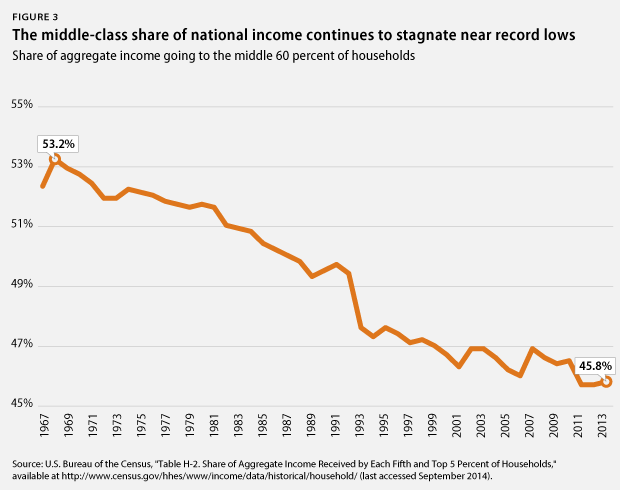
This shows it more clearly.
https://upload.wikimedia.org/wikipedia/commons/0/0d/Distribu...

> In 2015, in the United States, the poverty threshold for a single person under 65 was at an annual income of US$11,770; the threshold for a family group of four, including two children, was US$24,250.
Do you consider this getting by?
I don't deny that the commodity situation is better for people at the lower end of the income distribution. It's the middle that gets hollowed out.
It's impossible for everyone to be happy when you're making the collective decision.
Take meat. Used to be you'd go to the butcher for your meat, and you'd get a reasonably good product, from a butcher who knew where the meat came from, probably even the farmer who reared the meat. That was the way almost everybody got their meat, so the fixed overheads of having a butcher shop was spread over a large customer base.
Move along a couple of decades. Supermarkets, with their more efficient logistics, eat into the meat trade. Butcher shops almost completely disappear. But supermarket meat goes through a longer supply chain with larger suppliers that have the efficiencies of scale to cope with the pricing power supermarkets have. The butcher shops that survive turn into boutiques, where their unique selling proposition is what used to be commonplace: that they know where the meat is coming from and probably know the farmer that reared it.
The market bifurcates into two basic strategies, low price and high quality (see also Porter's Cost Leadership and Differentiation).
The consumer who's willing to pay a little bit more for a little bit more quality ends up having to pay a lot more rather than a little bit more, because the pool of people who could spread the fixed costs of the higher quality is split - most go for the lowest priced product. There's a ratchet effect, where slightly higher quality products are, at the margin, increasingly expensive because there's no scale in that strategy: the more expensive they become the less uptake they get, which means they have less scale, which means they become more expensive.
In some ways it's a collective action problem: what would be a better outcome for a large group of people can't really occur because individual actions can't sustain a stable state change. In other ways - many, if not most economists believe this - it's a better outcome overall, because more people get to use the bargain basement product.
But I think people in the middle are usually worse off in commoditized markets.