Sure, when they were babies and toddlers, it wasn't practical. But I've found that both your life, and the life of your children is better when you integrate them into the work that needs done and the life you want to live, and do not treat spending time with them as a separate activity.
This!
We have so much fragmentation on roles already, it is increasingly harder to find time to do things with our children, for both teaching and spending time with them. Cooking is that one thing that can build this relationship, teaching (and entrusting) the child to deal with potentially dangerous tools yet yielding a result that is immediately appreciable.
Personally, I live with a kitchen that can't reasonably fit more than one person, and all the counters are inaccessible to children.
Likewise, when they are tiny, you don't really give them knives or anything. But they can see what is going on, you can talk to them. They learn quickly. My kids have been making their own lunches since they were 6, starting with simple thigns like sandwiches or nachos. My 10 year old frequently cooks breakfast for the family -- eggs, pancakes, waffles, etc. My 8 year old does simpler things - grilled cheese, mostly.
Give kids a chance - they may surprise you.
As far as working in small spaces where people do not fit, that does sound like more of a challenge. But parenting is full of problem-solving opportunities.
But I think many people lose perspective on this. There are a large number of people who, once they have finished their long hours at work, finished their >1hr commute home, washed the clothes, taken the kids to their activities, picked them up from school, cleaned the house, helped with the homework, etc. find that they do not have time to dedicate to cooking. Often, these are poorer people, they may live a long distance from a good supermarket, and simply buying fresh groceries is a challenge.
Knowing people in this situation personally, they feel extremely guilty and regretful over the fact they can't make their kids nutritious home cooked meals every day. People not in that situation often don't realise that buying a freezer full of frozen meals and a cupboard full of tinned pasta/beans is often more cost effective than trying to plan buying fresh food such that it doesn't spoil - given the inherent variability in how long fresh food tends to last. And arguably, more importantly to individuals with cashflow issues, is the stability. When you buy that frozen Mac & Cheese dinner, you know that $1 is going to feed your child for an evening. And that meal is going to cost the same next week, and the week after. It's simpler to budget that way. If you buy locally sourced, organic head of lettuce at the farmers market - it might last two days, it might last two weeks - there's not really any way of knowing.
I know many people who take great pleasure in cooking with the family at the weekend, but don't have time in the week. So from Monday to Friday, they live from prepackaged frozen food, takeouts. Innovation in this space would be welcome - but simply telling people to "make time" to cook isn't going to change anything. Making Mon-Fri cheaper and healthier might make room for higher quality food at the weekend, though.
Food has been innovated on massively over the last 70 years. From the way it is produced to shipped and stored and finally how it is prepared. The industrialization of food has produced instant meals, TV dinners, fast food and led a mono agriculture policy.
A lot of what is labeled as a particular type of food isn't even what it says it is. Look at a loaf of bread sitting on the shelf. It will have 20+ ingredients! Many of them synthetic or unnatural. And it's not just these things added but the process of how it is made that it makes it "not bread".
And that's just the start. The way animals are raised and pumped full of drugs because of this method of raising them. The packages of pre-made food that is full of a list of who knows what to add color and consistency and preservation.
The food industry has been plenty innovating. Between packaged and ready made food and fast food restaurants selling inexpensive meals the innovation is there and widely accepted. The problem is a lot of this stuff is bad for people and responsible for many health problems today and honestly it mainly tastes awful (that parts an opinion to be sure, but it's no wonder that "American food" has such a low opinion around the world).
The food industry had a revolution and it optimized for low price and convenience as people were sold a message that planning, buying ingredients, cooking and washing dishes is a hassle and not something to be proud of and to enjoy. I live in Manhattan and don't have much space but I can cook without hassle. If I had kids I'd be cooking with them and teaching them the value of it.
> Look at a loaf of bread sitting on the shelf. It will have 20+ ingredients! Many of them synthetic or unnatural. And it's not just these things added but the process of how it is made that it makes it "not bread".
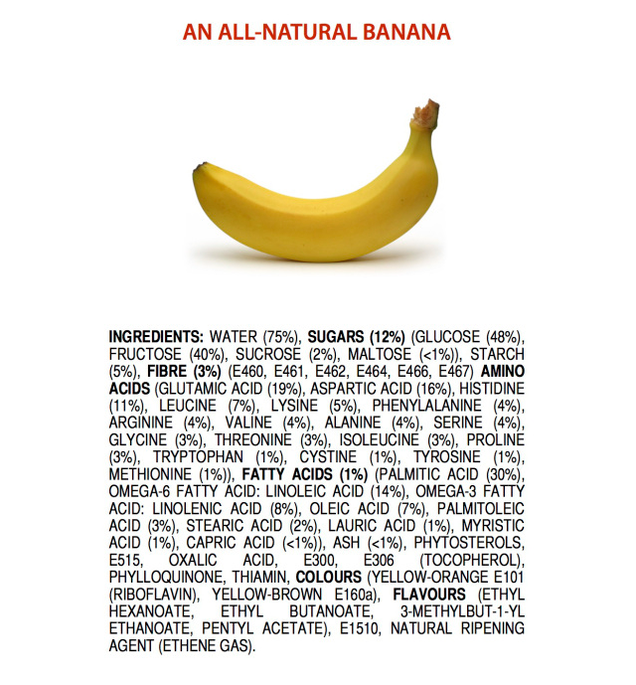
How "synthetic" they are depends on a bread (toast bread vs. normal, etc.), but a reminder - "bread" is not an atomic ingredient; even the most "natural" one would have a bunch of them on the label. Also, note the ingredients of a perfectly natural banana:
https://i.kinja-img.com/gawker-media/image/upload/s--o2mC_ak...
--
The point being, many people - myself included - consider preparing many of our meals a chore, not a pleasure. Preparing a fancy dinner every now and then is cool, but having to do that every day cuts into free time we'd like to use for something more interesting. I don't see why so many people have a problem with that.
It's just that a lot of us these days have different values than the people who designed the bread (and a lot of the people who continue to buy the bread), which means that what we think makes good bread is not the same thing as what they think makes good bread.
> It's just that a lot of us these days have different values than the people who designed the bread (and a lot of the people who continue to buy the bread), which means that what we think makes good bread is not the same thing as what they think makes good bread.
That's a fine point, but then again a lot of us these days have the same values as those who designed the bread. Why are we being pushed so hard to reject them, with arguments mostly bordering on chemophobia?
Look, I like the fact that people don't starve. That poor people can get the nutrients and vitamins they need. Everything in the industrial food revolution was designed to make food cheaper for consumers. But there's a cost to that too. And early onset diabetes, heart failure for people in their 40's and other health issues are only part of the price.
It's not chemophobia - at least not for me. It's the breaking of the marketing we've been sold that cooking is hard, that cooking is very time consuming and that prepared industrialized food is just as good for you. As for the bread example, it isn't bread. And it could only be labeled bread after these manufactured lobbied government and the FDA in the 1940's to allow it to be called bread.
Yeah, there's a lot of snobbery around slow food and natural food. A lot of that is class distinction I assume and it's annoying. But I don't think you need to buy that kind of stuff. Get the vegetables that aren't organic. Buy meat that isn't "free range". But by all means buy quality ingredients and learn to cook for yourself a couple meals a week.
>People used to be very happy about those additions in the past, when they could relate to more "natural" food and its problems.
This makes no sense at all. People were happy for the convenience and sold the lie that cooking is hard and a waste of time when you can just buy this processed food and eat it right now.
Oh, I wasn't disagreeing with you. I think the stuff's important to have. The fact that nutritious, long-lasting bread of unprecedented quality is so astonishingly cheap and ubiquitous is a miracle of the modern age.
My personal theory is that it's a combination of conspicuous consumption ("but supermarket bread is for poor people"), plus a deliberate attempt to push more expensive products with higher profit margins --- mass produced bread is now so cheap that the margins must be tiny. The cheapest loaf of Chorleywood Process bread from Tesco (one of the big UK supermarkets) is £0.40, which is about 50 US cents:
http://www.tesco.com/groceries/product/details/?id=258742688
Meanwhile, go upmarket to the equivalent instore bakery loaf, and you're spending a pound:
http://www.tesco.com/groceries/product/details/?id=255809172
That's baked from frozen dough in the supermarket itself rather than cooked at a central bakery, which is going to legitimately push the price up, but it's still over twice the price for what is nutritionally the same stuff (compare the two tables above). Even the ingredients lists are almost identical. I think it's still Chorleywood Process, too, although probably from a different batch of dough...
(I'm a bread junkie. I like nice bread, and am willing to pay for it; and you know what? Those one pound loaves above are pretty good. I wouldn't buy the prepackaged loaves, though; they've been sliced, and nothing ruins a loaf more than preslicing it. One day I want to see a loaf of really cheap supermarket bread, unsliced, straight out of the oven. I suspect it would be pretty good.)
(Chorleywood Process, BTW: http://www.bbc.com/news/magazine-13670278)
Sugar is in it. Sugar. In bread. As if the white flour starch isn't bad enough for you as it turns into sugar but then actual sugar is added. No wonder diabetes is such a problem.
Where's the fiber? Well, that's added later and in measly amounts so it can actually be called "bread".
There is hardly any nutrition in this bread. And you admitted you didn't even know that. It was designed to be profitable - not in any way be nutritious.
"Make it better" - for who? The 4 years olds with diabetes?
I know "bread" is a broad term and some people swear by the dark "tastes like dried grain with glue" varieties. But others don't. Personally, I prefer "ISO standard" white bread. Not all food choices are made to optimize for perceived health value. Some are also made for taste.
At risk of constructing a straw man, it does appear to be a widely aired view that we ought to go back to "all-natural" meals cooked from raw fresh, organic, non-GM ingredients. In my experience, vanishingly few people actually do this, because it actually is a hassle and doesn't fit well within our modern busy two working parent lifestyles. Indeed, within your own reply you treat the innovation within the food industry with disdain.
I agree that, often, food innovation has optimised for the wrong goals: strictly prioritising convenience over health, for example. But whether you like Soylent-related products or other innovations in food, it's astounding the number of people who are willing to publicly attack engineered food products simply because it's not natural enough for their preferences and lifestyle. But those same people do not care about the naturalness of all the other technology they use.
With convenience food, I believe the proverbial cat is out of the bag and there's no putting it back in. Short of a massive economic/technological disruption that gives adults in families as much free time as they used to have, it's quite unlikely we'll see a revolution in home cooking. Maybe Soylent and other engineered foods are actually healthier than living off takeouts and microwave meals - as many people do - and are worth investigating further, without overly harshly judging those who currently find themselves in situations where they can't find time to prepare home cooked meals every day.
As for family time: Why not both? My mother made it a point to have me hang out in the kitchen and help out and, as a result, I like cooking and know how to do things ranging from "What do I have left in the fridge?" to "Alright, let's make something fancy". Obviously having the kids use knives isn't smart until they are older, but just having them peel potatoes or hand you stuff is a good bonding experience. And, when they ARE older: you got yourself some cheap labor
And, to get back to the skillset thing: That really helps with saving time. I generally DON'T plan my meals (weekends when I am not out and dates are the only times I really use recipes). My food shopping is generally "What is on sale? Alright" and then I roll from there. And a lot of that goes down to being a kid and watching my mother figure out what was left in the fridge. Sometimes you make an awesome quiche or casserole. Sometimes you just throw some rice in a pot, saute some meat, and then throw a can of vegetables in near the end. And sometimes you are eating bologna and ramen.
Nobody sane is saying to go super all out or to never eat out/eat takeout/frozen food. But home cooked meals are generally healthier, a lot cheaper, and teach kids how to eat right and fend for themselves.
Because cooking isn't everyone's idea of a good time.
That is kind of parenting. You put up with crap to teach your kids.
Also, cooking can be pretty fun. Again boils down to the kind of mentality you have and how you approach it.
Because then, when they are adults, they won't be discouraged because "it is too hard to get all the ingredients" or "it takes too long" because they'll have a better understanding of how to just roll with it. Maybe they won't be making fancy dishes ,but they also will understand how to do a twenty minute meal.
Case in point: You seem to think you have to be a foodie (screw that word and everything about it) to cook with your kids.
Going back to the sports analogy: No one is saying to force your kid to live outdoors. But taking the time to throw a ball around or take them on a hike or whatever conditions them to associate physical activity with fun which, in turn, encourages them to do it on their own.
This is also targeted at people who are choosing fast food over home made food because they want to, not because they have to.
Innovation is great, but if you read the article it talks about many benefits to making food, I'd say the intangible benefits are the greatest, i.e., purpose and accomplishment.
You talk about doing things with your kids. Sitting down with kids and eating a meal is an important family bonding time.
You analogies made no sense. The clothes and cars are get washed and fixed the same way. Soylent is NOT the same as eating real food.
If I had to guess - and I do - I'd wager that his family just orders in or goes out for dinner more than others. And as a new parent myself, I can completely understand.
The title of the story should be changed... Liquid meals were mentioned but not Soylent specifically.
I did, too, at first.
To make tasty, varied, high quality food is not even always as cheap and healthy as one might imagine. Fresh ingredients go bad quickly, and can sometimes be difficult to source, so you have to plan carefully. Many of us live in small apartments with limited space for preparing food and small refrigerators. We work long days, and both adults need to work now. Saving time on planning, buying ingredients, cooking and washing dishes is very appealing.
Why do many people think food should be immune from innovation? We have replaced manual clothes washing with automated washing machines, most people now take their car to a mechanic rather than mending it themselves.