Mark my words, SpaceX is quietly working toward nothing less than a revolution in global data infrastructure, just as Tesla is working to accelerate a revolution in global energy infrastructure. Sneaking in some software, onboard storage, putting them on all Tesla cars, mesh networking the terrestrial base stations with MIMO links, etc.
Cars suddenly become a global peer-to-peer mesh sneakernet. It would be fun if Tesla distributed data via "pulses" between passing cars... (signed high resolution maps? deep learning connectomes? the latest Netflix original series? :D)
>Phased array flat panel antennas cannot be purely software steered sufficiently to track a low earth orbit satellite from horizon to horizon.
Righto. SpaceX plans to steer the beam down to 40° from the horizon. This also minimized path losses.
Drawing from the SpaceX filing: http://i.imgur.com/7zOZ7kr.png

>All Ku-band downlink spot beams on each SpaceX satellite are independently steerable over the full field of view of the Earth. However, user terminals at the customers’ premises communicate only with satellites at an elevation angle of at least 40 degrees. Consequently, as shown in Figure A.3.1-1 below, each satellite operating at an altitude of 1,150 km will provide service only up to 40.46 degrees away from boresight (nadir), covering an area of about 3.5 million square kilometers (1,060 km radius)
source: Figure A.3.1-1 on pp6 of the FCC technical information document, currently 404, via /u/SkywayCheerios
https://www.reddit.com/r/spacex/comments/5d9724/spacex_has_f...
https://licensing.fcc.gov/myibfs/download.do?attachment_key=...
http://webcache.googleusercontent.com/search?q=cache%3Alicen...
I mean, that's a really cool 40,000 ft view idea and all, but global data infrastructure is made up of things like the Hibernia Atlantic cable, its several dozen cousins of post-2000 transatlantic and transpacific cables with DWDM terminals on both ends, and cool things like 100, 200, 400Gbps per wavelength coherent QPSK/16QAM DWDM terminals. And major terrestrial traffic exchange points of existing Internet infrastructure where ISPs put $150,000 core routers (example: 60 Hudson, NAP of the Americas, Telehouse Docklands, Otemachi Building in Tokyo, One Wilshire, 350 E. Cermak, etc).
Satellite traffic is a pretty tiny drop in the bucket compared to terrestrial backbone infrastructure. It's a truly admirable goal to bring affordable broadband to really impossible to reach locations via satellite. On the other hand there are a lot of emerging terrestrial WISP technologies and PTP microwave technologies that can be used in rural areas to provide bandwidth without the need to pipe it up into space and back. It's a lot cheaper to establish a tower site on top of a mountain, even if you need to bulldoze a road to the top, and spend $30,000 on routers and PTP/PTMP radio gear.
In some of the areas of the rural western US where my network engineering job touches, there are WISPs which are rapidly eating into the customer base of people who are (rightfully so) dissatisfied with highly oversubscribed consumer grade VSAT satellite systems.
In the end there will be a combination of many things. The next generation of high capacity Ka-band geostationary satellites (ViaSat-2, etc) are a lot higher capacity. Services like o3b allow ISPs to buy a dedicated 1:1 high capacity pipe to places that can't be reached by PTP microwave and are uneconomical to reach by submarine or terrestrial fiber (example, all of o3b's new pacific island nation state customers). There's traditional geostationary c and ku band capacity from SES, Eutelsat, Intelsat, AsiaSat, russian companies, etc. And of course terrestrial fiber. You don't need a huge amount of money to run singlemode these days, assuming aerial wood poles and a mostly rural area, you need two guys, a bucket truck and about $10,000 worth of tools.
Could an OTA update (and repointing 90°) turn a satellite terminal into an auto/calibrating point-to-point MIMO link?
>global data infrastructure is made up of things like the Hibernia Atlantic cable
Surprisingly the stated primary goal of the SpaceX constellation is actually to compete with long-distance fiber backhauls. Their sell for satellite backhaul is that it's lower latency (no need to avoid continents, 50% faster speed of light, fewer hops) and works everywhere.
Giving global gigabit internet to rural areas and ~10% of urban customers (with the rest on fiber) is only a bonus. :)
Most of what we know about the plan comes from this video. Timestamp is to the start of the juicy bits. https://www.youtube.com/watch?v=AHeZHyOnsm4&t=2m10s
The entire data throughput capacity of a current generation, 5500 kilogram, geostationary Ka-band satellite that costs $185 million to build and launch is much, much less than the 80 channel x 100 Gbps per channel DWDM system you can run on two strands of 9/125 singlemode fiber. And vastly less than the 144, 288 or 864 strand count fiber cable you would see laid between two cities by a carrier-of-carriers operator like Zayo these days.
It is fabulous to see more competition for high priced monthly-leased transport kHz/MHz from geostationary satellite operators. O3b was an amazing thing (and still is). More competition is good. But it's a pipe dream to say that satellite backhaul will ever be preferable to fiber carrying N x 10GbE circuits or a 100GbE circuit...
https://en.wikipedia.org/wiki/Shannon%E2%80%93Hartley_theore...
I expect crosslinks and backhaul up/down will be multipath laser w adaptive optics, not RF. As you say the physics demands it.
At 1100 km altitude each satellite has vacuum line-of-site to any other satellite within 6000 km (ground track). By "skipping" satellites you gain extra bandwidth capacity and reduce latency. Easy to route around damage, with no single point of failure (unlike fiber in certain areas). Obviously this will all be optimized with network and timing analysis to hell and back, just like fiber.
LEO has advantages of lower distance traveled, dramatically lower attenuation, faster speed of light, fewer hops, no cable breaks to fix, and no actual cable to run (which the expensive part of fiber, after all). You just build the repeaters, and exploit the fact that the exosphere is really transparent.
Musk, a guy who knows his physics and math, predicts in that youtube video that they'll ultimately do "more than half" of all long distance traffic. He also acknowledges that they have to 'skate to where the puck will be' re: telecommunication technology or they'll end up dead like innumerable predecessors. It's an interesting watch.
The filing states they'll be using free space optics / lasers between satellites. The Ka/Ku links are only for the initial uplink and downlink.
> But it's a pipe dream to say that satellite backhaul will ever be preferable to fiber carrying N x 10GbE circuits or a 100GbE circuit...
It is not a pipe dream. Free space optics in... well space, have a 50% propagation latency advantage vs terrestrial fiber. This helps equalize things somewhat.
Then there's a huge bottleneck, if the links from the satellite constellation as a whole to the trunk earth stations (not the CPEs) are high capacity Ka-band, there's RF issues with capacity...
It's like if you have a network that's composed of a whole lot of 10GbE backbone links from router to router and your IP transit connection to upstream ISPs/the global v4/v6 routing table goes through one 1000BaseLX link.
That aside, I don't think there's a big market for even lower latency (apart from algo traders). It's bandwidth that matters. You can get stable <150ms round trip times Europe<->East Asia and much shorter times to the US already. Problems with servers on other continents are not due to high latency but low throughput. And as others have pointed out, I don't think a system of satellites can compete with enormous bandwidth a single sea cable can provide.
Does anyone know if there are actual numbers out that show how satellites could transfer even a fraction of what's already travelling below surface?
Rural areas will definitely profit. But while the goal is great (internet for all), it's probably not what pays the bill. Aren't FB/Google's ideas of planes/balloons cheaper?
The speed of light in a medium is slower than the speed of light in vacuum. Fiber commonly propagates at just 200e6 km/sec.
Latency is still important because it's a significant limitation of GEO satcom.
> Does anyone know if there are actual numbers out that show how satellites could transfer even a fraction of what's already travelling below surface?
I'm unaware of any fundamental physical limit that prevent optics in space from matching or exceeding the bandwidth of terrestrial fiber. In terms of engineering the main limit is likely keeping beams in precise alignment.
Yes, very close. The index of refraction of air is 1.0003, so the speed of light in air is c/1.0003 = 99.97% the speed of light in a vacuum.
The index of refraction in a doped silicon telecommunications fiber core is around 1.4475, so the speed of light is 1/1.4475 = 69.08% the speed of light in a vacuum.
>Otherwise it's probably just 10-20% which I guess would be slower after considering the extra distance?
Undersea fibers have to avoid these things called 'continents.' For long distance hops this makes satellite the fastest system that's physically possible. https://personalpages.manchester.ac.uk/staff/m.dodge/cyberge...
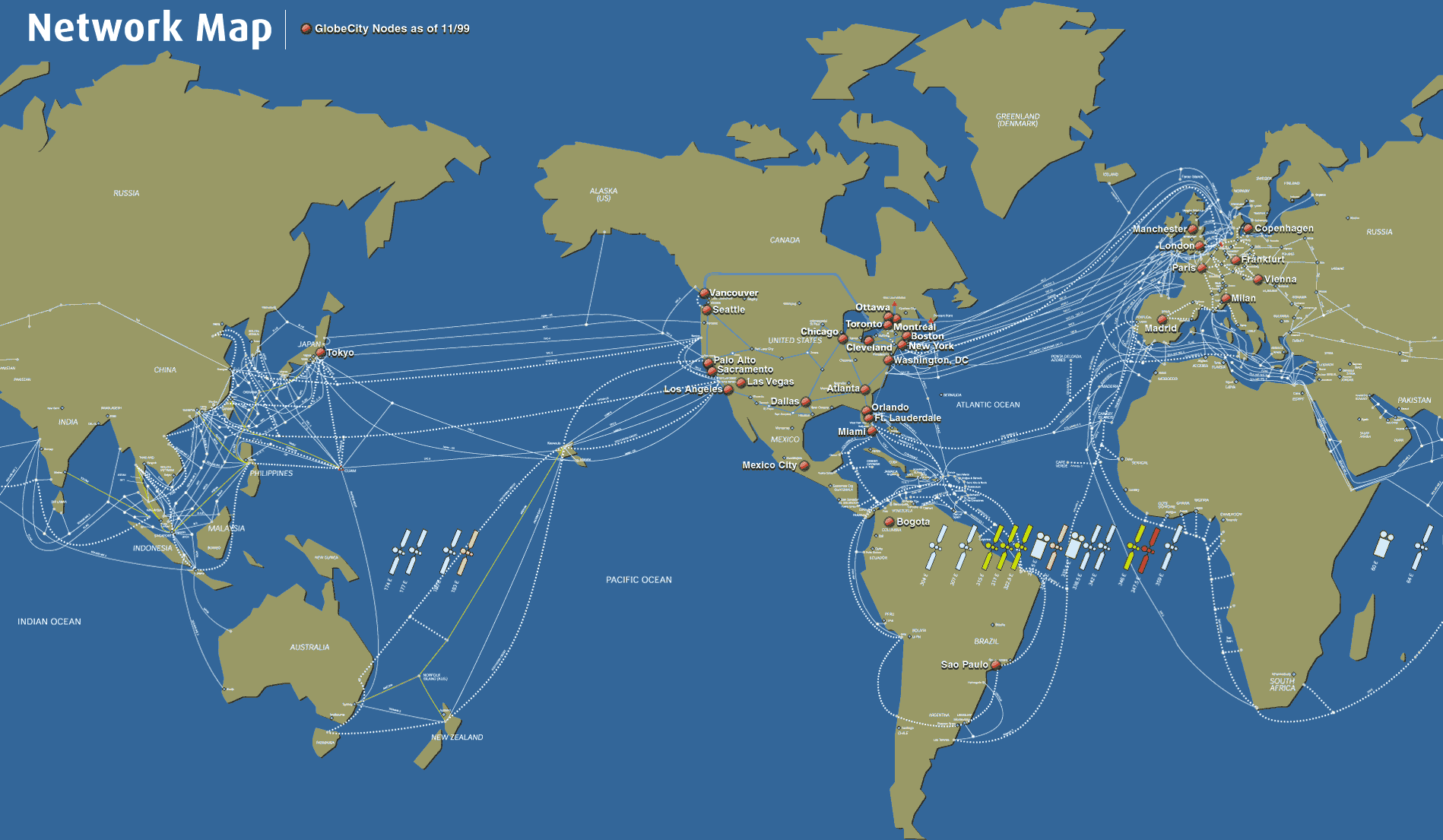
Regarding the sea cable length: the continent argument is what I was referring to before. I don't think it's valid as most data flows US<->Asia or US<->Europe. And in both cases the ways are nearly direct. Only Europe<->East Asia has a major detour but I don't know if that warrants a global satellite system. One could still put a cable through russia (actually wondering why that doesn't exist for algo traders, connecting HK and London directly).
My first job out of school in 1998 was writing test plans for the antenna pointing and tracking for the Teledesic CPE at Motorola. If I remember right, the initial plan was to have dual steerable dishes inside a pair of radomes—like a pair of Mickey Mouse ears. There was a vague future plan for phased-array antennas, but at the time it wasn't realistic to talk about getting them on roofs at a reasonable price point.
The bigger challenge was the optical intersatellite links; routing traffic between LEO satellites using lasers. The lasers had to track satellites in adjacent planes of the constellation that were traveling in the opposite direction.
It's interesting to see the same general idea for the large constellation come up every few years. If we had actually started building it in 1998, it would've been on a second or maybe even third generation by now.
I'm a little surprised that Apple hasn't given it a try with their billions sitting around. 4K FaceTime, or even just downloading movies or apps instantly would be a selling point for their other hardware.
Didn't Iridium get around that by having a single "seam" between adjacent oncoming planes which signals don't pass, but for all other adjacencies using crosslinks between planes?
The really curious part is how the satellite to ground trunk link will be accomplished, if they're going to try to build something like a modern version of the satellite-to-satellite links that Iridium satellites use, but at much higher capacities, draining traffic from multiple satellites through whichever one happens to be over a gateway earth station at a particular time. Or perhaps the satellites will be able to do that and also opportunistically connect to operator-owned earth stations when they are in LOS.
Also with 4000 satellites, you probably wouldn't have to track one all the way to the horizon.
Phased array flat panel antennas cannot be purely software steered sufficiently to track a low earth orbit satellite from horizon to horizon. It's not good enough to just put a flat panel phased array facing straight up, you won't have enough gain aimed in the direction where the satellite actually is at any given moment. Assuming a CPE device that measures 1.5'x1.5' to 2'x2' in size, it will still need a motorized azimuth and elevation stepper motor system (or equivalent) to track a LEO satellite.
If you're trying to do multi-Mbps data to/from a satellite in bands >10GHz (and probably >18GHz), the path loss through the atmosphere and RF parameters mean that you want as much gain as possible... This is why the most economical solutions for high capacity two way satellite through geostationary transponder capacity involve 1.8 to 3.0 meter size dish antennas. Gain is important. Gain and enough signal over noise ratio that you can do higher order QAMs and not spend half your bitrate on FEC.
You could, I suppose, if the antenna system was cheap enough and large enough build a non moving, cone or pyramid shaped antenna covered in phase array segments that could maintain a high bandwidth connection in the >10GHz bands to a moving LEO satellite. But it would be pretty large.
edit: for those who are curious and want to see an example of a parabolic (steered) use for moving satellite comms:
https://www.google.com/search?q=melco+antenna+mitsubishi&ie=...
http://proceedings.kaconf.org/papers/2015/bsw_4.pdf
there is also an israeli company which is a competitor to mitsubishi in this space. and a few others.
if you watch the weekly FCC filings for new satellite equipment licenses, there's a lot of MELCO antennas flying around on top of mid and large sized jet aircraft.