The speed of light in a medium is slower than the speed of light in vacuum. Fiber commonly propagates at just 200e6 km/sec.
Latency is still important because it's a significant limitation of GEO satcom.
> Does anyone know if there are actual numbers out that show how satellites could transfer even a fraction of what's already travelling below surface?
I'm unaware of any fundamental physical limit that prevent optics in space from matching or exceeding the bandwidth of terrestrial fiber. In terms of engineering the main limit is likely keeping beams in precise alignment.
Yes, very close. The index of refraction of air is 1.0003, so the speed of light in air is c/1.0003 = 99.97% the speed of light in a vacuum.
The index of refraction in a doped silicon telecommunications fiber core is around 1.4475, so the speed of light is 1/1.4475 = 69.08% the speed of light in a vacuum.
>Otherwise it's probably just 10-20% which I guess would be slower after considering the extra distance?
Undersea fibers have to avoid these things called 'continents.' For long distance hops this makes satellite the fastest system that's physically possible. https://personalpages.manchester.ac.uk/staff/m.dodge/cyberge...
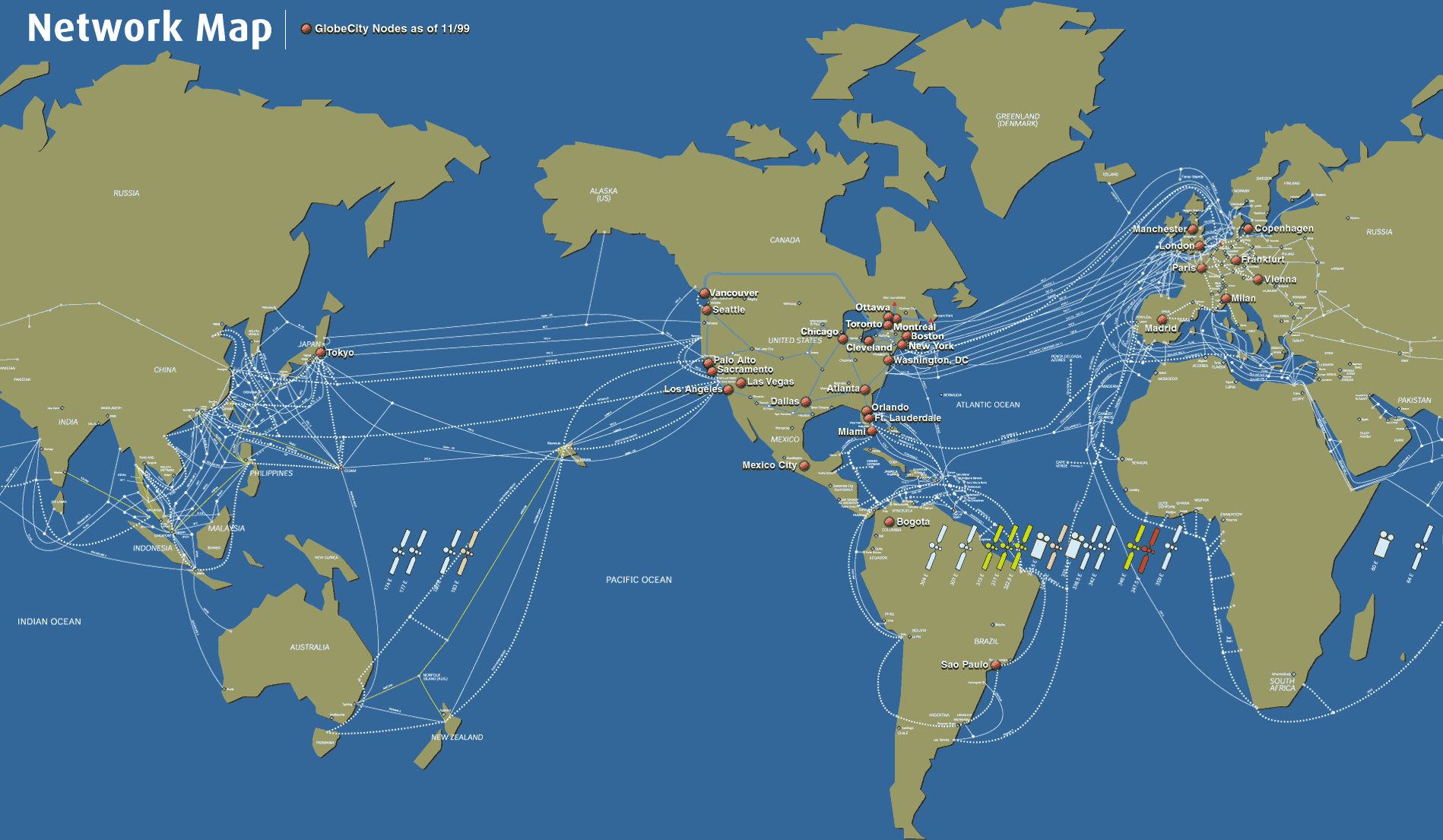
Regarding the sea cable length: the continent argument is what I was referring to before. I don't think it's valid as most data flows US<->Asia or US<->Europe. And in both cases the ways are nearly direct. Only Europe<->East Asia has a major detour but I don't know if that warrants a global satellite system. One could still put a cable through russia (actually wondering why that doesn't exist for algo traders, connecting HK and London directly).
That aside, I don't think there's a big market for even lower latency (apart from algo traders). It's bandwidth that matters. You can get stable <150ms round trip times Europe<->East Asia and much shorter times to the US already. Problems with servers on other continents are not due to high latency but low throughput. And as others have pointed out, I don't think a system of satellites can compete with enormous bandwidth a single sea cable can provide.
Does anyone know if there are actual numbers out that show how satellites could transfer even a fraction of what's already travelling below surface?
Rural areas will definitely profit. But while the goal is great (internet for all), it's probably not what pays the bill. Aren't FB/Google's ideas of planes/balloons cheaper?