News for hackers. Stuff that matters.
Re:Zuckerberg and Chan aim to tackle all disease by 2100 by kendallpark on Wednesday September 21, 2016 @05:11PM (#12552283)
I'm glad they're putting money into medical research, but I kinda roll my eyes when people make big claims about curing X, especially when X is something incredibly broad like "cancer" or in this case, "all diseases." AI/ML has barely scratched the surface of its potential in medicine, however, I find it naive to think that you can throw AI/ML at any random disease and always get a cure. Even after a century. Will we have a cure for trisomy 21? For antisocial personality disorder? For obesity and addiction? These things are far more complicated than just creating the right drug.

But as much as I'm rolling my eyes at their blanket statement, the spirit of "yes we can!" does way more for science and progress than naysay of critics.

Re:Zuckerberg and Chan aim to tackle all disease by 2100 by segmondy on Wednesday September 21, 2016 @10:45PM (#12553956)
People would have rolled their eyes, if someone said. I wanted to connect the world. I want to connect virutally everyone, where you can just reach anyone at anyplace at any time for cheap.

30 yrs ago, in a different part of the world. My father had to catch a bus from a village to the city, then catch a plane to a major city to make international phone call to the US to his business partners. Today, people in that same village can sign on to HN and reply to this very post. Or tweet and facebook real time.

Maybe they won't be the one to solve it, maybe it would take a bit longer, who knows? Gotta give it a shot. Maybe we won't cure all the disease. Perhaps we eliminate 85%. That would be great too. Stay optimistic my friend.

Re:Zuckerberg and Chan aim to tackle all disease by 2100 by Chathamization on Thursday September 22, 2016 @09:14AM (#12556580)
> I wanted to connect the world. I want to connect virutally everyone, where you can just reach anyone at anyplace at any time for cheap.

If we're talking about the same time frame, 84 years ago, I don't think most people would doubt that it could happen. This is a period where there was an enormous growth in telecommunications, and I don't think most people thought it was obviously going to suddenly stop and stagnate for 84 years.

My guess is the idea wouldn't have seemed implausible even earlier. Once the telegraph came along, it probably seemed like at least a possibility.

However, if a wealthy individual 84 years ago who hadn't been involved in telecommunications decided to throw some money at it and said they were going to connect everyone 84 years in the future, people would probably be skeptical - and rightly so. Especially if the amount of money was less than many of the smaller players in the industry.

As the article points out (about the Zuckerberg effort), "One British charity - Cancer Research UK - is likely to spend more in that time on just one disease."

And "connect the world" is vague enough that it's easier to claim success with low hanging fruit. This is more like "I want to be able to instantly transfer anything anywhere in 84 years."

Re:Zuckerberg and Chan aim to tackle all disease by 2100 by smsm42 on Thursday September 22, 2016 @04:31AM (#12555386)
> Gotta give it a shot. Maybe we won't cure all the disease. Perhaps we eliminate 85%.

85% looks wildly optimistic too. And "giving it a shot" is not exactly new idea somebody needs to be convinced in - people are giving it a shot since the idea of medicine was born, which was probably before recorded history started. If the money they use for research bring fruit - excellent, but I'm not sure money is what limits us (and that 3bn is going to fix that if it were the problem), and certainly arbitrary date and bombastic goals is not what was missing from medical research field before.

Re:Zuckerberg and Chan aim to tackle all disease by 2100 by vectorpush on Thursday September 22, 2016 @02:25AM (#12554848)
Hindsight is 20/20. You can look back on many innovations and say that they'd be impossible to imagine in the past, but that doesn't have any bearing on the inherent viability of a given idea. I'm not saying that the Zuck/Chan moonshot isn't a worthwhile endeavor, only that examples of past skepticism prove nothing about what is actually possible.
Re:Zuckerberg and Chan aim to tackle all disease by 2100 by jamesrcole on Thursday September 22, 2016 @05:25AM (#12555597)
> You can look back on many innovations and say that they'd be impossible to imagine in the past

I'd suspect that most innovations would have had plenty of experts and other people saying why they weren't possible.

Re:Zuckerberg and Chan aim to tackle all disease by 2100 by chii on Thursday September 22, 2016 @07:08AM (#12555959)
There are lots of extraordinary claims being made everyday. It's the correct rule of thumb to be as skeptical possible, for there are many more outrageous claims than there are legitimate ones.
Re:Zuckerberg and Chan aim to tackle all disease by 2100 by jamesrcole on Friday September 23, 2016 @04:25AM (#12563117)
If you're interested in truth you should always be skeptical about everything.

But I think it needs stressing that being skeptical is not the same as being dismissive or ridiculing or having a hostile attitude towards things.

I think that the reason people tend to reject new ideas tends to be more on emotional terms rather than for truly skeptical reasons.

Re:Zuckerberg and Chan aim to tackle all disease by 2100 by DavidWanjiru on Wednesday September 21, 2016 @11:11PM (#12554052)
It seems to me like the biggest things are impossible to see with a "normal" outlook. It's as if you either can't see the big thing, or you see it in a fantasy world, a fiction of some kind (science or otherwise).

Take connecting the entire world. Even after the technology existed and had been deployed (the very early system that gave rise to the internet as we know it), people didn't look at that early version connecting a handful of places and think, "Wow, this could connect EVERYONE!" They didn't stand there, looking at the terminals of two connected computers, and imagine a connected world like the one we live in today. They didn't talk about ecommerce and social media global events being reported on in near real time. No one had to roll their eyes, because no one was making these grand claims.

I can't find the link now, but I read somewhere that it took YEARS after the Wright brothers had achieved first flight to get the attention of the world. People didn't see how transformative that thing could become, yet the proof of concept was there.

When you look at all the big tech moments in (recent-ish) history, the car, modern computation, the PC, aviation, you don't see people coming out with these grand declarations before the fact. And it's not for lack of intelligent, visionary people.

So it makes me wonder, whenever a person makes such grandiose plans, and they're not fiction writers, what's so different about them that they'd be able to see so far ahead?

Maybe they're different. How would I know? But history makes me skeptical.

Re:Zuckerberg and Chan aim to tackle all disease by 2100 by sillysaurus3 on Wednesday September 21, 2016 @11:27PM (#12554111)
I can't find the link now, but I read somewhere that it took YEARS after the Wright brothers had achieved first flight to get the attention of the world. People didn't see how transformative that thing could become, yet the proof of concept was there.

The truth is the opposite: https://news.ycombinator.com/item?id=12433966

Wrights were actually very secretive and they were reluctant to publish anything before they got the patent. They were so adamant about the patent that they didn't do any public demonstration of flight for years until they were literally forced by competing claims. In those times people making claims for "heavier than air" flights were numerous and it was hard to take anyone seriously unless they do demonstration. They not only chose not to do so until they got patent but also did almost nothing to enhance their technology meanwhile. Their contribution except for first flight is very marginal and their rest of the lives are dominated by nothing but patent worries, bringing massive lawsuits on others and getting royalties. They also made a very generic patent claim essentially asserting that any system that produces lift is covered by it. This produced a lot of friction in bringing new innovations to market leaving USA significantly behind of Europe.

In addition to this, there were flight enthusiasts all over the world, and particularly in France. They were hang-glider enthusiasts at the time, as that was the cutting-edge flight technology. One of the famous hang-glider pilots died due to his belief that a hang-glider ought to be controlled by shifting one's body weight, which led to a fatal stall. This further convinced the Wright brothers that "the control problem" was the most important problem to focus on.

A lot of people wanted to fly.

This is all tangential to your point, though, and wasn't meant to take anything away from it.

Re:Zuckerberg and Chan aim to tackle all disease by 2100 by pseud0r on Thursday September 22, 2016 @07:03AM (#12555939)
In 1915 Nikola Tesla wrote in the New York Times

"Some day there will be, say, six great wireless telephone stations in a world system connecting all the inhabitants on this earth to one another, not only by voice, but by sight. It's surely coming."

Re:Zuckerberg and Chan aim to tackle all disease by 2100 by abecedarius on Thursday September 22, 2016 @02:02AM (#12554753)
Re:Zuckerberg and Chan aim to tackle all disease by 2100 by afarrell on Thursday September 22, 2016 @04:07AM (#12555307)
The whole world was connectable in 1950. The problem was just the cost of manufacturing all of the telephone/telegraph equipment and laying all the cable.
Re:Zuckerberg and Chan aim to tackle all disease by 2100 by dredmorbius on Friday September 23, 2016 @05:50PM (#12568230)
System configuration had a lot to do with it. Telephony was based on physical circuits. "Switchboard operators" literally plugged in cables to connect two phones together. Mechanical switches were just that -- mechanical systems which could join two lines. A telephone prefix (North American system) corresponded (generally) to a switch, which was a dedicated building, usually occupying much of a block, present in a given service area. If your town had a local phone-company building (or multiple buildings), that wasn't an office but the outer case around a large mechanical device. I was quite suprised the first time I was let inside one by the reality.

Virtual and digital switching, or better, packet-based networks, remove that problem. At the heart of most messaging systems now is the directory -- either of individual addresses, or of systems on which those addresses reside. Hence: DNS, MXs, and the like, for email.

(This makes me realise that one way around the Global Directory of Everyone problem of current messaging systems is to split up the address space again.)

Re:Zuckerberg and Chan aim to tackle all disease by 2100 by crimsonalucard on Thursday September 22, 2016 @03:38AM (#12555158)
Stay optimistic? How about stay realistic? Lets not dream of fantasies but rather attempt to make accurate predictions unfettered by the biases of optimism or pessimism.

There is a line that can be crossed if I make a prediction and say that by 2100 humanity will become as powerful as Gods. That statement is ludicrous when judged by common sense. It is not unrealistic to the say the same of having ALL diseases cured by 2100.

I'm basically "rolling my eyes" at your comment.

Re:Zuckerberg and Chan aim to tackle all disease by 2100 by VOYD on Thursday September 22, 2016 @04:24PM (#12560057)
But that is creating something, not fixing something.
Re:Zuckerberg and Chan aim to tackle all disease by 2100 by isolli on Thursday September 22, 2016 @04:43AM (#12555439)
The human body is orders of magnitude more complex than the (admittedly uplifting) achievements you mention.
Re:Zuckerberg and Chan aim to tackle all disease by 2100 by BurningFrog on Wednesday September 21, 2016 @06:11PM (#12552733)
I think the current medical research system is badly broken in several ways, and it's possible that a few billions spent on alternative approaches would bear a lot of fruit.

It might also not, but I'm very glad if someone tries.

Re:Zuckerberg and Chan aim to tackle all disease by 2100 by vibrio on Thursday September 22, 2016 @04:37AM (#12555411)
I agree that medical research is broken in many ways. A steady stream of 'outsiders' set out to shake it up, from hedge fund billionaires that discover their kid has an incurable disease to google's calico grabbing some of the most renown industry leadership. I continue to pray for rain, but the advances from such initiatives have been incremental if any, rather than revolutionary. I would say the most impactful model to date has been the Howard Hughes Medical Institure, is focused on fundamental science discovery---where the bulk of the uncertainty lies in drug development. I am glad to hear of MZ/PC generosity and focus on helping others. Some might take the same money and build the worlds ugliest sailboat, or endow a business school and it would be their right. All that said, from a biotech start up biotech perspective, $3B a ton of cash. From a Pharma R&D budget, it's significant but it just ain't that much. How they will use it will matter if we are to remember this in 15 years (which is only 1-2 product life cycles for biopharma currently.)
Re:Zuckerberg and Chan aim to tackle all disease by 2100 by euyyn on Wednesday September 21, 2016 @07:35PM (#12553210)
What approaches do you mean? In which ways do you think it's broken?
Re:Zuckerberg and Chan aim to tackle all disease by 2100 by nicklaf on Wednesday September 21, 2016 @07:52PM (#12553287)
http://slatestarcodex.com/2014/04/28/the-control-group-is-ou...

He quotes Eliezer Yudkowsky:

Parapsychologists are constantly protesting that they are playing by all the standard scientific rules, and yet their results are being ignored – that they are unfairly being held to higher standards than everyone else. I’m willing to believe that. It just means that the standard statistical methods of science are so weak and flawed as to permit a field of study to sustain itself in the complete absence of any subject matter.

This general topic sometimes comes up on HN (most recently, yesterday†). Here's a good starting point:

https://hn.algolia.com/?query=http:%2F%2Fwww.phdcomics.com%2...

† https://news.ycombinator.com/item?id=12535880

Re:Zuckerberg and Chan aim to tackle all disease by 2100 by Thimothy on Thursday September 22, 2016 @05:35AM (#12555643)
That Slate Star Codex article is one of the most depressing things I've read for a while, thank you.
Re:Zuckerberg and Chan aim to tackle all disease by 2100 by dredmorbius on Friday September 23, 2016 @05:51PM (#12568238)
SSC is an underappreciated gem. There's much brilliance in't.
Re:Zuckerberg and Chan aim to tackle all disease by 2100 by smsm42 on Thursday September 22, 2016 @04:33AM (#12555394)
I think the problems are known to many in the field. Getting to the solution for it may be trickier.
Re:Zuckerberg and Chan aim to tackle all disease by 2100 by andrewprock on Wednesday September 21, 2016 @08:10PM (#12553345)
Do you have anything from a more reliable source?
Re:Zuckerberg and Chan aim to tackle all disease by 2100 by nicklaf on Wednesday September 21, 2016 @08:26PM (#12553403)
I included a reliable source! Click my link to yesterday's HN story. It is an interview with John P.A. Ioannidis, "who is a professor at Stanford University and one of the most highly cited researchers in the world".
Re:Zuckerberg and Chan aim to tackle all disease by 2100 by aangjie on Thursday September 22, 2016 @02:25AM (#12554847)
I think alternative approaches can bring some things, however, I'm not too sure of all these(Gates a few days back, Zuckerberg today) will encourage alternative approach. But given those guys history, let's hope so.
Re:Zuckerberg and Chan aim to tackle all disease by 2100 by toufka on Wednesday September 21, 2016 @09:28PM (#12553659)
Without disagreeing with your point, there are actually currently gene therapies to cure trisomy 21 [1] (a clever trick of affixing the signal that is used to silence a (female's)/the (male's) X chromosome to the 3rd of the 21st chromosomes). I don't think it's all the way through FDA approval, and is still very much experimental, but is exactly the kind of thing that is curable. And that is where your point stands: it is hard to know which unknowns are easy unknowns, and which unknowns are nearly impossible unknowns because both are currently of the same quality - unknown. The grandiose claim is fancy, and much will be accomplished in 80 years, but even ill-defined language of 'disease' and 'cure' belies our ignorance.

[1] http://www.biospace.com/News/down-syndromes-extra-chromosome...

Re:Zuckerberg and Chan aim to tackle all disease by 2100 by dhbradshaw on Wednesday September 21, 2016 @07:13PM (#12553099)
Here's my best prediction for how it's could happen: when the all human immune systems are able to learn from each other, we'll be most of the way there. The immune system is at the center of most human diseases. Cancer? It's the best solution. Infection? Best solution. Autoimmune disease?Fixing the immune system would be the best solution to autoimmune disease. Right now, if you want your body to be immune to something, you're immune system has to learn that particular immunity. If we can form an artificial immune system "culture" then it seems like learning could be much, much faster.
Re:Zuckerberg and Chan aim to tackle all disease by 2100 by nextos on Wednesday September 21, 2016 @07:27PM (#12553165)
It is. That's why immunotherapies have gone from a fringe area to something super hot attracting tons of funding.

But first, we need to understand the cell. For this we believe we need not only statistical learning, but also formal methods. See e.g. a slightly dated but brilliant paper from Luca Cardelli:

http://lucacardelli.name/Papers/Abstract%20Machines%20of%20S...

Re:Zuckerberg and Chan aim to tackle all disease by 2100 by jonny_eh on Wednesday September 21, 2016 @07:24PM (#12553148)
> Autoimmune disease?Fixing the immune system would be the best solution to autoimmune disease

Zuckerberg should give you all his money.

Re:Zuckerberg and Chan aim to tackle all disease by 2100 by tominous on Wednesday September 21, 2016 @07:50PM (#12553277)
I'm struggling to see how that can be done without in vivo genetic engineering (to ensure immune compatibility), constant blood surveillance of the population (to detect pathogens), chemical infusions deployed en masse like a firmware update, and giant cube-shaped space ships.
Re:Zuckerberg and Chan aim to tackle all disease by 2100 by dhbradshaw on Wednesday September 21, 2016 @10:17PM (#12553850)
We'd have to develop an external assay that can ensure immune compatibility. If we're lucky, we find a finite set of molecules that lead to immune incompatibilities from person to person and make an assay that focuses on those molecules.

Constant blood surveillance is already a fact--that is, perhaps we don't need more blood. Instead, we just do the immune sequencing on the stream that's already available. Spread out over the whole population, that's a lot of information. Firmware updates, if necessary, could be handled on an as-needed basis, or more generally like flu vaccines.

I'm not sure how the giant cube-shaped space ships will be handled--that's definitely a hurdle to consider.

Re:Zuckerberg and Chan aim to tackle all disease by 2100 by pazimzadeh on Wednesday September 21, 2016 @08:01PM (#12553318)
How about using commensal bacteria to design an "external immune system" which can respond to any pathogen we program it too. Bacteria coat basically all cavities in your body and could scan incoming threats and respond to them before the human immune system is every involved.
Re:Zuckerberg and Chan aim to tackle all disease by 2100 by tominous on Wednesday September 21, 2016 @08:04PM (#12553330)
Sure, as long I get to be the programmer and deploy the updates. :) You can call me God-Emperor Tominous.
Re:Zuckerberg and Chan aim to tackle all disease by 2100 by pazimzadeh on Thursday September 22, 2016 @12:10AM (#12554286)
That doesn't seem too improbable actually. I think that IDE's for designing genetic circuitry aren't far away.
Re:Zuckerberg and Chan aim to tackle all disease by 2100 by projektir on Thursday September 22, 2016 @12:24AM (#12554341)
I think we'll create superior bodies for humans that disease never had a chance to adapt to much faster than we'll be able to figure out how to make immune systems communicate without also promoting adaptation from surrounding diseases.

Fixing the existing body is nice, but you're forever limited by what nature intended, and what it intended is just not very good.

Re:Zuckerberg and Chan aim to tackle all disease by 2100 by sriku on Thursday September 22, 2016 @09:08AM (#12556537)
I, for one, am imagining a news item 84 years into the future - "how letting people share lunch pictures and stalk other people has led to the eradication of all diseases".

The history of technology is filled with cross pollinations of that kind - ex: GPUs invented for high quality 3D amusement being used for AI and protein folding research.

Re:Zuckerberg and Chan aim to tackle all disease by 2100 by joe_the_user on Wednesday September 21, 2016 @05:43PM (#12552532)
One would roll one's eyes if someone promised to fix every single bug in a vast, buggy, fifty-year old software project.

But just ending cancer would essentially be a project for externally ameliorating, not even fixing, the bugs of 4 billion years of (genetic) code, code that "just happened" with "bugs" that survived because they weren't selected against.

Re:Zuckerberg and Chan aim to tackle all disease by 2100 by gmarx on Wednesday September 21, 2016 @06:09PM (#12552720)
That's doesn't even account for the probably larger number of bugs that develop over the lifetime of the system. Then, once a cancer develops it evolves further mutations over time.

You probably cannot defeat cancer merely by genetic engineering every new birth

Re:Zuckerberg and Chan aim to tackle all disease by 2100 by fnl on Wednesday September 21, 2016 @07:10PM (#12553083)
Epigenetics is the word you're looking for here. And probably some healthy dose of metabolomics. Cancer is way more complex than "just" changes in the genetic code.
Re:Zuckerberg and Chan aim to tackle all disease by 2100 by gmarx on Friday September 30, 2016 @04:57PM (#12615242)
I don't think so. I'm sure there are epigenetic effects in cancer but I'm also pretty sure that cancers develop new mutations as they proceed. Ones that fool the immune system or chemotherapy agents get selected for and drive the cancer forward
Re:Zuckerberg and Chan aim to tackle all disease by 2100 by projektir on Thursday September 22, 2016 @12:28AM (#12554360)
You can fix all the bugs in the fifty-year old software project... by writing a new version of it.

Sometimes the right solution doesn't deal with existing problems but tries to go somewhere else entirely.

Re:Zuckerberg and Chan aim to tackle all disease by 2100 by supercoder on Thursday September 22, 2016 @04:49AM (#12555473)
So you're suggesting they're going to just give birth to a super race of people ?
Re:Zuckerberg and Chan aim to tackle all disease by 2100 by projektir on Thursday September 22, 2016 @09:06AM (#12556522)
I'm suggesting we build a new one, either through genetic engineering or replacement of parts. In the context of Zuckerberg and Chan, this would involve promoting the funding and research of things like stem cells, artificial organs, test tube babies, etc. Given how much such things are opposed to the public, a lot of things could come out of it.
Re:Zuckerberg and Chan aim to tackle all disease by 2100 by tomhoward on Thursday September 22, 2016 @09:12AM (#12556566)
That position assumes things about the fundamental nature of cancer that are not at all proven.
Re:Zuckerberg and Chan aim to tackle all disease by 2100 by nkozyra on Wednesday September 21, 2016 @09:32PM (#12553678)
The skepticism is totally warranted, but you have to really consider the strides made in just 100 years. There's practically a Moore's Law of medicine happening.

We're still really dumb about a lot of things related to natural mortality, but exponentially smarter and more capable than we were 50 and then 200 years ago.

Re:Zuckerberg and Chan aim to tackle all disease by 2100 by MasterScrat on Thursday September 22, 2016 @04:42AM (#12555432)
> when X is something incredibly broad like "cancer"

Relevant PHD Comics about how "there will never be a cure for cancer":

http://www.phdcomics.com/comics/archive.php/archive_print.ph...

Re:Zuckerberg and Chan aim to tackle all disease by 2100 by wyager on Wednesday September 21, 2016 @10:59PM (#12554015)
General-purpose nanorobotics would pretty much allow us to do arbitrary medical procedures with cell-level accuracy. Cancer would be easy. Modifying brain structure would be easy. Pretty much everything would be easy.
Re:Zuckerberg and Chan aim to tackle all disease by 2100 by srunni on Thursday September 22, 2016 @01:35AM (#12554619)
See chapter 3 ("Nanotechnology will not lead to super-abundance") of Against Transhumanism for a good argument for why this isn't so simple: http://www.softmachines.org/wordpress/wp-content/uploads/201...

Summary

1. Lack of rigidity, excessive stickiness of molecules (Van der Waals force), constant random interactions (Brownian motion) at the microscale of cells means mechanistic intuitions from the macroscale don't apply.

2. High surface area (combined with VdW force) causes problems related to friction and energy dissipation.

Re:Zuckerberg and Chan aim to tackle all disease by 2100 by wyager on Thursday September 22, 2016 @01:47AM (#12554679)
I didn't want to navigate that PDF, so I read the author's IEEE article, which I think has similar content.

What a boring criticism! All of the things he mentions are easily approachable engineering challenges. His conclusion seems to be "mechanical engineering as with gears and pulleys won't work with nanobots". Duh! No one claimed otherwise.

> mechanistic intuitions about the microscale don't apply.

Obviously. Why would you or the author think nanotechnology optimists don't know this? Half the reason we don't have nanobots is because we don't yet have the engineering expertise and practical tools for these scales. The other half is that we're still working out efficient 3D nanofabrication. They are related problems. These are not physically insurmountable issues (as demonstrated thoroughly by organic life). There are a hundred different fields of study that are slowly eating away at the edges of the general purpose nanofabrication problem.

Re:Zuckerberg and Chan aim to tackle all disease by 2100 by srunni on Thursday September 22, 2016 @02:13AM (#12554791)
> All of the things he mentions are easily approachable engineering challenges.

If they are so "easily approachable," feel free to solve them any time. I think you'll find that solving problems in living systems (let alone in the clinic) is much more challenging than it might appear from a CS/physics perspective (https://www.quora.com/What-is-the-Andy-Grove-fallacy?share=1).

I'm not saying it's not worth trying (it's certainly a more worthwhile endeavor than getting people to click on more ads), but that it's important to be realistic (for example, that all disease is unlikely to be cured by 2100).

Re:Zuckerberg and Chan aim to tackle all disease by 2100 by wyager on Thursday September 22, 2016 @02:58AM (#12555000)
"Easily approachable" doesn't mean I can just go ahead do it. It means I can see how one would start working on it, and in fact many people are.

In fact, I am currently working in a nanotech lab, so I am hopefully helping a bit ;)

None of the problems you linked to are things that need to take a hundred years to solve. It's probably more accurate to measure development barriers in R&D costs than years. At the very least, we could just reverse engineer biology.

Re:Zuckerberg and Chan aim to tackle all disease by 2100 by srunni on Thursday September 22, 2016 @09:07AM (#12556529)
> I can just go ahead do it.

Doing experiments on animals (and especially humans or other vertebrates) is the exact opposite of something you can just go ahead and do. The best way to see that is to give it a go yourself.

> At the very least, we could just reverse engineer biology.

Many people in the past with a CS/physics mindset have made similar claims. If you try to work with living systems, I'm sure you'll see why these problems aren't just a matter of spending R&D dollars.

Re:Zuckerberg and Chan aim to tackle all disease by 2100 by wyager on Thursday September 22, 2016 @11:07AM (#12557307)
> If you try to work with living systems, I'm sure you'll see why these problems aren't just a matter of spending R&D dollars.

Perhaps you can explain it to me, so I can skip becoming a bio researcher.

Re:Zuckerberg and Chan aim to tackle all disease by 2100 by pyrale on Thursday September 22, 2016 @09:58AM (#12556832)
Some sort of high level body magic would work too, I'm thinking about some kind of general purpose blood-magic ritual.

I know optimism in and around computer tech is through the roof, but the levels of delusion on tech disruption topics in our community never ceases to amaze me.

Re:Zuckerberg and Chan aim to tackle all disease by 2100 by user731955373 on Wednesday September 21, 2016 @05:21PM (#12552365)
"yes we can!" built the atomic bomb.
Re:Zuckerberg and Chan aim to tackle all disease by 2100 by prewett on Wednesday September 21, 2016 @06:44PM (#12552927)
"Build an atomic bomb" is a lot more specific than "cure all diseases." In fact, "cure all diseases" is kind of the opposite of a SMART (specific, measurable, achievable, realistic, time-based). Whereas, to goal to build a device capable of detonating via nuclear fission is pretty specific, particularly to a physicist. Also very measurable and highly time-based.

Not even the Gates foundation is trying to cure all diseases, and Bill Gates is smart and gets stuff done. This sounds like feel-good charity to me, but we'll see what the results are in 100 years, I guess.

Re:Zuckerberg and Chan aim to tackle all disease by 2100 by scrollaway on Wednesday September 21, 2016 @07:55PM (#12553300)
I agree with you, but I'd like to point out that it's easy to say "x is very specific" if you know exactly what x is after-the-fact.
Re:Zuckerberg and Chan aim to tackle all disease by 2100 by prewett on Thursday September 22, 2016 @12:15AM (#12554305)
True, and a good point to make. My understanding of the difficulty of the atomic bomb was that everyone knew what to do (smash enriched uranium together such that was more than a certain mass), but they had a lot of difficulty getting the spherical detonation right. So the problem wasn't unknown from the physics side, but was rather an engineering problem. Compare to "cure all diseases," which we don't even know how to do theoretically.
Re:Zuckerberg and Chan aim to tackle all disease by 2100 by kendallpark on Wednesday September 21, 2016 @05:23PM (#12552390)
Which is a remarkable scientific achievement, independent of its use.
Re:Zuckerberg and Chan aim to tackle all disease by 2100 by goatlover on Wednesday September 21, 2016 @05:32PM (#12552448)
Remarkable in the same way a future gray goo invention would be. And it was a military initiative, developed for military reasons.
Re:Zuckerberg and Chan aim to tackle all disease by 2100 by EGreg on Wednesday September 21, 2016 @07:17PM (#12553121)
So was the internet.

You never know if we will need that arsenal against asteroids.

Re:Zuckerberg and Chan aim to tackle all disease by 2100 by czep on Wednesday September 21, 2016 @09:13PM (#12553592)
And from whose rocket are you going to trust launching those nukes? I'm not interested in even being in the same Hemisphere as such a launch!

And everyone knows lasers are the solution to errant asteroids. Perhaps attached to evil sharks :)

Re:Zuckerberg and Chan aim to tackle all disease by 2100 by nixos on Wednesday September 21, 2016 @06:16PM (#12552768)
Which is _much_ (orders of magnitude) easier than curing Cancer
Re:Zuckerberg and Chan aim to tackle all disease by 2100 by iaw on Wednesday September 21, 2016 @06:20PM (#12552793)
Arguable. We can only compare difficulty after the fact, if Einstein hadn't rolled along with relativity and 3 decade gap for research, the atomic bomb wouldn't have been possible.

There may be a 'relativity' level discovery in biology/aging/cancer that will change the historic perspective. We can't know until after the fact.

Re:Zuckerberg and Chan aim to tackle all disease by 2100 by rayiner on Wednesday September 21, 2016 @07:12PM (#12553095)
The difference between "yes we can!" re: the atomic bomb and Zuckerberg's post is that the former happened after the fundamental discoveries in physics that made the atomic bomb possible. By the time someone said "yes we can!" a theoretical analysis of how the bomb would work already existed.

That fundamental advancement in biology hasn't happened yet. That's the difference between rational optimism and irrational and mindless optimism.

Re:Zuckerberg and Chan aim to tackle all disease by 2100 by iaw on Wednesday September 21, 2016 @07:41PM (#12553233)
Respectfully, I disagree.

The fundamental discoveries necessary for the nuclear bomb weren't discover until after Leo Szilard [0] proposed the weapon. Given that none of us were alive between 1906 and 1945 it's hard to fully grasp how the scientific understanding evolved over those 39 years.

Einstein's work paved the way for Leo Szilard's vision but that vision was in no way a given. If it weren't for WWII, and Einstein's support, Leo would not have been able to garner the $2 Billion (1940's money) in support that was necessary to build the bomb.

Even then, there was a coin-toss level certainty that it would do anything.

Similar to Einstein's work preceding the discovery of Fission and the Atomic bomb. We have a great deal of work in biology around aging, telomere's, transcription errors, and more that hasn't been leveraged by the medical industry for varying reasons.

I'm not ready to be a naysayer on this topic, historically as a species we've had remarkable success in accomplishing things that were considered impossible before we did them.

[0] http://nuclearweaponarchive.org/Usa/Med/Discfiss.html

Re:Zuckerberg and Chan aim to tackle all disease by 2100 by rayiner on Wednesday September 21, 2016 @07:53PM (#12553290)
The discovery of fission was not the product of the Manhattan Project but a continuation of research into the atomic nucleus that had been proceeding for decades. Once that happened, Einstein's theory told you that the process would release a large amount of energy, and a bomb became simply an engineering task. By the time someone wrote a check, the basic mechanism of the runaway fission reaction was understood.

That's totally different than the current situation with say cancer. In the world of physics and engineering, a "coin-toss" shot at working is actually a pretty well-developed idea. There is no ready-to-go idea you can point to and say "if we spent $20 billion building this it's have a coin-toss's chance of curing cancer."

Re:Zuckerberg and Chan aim to tackle all disease by 2100 by iaw on Wednesday September 21, 2016 @08:27PM (#12553408)
I don't know where you see me stating that the discovery fission was a result of the Manhattan Project, it was a predecessor. The order of actions was: Einsteins Relativity -> Leo's Bomb Patent -> Discovery of Fission -> Manhattan Project -> Bomb.

> By the time someone wrote a check, the basic mechanism of the runaway fission reaction was understood.

I find that to be a gross simplification. I would challenge that the basic mechanisms of the fission reaction were as well understood then as we understand the basic mechanisms behind cancerous mutations now.

> There is no ready-to-go idea you can point to and say "if we spent $20 billion building this it's have a coin-toss's chance of curing cancer."

Over what time-horizon? We've achieved a great deal in the last 100 years that would have received less than a coin-toss probability if one were to be having this same argument in the early 1900s. The Haber Process [0] is a great example of something that we had no way of expecting we could accomplish (the energy efficiency aspect) before it happened.

What would you prefer Zuckerberg does with his money? I mean, he could build a massive yacht like Jobs before he died... As a species we have consistently accomplished feats that were as unlikely as the mitochondrial symbiosis that allowed us to exist in the first place, is there a reason to discount our abilities to continue this trend?

[0] https://en.wikipedia.org/wiki/Haber_process

Re:Zuckerberg and Chan aim to tackle all disease by 2100 by rayiner on Wednesday September 21, 2016 @09:03PM (#12553556)
> Over what time-horizon?

The relevant time is right now. If the U.S. government had said "yes, we can do it!" and invested $20 billion in building an atom bomb in 1915, they would've pissed that money away. It would've been mindless optimism. Doing it after fission had been discovered was a calculated investment.

Re:Zuckerberg and Chan aim to tackle all disease by 2100 by nixos on Wednesday September 21, 2016 @09:17PM (#12553616)
> Over what time-horizon? We've achieved a great deal in the last 100 years that would have received less than a coin-toss probability if one were to be having this same argument in the early 1900s. The Haber Process [0] is a great example of something that we had no way of expecting we could accomplish (the energy efficiency aspect) before it happened.

The issue is that we're quite a few "Nobel-worthy" inventions away from curing Cancer.

I mean, biologically we're not in the equivalence of 1950's physics. We're holding in 1300's physics.

I saw that someone once compared curing Cancer to landing on a moon without knowing basic Newtonian physics.

I expect that before we cure cancer, we'd have found ways to cure all "normal" diseases, have "designer babies" without side-effects, have "instant, proof-perfect medicines", etc.

I'd want his to work on those issues.

Right now it'll probably end up like Google X. A great lab, makes great prototypes, but practically get left behind by incremental technology.

Re:Zuckerberg and Chan aim to tackle all disease by 2100 by nixos on Wednesday September 21, 2016 @07:54PM (#12553297)
It wasn't a coin-toss away. The Hiroshima bomb was almost guaranteed to work.

The question if Nagasaki would work, which is why they did Trinity.

The theory was there when the Manhattan project started - it was an engineering hurdle, not a scientific one.

Manhattan Project : Curing Cancer :: Apollo : Warp Drives

Re:Zuckerberg and Chan aim to tackle all disease by 2100 by dredmorbius on Friday September 23, 2016 @05:59PM (#12568274)
Just amplifying and clarifying your point: Hiroshima was the first practical test of the uranium-bullet method.

Nagasaki was the second practical test of the plutonium implosion method.

Re:Zuckerberg and Chan aim to tackle all disease by 2100 by Cybiote on Wednesday September 21, 2016 @07:55PM (#12553301)
I strongly disagree that you can only compare difficulty after the fact. The full class of cancers is an object of lots higher complexity than quantum mechanics. For one, you need a theory of quantum mechanics to fully predict from the details of a cell (this is not the same thing as saying cells leverage entanglement and maintain superpositions).

A population of cells is more complex than an atom as it requires more parameters to be fully specified. It is also harder to predict because there are several levels of non-linear feedback interactions within an environment that can never be fully given ahead of time. A population of cancerous cells is more complex than a population of cells because their dynamics are not stationary in time. Unlike a typical population of healthy cells, cancerous ones are able to, in effect learn and more effectively than even the immune system. Extend this to the full class of cancers to see why a simple mathematical theory of the kind we find in atomic physics is highly implausible.

As such, we have an object of higher descriptive and predictive complexity than atomic physics. Searching for this theory will take longer and is much, much more difficult in a formal sense.

Re:Zuckerberg and Chan aim to tackle all disease by 2100 by iaw on Wednesday September 21, 2016 @08:07PM (#12553338)
> The full class of cancers is an object of lots higher complexity than quantum mechanics.

Could you elaborate as to why you believe that?

Having worked on both biological and physical simulations the limits from a ground-up perspective are quite similar. While there are no well-understood analytic forms to describe biological systems, unlike in quantum systems, the fundamentals of the problem are the same: we can't predict things because there are too many interactions to easily model.

There is a whole world of non-traditional techniques opening up with increases in computational capacity.

Re:Zuckerberg and Chan aim to tackle all disease by 2100 by Cybiote on Wednesday September 21, 2016 @09:44PM (#12553718)
You see the problem yourself by pointing out the required increase in computational capacity. Quantum mechanics can be described and predicted using fairly straight forward mathematics. Its descriptive complexity is lower than for a cancer whose functioning is a non-linear dynamical system not at thermodynamic equilibrium and changes in time. It's true that for QM, the computational complexity quickly goes up beyond toy harmonic oscillator problems but in a search for a theory, the descriptive complexity and number of fundamental parameters per observation is what controls search time.

We also don't know to what extent quantum computation would aid predictive modeling of protein interactions. It's possible that there are no leaks at the classical level of abstraction as to hurt predictability. But the problem still remains that experiments to fix parameters are hurt by the fact that the system is changing under you and interacts in a complex way with its environment which can't be known ahead of time. So the computational complexity is not necessarily easier (in a practical sense) even if we assume that there is no utility in modeling quantum effects.

One very theoretical idea of solving cancer (per cancer) would involve searching for a 'problem', an insult, outside of the learnability class of evolution which also does not harm healthy cells. This is computationally likely harder than BQP. Anything less, even if equipped with a quantum computer, would be evolved out of and with any survivors less attackable. Any way you look at it, it is a far harder problem than working out fission.

Re:Zuckerberg and Chan aim to tackle all disease by 2100 by zbyte64 on Wednesday September 21, 2016 @06:27PM (#12552823)
Just from a data volume perspective cancer and atomic bombs are magnitudes apart. Throw in the fact that cancer evolves and understanding those mutations requires unraveling millions of years of evolution and you've got a doozy.
Re:Zuckerberg and Chan aim to tackle all disease by 2100 by iaw on Wednesday September 21, 2016 @08:31PM (#12553420)
I strongly believe that our analytic capabilities (as a species) have grown by orders of magnitude since we built the bomb.

My entire point was that the bomb wasn't a given in it's day (in spite of what the retrospective belief seems to be), just because something is out of our grasp now doesn't mean we won't reach it if we try.

Re:Zuckerberg and Chan aim to tackle all disease by 2100 by 1_2__3 on Thursday September 22, 2016 @01:52AM (#12554705)
Reading your comments it really seems like smart and knowledgeable people are trying to make substantive arguments replies and you're answering with woo-woo. You should probably listen more. I've learned a lot from reading them.
Re:Zuckerberg and Chan aim to tackle all disease by 2100 by idlewords on Wednesday September 21, 2016 @07:20PM (#12553128)
You don't need Einstein or relativity theory to build an atomic bomb. Experimentalists discovered fission, and could have built a bomb even if there were no theoretical basis for it.
Re:Zuckerberg and Chan aim to tackle all disease by 2100 by iaw on Wednesday September 21, 2016 @07:54PM (#12553295)
You are 100% correct about what could have been. However, the reality is that Einstein's work paved the way for Leo Szilard to envision an atomic bomb before fission had been discovered.

http://nuclearweaponarchive.org/Usa/Med/Discfiss.html

Edit: Reflecting on this, without quantum mechanics (which stemmed from Einstein's relativity work), Oppenheimer would not have had the mathematical tools that were heavily leveraged building the bomb. The bomb is more than throwing together two sub-critical pieces of material, knowledge from quantum mechanics was critical in the prediction of which fissile materials could yield a functional weapon (of which there are very few).
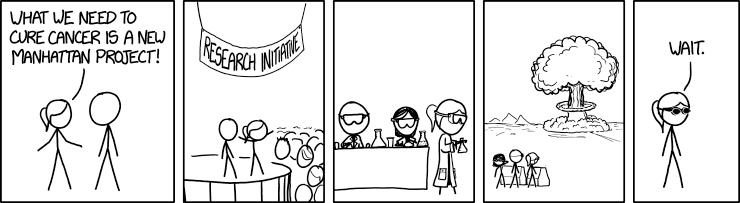
Re:Zuckerberg and Chan aim to tackle all disease by 2100 by M_Grey on Thursday September 22, 2016 @09:52AM (#12556792)
I think he might be an HN user...

http://imgs.xkcd.com/comics/manhattan_project.png

Re:Zuckerberg and Chan aim to tackle all disease by 2100 by bsder on Wednesday September 21, 2016 @07:32PM (#12553196)
Only by turning almost 10% OF AN ENTIRE COUNTRY into doing nothing but producing an atomic bomb.

That's not 2 billion dollars, that's 2 TRILLION dollars.

So, basically, redirecting the US military budget. I approve.

Re:Zuckerberg and Chan aim to tackle all disease by 2100 by rory096 on Wednesday September 21, 2016 @08:42PM (#12553459)
Source? Estimates I see for the Manhattan Project from a quick google range from .25% to .41% of GDP.

[0] https://www.fas.org/sgp/crs/misc/RL34645.pdf

[1] http://mitchellhowe.blogspot.com/2006/02/want-manhattan-proj...

[2] https://arxiv.org/pdf/1511.09054.pdf

Re:Zuckerberg and Chan aim to tackle all disease by 2100 by akiselev on Wednesday September 21, 2016 @09:10PM (#12553580)
He's likely thinking of the urban myth that over 10% of the US's power generation was used for the Manhattan Project [1] and confusing it with the cost of the project, for which estimates vary but is around $2 billion total (1945 GDP was $2 trillion).

[1] http://meetings.aps.org/Meeting/APR11/Session/H13.4

Re:Zuckerberg and Chan aim to tackle all disease by 2100 by bsder on Thursday September 22, 2016 @08:54PM (#12561568)
I'm also referring to the fact that estimates put in that almost 1 in 11 people in the US were involved in some facet of atomic bomb development.

The point being that atomic bomb development required a gigantic commitment.

Re:Zuckerberg and Chan aim to tackle all disease by 2100 by robotresearcher on Thursday September 22, 2016 @12:10AM (#12554287)
> That's not 2 billion dollars

The Manhattan project cost about $2B in 1940s money; equivalent to around $26B today.

https://en.wikipedia.org/wiki/Manhattan_Project

Re:Zuckerberg and Chan aim to tackle all disease by 2100 by smsm42 on Thursday September 22, 2016 @04:39AM (#12555423)
Blowing stuff up is usually easier than fixing stuff. Do we have cold fusion yet (not Macromedia :)? Do we have fusion reactors yet? In fact, we seem to be slowly losing ability to have any use of nuclear energy except blowing stuff up - it's next to impossible to get a new nuclear plant built, and old ones are being closed down. By the same 2100 we may have the atomic bomb as the only way to use nuclear energy we have. And still no fusion.
Re:Zuckerberg and Chan aim to tackle all disease by 2100 by onion2k on Thursday September 22, 2016 @01:50AM (#12554695)
"Yes we can!" built everything, whether it's good or bad, large or small.
Re:Zuckerberg and Chan aim to tackle all disease by 2100 by johansch on Wednesday September 21, 2016 @06:22PM (#12552799)
Mark ("and Priscilla") are pledging $3B.

The Manhattan project cost was "about $26 billion in 2016 dollars" according to the Wikipedia article. They are short $23B.

Re:Zuckerberg and Chan aim to tackle all disease by 2100 by pmoriarty on Wednesday September 21, 2016 @07:06PM (#12553061)
"They are short $23B."

That's where this part comes in:

"The more people believe we can cure all disease in our children's lifetimes, the more likely the government is to invest in it"

Re:Zuckerberg and Chan aim to tackle all disease by 2100 by johansch on Wednesday September 21, 2016 @07:30PM (#12553187)
They (Government-sponsored scientists) were already working on all of these things.
Re:Zuckerberg and Chan aim to tackle all disease by 2100 by agumonkey on Wednesday September 21, 2016 @07:48PM (#12553270)
That a quarter bill.
Re:Zuckerberg and Chan aim to tackle all disease by 2100 by cmdrfred on Wednesday September 21, 2016 @07:31PM (#12553192)
Do you have a E=MC2 sort of revelation in regards to cancer?
Re:Zuckerberg and Chan aim to tackle all disease by 2100 by johncolanduoni on Wednesday September 21, 2016 @07:11PM (#12553089)
How did we miss this universal cure sitting right under our nose!
Re:Zuckerberg and Chan aim to tackle all disease by 2100 by nathan_f77 on Thursday September 22, 2016 @09:51AM (#12556785)
I'm the opposite, I always roll my eyes when doctors say that AI/ML will never replace human doctors, or at least that it can never replace their human intuition or empathy. Human intuition is exactly what will be superseded by machine learning. I know empathy is important, and I read something about lonely people being less likely to have a fast recovery, but it just isn't all that important for accurate diagnoses or treatment.

Further reading from Vinod Khosla: http://fortune.com/2012/12/04/technology-will-replace-80-of-...

Re:Zuckerberg and Chan aim to tackle all disease by 2100 by angersock on Wednesday September 21, 2016 @10:37PM (#12553927)
So, I think the interesting question is--take them at their word, and what do we then do with the resulting population explosion?

It's kinda like efforts to modernize (read: give Western lifestyles to) a lot of South Asia and Africa...a lot of pollution and ecological destruction that is probably not a good thing.

Re:Zuckerberg and Chan aim to tackle all disease by 2100 by projektir on Thursday September 22, 2016 @12:31AM (#12554371)
Given low birth rates in developed countries I'm not sure that the population explosion would sustain itself if the area was properly governed.
Re:Zuckerberg and Chan aim to tackle all disease by 2100 by fredgrott on Wednesday September 21, 2016 @06:41PM (#12552908)
cancers are not broad, yes the areas of the human body they affect..yes that is broad..

Mark was reacting to this:

http://www.ncbi.nlm.nih.gov/pmc/articles/PMC1994798/

Re:Zuckerberg and Chan aim to tackle all disease by 2100 by fsloth on Thursday September 22, 2016 @02:25AM (#12554846)
" For antisocial personality disorder? For obesity and addiction?"

If we have a hypothetical scheme to find out all drugs that can be found, and see that the cure for those is not there, that is as a conclusive contribution into finding cure to those ailments as finding a cure. Most biggest discoveries are not about going on a beeline to a solution as a race. Rather, one is charting an unknown territory. As the unknown part shrinks, one does not need to spend energy in stumbling there and concentrate on other areas, finally reaching a solution (if a solution can be found).

Re:Zuckerberg and Chan aim to tackle all disease by 2100 by nso95 on Thursday September 22, 2016 @06:07PM (#12560737)
It's better to be optimistic and try than pessimistic and do nothing
Re:Zuckerberg and Chan aim to tackle all disease by 2100 by bbcbasic on Wednesday September 21, 2016 @08:12PM (#12553352)
Reminds me of this episode of The Outer Limits: https://en.wikipedia.org/wiki/The_New_Breed_(The_Outer_Limit...

TLDR:

"Andy later discovers that he has pelvic cancer, and has approximately one year to live if the hip and leg are not removed. In desperation he sneaks into Stephen's lab and injects himself with the nanobots" ... "The nanobots continue making "improvements" to Andy, including giving him eyes in the back of his head, bones above his stomach, keen hearing, and jellyfish-like stinging tentacles on his skin."