News for hackers. Stuff that matters.
Re:Cornell wants to drill 2-4mi underground for enhanced geo... by TeMPOraL on Monday September 19, 2016 @01:45PM (#12533192)
Almost everything we do that initially seems like a good idea stops being such when we start doing it at scale. Burning fuels wasn't a problem at the eve of the industrial revolution. I wonder what ecological issues will hit us globally as we scale up geothermal energy use. E.g. I've read somewhere that people putting too many ground-exchange heat pumps in a small area can cause problematic cooling of the ground. Right now it's probably only a problem for the energy efficiency of the pumps themselves, but as we scale up, I worry about unintended environmental consequences.

Wikipedia seems to have only basic numbers up:

https://en.wikipedia.org/wiki/Geothermal_energy#Renewability...

The first sentence of that section says that "geothermal power is considered to be renewable because any projected heat extraction is small compared to the Earth's heat content." I'd like to see some estimates on how much of that heat content is available on the depths we're drilling down to (as opposed to the contents of the whole planet); and again, trees were a renewable resource too, before the industrial revolution.

Re:Cornell wants to drill 2-4mi underground for enhanced geo... by dpark on Monday September 19, 2016 @02:48PM (#12533721)
> The first sentence of that section says that "geothermal power is considered to be renewable because any projected heat extraction is small compared to the Earth's heat content." I'd like to see some estimates on how much of that heat content is available on the depths we're drilling down to (as opposed to the contents of the whole planet);

Wikipedia links to an article with more detail. The crust alone is estimated to hold enough heat to supply all of the Earth's electricity generation at current levels for about 80 million years.

https://web.archive.org/web/20100308014920/http://www.iea-gi...

The total heat content of the Earth is of the order of 12.6 x 10^24 MJ, and that of the crust the order of 5.4 x 10^21 MJ (Dickson and Fanelli, 2004). This huge number should be compared to the world electricity generation in 2005, 6.6 x 10^13 MJ.

> and again, trees were a renewable resource too, before the industrial revolution.

Trees are still a renewable resource, more so since we largely stopped using them for fuel as a result of the industrial revolution.

Re:Cornell wants to drill 2-4mi underground for enhanced geo... by drostie on Monday September 19, 2016 @05:17PM (#12534806)
I think it's more compelling, however, to just think about how much bigger the interior of the planet is than our existence at the surface.

We live on maybe ±1km of the surface or so; we don't dig much deeper than that except perhaps when exploring very deep caves or so. The radius of the Earth is approximately 6300 km. One volume is (4 pi/3) R^3 and the other is 4 pi R^2 dR, so the one volume is larger by a factor of 6300/3; we can only hope to visit one two-thousandth of the Earth's total volume with holes 1km deep. Up that to 10km deep and you'll still only get one two-hundredth of the Earth. Oh, and we've only got about a third of that because oceans.

Re:Cornell wants to drill 2-4mi underground for enhanced geo... by WalterBright on Monday September 19, 2016 @05:19PM (#12534818)
Essentially, we're all just pond scum!
Re:Cornell wants to drill 2-4mi underground for enhanced geo... by dredmorbius on Wednesday September 28, 2016 @06:12AM (#12596555)
It's worth keeping in mind that when coal reserves were first being estimated in the US, ~1865 - 1875, the total reserves were considered to be over 1 million years' supply at then-current rates of usage.

Oddly enough, constantly growing usage can cut into that time-to-depletion estimate fairly quickly. Present estimates are that US coal reserves are ~200 - 1,000 years, depending on the recoverable yield.

Re:Cornell wants to drill 2-4mi underground for enhanced geo... by dman on Monday September 19, 2016 @02:56PM (#12533796)
Keyword there is => "current levels"
Re:Cornell wants to drill 2-4mi underground for enhanced geo... by dpark on Monday September 19, 2016 @03:42PM (#12534110)
I picked a convenient number. Feel free to provide any sane projection and see how the numbers fall out.

Or you can fear monger and oppose change and prefer that we burn fossil fuels indefinitely, I guess.

Re:Cornell wants to drill 2-4mi underground for enhanced geo... by dman on Monday September 19, 2016 @04:24PM (#12534394)
Please refrain from assigning intent to a simple comment.

Given the large amount of statistics and facts that you bring to the question it is clearly evident that you know more about this problem than I do. I merely wish to point out that a simple linear scaling of current consumption levels is not a convincing model for adoption of any new technology / paradigm. You had me on the facts, but lost me on the projection.

Re:Cornell wants to drill 2-4mi underground for enhanced geo... by dpark on Monday September 19, 2016 @05:10PM (#12534752)
When you say something like Keyword there is => "current levels", it comes off as pessimistic and poisonously negative. It's the kind of statement that shuts down conversation rather than encourages it. Rather than inquisitive, this comes off as dismissive. I may have misread your intent, though, and if so I apologize.

I am aware that constant usage is not generally a valid assumption. I made a simplifying assumption that I believe reasonable given the sheer size of the energy store. It doesn't matter much if our usage is constant or increases a thousandfold. There's so much energy in the crust that we essentially could not use it all, and I doubt that we would use enough to cause global issues (vs local issues caused by overuse in certain areas which seems more feasible).

P.S. To be clear, I don't know much about this problem at all. My only data is from Wikipedia and its references.

Re:Cornell wants to drill 2-4mi underground for enhanced geo... by dsp1234 on Monday September 19, 2016 @05:29PM (#12534904)
I made a simplifying assumption that I believe reasonable given the sheer size of the energy store.

One of the points that TeMPOraL made above is "and again, trees were a renewable resource too, before the industrial revolution.". The point being that resources that are seemingly infinite when first used can end up being not so unlimited.

So for example, the person downthread who uses energy trends estimates a lower bound of about 1000 years (if current energy consumption trends continue, we immediately switched to only geothermal, and we used the entire heat of the earth edit: Earth's crust, not the whole earth). So now we have a range of 1,000 to 800,000 years (based on varying assumptions).

800,000 years to take up 0.001% of the total heat would be fine. 1,000 years to take up 100% of the heat would be really bad.

The 1,000 year quote is based on historical data, and 800,000 years is based on flat/zero growth. So there appears to be room for discussion, not all of which is 'fear monger'ing.

Re:Cornell wants to drill 2-4mi underground for enhanced geo... by dpark on Monday September 19, 2016 @06:12PM (#12535204)
> One of the points that TeMPOraL made above is "and again, trees were a renewable resource too, before the industrial revolution.". The point being that resources that are seemingly infinite when first used can end up being not so unlimited.

It's legitimate to ask what our energy usage might grow to. It's not legitimate to dismiss potential energy sources because we cannot predict the future with perfect accuracy. We will never predict the future perfectly, or even close, and if we have a choice between killing the planet in 1000 years or killing it in 100, we'd still be better off taking the first option.

The "1000 years" comment also assumes we'll double our energy usage every 25 years. If we accept that as true then our only viable strategy is to get off this planet because it assumes that in 1000 years we will literally have extracted all energy from the core. We're doomed if this is our future.

Also, please stop mentioning the trees. This has been addressed multiple times now. The industrial revolution didn't result in trees being cut down. Quite the opposite. The large-scale adoption of fossil fuels resulted in forests rebounding worldwide as we stopped relying on timber as a fuel.

> *The 1,000 year quote is based on historical data, and 800,000 years is based on flat/zero growth. So there appears to be room for discussion, not all of which is 'fear monger'ing.

It's rather generous to say it was based on historical data. It was based on taking the log2() of our current energy usage and eyeballing an energy usage chart to produce a guess at a 25-year doubling rate. Our energy growth is no more a constant than our usage, though, so extrapolating this way is as unrealistic as assuming we'll stay at present-day usage forever.

There is certainly room for discussion. Again, though, I'll point out that a discussion should be about options and not just the worst case for geothermal exhaustion. If we found that we could replace all of our fossil fuel use with geothermal but we'd only get to extract energy for 1000 years safely, that would be a great deal, because the obvious alternative is that we literally burn every bit of fossil fuel we can extract from the Earth.

Re:Cornell wants to drill 2-4mi underground for enhanced geo... by eggy on Monday September 19, 2016 @11:37PM (#12536845)
On the trees numbers, the US now actually has more forest or trees than it did at the start of the twentieth century.

The argument sometimes gets confused, since conservationists are concerned about the loss of old-growth forests, and animal habitats vs. the quantity and area of forests.

Re:Cornell wants to drill 2-4mi underground for enhanced geo... by incongruity on Monday September 19, 2016 @03:04PM (#12533852)
...and "80 million".

Fine, let's quadruple consumption – we're good for 20 million years. Ok, okay, let's go to 100x consumption – we're good for 800,000 years. I think we're ok.

Re:Cornell wants to drill 2-4mi underground for enhanced geo... by dsp1234 on Monday September 19, 2016 @03:32PM (#12534049)
Since the magnetic field of the earth, which protects us from the solar winds among other things, is generated by spinning of the molten outer core, do you happen to know how much of that energy would be available before adverse effects happen?

It's obvious that the answer is less than 100%, since a completely solid core would provide no magnetic field. Is there some way to tell whether it's closer to 0.1%, 1% or 10%?

Re:Cornell wants to drill 2-4mi underground for enhanced geo... by Tuna-Fish on Monday September 19, 2016 @05:26PM (#12534890)
The 80 million years figure is for the heat content of the crust, not the entire earth. The heat content of crust is approx 0.04% of the heat content of earth.

It's not really possible to use enough geothermal for it to have a noticeable effect on the lifespan of the magnetic field. Even completely removing the solid crust of the earth would not really register.

Re:Cornell wants to drill 2-4mi underground for enhanced geo... by dsp1234 on Monday September 19, 2016 @05:39PM (#12534984)
This is a really great point, and probably the key one. It's also probably a good assumption that heat extracted from the Earth's crust after some point would stabilize due to heat differential from the layer's beneath the crust.

So we could take out some percentage of the heat of the crust, thus lowing the total temperature by some amount, but then that loss would be replenished from further down in the core.

It looks like from the calculations elsewhere in the thread that it probably wouldn't even be physically possible to extract that much energy from the crust. We'd just run out since there would be some lag time in replenishing the heat from the core through to the areas of the crust.

Re:Cornell wants to drill 2-4mi underground for enhanced geo... by dpark on Monday September 19, 2016 @03:37PM (#12534080)
Let's assume it's not just 0.1% but 0.001%. That still leaves us a comfortable runway of 19 million years at our current levels.

But also let's hope it's not 0.001% because I'm pretty sure the core will cool more than that on its own over a shorter timespan than 19 million years.

Re:Cornell wants to drill 2-4mi underground for enhanced geo... by drivebyneatfact on Monday September 19, 2016 @05:20PM (#12534825)
Wikipedia suggests cooling of 100 degrees C every billion years.

19 million years is 1.9% of the billion year rate. So it suggests the core should lose 1.9C in 19 million years. That's about 0.035% of the total temp, using Wikipedia's 5700C as the temp estimate.

That's a great initial guess, given how much uncertainty is (i've recently heard core temp could be 4x the wiki number, and some people estimate the earth's core only has lost a few degrees since it formed, rather than nearly 500 degrees). Neat stuff, thanks for providing the opportunity to look in to this.

Re:Cornell wants to drill 2-4mi underground for enhanced geo... by nitrogen on Monday September 19, 2016 @05:09PM (#12534742)
Won't thorium decay keep it warm for a good long while?
Re:Cornell wants to drill 2-4mi underground for enhanced geo... by dpark on Monday September 19, 2016 @06:15PM (#12535222)
I'm honestly not sure. I don't know how much energy is being created inside the Earth and how much is just residual. It's my understanding that the Earth is slowly cooling, though, so radioactivity isn't replenishing heat as rapidly as we're losing it.
Re:Cornell wants to drill 2-4mi underground for enhanced geo... by dman on Monday September 19, 2016 @03:23PM (#12533984)
Can we do the same math for electricity consumption from 100 years ago? :)
Re:Cornell wants to drill 2-4mi underground for enhanced geo... by Normal_gaussian on Monday September 19, 2016 @04:03PM (#12534253)
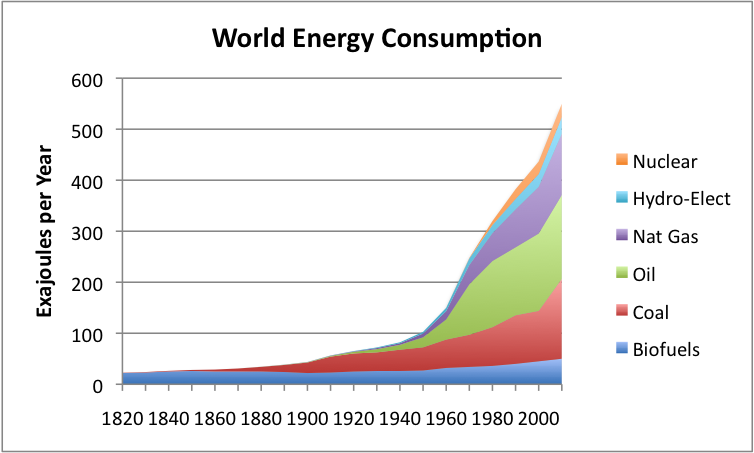
https://ourfiniteworld.com/2012/03/12/world-energy-consumpti...

No idea how good the source is, however it looks like we have a nice exponential there.

Lets see what the envelope says for an exponent of 2:

Using numbers from parent commentors, log2(6.6 x 10^13) is about 45.9, so we are in our 46th doubling period. A guess on the graph says its 25 years to double.

> The total heat content of the Earth is of the order of 12.6 x 10^24 MJ, and that of the crust the order of 5.4 x 10^21 MJ (Dickson and Fanelli, 2004).

so that's end of crust energy usefulness at the start of the 72nd period and end of Earth energy less than halfway through the 84th period.

So that gives us 500-1000 years of energy from now if we solely use the planets heat. Whether we soley use it or not becomes largely irrelevant due to the exponent, we can stretch it as a major source a few hundred more years or so.

Of course, if in 1000 years we aren't only using this planet we should be good. How many years to the next system again?

Re:Cornell wants to drill 2-4mi underground for enhanced geo... by iaw on Monday September 19, 2016 @04:22PM (#12534377)
Not a good analogy, 100 years ago not only was the population lower but there was no electrical infrastructure.
Re:Cornell wants to drill 2-4mi underground for enhanced geo... by dman on Monday September 19, 2016 @04:33PM (#12534468)
You are successfully making the point I was trying to.

We are willing to concede that usage patters from 100 years ago are unrealistic current realities.

However we would simultaneously like to use the current reality to project future realities that are much farther away (in some cases 19 million years away).

Re:Cornell wants to drill 2-4mi underground for enhanced geo... by dpark on Monday September 19, 2016 @05:14PM (#12534777)
It doesn't actually matter much if our usage projections are good. What matters is 1) that the energy store is so massive that it's hard to imagine how we could possibly exhaust it, and 2) the current dominant alternative (i.e. fossil fuel) is known to be terrible for us. If we switched to geothermal and set the world up to end humanity in a thousand years, we'd still be better off than continuing our desperate use of fossil fuels and ending humanity even sooner.
Re:Cornell wants to drill 2-4mi underground for enhanced geo... by jsudhams on Monday September 19, 2016 @11:17PM (#12536752)
The issue is we use up fossil fuels we could still continue for more years, I don't see any reason for it to end much before that. If we make mistake with earth core we would mostly surely setup end of humanity atleast. I would rather focus on getting the world to a place where willno borders and safe religion etc.. which would get lot more runtime for humans than this. If we optimize food production find a better alternative for capatalism we may live better with or with out need for fuel
Re:Cornell wants to drill 2-4mi underground for enhanced geo... by dpark on Monday September 19, 2016 @11:46PM (#12536892)
Our food production is driven by fossil fuels. Everything from the farm equipment to the fertilizers we spread to the trucks we ship it in are powered by fossil fuels. When we run out of fossil fuels, we better have a back up energy source (or sources) ready, because our food production will plummet if not. So will basically every industry, since they all depend on cheap transport and automation at this time. So we'll all starve while the economy collapses around us and our infrastructure falls apart as we have neither the money nor the energy supplies to fix it.

Yeah, our dependence on fossil fuels is a huge problem, and not just because of climate change (which might also kill us).

Re:Cornell wants to drill 2-4mi underground for enhanced geo... by eggy on Monday September 19, 2016 @11:49PM (#12536910)
I agree somewhat, but even though more devices are electrical or electronic and attached to the grid, they are more efficient. My 42" LED TV is using 95W, less than a 100W light bulb, whereas my old 19" tube color TV in 1978 used more.

Mobile phones didn't exist when I was young, and there are certainly a lot of them now even if they are low power devices, so it would be interesting to see electrical usage patterns pre-mobile phones vs. today.

The same goes for cars. Cars were using leaded gasoline in the US and getting 8 to 12 mpg, and now 30 to 35 mpg or greater on the highway, but do people drive more frequently, and with single riders?

Another question is would any cooling of the total Earth's heat energy be offset by global warming? The thermal differential would be less thereby slowing the migration of heat to the surface?

Re:Cornell wants to drill 2-4mi underground for enhanced geo... by andruby on Tuesday September 20, 2016 @03:49AM (#12537859)
This assumes that nothing mayor is going to change. What if we somehow build a spaceship route from Earth to Mars and we power it through electricity. How much higher would our consumption be if we launch 10,000 spaceships every day?

Or maybe we want to terraform our own planet to counter climate change. These things could use amounts of energy orders of magnitude higher than we use today.

I'm sure 100 years ago didn't expect we would launch 100,000 airplane flights every day [0] :) Nor did they think we would send spaceships to Mars.

[0] http://www.garfors.com/2014/06/100000-flights-day.html

Re:Cornell wants to drill 2-4mi underground for enhanced geo... by dpark on Tuesday September 20, 2016 @03:12PM (#12542375)
What if we also solve fusion and build a Dyson sphere and farm unicorns for automotive fuel?

It seems somewhat unreasonable to assume that our energy usage is going to exponentially increase due to as-yet-unforeseeable future needs and at the same time assume that we'll completely fail to find additional energy sources in the same timeframe.

Re:Cornell wants to drill 2-4mi underground for enhanced geo... by stouset on Monday September 19, 2016 @05:47PM (#12535041)
We can only go through a few more doublings of our current energy production rate before we boil the oceans from a thermodynamic equilibrium standpoint (ignoring greenhouse gases).

Earth has a fixed surface area. And the only way to get rid of waste heat from energy production is to radiate it into space. Finding this equilibrium for given quantities of energy generation into waste heat is a pretty straightforward calculation.

Re:Cornell wants to drill 2-4mi underground for enhanced geo... by SamBam on Monday September 19, 2016 @01:53PM (#12533263)
The point of renewables is rarely to do them all "at scale" where we're expecting that one renewable to power the entire planet.

Yes, if we try to use solar for the entire planet, we'll destroy the world trying to mine every last bit of silica. If we try and use wind for the entire planet, we'd need to build something like 6-8 million turbines, possibly causing environmental destruction on the way.

Rather, the point is to say "here's a huge vein of untapped energy, some of which could be tapped without damaging the environment and without releasing carbon."

Green energy is a mix, and extrapolating to "what if everybody did this" is rarely the right question, especially when the current alternative is "keep burning oil."

Re:Cornell wants to drill 2-4mi underground for enhanced geo... by thatcherc on Monday September 19, 2016 @02:09PM (#12533381)
Just curious - is that much silica needed to power the whole planet? We've got entire deserts full of silica sand and most rocks are composed mostly of silicon. I feel like refining enough silicon to power the world via solar wouldn't be hugely destructive.
Re:Cornell wants to drill 2-4mi underground for enhanced geo... by pg314 on Monday September 19, 2016 @02:16PM (#12533450)
Most of the raw Si is used in the steel industry. Only a tiny fraction is used in electronics applications. So, Si would not be the bottleneck (refining it to the high purity needed for electronics applications is very energy-intensive, though).
Re:Cornell wants to drill 2-4mi underground for enhanced geo... by etrautmann on Monday September 19, 2016 @06:12PM (#12535203)
It's the rare-earth doping elements that are the issue, not the silicon. We have silicon in extreme abundance.
Re:Cornell wants to drill 2-4mi underground for enhanced geo... by caf on Monday September 19, 2016 @11:13PM (#12536736)
Typical dopants for solar cells are elements like B and K, not rare earths.
Re:Cornell wants to drill 2-4mi underground for enhanced geo... by philipkglass on Monday September 19, 2016 @03:00PM (#12533821)
Industry average for solar PV is currently about 5 grams of silicon consumed per nameplate watt of module capacity. That includes processing losses (wafer sawing, etching, etc.)

I'm going to assume a capacity factor of 20% for solar PV. That's significantly lower than the 28.6% capacity factor recorded for utility scale PV in the US last year, much higher than the ~10% you might expect in Germany. Choosing a high-ish solar capacity factor I'm going to note that most of the world's population lives in countries with better solar resources than Germany and that more solar PV is being installed on the utility scale than on e.g. household rooftops. Utility scale projects are sited for better sun resources and can use mechanical trackers that aren't suited for rooftops; both of those contribute to higher capacity factors than you can get out of opportunistic installations on existing rooftops, whichever country you're building in.

I'm also going to assume that modules have 25 years of factory-spec-power-equivalent output. Data from real-world solar installations show that the median module lasts about 30 years before it needs replacement (and more rigorous pre-sale testing may be pushing that number up in recent years), but maximum power output also declines over time due to a variety of degradation mechanisms, so I'm fudging these two factors together for 25 years' equivalent of "like new" power output.

Multiplying the capacity factor of 0.2 by the expected 25 years of like-new-power-output, we see that each nameplate watt of solar power installed is expected to provide 5 watt-years of energy output. The steady-state production rate you need for the world to have X watts of solar-generated power over the course of the year is then X/5.

Concrete numbers time: world electricity consumption in 2013 averaged about 2.28 terawatts. The world would need to produce about 457 gigawatts-peak of solar modules per year to produce this much electricity over the course of a year, consuming about 2,285,000 tonnes of silicon. World primary energy consumption in 2015 averaged about 17.3 terawatts. To match that on an annualized basis you'd need to produce 3.46 terawatts-peak of solar modules per year for a silicon consumption of about 17,340,000 tonnes.

Silica is about 46% silicon, so you'd need to mine ~5,000,000 to 38,000,000 tonnes of silica per year in order to produce enough silicon for solar PV to take over world electricity production or all world energy consumption respectively. For comparison, world sand consumption in 2014 was estimated at 15 billion tonnes, roughly 3 orders of magnitude greater. (Silicon producers usually don't start with sand anyway; they use coarsely crushed lumps of silica-rich materials like quartzite, quartz, or chert, which are even more abundant than clean sand.)

Note that I am NOT claiming that you could actually replace all the world's diverse energy sources with electricity from silicon based solar PV. There are of course no oceangoing ships that can be powered by electricity, no electrical passenger aircraft, etc. And even if we were just trying to replace fossils for current electricity generation, storage remains a hard open problem. Without cheap, abundant electricity storage it will be impossible for solar PV to take even a 40% share of world electricity consumption. But I hope that the numbers make it clear that silica availability is not a material constraint on solar PV deployment scale.

Re:Cornell wants to drill 2-4mi underground for enhanced geo... by raverbashing on Monday September 19, 2016 @03:32PM (#12534047)
You could probably cover the Sahara in solar panels and still have a lot of sand there

Silica is not the bottleneck

Re:Cornell wants to drill 2-4mi underground for enhanced geo... by roninb on Monday September 19, 2016 @02:14PM (#12533427)
> Rather, the point is to say "here's a huge vein of untapped energy, some of which could be tapped without damaging the environment and without releasing carbon."

Did we say that about trees? Fossil fuels? Have we said that about silica, lithium, or rivers (we're having plenty of issues from Georgia to Pennsylvania along the Appalachians because of just that)?

I agree with what you're saying, I just don't think your last sentence is right. Kinda seems like a contradiction if everyone overuses resources (keeps burning oil) and it's causing problems (and we know that is a class of problem that we've experienced with other substances like rubber, trees, fish, dodo birds, lithium - hell, anything we can get our hands on), shouldn't we ensure other problems don't pop up from overusing resources (what if everybody else did this)?

I think the exact point is to not make the same mistake we've made with pretty much every other resource we've ever found...

Re:Cornell wants to drill 2-4mi underground for enhanced geo... by hueving on Monday September 19, 2016 @02:45PM (#12533694)
>I think the exact point is to not make the same mistake we've made with pretty much every other resource we've ever found...

So... keep burning oil instead of experimenting with this?

Re:Cornell wants to drill 2-4mi underground for enhanced geo... by roninb on Tuesday September 20, 2016 @07:54AM (#12538778)
So... don't overuse resources. And when presented with the question of "how does this scale?" don't ignore how fabulously efficiently we damaged the environment every other time we've scaled production up.

Not sure how you got "keep burning oil" from that...

Re:Cornell wants to drill 2-4mi underground for enhanced geo... by hueving on Tuesday September 20, 2016 @11:25PM (#12545167)
We're not even near the scaling part. It's silly to argue about how something will have issues if the entire world did it. There are tons of things we do today that wouldn't scale environmentallly if the entire world wanted to do the same thing (e.g. flying).
Re:Cornell wants to drill 2-4mi underground for enhanced geo... by URSpider94 on Monday September 19, 2016 @04:51PM (#12534581)
We have more trees in the USA now than we had in Colonial times.
Re:Cornell wants to drill 2-4mi underground for enhanced geo... by wcoenen on Monday September 19, 2016 @07:36PM (#12535658)
The forest area seems to have decreased significantly between 1760 and 1910.

http://forestry.about.com/od/forestresources/tp/forest_fact_...

Re:Cornell wants to drill 2-4mi underground for enhanced geo... by marcosdumay on Monday September 19, 2016 @03:24PM (#12533991)
Hum, no. Solar scales very well.

Silica already covers most of the places were we would like to place panels, we will have much worse problems way before we run out of land, and there is no required rare resource for it.

There are shorter bottlenecks on energy storage. But even then Na-S will get us a long fraction of the way solar can go.

Re:Cornell wants to drill 2-4mi underground for enhanced geo... by Retric on Monday September 19, 2016 @02:38PM (#12533637)
The globe has three primary energy sources leftover heat(1), radioactive decay, and gravitational drag. These adds up to 0.03% of the 173,000 TW of solar power. However, 51.9 TW is greater than the entire energy demand projected to be 27 TW in 2020.

Of note, heat flux increases with both absolute temperature and temperate difference. So, with a deep enough bore you could extract GW's of power for thousands of years. 2-4 mi is rather short unless your tapping heat over a large area.

(1)Leftover heat is currently "100 billion times annual world wide energy demand" so this really can be considered 'renewable.'

PS: ~52 TW / 196.9 million miles = 264w/square mile on average. However, energy is not spread anything close to evenly.

Re:Cornell wants to drill 2-4mi underground for enhanced geo... by cossatot on Monday September 19, 2016 @04:52PM (#12534589)
From 'The Solid Earth' by CMR Fowler (the geophysics book closest to my desk), the Earth's surface heat flux is 44 TW. This is not the total heat energy in the earth, it's the amount of internal heat (from the sources you've specified) radiated into space every second. I think that the difference between 44 and 51.9 is not budgetary (in the sense that the 8 TW difference is a different source) but reflects uncertainty in the estimates.

This is just to clarify what the numbers really mean, in case anyone thinks ~50 TW is the total heat energy (i.e. mass * heat capacity * absolute temperature) of the earth. My back of the envelope calculation is the total heat energy (m * Cp * T) = 2.5 E 31 W, using mean temperature of 4500 K (mantle) and 11000 K (core), Cp 1000 (mantle) and 450 (core) (in J / kg), and the fraction of the earth's total mass (6E24 kg) made up by the mantle (0.6) and core (0.3). I'm ignoring temperature dependence of heat capacity because I don't want to look it up. And ignoring latent heat, and other simplifications...

Re:Cornell wants to drill 2-4mi underground for enhanced geo... by Animats on Tuesday September 20, 2016 @03:27AM (#12537785)
For comparison, world electricity production averages about 2.6 TW.
Re:Cornell wants to drill 2-4mi underground for enhanced geo... by eggy on Tuesday September 20, 2016 @12:00AM (#12536956)
The sun is becoming 10% more luminous every billion years as it approaches its red giant phase. This is very long term, but in effect it will increase the amount of heat on Earth over time.

The Earth will be uninhabitable long before the sun goes red giant though! About a billion years from now [1].

[1] http://theconversation.com/the-sun-wont-die-for-5-billion-ye...

Re:Cornell wants to drill 2-4mi underground for enhanced geo... by Retric on Tuesday September 20, 2016 @08:22AM (#12538912)
Black body radiation is T^4 and we can add orbiting sun shades so it's not clear where the cutoff point is.
Re:Cornell wants to drill 2-4mi underground for enhanced geo... by menacingly on Monday September 19, 2016 @01:50PM (#12533241)
The same thing has occurred to me about wind. I don't know the numbers, of course, but it seems like there is a scale at which the wind no longer has energy it needs to do windy stuff
Re:Cornell wants to drill 2-4mi underground for enhanced geo... by maxerickson on Monday September 19, 2016 @02:00PM (#12533318)
Just for scale estimation, a hurricane is much larger than human electric utilization.

http://www.pbs.org/wgbh/nova/earth/hurricane-power.html

What it amounts to is that the amount of solar energy reaching the Earth is just massive.

Re:Cornell wants to drill 2-4mi underground for enhanced geo... by keithly on Monday September 19, 2016 @02:23PM (#12533518)
Good points, but trees were a primary energy source before the industrial revolution. When fossil fuels like coal replaced trees for cooking and heating, trees began to return to the landscape. Some areas of the US are more forested now than they were in the 19th century, also due to more efficient agriculture.
Re:Cornell wants to drill 2-4mi underground for enhanced geo... by monk_e_boy on Monday September 19, 2016 @02:20PM (#12533484)
We have a fair bit of geothermal energy/heating in my local area. I've always assumed that it is exchanging heat from underground, heat comes up and cool goes down. The cooling is slowly seeping out through the rock into the magma causing it to solidify. This solid spike of rock now grows as the geothermal exchange continues, the spike grows into a sail, a giant rock sail poking down into the slowly moving magma. Eventually the magma current pushes against the rock sail which is attached to the town above causing the whole lot to flip over like an iceberg.
Re:Cornell wants to drill 2-4mi underground for enhanced geo... by maxerickson on Monday September 19, 2016 @01:57PM (#12533294)
The heat flux is the important bit, the regions below the extraction zone will be hotter and continue to push heat into the extraction zone. So it only matters if enough heat flows into the extraction zone to make up for the increased heat being taken out (vs the normal rate).

One of the most developed power plants ran out of steam before it ran out of heat.

https://en.wikipedia.org/wiki/The_Geysers

Re:Cornell wants to drill 2-4mi underground for enhanced geo... by zappo2938 on Monday September 19, 2016 @03:08PM (#12533877)
We came very close to making whales extinct using their blubber for oil lamps. That changed in the mid 1800s when they first kerosene from petroleum. They would dump the gasoline by product into streams in Pennsylvania. The oil business almost went belly up when the light bulb was invented.
Re:Cornell wants to drill 2-4mi underground for enhanced geo... by wyldfire on Monday September 19, 2016 @05:40PM (#12534986)
I've wondered the same thing about wind, solar, hydroelectric and tidal power generation.

Can the planet maintain homeostasis if we remove many terawatts of energy from it?

Re:Cornell wants to drill 2-4mi underground for enhanced geo... by wokky on Monday September 19, 2016 @03:40PM (#12534099)
I don't think asking the question is silly, but bear in mind that the internal heat of the planet is escaping whether we tap into some of it or not.
Re:Cornell wants to drill 2-4mi underground for enhanced geo... by jcoffland on Monday September 19, 2016 @03:37PM (#12534077)
Heat pollution might be the bigger problem. But it's probably no worse than burning fossil fules.
Re:Cornell wants to drill 2-4mi underground for enhanced geo... by M_Grey on Monday September 19, 2016 @11:20PM (#12536771)
I'm curious what environmental consequences you're concerned about? It's not as though this heat is trapped and we're magically releasing it; the alternative is for it to radiate away into space.
Re:Cornell wants to drill 2-4mi underground for enhanced geo... by TeMPOraL on Tuesday September 20, 2016 @05:43AM (#12538234)
Sure, but as it slowly makes its way towards the surface and then space, it keeps the soil warm. I'm worried that various biological processes in soil may be depending on the constant flux of heat from underground, and if we disrupt it, we may end up accidentally degrading or even sterilizing soil over large areas.
Re:Cornell wants to drill 2-4mi underground for enhanced geo... by WalterBright on Monday September 19, 2016 @05:21PM (#12534844)
I remember when cold fusion came out in the late 1980's. A number of people objected to it on the grounds that using all that cold fusion energy would warm up the planet.
Re:Cornell wants to drill 2-4mi underground for enhanced geo... by swiley on Monday September 19, 2016 @09:24PM (#12536265)
I know when I was in highschool the science textbook we had said "heat pollution" is one of the worst things for the environment and is very hard to track down.
Re:Cornell wants to drill 2-4mi underground for enhanced geo... by flushandforget on Monday September 19, 2016 @02:20PM (#12533485)
Exactly it may take years and lots of heat energy extraction, but the Earth could end up cold. I don't think it's a renewable.

On the flip side you can do this the other way round: trap solar in a heat store below ground, piping the heat down below. It becomes a giant battery. The earth insulates the heat store (providing there is no water run through / water table to wick out the heat). You reverse the process during cold spells into a building.

Re:Cornell wants to drill 2-4mi underground for enhanced geo... by dpark on Monday September 19, 2016 @02:32PM (#12533591)
Then nothing is renewable. Eventually the sun runs out of fuel.

Renewable cannot be taken to mean truly limitless or nothing is renewable. Renewable means practically limitless. How much heat do we have to pull from the Earth before it causes a problem? I don't know, but I bet it's a lot more than we will in the next 10K years even with heavy investment in geothermal.

The Earth also doesn't have a fixed amount of heat inside. Heat is constantly being produced by, e.g., tidal forces and radioactive decay.

Re:Cornell wants to drill 2-4mi underground for enhanced geo... by masklinn on Monday September 19, 2016 @02:55PM (#12533789)
> the Earth could end up cold. I don't think it's a renewable.

The earth's mantle and crust contain decaying radioisotope, and it gives off primordial heat, totalling about 45TW to the surface split roughly half and half (that's just the stuff naturally heating you from the ground).

While that's small potatoes compared to incoming solar radiation (let alone solar energy generation) the current electrical budget of humanity is 20000 TWh per year. That corresponds to about 450h of the "thermal waste" of the planet, or a bit under 3 weeks.

And that's just the waste energy, for the planet to end up cold we'd have to tap into the core, we can't even remotely reach there (humanity's deepest boreholes are ~12km deep, which is about half a thin continental crust and rougly 0.2% through to the earth's center)

Re:Cornell wants to drill 2-4mi underground for enhanced geo... by Retric on Monday September 19, 2016 @03:01PM (#12533828)
While there is plenty of heating going on, it's not actually needed for this to be considered 'renewable'.

Currently stored heat is "approximately 100 billion times current (2010) worldwide annual energy consumption". So at 10x current energy extraction the sun will engulf the earth before the earth cools, thus warming it back up.

Re:Cornell wants to drill 2-4mi underground for enhanced geo... by masklinn on Monday September 19, 2016 @03:07PM (#12533874)
Good point, I just went with what the earth gives off as "waste" to the surface anyway, but you're completely right that we could be tapping into the primordial reservoir and not make a dent into it anyway.
Re:Cornell wants to drill 2-4mi underground for enhanced geo... by randyrand on Monday September 19, 2016 @06:23PM (#12535267)
It's interesting even "renewable" energy can be a problem at some scale too.

For instance, at some scale solar would need to be placed over plants, ergo CO2 problems again.

And at some scale (hugeeeee scale), even wind energy disturbs nature's air currents and would likely cause pretty big problems there too.

Re:Cornell wants to drill 2-4mi underground for enhanced geo... by hutzlibu on Monday September 19, 2016 @07:24PM (#12535608)
https://upload.wikimedia.org/wikipedia/commons/e/ed/Fullneed...

You see the size of the red squares compared to the size of the dessert?

Re:Cornell wants to drill 2-4mi underground for enhanced geo... by randyrand on Tuesday September 20, 2016 @03:34PM (#12542584)
"At some scale" does not imply "at our current scale." Our current energy use is a fraction of the energy we will be using 500 years from now, which really is not that far off in terms of human history.

I would imagine we will be using ~500x in 2516, a doubling every 55 years. All of earths deserts and more would need to be covered, even at 100% solar cell efficiency.

edit: global energy use has actually doubled every 20 years recently https://gailtheactuary.files.wordpress.com/2012/03/world-ene...
Re:Cornell wants to drill 2-4mi underground for enhanced geo... by wcoenen on Monday September 19, 2016 @07:55PM (#12535763)
There would be trouble even with magical free energy.

Before the oil shocks in the seventies, oil production and use was more than doubling every decade. [1] If that kind of energy growth resumed unabated, then in about 200 years we'd be producing about as much power as the Earth receives from the sun. We'd cook in our own waste heat, no CO2 required.

https://en.wikipedia.org/wiki/Petroleum_industry#/media/File...

Re:Cornell wants to drill 2-4mi underground for enhanced geo... by randyrand on Tuesday September 20, 2016 @03:39PM (#12542623)
That's interesting. I wonder how well we can shoot our waste heat into space?

E = mc^2, so convert the energy into mass and shoot it into space?

Re:Cornell wants to drill 2-4mi underground for enhanced geo... by wcoenen on Wednesday September 21, 2016 @06:13PM (#12552749)
In principle heat can be gotten rid of with radiators, like the EATCS[1] on the International Space Station.

To maximize the heat radiated away, you'd need radiators with as much surface area as possible with an unobstructed view of the sky (no cloud cover). They'd also need to be as hot as possible, because thermal radiation power rises with the 4th power of absolute temperature

There have been attempts to detect such thermal radiation from alien civilizations[2].

[1] https://en.wikipedia.org/wiki/External_Active_Thermal_Contro...

[2] https://arxiv.org/abs/1408.1134