Oh, by the way, "The referendum was non-binding, it's advisory".
There have been a number of EU nationals quoted in the media as being aggrieved by this, but in many cases they have lived here more than long enough to become citizens and not chosen to do so.
[0] http://www.electoralcommission.org.uk/faq/voting-and-registr...
Last year I started citizenship proceedings for me and my wife, aggrieved by the darkening mood, but tbh at this point I think I'll save the money for a visa elsewhere. It's clear I'm not welcome anymore, despite paying more taxes and using less services than most beleavers; and it's clear the country as a whole wants to go back to the bad old days of Thatcher, with all its urban decay, racism, violence and permanent Tory majorities. I think my children might get a better chance elsewhere.
I made the exact same mistake, for the exact same reasons.
A democracy is about people whose lives will be significantly affected by a decision having a right to take part in the decision-making.
Why this logic was applied to resident Commonwealth and Irish citizens differently from residents from EU?
Regarding Commonwealth citizens - I'm not sure of the logic, but it has something to do with Britain occupying them... At any rate, these are legal loopholes and not the standard state of affairs.
I presume it's related to their historic status as British Subjects (which some of them will still hold, though it's been impossible to gain status as such since the 1980s), which would have granted them the right to vote in Westminster elections and referendums.
It costs £1588 [0], which is a lot of money to spend on something which gives no benefits (to an EU citizen) other than being able to vote in general elections (and referenda).
[0] Comprising:
£1236 - citizenship
£72 - passport
£70 - Saturday appointment to check documents (optional)
£10 - passport check
£150 - English test
£50 - life in the UK test
Woa. Hang on a minute. Why do I have to become a UK citizen in order to be able to partake in the decisions that directly affect my life?
I've lived here for over a decade now. I studied here, I work here, I pay taxes, I pay contributions to the NHS. Why does it make any difference whether I'm a UK citizen or not?
In fact, the only difference between myself with British citizenship and myself without, is ... whether I have the British citizenship or not.
And yet that difference determines whether I can vote or not. How does that make any sense? It's exactly as reasonable as granting the right to vote to only men, or only Christians, or something completely unacceptable like that.
I live in this country that wants to call itself democratic. Like, it just made a point of how it loves democracy so much it's willing to jump off a cliff singing God Save the Queen because it didn't think it had enough democracy.
So how is it all so democratic that a few million active, productive people living here don't get to have a say in their own affairs?
The difference between a citizen and a resident is that a citizen has made a long term commitment to the country. A citizen has decided that they want to be a part of the country, with all of the privileges and responsibilities that entails.
Take a spectrum of immigration statii:
- Temporary resident working on a visa or similar.
- Long term resident working with indefinite leave to stay or permanent residence.
- Citizen
Now imagine what would happen if they can vote:
- Temporary resident: Doesn't necessarily care about long term effects of their vote on the country. Could vote for short term changes that benefit them then leave. Isn't integrated with the culture and could cause discontent.
- Long term resident: Hasn't committed to a long term relationship with the country so is essentially the same as a temporary resident. Has the option to become a citizen __and has chosen not to__.
Why shouldn't you agree to commit to the country long term if you want the privilege of affecting it long term?
I'd need a citation for that being the reason; anecdotal I know, but I have several non-Scottish/British pals who all voted Yes for independence.
It's generally accepted that the reason that Yes lost was that we had the full might of the British state propaganda machine putting the fear of god into people, i.e. British Government, BBC and practically every newspaper (the exception being the Sunday Herald). It was called "Project Fear" [0, 1]
0: https://en.wikipedia.org/wiki/Project_Fear_(British_politics...
53% Yes for Scots-born,
72% No for rest-of-UK born,
57% No for non-UK
2. I voted 'remain'. If this result is ignored for a.second referendum I will vote 'leave' because I believe democratic respect is more important than EU membership.
3. Your 10% figure is pure conjecture.
4. It was a 4% margin.
5. Whether the referendum is legally binding or not has no bearing on its democratic legitimacy, nor on the potential fallout of ignoring the result.
Cameron saying "I will campaign for in or out depending on whether I get a good deal for Britain". Reality: he got nothing and then claimed leaving the EU would be morally wrong.
Cameron saying "this isn't about me, I'll stay on no matter what". Reality: resigning the very next day, having known full well he'd do that if he lost yet he openly lied to the public about it.
Osborne saying "there'll be a punishment budget". Reality: that has now mysteriously vanished.
But I don't think any of that will really matter in a rerun anyway. The pro-remain side seems to think voters are spreadsheets that weigh up the output of yet more spreadsheets which pretend to represent the real world, and then make their decision based on that.
In reality most Leave voters clocked ages ago that politicians were not trustworthy and made up their minds based on other factors. If the referendum is ignored then expect a lot of Remain voters in the regions to switch to Leave: it will be widely interpreted as the end of democracy itself if they don't.
I really hope we don't find out how a second referendum goes, as I think it would paint the EU and westminster in a worse light, and put UKIP firmly into ascendancy.
*I really hate all these portmanteaus...
For example, many powerful free-trade Libertarian think-tanks backed Brexit: the Hoover Institution [0], the Cato Institute [1], the Adam Smith Institute [2], etc.
These certainly aren't racist dumb-dumbs or protectionist "little Englanders", and their opinions are well worth a read. While bigots exist and certainly voted 'Leave' that does not mean that there are not good, open, free-market reasons to leave the EU.
[0] http://www.hoover.org/research/cautious-yes-brexit
[1] http://www.cato.org/publications/economic-development-bullet...
http://blogs.ft.com/ftdata/files/2016/06/brexit-education-re...
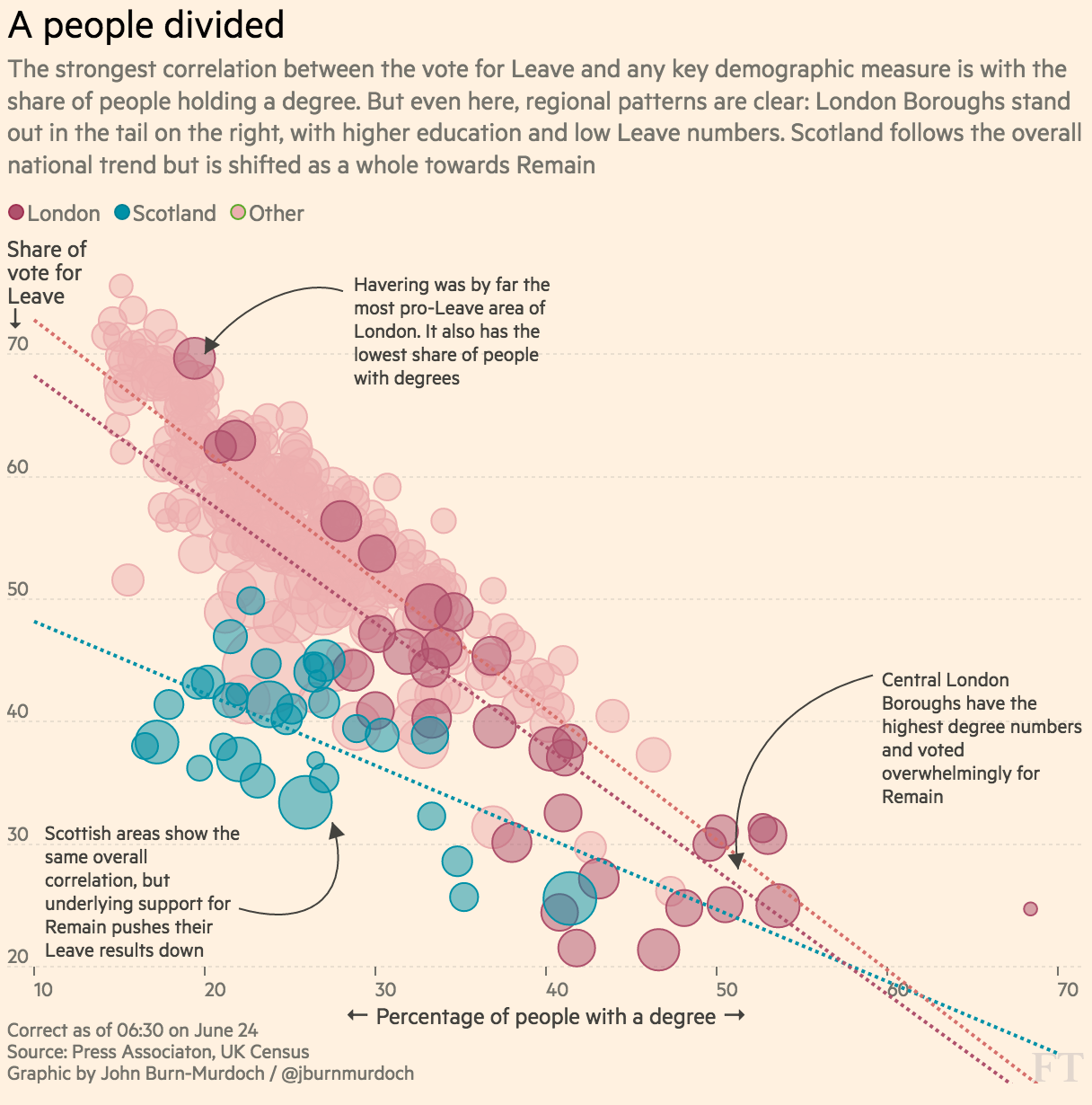
You are right that there are lots of people without University educations which backed Brexit. Rather than hating them perhaps you could try to understand their struggles and feelings on how they have been betrayed by the establishment [0]?
[0] http://www.theguardian.com/politics/2016/jun/25/meet-10-brit...
But they clearly believed so strongly, that they didn't think it was wrong to stoke immigration fears to win, and then turn round and explain that actually, free market economics suggests that low wage immigration is actually a good thing. This is playing with fire, and may end tragically.
Cornwall mostly voted Leave (higher the UK average) but have since asked for the EU funding for Cornwall to be protected.
http://www.independent.co.uk/news/uk/home-news/brexit-cornwa...
How dare you paint me in that light when you know absolutely nothing about me or my motives for wanting to remove my country from the clutches of an undemocratic state. Your narrow-mindedness is part of the reason I want out.
This all reeks of bitterness and toy-throwing by those that voted remain.
It's over. We are out. Accept it or feel free to move to a European country... I don't mind.
People with pre-existing xenophobic/racist have found vindication & legitimisation with the referendum result.
Many papers today are carrying stories of attacks along these lines, I'm sure the rest will in the following days also.
"It's over. We are out. Accept it or feel free to move to a European country... I don't mind."
The back-pedalling has only just begun. People voted leave for a lot of reasons, and they will have their displeasure at progress heard to differing degrees.
I'd suggest you give it a little while before you take it as read that any side won for the cause they voted for.
At the very least this is unhelpful, and devalues the impact of such words.
While I'd agree such terms are being carelessly banded about, there's no need to go looking for reasons to be offended here.
The probelm is that those who raise objections to immigration never seem to have anything constructive to say after that. So if you're not a racist or xenophbe, how about we have a discussion about allowing freedom of movement but actually SOLVING the problems that have been brought about by it?
The EU are going to demand freedom of movement if we are to stay in the EEA - so what's your answer?
It's not xenophobic to want to curb the net migration number.
And even if UK doesn't remain in EEA, immigration will be a fact of life. Hell, half of all immigrants in the UK don't even come from the EU!
Other countries may well demand a get-out, if they perceive it's to their advantage. And if it is, I'm not sure why the EU should seek to stop them either.
I guess we'll see one way or another.
We've already seen a rise in xenophobic, racist, hate crime.
To use UKIPs line, why aren't moderate anti-immigrationists condemning this violence?
But you have done exactly that, associated anyone bringing up the subject with a fascist ideology.
> We've already seen a rise in xenophobic, racist, hate crime.
Have we?
Yes. We need to National Crime Survey to be certain, but police forces are already reporting an increase in reported incidents, and affected groups are reporting an increase in incidents.
https://twitter.com/sima_kotecha/status/747404962242633728
UKIPer in that thread calls Sima Kotecha a liar, manufacturing fake outrage, when she describes someone calling her a paki.
That we also have them at the UK level is irrelevant to me, we're not having a referendum on that (yet).
Your definition of xenophobic is so wide that it would cover the very existence of nation states within the EU. I don't think all that many people share it.
Then democracy itself is too
> The EU is no less democratic than the UK itself
MPs are elected
> they don't impose on us because we are part of it
Not for much longer.
Unfortunately the most discussed argument is to have sovereignty over who can come into the country and who cannot. That is racism to me.
I wanted sovereignty over everything: Border control is just one part of the whole argument.
> Unfortunately the most discussed argument is to have sovereignty over who can come into the country and who cannot. That is racism to me.
I don't, however, agree with your stance that having a say who can and cannot come into the country is racism. How can you say that it's ok to let anyone in but by saying we need checks and balances is racism?
You may call it discrimination but that takes many forms, not all of them bad.
Racism it is not.
Edit: spelling, clarification
Agreed.
> How can you say that it's ok to let anyone in but by saying we need checks and balances is racism?
Discrimination and racism sound like the same to me. I read people saying they would like to choose based on peoples skills, which is a complete nonsense. Why not let the market decide? People would be able to come in as they like, if they wouldn't get a job nor benefits, I'm sure they would go away. Otherwise, it would mean they have a place in here. Wouldn't that be a wiser decision?
So it was "just" xenophobia and bigotry. That's all fine then. Carry on.
You've got effectively called me a racist there. You realise this is precisely the sort of rhetoric that's lead us here?
The attack on the Polish cultural centre is "rhetoric"? The murder of Jo Cox is rhetoric?
Feel offended, but at least don't try to paint yourself as subject of hate.
But you know full well that the rhetoric I'm talking about, as exemplified by that post, is the attempt to paint everyone with any 'leave' symapthies as a racist.
https://twitter.com/paullewismoney/status/747080385683660801
I didn't vote leave, for a start.
The shouting down of dissenting opinions by either directly or indirectly labelling them as racist, rather than taking them seriously or even trying to understand them, is one of the factors that has lead to widespread disillusionment with both Westminster and the EU.
That's what I'm saying.
I'm not saying that this is all voters general opinion, but it sure looks like the majority's. I don't hear anyone coming up with plausible arguments and I really wanted to hear them.
There are many good arguments and many bad ones that don't involve hatred of foreigners. "Take our country back" would, to me, meaning regaining full legislative control. Yes, this includes immigration, and yes I would limit that based on skills and an annual quota.
I don't believe for a second this is racist.
And I'm actually curious about what would those skills be as I don't believe that's a reasonable approach..
I feel no need whatsoever to defend myself from accusations of racism based on support of the idea of quota and skill-based immigration.
Anyway, it was your vote, I don't really care.
My idea of racism, it sure is wide.
Who is John to limit people from going wherever they want, while trying to make a living? Does the place where John was born makes him different or special somehow? I consider this racism. Isn't John going to end up making bricks same way as the migrant?
It just sounds way more rational to let the market decide. If immigrants can't find a job in here I'm sure they will leave and move some place else. If they happen to find a job and contribute to our society, then this should mean they have their place here. They should be able to stay and live.
And I'm sure there will be plenty of jobs, without the need for a specific skill set, that they will be willing to do. Jobs that many people in this country refuses to accept, because 'it's just £7 an hour' or because 'I didn't study for this' or whatever.
The main reason given by Leave voters was "The principle that decisions about the UK should be taken in the UK"
Decisions about Scotland should be taken in Scotland
Or even dissolving England.
Decisions about London should be taken in London.
In fact, the argument you just quoted is basically "representative democracy is bad".
Edit: if you downvote, please leave a comment arguing why.
At least 100 countries are more diverse, ethnically, linguistically, racially, you name it. Germany is among them, so is the US. France is about the same level of diversity. A majority of EU countries are more of a melting pot than the UK, in fact.
The UK is 87% white, 95% English speaking, 92% Christian/atheist/agnostic. It doesn't get much less diverse than that.
And of course the places that aren't homogenous (inner London for instance), all voted "remain" by a huge margin.
Overall it's not particularly diverse. One of the larger towns (Cheltenham, pop about 110,000) is 96% White British in last census. Nearby Gloucester is much more diverse - one street has over 70 different languages spoken as a first language, and the school in the UK (but outside London) with most different languages spoken as a first language is in Gloucester.
So, while I believe the UK is diverse it's a bit more complicated than that.
I'm reminded of the proposal of "managed decline" for Liverpool in the 80s. Give up rather than fixing the problems. Ironically Liverpool has since prospered enough to vote Remain, although that vote may also be due to the longstanding boycott of the Sun newspaper there.
But that makes your point stronger, no? That even in this small (by population, not geographical) rural county there's still a mix of not much diversity and lots of diversity.
Some sharia "courts" operate in the UK, as do Beth Din and Ecclesiastical Courts.
They're mostly for mediation and actual courts feel free to ignore them.
They've all been involved in pretty severe human rights abuses. Christian courts moved abusing priests around the country rather than reporting them to the police; Christian courts did little to prevent the sexual, physical and emotional abuse of children by nuns. Beth Din are currently involved in not giving Jewish women "Gets" - a religious divorce that can only be provided by the husband. http://www.independent.co.uk/news/uk/home-news/scandal-of-wo...
Sharia Zones, as talked about by US media, don't exist.
True - though the gov white paper mentioned that it was, in effect, binding because ignoring its result would irreversibly damage representative democracy.
Even if the UK were somehow to backtrack: they broke any faith and goodwill on EU side (not the entire EU but key members).
Politically, the Tories have to rally Brexit - or they will get killed by UKIP in the next election run.
The box is open. At some point in 10-20 years, a new agreement will probably bring the UK back to most of its EU membership. Until then, there's no way back.
In Sweden, several national referendums have been ignored by the government (shutting down nuclear power, switching to right hand traffic, new pension system). It has had no negative effect on either parties or politicians really. People are only angry as long as it stays in the public eye.
The truth is. To carry out politics you need politicians, and the No-side in the EU question is made up of a clique of populists joined by mass media. Without broad support by most politicians in the UK, the actual act of leaving will never actually come to pass.
Refusing to leave at this point will make things worse, not better.
Obviously, the losing side of any politcal battle will always want a redo. And obviously the winners will always prefer to keep the results as they are. Letting the losers try again until they win is like a DOS attack.
Btw, I totally agree though that leaving something like succession up to a simple majority is crazy. Seems 2/3 is more appropriate for big things like this, going to war, and what not.
I wonder where do you get the 10% figure; how on earth would you know that in the three days since polling? It's difficult to know what to make of folk who given three months of intense EU/Out/In discussion across the land suddenly discover that they didn't think their vote mattered or that they couldn't make up their minds and tossed a coin. They need a lesson in how democracy works.
It was expected that the pound would fall and markets react negatively in view of the immediate uncertainty. Aside from that, what's happened that would make someone say "I didn't know it would be like this"?
Even Paul Krugman, a would-be remainer says " I’m finding myself less horrified by Brexit than one might have expected – in fact, less than I myself expected. The economic consequences will be bad, but not, I’d argue, as bad as many are claiming. The political consequences might be much more dire; but many of the bad things I fear would probably have happened even if Remain had won."
> “I said to him, so where’s the plan? Can we see the Brexit plan now?” Islam told Botting, without naming the MP specifically.
> He said the pro-Leave Tory replied: “There is no plan. The Leave campaign don’t have a post-Brexit plan.”
> According to Islam, the MP then pointed toward the Houses of Parliament and said: “Number 10 should have had a plan”.
https://twitter.com/PED7/status/747063871765086208?ref_src=t...
I have spent a significant portion of my life living in countries where I was not a citizen, paid taxes and was unable to vote. Just like there are millions of Europeans paying taxes in the USA and unable to vote. This applies to most countries and does not make them any less democratic.
At the end of the day Democracy is a shit system. A really shitty system, but we keep it around because it is better than the other systems.
It's as big as a constitutional change and such change usually require more than 50% to be adopted.
There were dreadful lies on both sides. Personally I treated the entire campaign period as a sideshow we'd have been better off without, the issues and opinions about EU membership are far deeper rooted than the last few weeks of noisy bickering.
Further, the constitutional changes that got us in were not subject to supermajority conditions, in fact no political party that implemented them had an equivalent mandate behind them to either side of the referendum vote.
I disagree. Leave's lies were on a completely different (larger) scale. Most fundamentally, Leave claimed that Brexit would not be an economic disaster, which they cannot possibly have known — especially since they very clearly have no plan at all for what's next.
Did Remain have a lie painted on the side of their bus? A lie printed on huge posters at press conferences? A lie that they rode back from on the morning of the results?

http://www.independent.co.uk/news/uk/politics/brexit-eu-refe...
I voted Remain, BTW, and don't support UKIP. But I'm not prepared to grab pitchforks on a tenuous claim of hypocrisy either.
The problem is that many people voted based on that and many other lies and are feeling betrayed. Now the guilt will vanish as usual... will be no one's fault.. but somehow someone will be able to fulfil their agenda.
----
Some people voted leave for less immigration, others for more balanced (non EU-biased) immigration, it seems that these goals are fundamentally at odds. This isn't the only example of polarising goals that people have expressed. Until a referendum is put forward that actually allows people to express the end result they're hoping for (leaving the EU just seems to be the first step, not the goal for most people), I strongly believe it's undemocratic to proceed under the false argument that the people have spoken.
For what it's worth, the point i'm making is the same as the argument in favour of alternative vote (or single transferable vote) vs first-past-the-post elections. The way in which people are polled is insufficient for ascertaining what they actually want. A binary choice doesn't work in a world with more than two possible opinions.
----
On immigration I worry that we will see a crack down on non-EU immigration to allow continued EU immigration. People will argue that they are closer to us culturally, and they would be right. It is hard to see how the government can avoid appeasing ant-immigrant sentiment at this point.
I agree 100% that we need a better voting system. I can't stand UKIP, but I absoutely think they should have more representation in parliment. It would be good to use this as an oppurtunity to reform the house of lords into being fully elected. Give them the authority that the EU held in terms of long term regulation. We need an institution that can take a long term view which we will sorely miss post Brexit.
And there's the problem.
There IS a case to be made that a democratic majority with a margin of merely 4% is something that can, in fact, be ignored. In the United States, we have these lovely Senate filibusters, for instance, which everyone loves to complain about when their party isn't the one doing them. And vetos. And Supreme Court smackdowns.
The UK has at least a couple of these it could theoretically apply (e.g. the fact that Parliament isn't bound by the results, and some long-shot ones like Scottish Parliament or the royal veto that they apparently never use) but when you put something on the ballot like that and make the entire nation vote, it kind of sends a message that this is something that's going to be respected. If there's a whole new Parliament in a few months that may be different? But substantial fallout will remain.
This may well come as a surprise to many Brexit voters. It certainly sets out his stall for what he hopes to achieve, presumably he'll happily sign up for mass immigration as long as the finance industry gets opt-outs from EU fraud investigations or whatever his backers want to get out of this. Re-invigorating northern England's former industrial heartlands is nowhere on his list, and the anger of the people who live there can in no way harm the Conservative party in the UKs current parliamentary system.
Not to me - the opaque processes of unelected EU officials was the main reason.
I think UKIP will sit back and let the next Conservative government fail to deliver on some key Leave promises - I think they'll be targeting the 2020 election on a "the Conservatives didn't deliver on what Leave promised but UKIP will" platform.
The next Conservative leader will probably offer Farage a peerage to try and neutralise him but I suspect he is far too clever to fall for such an obvious ploy.
http://www.huffingtonpost.co.uk/entry/nigel-farage-eu-refere...
That, combined with the fact that things are currently going to hell in a hand basket (look at the FTSE250, comprised of business that make most their money within the UK, as opposed to the FTSE100 which doesn't), makes the out vote at best questonable right now.
Be that as it may, I voted remain, but only beause now was not a good time to leave and nobody seemed to have a plan for exit. But I have faith in Britain - what I hope will happen is that we will accept freedom of movement, and that we will bloody well deal with it properly this time by shutting up the racists and investing in intrastructure, health and housing such that the cause of all the mess that led up to all this doesn't happen again. Fuck austerity this time - spend like there's no tomorrow, because frankly there might not be a tommorrow otherwise. Whethe that actually happens in my lifetime, I doubt, but hey oh.
You could make the same argument about those that voted to remain.
> That, combined with the fact that things are currently going to hell in a hand basket (look at the FTSE250, comprised of business that make most their money within the UK, as opposed to the FTSE100 which doesn't), makes the out vote at best questonable right now.
Not really. It's only natural that there will be some short term downward moves in the markets due to uncertainty about the future. But we don't know what the medium and long term holds.
And agreed the UK's short-term econonomy is pretty much the least of its problems. But do you have a scenario in which it ends up peachy keen for the UK and Europe by about 2020? I sure as hell can't think of one.
Yes. Do you have any examples?
Here's the one I'm going to keep using from the Leave campaign: http://imgur.com/indvx6a
- "Brexit 'could cause mortgage rises', says Cameron"[1]
- "Every household would be £4,300 a year worse off by 2030"[2]
- "Taxes would go up if we leave the EU"[2]
- "House prices will fall by up to 18 per cent by 2018"[2]
- "Inflation would be 2.3 percentage points higher if we leave"[2]
- "Leaving the EU would wipe £32,000 off the average pensioner’s wealth"[2]
- "Food bills would rise by an average of £220 a year"[2]
[1] http://www.bbc.co.uk/news/uk-politics-eu-referendum-36454017
[2] http://www.independent.co.uk/money/your-money/right-to-remai...
At least insofar it's true that many people just voted to "send a signal" but didn't actually think they'd get a majority, that strikes me as going by the letter of the law rather than the spirit of it, so to speak.
> If this occurs we can expect politics in the UK to become dangerously divided and unsettled, and the likes of UKIP to become a seriously large party in the next parliament, not to mention civil unrest in various forms.
Hmm, sounds like a lose/lose situation: http://usuncut.com/world/hate-crimes-across-england-evoke-ni...
Admittedly, both these points are kind of anecdotal, I don't have an overview or a glass ball either. But still, I don't really get the "it might be a mistake, but you have to go through with it" stuff.
Maybe not the long grass, but it's a poison chalice for the next leader for the reasons you say - trigger article 50 and Scotland leaves UK and tries to join EU. Don't leave and the majority voters get angry. (And we really don't need them getting angrier since a small minority are angry enough to spray paint Polish community centres; to print and laminate "no more polish vermin" cards. (EDIT: Both these things have happened post-ref.)
Some men just love to watch the world burn. I will never understand this sentiment.
Other way round. UK politics was already divided and unsettled, it's just that an illusion of stability and consensus has been pasted on the front. The cardboard facade has collapsed when asked to bear weight - just look at the leadership chaos!
This referendum and its result is really a result of dozens of problems which have been pushed under the rug. It's all the unexploded bombs of nasty controversies that were never properly defused, just piled up in a corner.
The "immigration" question covers lots of nasty questions, for example. What is the EU doing about refugees? Why has Sangatte festered for so long? What should the right response to radical islamist violence be? What is the economic function of towns whose businesses collapsed in the 70s and have not improved? What's going on in the "crap towns" like Great Yarmouth and Boston, Lincs.? Why are voters struggling to get GP appointments and school places?
What is the UK constitution? Don't say "unwritten", because that's not true; instead it's scattered bits and pieces from Factortame to the Good Friday Agreement. That's why we're having this discussion about Scotland blocking it - it's not clear how any of this works. Is it really a good idea that Parliament can make big constitutional changes by simple majority (e.g. Fixed Term Parliaments Act)? Why do we have so many different voting systems but use the crap one for the important election? Does the House of Lords count as "undemocratic" compared to, say, the EU commission?
What is the proper relationship of the non-English parts of the UK to the Union? Scotland regards Westminster as the distant, unaccountable elite and finds the distant, unnacountable Brussels elite more cordial. Despite the fisheries problem.
What should UK economic and employment policy be? Are we funding the current account deficit by selling houses to foreigners from kleptocratic states and China? Are we too dependent on financial services which are too centralised in London?
Was Greece treated fairly? What about Portugal, Ireland, Italy and Spain? What about the Polish constitutional crisis? Is Hungary run by Nazis? What if the Austrian election had gone differently?
Did you know the EU has a Trump-style border wall? It's in Bulgaria.
This twitter gives the view from Northern Ireland, which was "dangerously divided and unsettled" for years with malign neglect from the UK government: https://twitter.com/shockproofbeats
I'm sure that you, personally, have answers to all these questions. My point is that there is no broad consensus on all of them, they've nagged at the UK for years, and now they've all been made relevant.
https://twitter.com/shockproofbeats/status/74736207057689804...
You need to keep clicking "Show more" to reveal all 32 tweets in that series.
There is no such mandate, implied or otherwise. The referendum was advisory. Legally there is nothing compelling the government to act on the result.
That situation would change in a heartbeat if the Queen actually tried to rule.
a) She convinces the Leader of the Commons to bring a motion to dismiss parliament (under the 2011 Fixed Term Parliaments Act this requires a 2/3rds majority).
b) She convinces the members of the Privy Council to form a National Coalition, and to stand as such for election on a manifesto centred on EU membership.
Alternatively, she finds someone who can command the confidence of the House of Commons across party lines, and gets agreement across party lines (likely through the Privy Council) to support the appointment, and duly appoints them Prime Minister (this is roughly how Churchill became Prime Minister in 1940, with no election held since 1935 and none would be held till 1945). The cross-party Government then formed can then seek a mandate to remain in the EU in a number of ways (such as then falling to an election or a second referendum).
One shouldn't understate the amount of influence the Queen can have, and maintain, if she plays her cards right.
In 1975 in an extreme circumstance the Governor-General (the Queen's representative in Australia) dismissed the sitting Prime Minister and appointed a new one: https://en.wikipedia.org/wiki/1975_Australian_constitutional...
Not sure exactly what might happen here.
There is a lot compelling action, I mentioned some of the possible fallout scenarios in my post.
This is the latest, like others it's more of an exercise in denial than it is in reality. Many of these things could come to pass, it's true, but each one carries with it the implication that a direct democratic mandate, to leave the EU, is ignored.
If this occurs we can expect politics in the UK to become dangerously divided and unsettled, and the likes of UKIP to become a seriously large party in the next parliament, not to mention civil unrest in various forms.
The people that voted leave already feel left behind and ignored by the state. Explicitly ignoring them and finding a way to work around their democratically expressed opinion is likely to be a really BAD idea.
--edit-- I notice the points attached to this post going up and down. To those downvoting, can you tell me where/why you disagree?