Interestingly, I think New Zealand law does have this case covered. There's special mention of "computer-generated" works under Section 5[1] of the Copyright Act which states (as I read it) that the person who wrote the computer program to generate the audio is the author of the audio.
[1] http://www.legislation.govt.nz/act/public/1994/0143/latest/D...
EDIT: Had another read and thought that actually it could also be the person that inputted their choices into the computer program that undertook "the arrangements necessary for the creation of the work"... Copyright is a murky section of law.
"Bits don't have Colour; computer scientists, like computers, are Colour-blind. That is not a mistake or deficiency on our part: rather, we have worked hard to become so. Colour-blindness on the part of computer scientists helps us understand the fact that computers are also Colour-blind, and we need to be intimately familiar with that fact in order to do our jobs.
The trouble is, human beings are not in general Colour-blind. The law is not Colour-blind. It makes a difference not only what bits you have, but where they came from. [...] The law sees Colour.
Suppose you publish an article that happens to contain a sentence identical to one from this article, like "The law sees Colour." That's just four words, all of them common, and it might well occur by random chance. Maybe you were thinking about similar ideas to mine and happened to put the words together in a similar way. If so, fine. But maybe you wrote "your" article by cutting and pasting from "mine" - in that case, the words have the Colour that obligates you to follow quotation procedures and worry about "derivative work" status under copyright law and so on. Exactly the same words - represented on a computer by the same bits - can vary in Colour and have differing consequences. When you use those words without quotation marks, either you're an author or a plagiarist depending on where you got them, even though they are the same words. It matters where the bits came from." - from http://ansuz.sooke.bc.ca/entry/23
Basically, non-recorded metadata about how a sequence of bits was created matters too. Not just the bits themselves.
cat /dev/random > /dev/eth0
Isn't the world a wonderfully messy place?
</hyperbole>
Sure, but (and I'm not a lawyer), intent of law is just as important as the literal meaning of law. Cases play out this intent and add to the corpus of knowledge as case law. So if you did write a program to generate all the data in the world, I'd imagine people would look at your intent, rather than just what you literally did.
Within the realm of audio production, there's an even closer equivalence: soundfonts, which are also little nearly-Turing-complete programs. Playing a MIDI file "through" a soundfont? No problem. Putting that track on a CD and selling it? Nope, need to license the font.
Really, you could think of procedural music generation as a really complex and "stateful" soundfont program that has a nonlinear relationship with its input.
I don't think there's anything legally stopping either behavior; it's just that neither GNU nor Adobe are in a market position where anyone would put up with that sort of behavior.
This was followed by the famous Bridgeman vs. Corel, which established that taking a picture of a work doesn't create a new copyright. Thus, pictures of public domain works are public domain. Despite much huffing and puffing and disinformation by the museum community, that's now settled law. Nobody has gone to court to try to overturn it. (The National Portrait Gallery (UK) threatened to sue Wikipedia, then backed down once they realized they would lose.) There's also Meshwerks vs Toyota; a 3D scan of a physical object doesn't create a new copyright in the 3D scan. That's an appellate decision and reaffirmed Bridgeman.
So, for copyright in the US, there must be an Author. (This can be a corporation, but that comes under the law on work-for-hire; the individuals involved are the initial authors but the rights accrue to the employer.) You can make a strong argument that under US law, works created by computers are not copyrightable.
  > You can make a strong argument that under US law, works
  > created by computers are not copyrightable.
I don't know exactly how Jukedeck works, but it seems self evident that it is the product of a huge number of creative decisions - which sound samples to include or generate, which sounds can be combined in a pleasing way, which melodic patterns are appropriate for various genres, how melodic patterns are modulated over time, etc. etc.
It's not as if the Jukedeck team created a general purpose AI and said "go make some music". They designed a system that can generate a limited (though large) range of music based on their own sense of creativity, taste and style. I argue that the music generated by such a system is clearly creative expression and thus subject to copyright to the same degree as traditional creative expression.
I do not think "sweat of the brow" decisions are relevant here. The lack of "sweat of the brow" copyright means that simply performing labor without a creative element does not qualify the product of that labor for copyright protection. There must be a creative spark present in the generation or transformation of the work.
The fact that, with Jukedeck, the creative spark happens at the time of producing and editing the code rather than at the time of the code generating the music is not relevant in my opinion.
Kind of like a studio letting you use their equipment under a prior agreement that anything you generate they own until you purchase it.
The same reason artists like Autechre deserve to own the copyright to music they created using algorithms. They wrote the software that made the song, it's just somewhat more abstracted version of composing isn't it?
Uh, do you think there's a sentient being here? Its just a relatively simple algorithm here (at least compared to sci-fi style AI), the same kind of thing that decides how to autofix colors in photos or do a transform in photoshop.
Dynamic music generation has been a thing since at least the 80s. I think I had an Apple// program that did this.
>works created by a non-human are not subject to U.S. copyright
I'd like to see you prove some silly music generator is on the equal footing of a living and intelligent animal to any court. I can't imagine you not being laughed out of courtroom.
E.g. the recently infamous selfie by a monkey was ruled public domain, having been produced by a non-human.
Every picture you've ever taken, the Universal Slideshow already contains that picture. The picture of your birth, every memorable moment of your life, and every possible variation of your death.
It's already there it just needs to be found. That's the entire point!
>(There is an extended Library that contains entire novels to be searched - the web version is a bit smaller/limited to pages.)
The creator has variations of the code that aren't online. For example, lower-case alphabetical letters was a choice to "remain true to the original concept" but a base64 variation that allows for capital letters is possible. Furthermore - searching for entire books rather than being limited to 3,200 characters is also possible. Also other languages would also be possible but require further variations of the code.
It's just having this work on the web to a website that sees 30-40k daily visitors because the algorithm isn't fast enough to meet those demands.
[0] https://libraryofbabel.info/forum/?bbp_user=1&bbp_reps=1&pag...
E:
Rate limited in posts. My reply to the below is as follows:
Your claims only hold for the web version. I was not speaking of the web version. So you are explicitly wrong. There is a version of the library that is not limited to those characters, that is not limited to lowercase Latin alphabet, and is not limited to being searched 3,200 characters at a time. So what are you contending by making such statements?
Yes. The web version is held to those limits. Which is why I explicitly mentioned I was not referring to the web version. Your claims only hold against the web version. So I'm not seeing the point you are trying to make here.
E2:
I hate how HN rate limits like this. :)
I'll concede that. Does ASCII art of a Chinese character represent the same information as the Chinese character? That's stretching things so I'm not making that as a counterpoint - but more of a thought experiment.
For example: https://libraryofbabel.info/bookmark.cgi?ygofnzdyjijlsc299
Edit: Reply to your reply: One inherent limitation with the current code is that it has to assume some encoding. Currently, there is no encoding that contains all known glyphs (e.g the Prince symbol, uncommon kanji, etc) so there will be texts that can not currently be generated, regardless of how much you increase the character set.
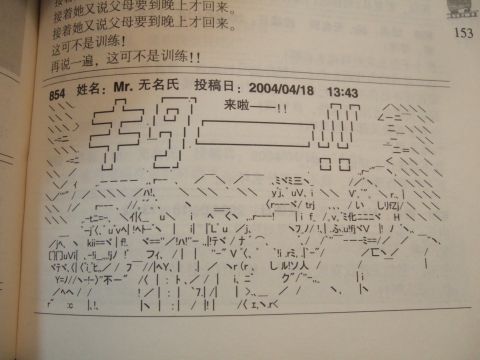
Edit2: Even if one were to allow ASCII art to represent a character, you then have the problem of how to distinguish between ASCII art substitution and actual ASCII art. Consider "Densha Otoko," which basically consists of message board posts that often contain ASCII art.
Why doesn't then Adobe own result of whatever "autofix colors" produces?
But this falls kind of in a gray area. If the AI created the tracks, why does the company own the copyright (and thus, have the right to sell it)? In December 2014, the United States Copyright Office stated that works created by a non-human are not subject to U.S. copyright (see: https://en.wikipedia.org/wiki/Monkey_selfie#Copyright_issues ). So, in theory, AI could also own copyright.
Moreover, do they actually check every newly generated track to make sure its not too similar to previously-sold tracks?