Related: China is in the late stages of a credit-driven investment bubble where tons of construction (roads, houses, trains, dams) have been built. It's an open question whether it was "worth it", it probably produced a lot of construction jobs, perhaps some good infrastructure, and spread trade knowledge throughout the economy, but at a huge cost to their taxpayers.
What? I don't make anything that you will buy. I can guarantee it. So why should I buy your products if you won't buy mine.
That makes no sense. The way money works, it doesn't matter who is buying from who, only that things are being bought.
Ever since grad school, we've always had a gradient of people from affording to eat out to not really being able to. As the generous folks covered me when I was poor, I'm happy to return the favor now that I'm not.
However, I'll generally make a spot check on someone who can really afford it but didn't seem to put in the right amount. If they don't pay enough for themselves, I'll give a quiet gentle reminder ("Hey, remember you did eat part of those nachos and had an extra beer. You might want to recalculate your portion.") and that generally solves the problem. Most people generally just forget as it's pretty easy to miscount in a shared context. And, if this is the first time and they drag their feet, I'll just pay it and talk to them afterwards. They may have hit a rough patch in life.
However, if the group gets to 15-20 people, I occasionally get someone who just systematically shorts things every time who is making more than enough to pay their share. If it's the third time it happens, I'm whipping out a calculator and calculating their portion exactly and publicly.
At that point, they either shape up when I'm around or they never show up again. Either solution is fine by me.
That era was famous for its very-indebted Yuppies (and the origin of the idea of "Yuppies" as we think of them.)
Some of this can't be blamed on the politicians. Easy credit and the rise of credit cards generally did a lot for this. But politicians did get to decide how credit regulations worked. It took awhile to outlaw live (not pre-approved -- you could pick them up and just use them!) credit cards arriving at people's houses, for instance. You could literally steal one out of somebody's mailbox and go rack up money in their name.
Not any more, obviously. But they lasted longer than you'd think. Credit was pushed very hard at consumers, and politicians do control the extent to which that's legal, even if they're not really to blame for it being possible.
Credit must be pushed hard. Credit is the origin of money, under these systems. Credit must expand so that the periodical interest obligations can be met by those with existing credit obligations. When credit no longer expands at a sufficient rate, the systems enter contractions, which will quickly end the system, unless credit expands enough to save the system for a while longer.
The only problem with personal debt is when it becomes systemic. The fallacy of composition is that what's good for individual is not necessarily good if we all do it at the same time. Normally lowing your price to be more competitive is a useful strategy, but not when it becomes a race to 0. We saw this in the great depression with farmers publicly throwing out their product.
As for governments, the austerity meme is class politics in disguise, and tends to lead to nasty social blowback. Governments can change monetary policy and other law, giving them a lot more options.
The prevailing neo-liberal (and progressive, at least in the US) notion is that smart people "understand" keynesian counter-cyclical economics and only dopes or rubes ... or bad actors (as you suggest) would advocate for austerity.
However, it really needs to be repeated: austerity is only braindead if you insist on ever-increasing aggregate demand. If you are willing to accept stagnant or even decreasing aggregate demand (for whatever reason) then austerity is perfectly reasonable and perhaps a good choice.
I'm not saying I'm in that camp, but I really don't like this false dichotomy - that austerity is braindead and only morons would advocate for it ... and leaving unsaid the almost universal assumption that aggregate demand can never, ever, be allowed to drop.
EDIT: and I also don't like the condescending, custodial tone that this always takes ... "oh how quaint that you would conflate a national economy with a household economy, here let me mansplain it to you". In fact, there are boundary conditions where they behave exactly the same (see argentina). People aren't as dumb as you think they are.
I think the problem is that austerity advocates argue that that aggregate demand will increase in the face of austerity, when we know that doesn't happen. Austerity advocates then often bring up the theory that if debt is lower, then external actors will have more confidence in the country and interest rates will decline.
So while I agree with you that no one needs to be condescending, it is challenging to deal with the pro-austerity folks when they seem to be fact-challenged.
I know this disagree with mainstream economics, and almost all niche economics theories. But it's happening again and again, so fuck the theories.
Of course. That doesn't mean governments follow a simple zero-sum model. Government economics is it's own beast, with (hopefully) it's own solutions.
re: fsck the theories - you may find this[1] interesting, which is a summary of where we stand right now on many aspects of government economics by econ prof Mark Blyth that he gave at a recent q&a session. It might be one of the most succinct explanations of just how badly we're fscked.
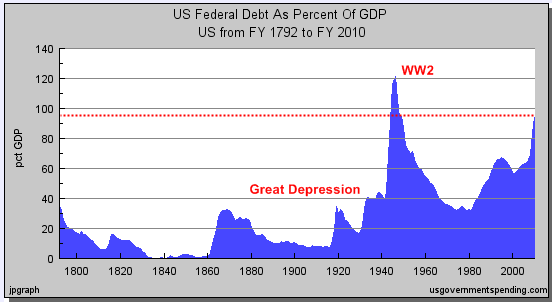
http://www.mybudget360.com/wp-content/uploads/2010/12/us-pub...
Japan (at the time, primarily a few zaibatsu) had serious financial problems when their export bubble popped in the 1920s. Unfortunately, they bought into myth that austerity lowers debts really badly, and decided it was a good idea to cut out 30% (!) of their GDP in two years. When that only made the situation worse, they doubled down and tried to cut another ~10%.
The zaibatsu and 37 banks went under in the inevitable bank-run, and quite a few financial leaders were assassinated when the military realized their budget was about the only thing left that could be cut.
Compared to that mess, the US has done a relatively good job of inflating away it's debts. Our gridlock blocked most of the austerity "fixes", so while we still have a mess of an economy, at least it isn't slashing a third of our GDP.
You've had your quote of unsustainable private debit, but not public.
How so, other than you don't like it? The data over the past 9 years seems to have confirmed a Keynesian analysis of the global economy.
"but it allows the governments to spend as much as they want"
No, that's not how it works. Keynes' theory is about how a general glut can happen, due to the role of money and bonds as a second and third variable in markets (vs the usual supply and demand curve). There are various techniques to get out of it, the only time government should spend money is when we've basically dropped interest rates to 0% - free money! - and companies still aren't spending it.
"Furthermore, it devalues the money in our wallet everyday we don't spend"
You mean by inflation? The inflation that doesn't currently exist? http://www.usinflationcalculator.com/inflation/current-infla...
Deflation on the other hand, has always been scary, for hundreds of years.
Now I know the necessity to do that has been dismissed by modern economists but actual Keynesian policies still have to be implemented by politicians who get elected. During recessions there tends to be a reluctance on the part of electorates to deliberately take on more debt which IMHO leads to Keynesian responses which are never quite robust enough to do the job they're intended to do.
Whereas if you did actually run a surplus during good economic times or at least during some of the good economic times then the public would likely be a lot more likely to back a real Keynesian response.
How much of "normal" GDP should you spend in a crisis in order to avert it? 5%? 10%? 20%? 50%? 100%? 500%? I've never heard a solid answer, mostly just "however much we spent wasn't enough" which seems a little tautological.
The only reason I'm picking on you is you said "never quite robust enough" as though you just plug a number into a formula and get an answer.
In terms of how much I would say between 5 and 10% depending on the severity of the recession and that need not all be in the form of government spending per se, it could also be a mix of tax cuts as well.
By your own numbers, that should have been enough, and yet you've complained it wasn't. What gives?
QE is complimentary to but not a replacement for a Keynesian response.
If you want loads of shiny new gadgets every year, and want it so most people spend their entire lives working just to pay rent and only a lucky few escape with "fuck you" money, then it's the system for you.
If you want the average person to have the economic freedom to work less, and actually get time to enjoy their discretionary purchases, then debt-based slavedriving is not what you want.
It's a deliberate policy choice, but gets obscured as authoritative "science" by centralization-supporting economists who are compensated with money and stature.
Deflation isn't scary, only the transition to it is (like any change). Deflation is actually the natural tendency, as doing things cheaper is precisely what market competition is based on (see: the entire technology sector).
This sounds made up. How is optimized production different from efficiency? How is growth unsustainable? An economy without growth is by definition zero-sum; is that what is sustainable, no more Pareto efficiency, that someone must lose for another to gain?
"If you want loads of shiny new gadgets every year, and want it so most people spend their entire lives working just to pay rent and only a lucky few escape with "fuck you" money, then it's the system for you. If you want the average person to have the economic freedom to work less, and actually get time to enjoy their discretionary purchases, then debt-based slavedriving is not what you "
Keynesianism has nothing to do with private debt or private spending habits, nor weekly work hours. You can blame many for such problems, I don't know why Keynes would have anything to do with this.
"Deflation isn't scary, only the transition to it is (like any change). Deflation is actually the natural tendency, as doing things cheaper is precisely what market competition is based on (see: the entire technology sector)."
That's not deflation.
Deflation is when the entire broad based market across products and services lowers their prices for the same products and services. It in practice causes depressions very similar (and deeper) than what we just experienced.
The tech sector lowers prices in a specfic sector by using new technology. By definition this is about classic creative destruction and reallocating of resources.
Deflation is what happens when there is not enough demand for the supply, and therefore everyone stops spending money, people lose their jobs. Interest rates fall to 0, and prices fall across the board. In other words, very close to what happened in 2008-2009.
Deflation was something that theoretically shouldn't happen by classical models until Keynes showed it does, and we saw it in earnest in Japan during the 90s.
Erm, this is a well known general trade off. Driving 55mph vs 80mph on the highway - the former uses less fuel for the same distance, the latter gets you further in the same amount of time.
> How is growth unsustainable?
If something is growing, eventually it becomes constrained by some sort of limit. If the expectation is that it is continually growing, hitting a limit means that it has "failed". Both of these general juxtapositions are quite common, so your picking apart of them seems quite defensive rather than understanding.
> Keynesianism has nothing to do with private debt or private spending habits, nor weekly work hours ... I don't know why Keynes would have anything to do with this.
Which is it - are you sure Keynesianism has nothing to do with them, or do you not know?
When interest rates are low (or nonexistant, like the past 6 years), people are discouraged from saving in cash. If they have a significant surplus, they budget month to month and put the surplus into opaque long-term "investments" (retirement fund at the wall st casino, etc). They don't perceive the cash value and treat the account like a lock box, so they base their spending power on monthly income rather than savings. Their utility curve remains fixed (they need that monthly income), giving them less bargaining power with employers so their wages remain low.
> An economy without growth is by definition zero-sum ... that someone must lose for another to gain?
Zero-sum is an awfully strong term, given that we're talking about production rates. Durable goods stick around - if a person receives 1 house/yr for a single year, and then someone else receives that 1 house/yr instead, are you really going to characterize this as "zero-sum" ?
In general, it seems that you're conflating production with the integral of production. This is a general theme of Keynesianism, given that it is explicitly about maximizing output by maximizing work. Given that the major economic phenomenon of our time is robots taking over historically human work, we should probably rethink this goal.
My point regarding deflation is that what happens in the tech sector is just a more pronounced version of what should be happening everywhere. Prices may rise in the short term (eg a discontinuity from depleting a source of a natural resource), but in general market competition should cause all prices to be trending down in the long term.
If you're using "production" as a synonym for "output", that's my misunderstanding of the words used. I get that it's a resource vs. output tradeoff. I had thought we were talking about productivity, i.e. lower rate of a unit of resource for the same output.
"If something is growing, eventually it becomes constrained by some sort of limit. If the expectation is that it is continually growing, hitting a limit means that it has "failed"."
Are limits fundamental and eternal? I mean, economic growth is basically the science of human achievement, the ability to accomplish more for fewer resources. And while certainly there are physical limits on Earth, which will temporarily halt growth at some point, is there a limit on innovation or on seeking out new resources? It's a big universe.
"Both of these general juxtapositions are quite common, so your picking apart of them seems quite defensive rather than understanding."
No, I genuinely find your point of view fascinatingly bizarre.
"Which is it - are you sure Keynesianism has nothing to do with them, or do you not know?"
I am quite sure about what Keynesianism thinks on this matter, and find your arguments confusing.
"In general, it seems that you're conflating production with the integral of production. This is a general theme of Keynesianism, given that it is explicitly about maximizing output by maximizing work. Given that the major economic phenomenon of our time is robots taking over historically human work, we should probably rethink this goal."
I'm not so convinced the current wave of robots taking over human work is all that different as the early industrial revolution in the late 18th century through Fordism and Taylorism in the late 19th/early 20th century.
However, I'll admit, if this time it truly is different, i.e. we're heading for an AI singularity or whatnot, we do need to rethink the goals of economic policy.
"My point regarding deflation is that what happens in the tech sector is just a more pronounced version of what should be happening everywhere. Prices may rise in the short term (eg a discontinuity from depleting a source of a natural resource), but in general market competition should cause all prices to be trending down in the long term."
I really can't agree with deflation as a desirable goal in our lifetimes, as it incentivizes doing nothing with capital.
Of course, as above, if diminishing returns to capital accumulation vanishes due to basically free automation, this may be worth considering. I think it's overly optimistic about technology to expect this, however.
Debt is borrowing tomorrow's prosperity
There's three kinds of debt. One is corporate. A company took on debt to buy some equipment. That can be mis-investment, but it's usually pretty good.
Second, there's personal debt. That counts both mortgages (usually worthwhile, unless you buy more house than you need) and stuff like credit card debt, where you're still paying for Christmas five years later. So, some is worthwhile, some not so much.
Third, there's government debt. This can be used effectively to create infrastructure. The problem is, though, that it's allocated not by a careful cost/benefit analysis. Instead, it's allocated by politicians. This kind of debt therefore has the highest propensity to be sheer waste.
For example, let's say you discover a large deposit of gold on land you own. You could use debt to buy the mining equipment to mine the gold.
Another example is if terrorists demolished all the bridges between Manhattan and Brooklyn. The government doesn't need a cost/benefit analysis to decide to use debt to rebuild some bridges.
Many leveraged miners are going bankrupt for having not done cost/benefit analysis on something so obvious...
Edit: Ok, I had a nice reply to someone, but then their comment was deleted, meaning my comment had nowhere to go.
I'll put it below.
---
>[Deleted Comment] Unfortunately without further information on your part is hard to know if you have deep insights, carefully thought out, or it is just a naive cynic comment like those that abound all over the internet.
It is a fair point. Unfortunately, any given text posted on the Internet is unlikely to be read much or given much credence by the few that do read it. Therefore, I try not to waste my time expositing large amounts of English text.
I don't know if I have deep insights. I do know that most seem to have no idea of the basic mechanism of the dominant monetary regimes and that such a mechanism easily explains many of the "bad things" which occur in the economy. For example, it's just a fact that debt must rise (assuming non-decreasing population and many other "standard assumptions").
>it's probably best if everyone buries themselves as far into debt as they can
This is basically the only possibility, except that the debt isn't forced to be spread uniformly. Instead, debt accumulates in regions. The steady state is basically: banks hold interest stakes in all debt, perpetually. Banks survive, while everyone else must deal with the wake forced on them by the massive amount of debt product which the banks produce.
College cost
Problem: college needs to be more affordable for lower-class kids
Solution: give them cheap loans to go.
End result: college prices rise because there's no downward pressure, kids graduate with enormous loans, and we're having this same conversation ("how can we stimulate spending?").
Housing
Problem: the poor can't afford housing.
Solution: Legislate it such that the poor can get access to loans to buy housing, with the government (really, society at large) subsidizing the cost.
End Result: Housing prices rise because loans are cheap, people get loans they can't afford, eventually people default on loans, pushing costs of loans up, the poor can't afford to buy housing. Cycle repeats.
This is where the conservative side of me thinks that government intervention really pushes this cycle along faster and faster, and makes things worse and worse (with the best of intentions). I think it was in the 90s that suddenly it became politically smart to think that "everyone should be able to own their own home", which sounds great on the surface, but there's so much more to it than a simple quote.
The question is often asked, what intrinsic reason is there to worry about income inequality? One reason is that when wealth is more evenly spread, the millions of micro-allocation decisions by many people help power a very efficient engine of capitalism. However, if the wealth is unevenly spread, then we have much fewer parties making very heavyweight allocation decisions, and many much smaller allocations being made by everyone else. Under that scenario, the engine of capitalism starts to drop in efficiency because it's choking on too high a amount of misrouted investments in some areas, and not enough in others.
What you're getting at is that when wealth becomes concentrated enough, you effectively have a centrally-planned economy with all its accompanying inefficiencies.
There are some pretty smart economists who've shown that here in this U.S., this is effectively already happening.
Basically, when people say "inequality? Who cares? It's capitalism!", what they're missing is, after enough inequality, it's no longer capitalism. You end up with a centrally-planned economy, which is where we are today.
"We had people like this back in Poland, except instead of venture capitalists we called them central planners. They too were in charge of allocating vast amounts of money that didn't belong to them."
(http://idlewords.com/talks/what_happens_next_will_amaze_you....)
The thing is that VCs are not that wealthy - even the wealthiest ones, like John Doerr, are not in the Forbes 100 list.
What they actually do is invest the money of others, often from not-so-wealthy people - money held in pension funds, 401ks, etc. So you could have a less unequal society in which VCs actually controlled more money - in fact, it wouldn't be surprising, since wealthy people often invest directly, instead of buying into VC funds.
If the thing we had was already capitalism, then doesn't the very fact that they have so much capital prove that they are the best at making the smartest (read: best return) investments?
And if not, then doesn't that mean the problem was that we already didn't have capitalism, and fixing inequality by itself is a fool's errand, since we should really be fixing the distortion that lead to the outcome of the bad investors owning the wealth?
It strikes me as a companion to a lot of "free market" talk really advocating a monopoly with no rules for the monopolist.
As free-market academic advocates have been saying for years, the fact is that Capitalists don’t actually like capitalism[1]. Like Chomsky says, what they want - and usually get - is capitalism for the poor and socialism for the rich.
That's why honest supports of capitalism get to frustrated when other people claim they are using No True Scotsman arguments by saying that they want actual capitalism, and not the current system. Capitalists (the actual owners of capital) have co-opted their discourse for their own benefit and have poisoned it to the regular person beyond hope.
[1] http://www.adamsmith.org/blog/economics/capitalists-don-t-ac...
The best investments require healthy businesses, which require supplier production and consumer spending, which are uses of money that compete with investments. If everyone who can afford a Tesla roadster would prefer to buy Tesla stock, then the investment never pays off, because Tesla can't actually sell enough roadsters. Eventually, someone has to buy something. Buying a piece of the company that makes a thing is not the sake as buying the thing it makes. One is actually beneficial economic activity, and the other is just moving money from one pocket to another in the same pair of pants.
All those loans given out for education and housing are not spending. They are just new ways to launch money out on outward trajectories such that it will inevitably return.
Once you are rich enough that you can't conceivably spend all your money via normal living expenses, you have a choice: accumulate even more money that can't be spent, or spend it on abnormal expenses. You can use your money to get more money, or you can use it to buy things that no one else can. You can buy paper from Fannie Mae and Sallie Mae, or you can build a better electric car. You can shuffle paper, or you can eradicate malaria. You can shuffle paper, or you can give a condom to every person on Earth that does not want to get HIV today. You can shuffle paper, or you can buy the swankiest, shiniest luxury yacht ever made. You can shuffle paper, or you can overthrow the government that murdered your grandparents. You can shuffle paper, or you can make sure that your local zoo can afford a new habitat for some threatened animal to whom you feel inexplicably connected.
We get bubbles when the people with money to spare only want to invest in the things that other people are spending their money on. Those people should not be investing. They should be making things to sell, or buying them, rather than trying to make the people who are doing those things indebted to them somehow.
People of all economic levels make smart and stupid decisions with money. If that money is spread out among many people making many decisions, then overall most people do reasonable things and we still can end up with a pretty good economy that is more resistant to bubbles.
Here is the degenerate case. Someone creates a corporation. They take $1000 from their pocket, put it in the corporate strongbox, issue 100 shares at $10 each, value the corporation at $1000, and put the shares and the key to the strongbox back in their own pocket. There is a lot of movement going on, but nothing has really changed. The corporation still doesn't do anything.
Now suppose that another investor joins in. They add $1000 to the strongbox, and take 100 shares. The value of the corporation is now $2000.
Really pile it on, now. 98 more investors each add $1000 to the strongbox and take 100 shares. The corporation is now worth a whopping $100k, with ownership split 100 ways. This is still a null entity to the larger economy.
Now let's have the corporation buy a moneymaking machine that costs $100k up front, and makes $100k per year. The investment $100k goes to the manufacturer, who now gets to spend it. The corporation hires a machine operator at $50k/year and spends $4k/year on insurance. The employee gets to spend half of what he makes with the machine. The corporation is now accumulating $46k in profit per year. The owners are sitting on ass, cashing fat checks, and the employee is dutifully sending out those checks.
That's fine. Without their pooled investment, none of them could have purchased the moneymaking machine alone. But the benefit does not come from the investment. It comes from spending money and doing actual work. Without that, you're all just building a new box to hold your money.
Now here's an alternate scenario. The person who would otherwise be the machine operator employee borrows $100k with 12 $3k quarterly coupons, and principal to be repaid after 3 years. (That's about 10.8% annual interest.) Each quarter, he makes $25k with the machine, pays a $3k coupon, spends $12k in living expenses, socks away $9k to pay off the principal, and $1k to insure the machine. After those 3 years, the operator can now spend that extra $12k/q on something other than living expenses.
Now we'll go one step further, and instead of getting that $100k from borrowing on a bond, the operator rents the machine from the manufacturer for $4k per quarter (insurance included in lease), and buys it outright after 3 years. Why would the manufacturer even consider that? Answer: he can't build the machines and operate them at the same time. The machine that builds the moneymaking machines must necessarily make more than $100k worth of machines per year, after all. If demand keeps up, the lease-to-own option could be bringing in more income than cash-and-carry sales.
So what do the investors really add, here, from the perspective of the machine operator and the manufacturer?
The "misrouted investments" you speak of, are only possible, on any large scale, by an ever increasing money supply provided by a central bank. To put in other words, there can be no bubbles, of any kind, without the expansion of the money supply. This expansion in the money supply is decidedly not capitalistic.
As he pointed out, not true, it's also possible by too much centralization of wealth, i.e. inequality. Inequality happens regardless of central bank interference with the money supply.
I think the problem is here. What is the definition of wealth?
Often wealth is conflated with money or capital. When you start off with a fictional concept, you get fictional results. What does it mean to accumulate wealth? Produce a pile of gold bricks? Amass fat stacks of cash? Obtain the most 1s in the most significant bits in your values in GS's databases?
It seems to me that there are only really people's wants and needs and whether or not they are currently being met. How can you put a wealth quantity into that framework?
>that they really don't know how to allocate it sanely
In what sense does a holder of massive accumulated wealth allocate it? Do you mean handing out cash with the expectation that the recipient will perform actions on demand?
How does this work, generally? Sure, there are people with "so much wealth they don't really know how to allocate it sanely," as you say. But ultimately what happens with it? The "super wealthy" don't have it sitting under their mattresses--it's in all kinds of investments: stocks, property, etc. I don't really get the point in your words, other than "some people have more money than others".
What counts as a valid use of money, to you? Paying for other people's college? Paying other people's mortgages? What makes one use of money/property more valuable than other uses? As seen on HN recently, mutual funds are investing in startups, some of which essentially pays our salaries. Is paying $10m for a yacht a less sane use of money than a million people paying $10 for gas?
For the 2nd time in as many days, I'll use Bill Gates as an example. He's apparently worth something like $80B. Apparently ~$15B is in Microsoft stocks, and the rest is in Cascade Investment LLC. That's all being invested in a variety of ways, certainly: some public companies, some bonds, some private company, etc. It's all being used in various ways, ultimately paying salaries, paying taxes on properties, investing in capital. If it were to be liquidated (assuming that you could do so without losing value), and given to everyone in the USA equally at $80B / 330 million people => $242/person in the US, why would that necessarily be allocated "better"? My naive guess would be that a significant chunk of it would end up at Walmart, Apple and Samsung--how is that more sanely allocated?
Or is your point that the government could better allocate that money? If the government were given $80B to use "on behalf of the people", do you think it would be better spent?
What does that mean for suggested fiscal or monetary policy? I don't know. I believe that capitalism makes sense at a lot of levels, but I also think that the over-accumulation of wealth unbalances the whole. The traditional proposed "solutions" to this are ineffective to me. e.g. increasing the minimum wage may do some social good but it's so far on the edges of the solving the fundamental problem it's laughable. Instituting a tax on wealth seems unworkable from a political level - and on top of that, it seems to be on the other far edge of trying to fix a problem long after the problem has occurred.
To me the fundamental problem isn't that individuals get wealth, it's that our financial system systematically approaches wages to be optimized down as a cost, and that companies are applauded for squeezing labor cost as equally as any other cost. So instead of investing in better training, or capital equipment, or better processes, a viable way to operate is to squeeze your employees as hard as possible. This is a process that's causing broad flow towards inequality and single worst misapplication of money flow in the economy, giving rise to the problem in the parent above. This is also a process that squeezes out the benefits of capitalism to people broadly in society.
I don't have a pat answer to solve that problem. Sometimes I wonder about a salary tax credit that looks something like an x% credit for the amount of money an employer pays in wages. It would have to be some fairly out-of-the-box proposal that shifts enough wages as a proportion of gross profits that would have an effect without fundamentally breaking down the way that capitalism does lead to benefits.
Yes, that's the point, if you're really rich, you don't spend most of your money, you invest it. And that's all very well and good, but there's a problem. In this world there are are all kinds of investments: excellent investments, merely good ones, poor investments, catastrophic ones. And the problem is, currently there is far more money in the hands of the wealthy than there are excellent investments for them to invest in. That means they're constantly on the prowl for new areas to invest in but even so, a lot of investments turn out to be catastrophic, meaning they don't generate wealth, they destroy it. And so, under these specific conditions, that there is far more liquidity than worthwhile places to invest, then yes, I would consider it better for some of that money to be taxed and spent than on just melting away in bad land deals, risky schemes and fraud.
Well, those "investments" need to have a rate of return/profit, and the more money is chasing the same amount of investments, the lower that rate drops. Eventually, you get the holders of concentrated wealth investing cheaply in bad ideas because, well, all the good ideas at good prices have been bought.
A stable society - when income inequality goes to far, it leads to first a destabilized society and then, occasionally, a revolution. As someone once said to me in answer to the question of why we pay taxes (a similar but different question) the answer was "To keep the pitchforks off your lawn."
Right or not, you'll get killed expressing that thought (no matter how well-intentioned) as a politician.
Speaking for my own alma mater, they spent $8m/year to lure the president away from a California school, because he's apparently very good at luring in sponsorships/donations from alumni (I never really understood WTF that meant). Then the college paid ~$10m for him to have a house in the "hip" part of the city. On top of that, the university spent many millions building new dorms with sushi bars and excellent views.
The costs rose a steady 4-5% a year while I was there, and I believe it's been at that clip for decades now. Sure, you can make the argument that it's to pay for their investments, but remember that the university also received in the neighborhood of $100m to rename an existing building on campus. And of course don't forget the monthly phone calls to solicit donations "for the students of tomorrow".
Unfortunately I think that the idea of everyone feeling that they are "above average" feeds into this--kids who can't afford it really, really want to go to this school. And subsidized loans make it very possible for people to borrow $65k a year to do it. It's a vicious cycle, because as prices rise, the more it seems that politicians want to make it easier for kids to go to any college they want to. Unfortunately I don't really know of a good way to stop people from making dumb decisions. There aren't many careers that can pay off $150-$200k in loans in any reasonable amount of time, and I'm not sure that it would work out well for the government to step in and say that you can't borrow more than $X for college from any source.
Building a traditional bricks-and-mortarboards university with actual tenured professors and students seeking valuable skills and knowledge is difficult. Making a half-assed university that gets all its revenue from government grant and loan programs while its graduates can't find jobs decent enough to pay off their loans is easier.
As long as there are ways for people to invest and reap the benefits rather than spend money and do the actual work, there will be investment bubbles, because there will never be any shortage of humans who would prefer to sit on ass and cash fat checks than to sweat all day for little visible return.
You alma mater pisses me off. It could have hired 80 non-adjunct employees, and built a new building with 40 classrooms and 100 offices in it. Instead, it hired one guy, whose job is apparently to beg people to give the school more of their money. And specifically, beg from alumni, many of whom will now be debt-encumbered and underemployed because they spent too much in tuition, learning things that don't help them to create beneficial economic activity, from people who are essentially underpaid temps with no future career path within the school.
The availability of the loans just makes it easier for schools to raise tuition without providing better service.
If you take away the loans, it's true that people who want degrees will have fewer opportunities, but one of those opportunities will likely be to attend school in a strip mall cubicle, learning from robot-assisted professors, for $500 a semester, plus $50 per credit-hour. That dude is going to learn just as much as the guy in the swanky dorm with theater-quality lecture halls and famous professors, but it'll cost him $10k instead of $200k.
Throwing money at a problem does not help, unless you are throwing it specifically at those people who are capable of fixing it.
Try increasing supply, instead.
College needs to be more affordable? Build more colleges. Results: more kids go to college, more professors have middle-class jobs, more construction companies build buildings...
Don't increase the costs by enabling people to pay more; increase the supply relative to demand so that the prices fall.
But I wouldn't conclude it is government intervention that causes the problem. It is the wrong type of intervention. IMHO.
I agree with you that intervention could be done well. But it very often isn't. I think we need to become more skeptical of politics as a source of solutions, because much too often, the solutions sound good but don't work out very well.
Though I don't disagree that Fed policy (along with the US government's "too big to fail" mentality) has exacerbated perverse incentives in the American banking sector.
I'm saying that when you look at how the dominant monetary systems work, the inevitable outcome is increasing amounts of debt as that is the only way to expand the supply of money. In fact, in current systems, money and debt share an almost 1:1 relationship. Any given dollar represents some one else's debt.
>and not the relative scarcity of global investment opportunities compared to the cumulative stock of global savings
There may be trivial relationships that affect local environments to some extent, but I think almost all effects are probably overshadowed by the more fundamental reality: debt as money.
Savings don't really exist. Savings is isolated money that debtors can't access (making it more likely that they default [as there is simply no more physical cash to meet the next payment obligation]).
Serious question: Why must the money supply must expand?
But, essentially, each dollar that is created also creates a secondary obligation (interest), for which no corresponding "money" is created. The interest obligation must be met with money created from a primary obligation (principal).
Such a system could perhaps be default free, if the interest receipts were uniformly distributed back to all participants in a timely fashion.
Typically, however, the interest proceeds are locked up, at least for a time, by those who are able to receive them (central banks and their dependents). In aggregate, if the interest proceeds become unavailable to the economy for a long enough period of time, it is guaranteed that at least some participant in the economy will not be able to meet an upcoming interest payment. Solutions: no interest; distribute interest to everyone (still requires some kind of trade solution); or, expand the supply of money.
Wealth isn't fixed in supply, nor can the money supply be that we use to trade it without bad effects on the economy. If wealth expands and money doesn't, price deflation hits; if wealth shrinks and money doesn't, price inflation hits. For stable pricing, money supply must fluctuate.
I'm sure this comment will be downvoted, but there's just as much if not more money to make on the way down. When people, companies and governments take on too much debt, and capital is misallocated, incredible opportunities to profit are created.
Of course, you'll never win much sympathy profiting from sanity. If you want sympathy, help "grow the economy" by leveraging yourself to the hilt and blaming evil bankers when your debt catches up to you. But please recognize that you're not really growing the economy; you're just mortgaging your future.
I have no idea if that's accurate, but it's an interesting thought. For the economy overall, it's probably best if everyone buries themselves as far into debt as they can, because it increases spending tremendously. Max out credit cards, buy as much "stuff" as possible (cars, real estate, college degrees, whatever).
The problem is that when the first real bump in the road comes along, suddenly most people are leveraged to the hilt and can't absorb the hit. And it feels like as long as I've been conscious (and maybe longer, who knows), we've been in this cycle of "easy money, spend spend spend" followed by "crap, bubble". Sure there's money to be made on the upside, but there's even more to lose on the way down.