It's unsatisfying not because it's wrong, but because it replaces a tidy narrative, (a narrative which suggests a public policy many of us would like to support) with "it's complicated". I think you have the picture reversed -- the article is saying the problem is nuanced and complex when we'd rather believe it was simply the war on drugs.
I disagree. I think it's unsatisfying because it naively minimises the wider effects of the WoD.
I'm not American so I don't really have a vested interest in your prison population and why it's there, I only really know that compared to your population size it's huge.
I am quite pedantic though, and it looked to me like firstly it wasn't complete in its reasoning and secondly like 300K people out of 1.7M is still a very significant amount.
It has trends which suggest it's of little relevance, sure, but nothing particularly concrete. For all we know the homicide rate in the mid 80s (for example) may have dropped to a historic low without the WoD.
If not, can you help me understand why?
Not right now, drunk.
When you have a truly complex problem, the way to solve it is to pick it apart into simpler parts. If we start with ending the war on drugs, and the prison pop only goes down 17%, we can move on to the next reform.
Unless you know why these people were in front of the cops to begin with, you can't speak to whether any given policy change will or won't affect arrest or imprisonment rates.
e.g. Stop-and-Frisk is a War on Terror policy, but regularly results in weapons and drug charges. Are the people ultimately sentenced for those offenses in prison because of weapon or drug laws, or anti-terror laws?
Rudy Giuliani got rid of all the annoying squeegee men that loved to shake down vehicular traffic. But now ... they're baaackkk "terrorizing city streets"!
http://nypost.com/2014/08/07/squeegee-men-are-back-and-terro... http://nypost.com/2015/07/19/squeegee-man-is-citys-latest-bl... https://en.wikipedia.org/wiki/Squeegee_man
Ie. Fake example, The crime in San Francisco shot up by 400% - woah! So much more crime. The population in San Francisco also shot up by 10,000%. Oh, so you're telling me that the ratio of criminals to non-criminals dropped by 95%?
But it might miss the point. Someone convicted of burglary may have been burgling to get money for their addiction. That may or may not be recorded. Although you might be right, maybe that sort of stuff is routinely recorded. I have no idea!
I too am confused why I was down-voted, but i guess you can't please everyone :\
This is either false or misleading because of how it is worded. The percentage of people serving time in state prison for drug offenses is ~53%
http://www.drugwarfacts.org/cms/Prisons_and_Drugs#sthash.eHL...
Legalizing drugs will not make them free, and they will still lead to addiction.
Indeed they will. But if addicts have easier access to medically supervised maintenance doses (for instance), without risking jail time, then there may be less crime committed to feed these habits. Stuff I've seen has suggested that (for instance) when heroin users know where their next hit is coming from (the clinic) they are better able to handle their addiction and able to make some progress in the rest of life (hold down a job, etc).
I'm not saying I definitely have all the answers, the picture is complex.
That's extremely wishful thinking.
We currently have abundant access to alcohol and alcoholism is still a problem.
It's something I've read about coming out of the Swiss model, which medicalises heroin addiction rather than criminalising it.
I'm not going to hunt for references right now so I guess we'll have to agree to disagree.
In other words, even if it was not paid for, but just made available on prescription, chances are substantial proportion of users would be able to afford to maintain their addiction without much, if any, crime.
Oh can you imagine the horror!
"Our tax dollars are going on keeping them no-good junkies in smack! Not on my watch!"
Even if it was the best thing for law and order, for society, for everyone.... yeah I know, it'll just never fly.
It will make them much cheaper and thus have about the same affect.

The modern controlled substances act was passed in 1970, and drug war spending started ramping up through the 1970's, and didn't really get going until the second half of the 1980's: http://blurbrain.com/wp-content/uploads/2013/09/drugs-vs-spe....

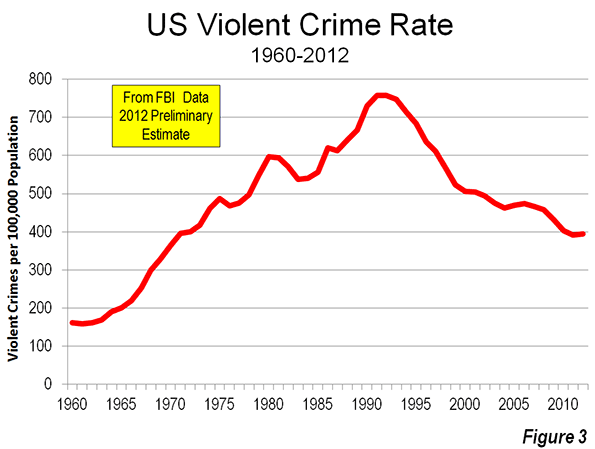
So what does the data tell us? Crime started spiking up about 10 years before the drug war even started. The big jump in drug war spending in the 1980's happened after two decades of rising crime, when crime rates were already near their peak. So if anything, the federal drug war (or peoples' appetite to wage it) seems to be a reaction to rising crime, rather than a cause.
Now, you could also say rising crime was the result of prohibition itself, not just the drug war per se. But narcotics began to be heavily regulated and effectively banned in 1915: http://www.druglibrary.org/schaffer/library/studies/cu/cu8.h....
Now, compare crime rate to incarceration rate and the timeline of the drug war: https://upload.wikimedia.org/wikipedia/commons/4/48/U.S._inc.... The incarceration rate is basically flat until 1975. By that time violent crime had increased by over 2.5x. The mind-blowing thing is that our incarceration rate doesn't catch up to our crime rate until after 1995! I.e. even though our incarceration rate quadruples from 1950 to 1995, in that time violent crime more than quadruples.
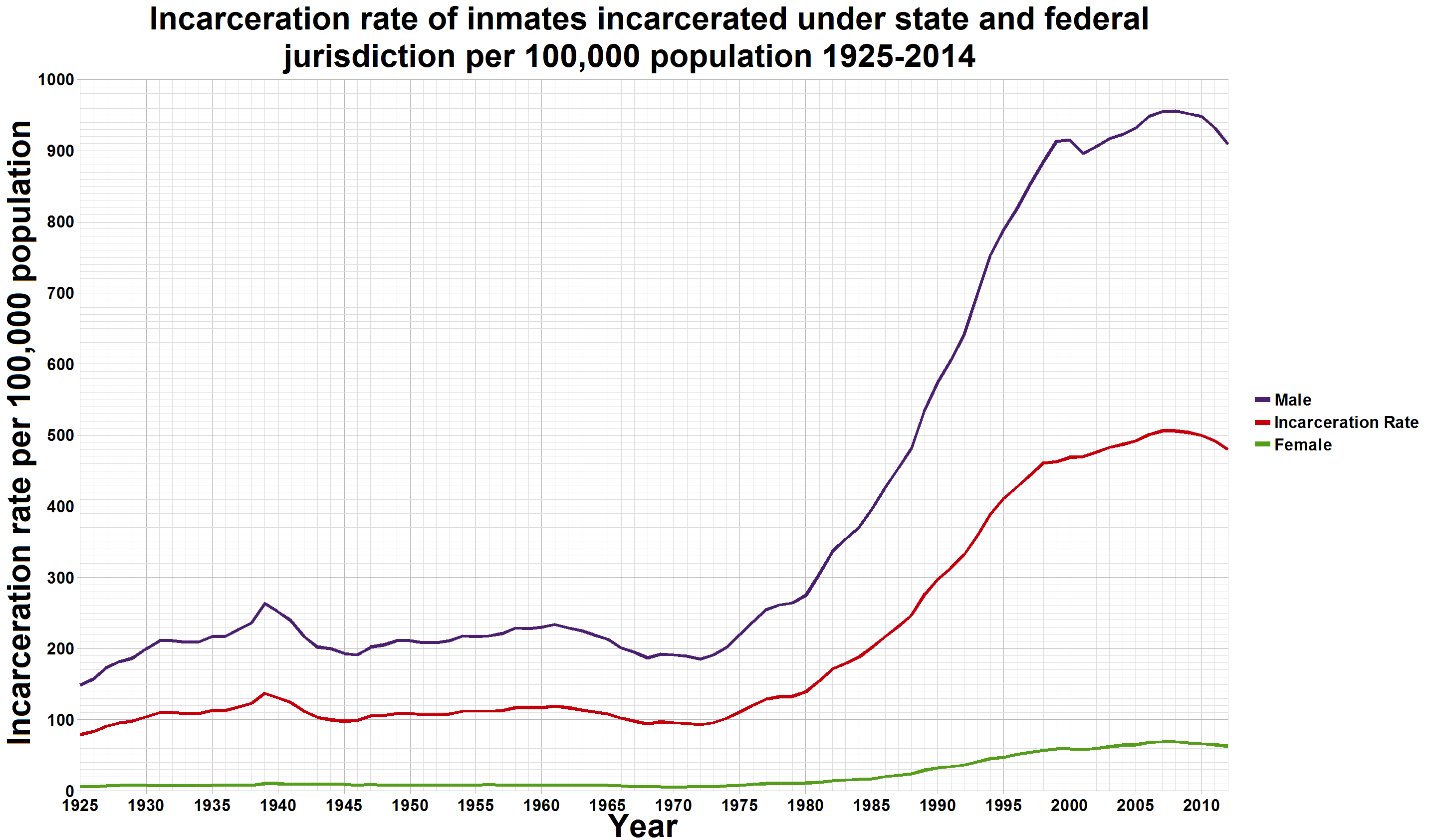
It's only after the big drop in crime in the late 1990's that our incarceration rate started to become disproportionate to our violent crime rate.
But according to John Pfaff, a professor at Fordham Law School, neither of those efforts will make a significant dent in the problem, because they are based on a false understanding of why the prison boom happened in the first place.
"The reason it’s important to get it right is that if we’re trying to reduce the prison population, we want to make sure we do it correctly—and if you focus on the wrong thing, you won’t solve the problem. So if you think it’s the war on drugs, you might think, ‘OK, if we just decriminalize drugs, that will solve the problem.’ And, you know, it’s true that if we shift away from punishment to treatment that could be a huge improvement. But just letting people out of prison—decarcerating drug offenders—will not reduce the prison population by as much as people think. If you released every person in prison on a drug charge today, our state prison population would drop from about 1.5 million to 1.2 million. So we’d still be the world’s largest incarcerating country; we’d still have an enormous prison population.
And if we focused on cutting back sentence lengths, maybe that would weaken DAs’ bargaining power at plea bargaining, but since people aren’t serving the massively long sentences anyway, it probably won’t have that big an effect on prison population either."
This is a weird argument, because reducing the prison population by 17% is a significant dent ..
I don't understand the logic. It does not follow from "ending the drug war won't solve our prison problem" that "we should maintain the drug war".
There is virtually no vocal user of HN that supports the drug war. In every thread about drugs on HN, you can safely assume the entire community agrees that the "War on Drugs" is toxic.
I would worry that trying to solve the whole issue at once, like the professor seems to suggest, would be a non-starter politically.
I ain't saying you're wrong because I don't have the figures to rebut that. I'm not even saying that the WoD is the major cause of violent crime, definitively, because I don't have those figures either.
Literally all I'm trying to say is that the analysis in the article seems short-sighted and incomplete because it only takes into account convictions directly for drug offences.
Hmmm. This is unsatisfying. How many are there for crimes that were committed to feed drug habits? How many for crimes related to but not directly involving drugs (turf wars, drug-money related offences etc)?
Sure, these are crimes and we should definitely still bring people committing these to justice, but I wonder how many just would not have happened without the WoD?
Clearly it's not the whole picture, but it might be a little more complex than the article makes out.