News for hackers. Stuff that matters.
Re:How Growers Gamed California’s Drought by raldi on Tuesday March 31, 2015 @08:05PM (#9300729)
It takes a gallon of water to grow an almond. So eating a single almond, grown in California, is like opening one of these (https://hornstrafarms.com/product_images/large/monadnock_gal...) and pouring it down the drain.

California grows 99% of the almonds in the United States, and 80% of all the almonds in the world.

This is only financially possible because we give almond farmers (and agriculture in general) gigantic subsidies on their water bills.

Sources:

http://www.motherjones.com/environment/2014/02/wheres-califo...

http://www.thewire.com/national/2014/07/almonds-are-sucking-...

Re:How Growers Gamed California’s Drought by WalterSear on Tuesday March 31, 2015 @08:42PM (#9300869)
Almonds are a drop in the bucket, compared to the sacred cow(s) that is meat.

It's just a tad bit more than NPR's 'trying to lose weight by cutting your fingernails'.

http://www.huffingtonpost.com/adam-j-rose/how-to-take-long-s...

http://www.onegreenplanet.org/news/californias-drought-whos-...

http://darwin.bio.uci.edu/sustain/global/sensem/MeatIndustry...

Re:How Growers Gamed California’s Drought by raldi on Tuesday March 31, 2015 @09:00PM (#9300929)
You're absolutely right. A quarter-pound hamburger costs 1,300 gallons of water, according to the WSJ: http://www.wsj.com/articles/SB120001666638282817

The organization that represents California cattle ranchers begged to differ, contesting that it's only 110 gallons: http://blog.calbeef.org/how-eco-friendly-is-beef-infographic...

Even using the latter number, just think about that. Eating one hamburger is like dumping 110 one-gallon jugs of water down the drain -- or leaving your kitchen faucet running full blast for over an hour with the current 1.8gpm flow restrictor mandated by code. Or flushing your code-mandated low-flow toilet 89 times.

And if you're talking about a 1-pound steak, multiply all those numbers by 4.

Am I saying you shouldn't eat beef? Of course not -- it's delicious! But California's beef producers should have to pay market rate for their water. If that means the price shoots up and I have to start eating hamburgers made from Texas cattle, so be it.

Re:How Growers Gamed California’s Drought by bryanlarsen on Tuesday March 31, 2015 @09:59PM (#9301102)
Those kind of statements imply that cattle destroy that water. The water is returned to the environment a few hours after it's ingested. It's usually just part of the natural cycle.

I know you understand this: you talk about eating Texas cattle instead of California cattle, but I wanted to emphasize it for others.

Vast numbers of cattle are raised in semi-desert conditions in Texas and Montana without the use of irrigated feedstock. Those cattle occupy the same ecological niche as the bison did 150 years ago, with a similar environmental impact. Tearing up the native prairie to grow any sort of grain or vegetable crop would destroy the land.

Re:How Growers Gamed California’s Drought by avn2109 on Wednesday April 01, 2015 @12:11AM (#9301526)
>> "...cattle occupy the same ecological niche as the bison did 150 years ago, with a similar environmental impact..."

Montana boy here. Even if I concede for purposes of argument that cattle and bison are ecologically interchangeable ungulates (debateable at best), surely we can all agree that it is not the cattle but rather the cattlemen primarily responsible for reshaping the natural environment in the American West, by bulldozing stock ponds, stringing barbed wire over the range, drilling wells, poisoning coyotes, supplanting native grasses with snakeweed and cheatgrass, and most importantly by enforcing a monoculture of cattle. Nature abhors a monoculture almost as much as it abhors a vacuum, and you would never find a bison-era Western landscape with only a single species of charismatic megafauna.

Nobody objects to a smallholder's spread of a dozen head of angus, but when millions of acres are given over to beef production alone, it's broadly disingenuous to claim that the environmental impact of cattle is isomorphic to that of bison on a systems level.

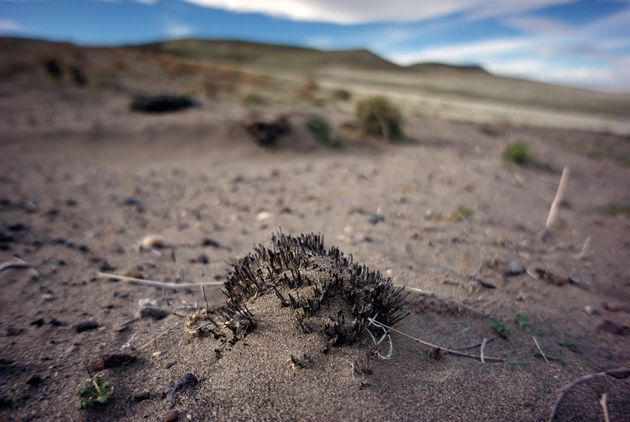
Cattle country today looks like this [0] and this [1], for miles and miles and miles.

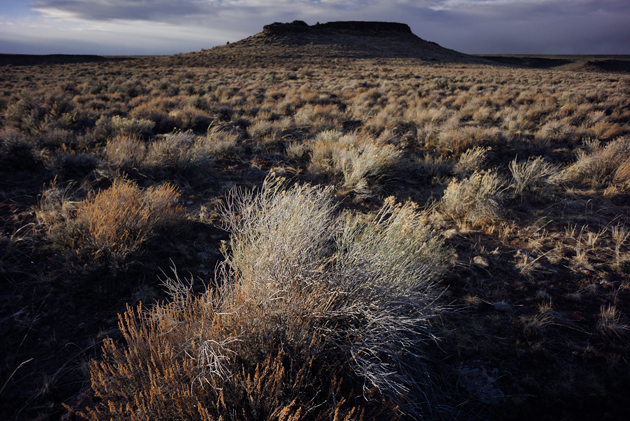
Bison country looked like this [2].

It's hard to see how those landscapes are even approximately interchangeable.

[0] http://harpers.org/wp-content/uploads/2015/02/HA027__1MHK0-1...
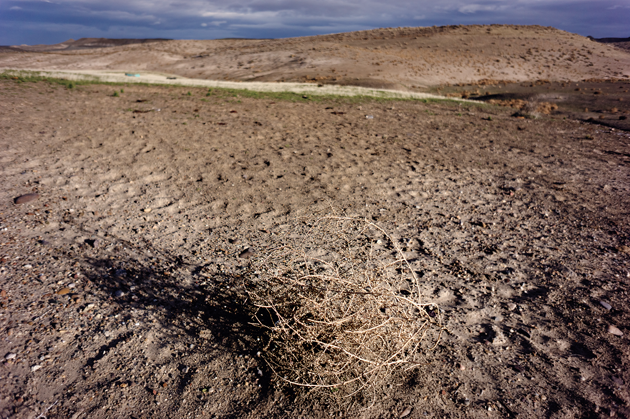
[1] http://harpers.org/wp-content/uploads/2015/02/HA030__1MHK0-1...
[2] http://harpers.org/wp-content/uploads/2015/02/HA031__1MHK0-2...
NB. All these pictures are taken from an excellent and rather relevant piece of journalism that ran in Harpers here (paywall): http://harpers.org/archive/2015/02/the-great-republican-land...

And I stole my list of rancher's sins from Ed Abbey.

Re:How Growers Gamed California’s Drought by thrownaway2424 on Wednesday April 01, 2015 @12:32AM (#9301623)
History repeating. Here's Harpers from 1947 on the exact same topic: http://home.comcast.net/~mdevoto/AGAINST.htm
Re:How Growers Gamed California’s Drought by bryanlarsen on Wednesday April 01, 2015 @02:26AM (#9301933)
Yes, you're right. But imagine if wheat was grown for the last 120 years rather than grazing cattle. Compared to that, cattle and cattlemen are fairly benign.
Re:How Growers Gamed California’s Drought by specialist on Tuesday March 31, 2015 @11:22PM (#9301335)
Right. And $1,000 spent on bullets has the same ROI as building schools.

"Those cattle occupy the same ecological niche as the bison did 150 years ago, with a similar environmental impact. Tearing up the native prairie to grow any sort of grain or vegetable crop would destroy the land."

No. Bison bite off the grass, leaving the roots. Unlike cattle. Some argue that bison were an important part of the ecosystem.

http://www.nature.org/ourinitiatives/regions/northamerica/un...

Re:How Growers Gamed California’s Drought by fizgig on Wednesday April 01, 2015 @08:16AM (#9302997)
There's been modern experimentation with "intensive grazing" to emulate what the early bison herds did to grasslands. Densely packed cattle are moved using temporary electric fence over smaller areas of pasture for shorter amounts of time. The end result is quality feed for the cows, the manure gets trampled into fields, helping water retention and fertility, and the cows are moved along before they completely destroy the area.

Joel Salatin, of Polyface Farms here in Virginia, uses this practice to good success.

I don't know if such practices can sustain the volumes of cheap beef production we enjoy now, but if we properly managed large grazing areas this way, we could utilize land/water/feed much more efficiently than we do now.

Re:How Growers Gamed California’s Drought by IndianAstronaut on Wednesday April 01, 2015 @01:47AM (#9301835)
The taste of ground bison isn't too bad. Not very gamey. Strips and steaks though are a different story.
Re:How Growers Gamed California’s Drought by raldi on Tuesday March 31, 2015 @10:04PM (#9301118)
> The water is returned to the environment a few hours after it's ingested.

Just like the water that comes out of my showerhead or toilet, but the state still places big restrictions on each of those.

Re:How Growers Gamed California’s Drought by thaumaturgy on Tuesday March 31, 2015 @10:25PM (#9301169)
I'd argue in your favor that the water coming out of your showerhead or toilet gets used a lot more efficiently than the water going into cattle. In the case of residential water, most of it pretty efficiently goes to treatment facilities which then reuse it again for municipal landscape watering or non-potable purposes.

In the cattle case, most of it goes to the superficial surface of the ground, and since so much of the beef and cattle operations in California don't have the luxury of grass or anything green on the ground, it just evaporates away.

Re:How Growers Gamed California’s Drought by bryanlarsen on Tuesday March 31, 2015 @10:23PM (#9301165)
The difference is that animals drinking water is part of the natural cycle, showers are not. There's essentially no difference between the water usage of cattle on unirrigated native prairie and the water usage of the bison that preceded them.

Of course, cattle in California isn't raised on unirrigated native prairie, like they are in Texas or Montana.

Re:How Growers Gamed California’s Drought by thrownaway2424 on Tuesday March 31, 2015 @11:34PM (#9301368)
Lots of cattle are raised on grasslands in California, but not in the San Joaquin Valley, because that would be a waste of prime land. You can find grazing lands in Marin, Sonoma, San Benito, and other hilly counties.
Re:How Growers Gamed California’s Drought by jtmcmc on Thursday April 02, 2015 @01:50AM (#9308888)
The water used is largely due to the amount of water used to grow the feedstock of the cattle. This is not returned shortly after it's ingested.
Re:How Growers Gamed California’s Drought by WalterSear on Tuesday March 31, 2015 @09:06PM (#9300942)
>Am I saying you shouldn't eat beef? Of course not -- it's delicious!

IMVHO, there are much better reasons to drop meat + dairy from your diet than water. Human taste is a malleable thing - after a while, other things start to taste much more delicious.

Re:How Growers Gamed California’s Drought by raldi on Tuesday March 31, 2015 @09:09PM (#9300952)
Fair point! But the last time I mentioned these stats, I was accused of pushing a militant vegan agenda, so this time I wanted to be sure to establish my meat cred.
Re:How Growers Gamed California’s Drought by SEJeff on Tuesday March 31, 2015 @11:42PM (#9301402)
And while totally respecting your POV please understand that some of us think things like Beef, Pork/Bacon, and Fisha re absolutely delicious.

We can agree to disagree and still be friends, or at least civil adults :)

Re:How Growers Gamed California’s Drought by mod on Wednesday April 01, 2015 @03:31AM (#9302146)
He literally said "it's delicious" in the post they're referencing.

You can agree to agree, I guess.

Re:How Growers Gamed California’s Drought by CalRobert on Wednesday April 01, 2015 @06:29AM (#9302687)
You're not even disagreeing, though. The point is that things can be delicious but still merit restraint in their consumption.
Re:How Growers Gamed California’s Drought by raldi on Wednesday April 01, 2015 @09:14AM (#9303241)
I'm not even arguing for restrained consumption! I just think we should charge California producers of these foods market rate for the water they require, even if that means they can't be profitably produced in California anymore, and we have to import them from places that aren't going through a drought.
Re:How Growers Gamed California’s Drought by maxerickson on Wednesday April 01, 2015 @09:33AM (#9303361)
What does 'the market rate' mean for all the infrastructure (I guess most of the agriculturally interesting surface water has been diverted under existing regulation)?

I don't mean that in a snide way, I just wonder what exactly you mean. Like, would it be okay under this market system for someone to purchase a large amount of the land where the water originates and construct a huge dam+reservoir? Would adjacent property owners have to go to court to redo the resolution of their competing interest in water that happens to flow across the properties?

Re:How Growers Gamed California’s Drought by hurin on Tuesday March 31, 2015 @11:48PM (#9301428)
A lot of land which is suited for cattle herding is not as a matter of fact suited for vegetable or grain production - the idea that vegetarianism is more ecologically sound is somewhat mythical.
Re:How Growers Gamed California’s Drought by ssmoot on Wednesday April 01, 2015 @10:27AM (#9303802)
I'm not at all in favor of dropping meat.

But unless I'm mistaken I think you're implying that by removing beef production, you'd have to substitute it with additional vegetable or grain production.

Where I think the pro-vegetarian argument would actually be that by decreasing meat production, you actually recover more vegetable/grain farm capacity since it's much more efficient for people to eat their veggies directly.

Just like it would be much more efficient to eat the 10lbs of sardines it takes to grow 1lb of salmon. (NB. I didn't look that up, but I think it's in the ball-park.)

Re:How Growers Gamed California’s Drought by hurin on Wednesday April 01, 2015 @11:09PM (#9308448)
It's an interesting topic.

>But unless I'm mistaken I think you're implying that by removing beef production, you'd have to substitute it with additional vegetable or grain production.

There are a lot of non-simple factors involved for example dairy and meat account for a majority of most people's protein intake, this would mean substitution for increased protein nutrition from plants (limited mostly to soybeans).

>Where I think the pro-vegetarian argument would actually be that by decreasing meat production, you actually recover more vegetable/grain farm capacity since it's much more efficient for people to eat their veggies directly.

This statement is mostly true for using vegetable/grain production land whose produce is used for cattle feed-lots right? What about cattle that get the larger % of their food from grazing?

Also there is a significant difference between human quality/desired food and animal feed. For example a lot more corn is used in animal feed than in human consumption - this is especially effective because maize is a c4 plant and until genetics gets there will continue to completely dominate other cultivatable plants in terms of yield.

p.s. I'm not saying that meat production in the US is ecologically friendly - it definitely is not - feedlot greenhouse gas production is almost entirely unregulated, they cause massive damage to local watersheds etc - but it's possible to do terrible damage to the environment with vegetable growth as well; I'm just arguing for a more or less objective view of the situation (and I don't think meat is evil is the correct answer).

Re:How Growers Gamed California’s Drought by CalRobert on Wednesday April 01, 2015 @08:27AM (#9303047)
Surely you know a claim like that should include some citation.
Re:How Growers Gamed California’s Drought by hurin on Wednesday April 01, 2015 @11:20PM (#9308475)
There was a good article I read awhile back (which was more global rather than limited to a specific nation) but I can't seem to find it now - nevertheless for example (random google search, an article about Mongolia (source: USDA; ref: http://bit.ly/1MD20ZN):

About 80 percent of agricultural production is animal-based while the remaining 20 percent mostly comes from field crops, mostly wheat. Only about 1 percent (1.35 million hectares) of total land is suitable for crops

Re:How Growers Gamed California’s Drought by guelo on Wednesday April 01, 2015 @01:08AM (#9301742)
Without knowing anything about this topic, calories produced per gallons of water used seems like the right metric. Some quick googling I got this math.

1 almond = 7 calories, 7 cals / 1 gallon = 7 cals/gal

1 lb beef = 213 calories, 213 cals / (110 to 1300) gallons = 2 to .16 cals/gal.

So there you go.

Re:How Growers Gamed California’s Drought by mod on Wednesday April 01, 2015 @03:30AM (#9302140)
Beef isn't all the same. You took the stock "1 lb beef calories" google result, which is reasonable, until you check say 70/30 instead of 85/15.

It shoots up to 1500 calories.

The almonds and any measure of beef probably results in a huge waste compared to some other methods of "growing" calories. I don't see them going away, though.

Re:How Growers Gamed California’s Drought by natejenkins on Wednesday April 01, 2015 @08:21AM (#9303019)
I wish 1 pound of beef was only 213 calories. I think you took Google's first result (https://www.google.com/search?q=1+lb+beef+calories) which is actually for 3 ounces (85 grams). You need to multiply that by 16/3 (there are 16 ounces in a pound) which gives 1136 calories/lb.
Re:How Growers Gamed California’s Drought by guelo on Wednesday April 01, 2015 @01:57PM (#9305498)
Oh cool. So using 1136 calories and the lower end of 110 gallons it comes to about 10 cals/gal which beats almonds!
Re:How Growers Gamed California’s Drought by throwthrow1 on Wednesday April 01, 2015 @01:31AM (#9301808)
> You're absolutely right. A quarter-pound hamburger costs 1,300 gallons of water, according to the WSJ: http://www.wsj.com/articles/SB120001666638282817

1,300 gallons is nothing! Think about how much water it takes for one fish.

[deleted]
Re:How Growers Gamed California’s Drought by raldi on Wednesday April 01, 2015 @10:31AM (#9303843)
I already addressed this here:

https://news.ycombinator.com/item?id=9301118

Re:How Growers Gamed California’s Drought by chc on Tuesday March 31, 2015 @09:00PM (#9300928)
I think you're exaggerating a little bit, but meat is a huge culprit that people don't talk about much. The meat and dairy industries make up 47% of California's water usage, while other agriculture uses 46%. A large part of the reason is that there is enormous energy loss in the growing-an-animal part of the food chain — every serving of an animal product comes from many servings of plant products given to the animal.

Source: http://www.waterfootprint.org/Reports/Fulton%20et%20al%20201...

Re:How Growers Gamed California’s Drought by WillPostForFood on Wednesday April 01, 2015 @02:58AM (#9302040)
It doesn't make up 47% of total water usage, it takes up 47% of water used in the production of goods and services. The definition of water footprint from your link:

The water footprint concept has been developed to estimate the amount of water consumed in the production of goods and services.

Re:How Growers Gamed California’s Drought by sbov on Tuesday March 31, 2015 @09:53PM (#9301087)
I wouldn't say drop in the bucket. Doing the math, from what I can piece together: 23 almonds in an ounce, 16 ounces in a pound, 1.1 gallons per almond.

23 * 16 * 1.1 = 404 gallons per pound of almonds. It certainly doesn't rise to the level of meat, but it's still a lot. Almonds alone also supposedly account for 10% of all of California's water use.

Re:How Growers Gamed California’s Drought by briantakita on Tuesday March 31, 2015 @09:39PM (#9301049)
We also centralize our agriculture & ship the product all over the world. The consequences are greater energy usage to transport the product, more fragile food economies, income inequality, water hoarding, biodiversity loss, pollution, desertification, decreased rainfall, soil erosion & degregulation, increased wear on roads, a consumerist mindset that is abstracted away from the environment.

Humanity is crazy. Simple as that.

We need to start thinking systemically; not react with myopic & reductionistic policies. Systemic solutions will solve our issues. Reductionistic policies will perpetuate this game.

Capital tends to pool together. These farms that are using up all of the water are capital intensive. In the mean time, large companies like Nestle are buying reservoirs in an effort to privatize the remaining water. The water supply is being diminished while the remaining water is being bought. One can infer that there are efforts to manipulate water supply to turn water into a commodity market that large corporations control. Intentional or not, that is what is going on right now.

Re:How Growers Gamed California’s Drought by dreamweapon on Wednesday April 01, 2015 @10:48AM (#9304006)
So eating a single almond, grown in California, is like opening one of these (https://hornstrafarms.com/product_images/large/monadnock_gal...) and pouring it down the drain.

It's highly misleading to suggest that the net impact of cycling a gallon of agricultural water (including irrigation + rainfall) is equal to that of a dumping a gallon of drinking water (packaged and delivered to your door, no less!) down the drain, of course.

Also, while the water footprint of almonds (and pistachios, cashews, etc) isn't great, if you aren't comparing it to that of other high-impact foods (in terms of water use by weight of end product) like say, dried tomatoes, butter, or most four-legged meat products -- not only per gram of end product, but per recommended serving (which for nut products is comparatively modest) -- then you're not only not helping us understand how we got into this mess (and how to get out); you're just pushing people's buttons, basically.

Re:How Growers Gamed California’s Drought by raldi on Wednesday April 01, 2015 @11:18AM (#9304282)
I didn't mean to single out almonds -- as you say, virtually all of California's agriculture is water-guzzling, and only sustainable because farms with seniority get substantial use-it-or-lose-it discounts on their water bills.

We need to end this across the board. If you can't produce something in the valley while paying a fair price for water, you shouldn't be producing it in the valley. Make something else, make it somewhere that's not drought-prone, or raise your prices to account for the water that goes into producing the product.

Re:How Growers Gamed California’s Drought by dreamweapon on Wednesday April 01, 2015 @12:06PM (#9304642)
I totally agree about making price levels reflect true resource costs, ending bad incentivization systems, etc. (Meant to edit my first post to mention that, but got distracted).
Re:How Growers Gamed California’s Drought by tzs on Tuesday March 31, 2015 @09:04PM (#9300937)
One gallon of water weighs 8.34 pounds (3.78 kg).

The average almond weighs under 2 g.

It follows that less than 0.05% of that water ends up in the final almond.

So...where does the remaining 99.95% of the gallon actually end up?

Re:How Growers Gamed California’s Drought by jonknee on Tuesday March 31, 2015 @09:34PM (#9301035)
Most of it evaporates. Either before it is absorbed into the tree or afterwards through transpiration.
Re:How Growers Gamed California’s Drought by crimsonalucard on Wednesday April 01, 2015 @01:24AM (#9301786)
I doubt that. A lot of it sinks into the ground... plants don't absorb everything.
Re:How Growers Gamed California’s Drought by throw_away on Tuesday March 31, 2015 @11:24PM (#9301340)
The nut is probably drier relative to the rest of the tree (especially compared to the leaves and the flowers) and then we usually roast or smoke & maybe salt them, so I would expect there to be low water content in the final product compared to the totality used in production.
Re:How Growers Gamed California’s Drought by calbear81 on Tuesday March 31, 2015 @09:14PM (#9300966)
That's a great question. I wonder if there's a more efficient way to water the plants that doesn't involve saturating all of the area around the roots just to ensure they can absorb the water?
Re:How Growers Gamed California’s Drought by femto on Tuesday March 31, 2015 @11:59PM (#9301469)
Deep pipe irrigation (if they aren't already using it).

http://permaculturenews.org/2014/04/24/get-started-efficient...

Re:How Growers Gamed California’s Drought by raldi on Tuesday March 31, 2015 @09:11PM (#9300957)
Same place it ends up when you rip out your flow regulator and take a 90-minute shower, or maintain a lush green lawn.
Re:How Growers Gamed California’s Drought by CONTRARlAN on Tuesday March 31, 2015 @09:24PM (#9300992)
So, reclaimed by the city and turned into safe drinking water?
Re:How Growers Gamed California’s Drought by nightski on Tuesday March 31, 2015 @08:59PM (#9300922)
On a per calorie basis that is on par with a tomato in the article you linked. In fact those numbers don't mean very much without context.
Re:How Growers Gamed California’s Drought by imgabe on Tuesday March 31, 2015 @09:08PM (#9300949)
That water doesn't just disappear from the face of the earth. It'll turn back up again.
Re:How Growers Gamed California’s Drought by thaumaturgy on Tuesday March 31, 2015 @10:28PM (#9301177)
C'mon, you're being a little obtuse. You're not dumb, surely you recognize that there is some difference in efficiency of water use? Or that the water doesn't turn up in the places where we need it, or in the volumes we need?
Re:How Growers Gamed California’s Drought by imgabe on Wednesday April 01, 2015 @07:33AM (#9302869)
The comments above imply that the water is no longer available once its "used". That's simply not the case. If you were to pour the water "down the drain" as OP suggested, it goes to a water treatment plant, has impurities removed, and re-enters the groundwater system. So it's not "gone" despite the meaning commonly implied by pouring something down the drain.

Yes, there are differences in using water in one place versus another. I kind of think "growing food" is pretty important use for water though. If OP doesn't want the farmers to use the water for agriculture, then what is it being saved to use it for? Watering golf courses?

Re:How Growers Gamed California’s Drought by thaumaturgy on Wednesday April 01, 2015 @08:33AM (#9303071)
Alright.

There is a small lake. This small lake is used as the freshwater drinking supply for a small town. The people in the small town are happy with the water.

Then someone downstream decides to grow some cows. The cows are thirsty and use a lot of water. The water comes from the lake, but there is enough rain so the people are still happy.

Then the rain stops. The lake shrinks, but the same amount of water continues to go to the cows. The water is poured onto the ground at the cows' feet. It is surely not wasted, because the water is going into the ground, but the people in the small town do not have enough water any more. They are less happy.

raldi's not calling for farmers to stop using water. He's calling for them to make the same reductions in use that everyone else has had to make. And, yeah, the water really is no longer available once it's used; Lake Oroville is not exactly the voluminous body of water it once was.

There's not really anything terribly controversial here.

Re:How Growers Gamed California’s Drought by kaitai on Wednesday April 01, 2015 @10:57AM (#9304112)
Wasn't sure which reply to reply to, so I'll reply one level up. Everyone's more or less right about the conservation of matter argument here, but everyone commenting is missing the aquifers and they're the key. Aquifer water is pure and clean, lovely and ancient. It's trickled down into its cracks between rocks over thousands and millions of years.

When California growers tap into aquifers to grow their almond-beef-whatever, they're not using a renewable resource. They're using a very finite resource. The aquifers in CA are in real danger of tapping out. Why do we care?

1) it takes a huge amount of infrastructure to move around surface water

2) it takes a huge amount of infrastructure to clean surface water, whether we're just taking out the antibiotic residue and dirt and THC or desalinating

3) the cost of this transportation and purification infrastructure will dramatically impact where people can live and grow their food.

Moreover, aquifer depletion has some funky effects. Sinkholes in Florida that swallow houses come from aquifer depletion -- the ground there is riddled with holes that really need to full of water if you want to support weight [1]. Some lakes start draining if they're (somewhat unusually) geologically linked to a declining aquifer, like White Bear Lake in Minnesota [2]. Part of the culprit in MN is that people can drill wells and use up to 10,000 gallons per day without a permit. Switching to surface water is an option in the Midwest, and the municipalities mentioned in MN are thinking about switching to Mississippi river water. But in central California, what surface water are you going to use?

Last, for the self-interested, aquifer water often makes the best beers :)

[1] http://www.livescience.com/27659-florida-sinkhole.html [2] http://www.minnpost.com/cityscape/2012/11/why-white-bear-lak...

Re:How Growers Gamed California’s Drought by imgabe on Wednesday April 01, 2015 @11:57AM (#9304559)
Thank you for actually explaining the issue instead of hysterically screaming nonsense that defies the laws of physics.
Re:How Growers Gamed California’s Drought by raldi on Tuesday March 31, 2015 @09:13PM (#9300962)
By that logic, let's all turn on every tap in the house. Drought averted!
Re:How Growers Gamed California’s Drought by Potando on Wednesday April 01, 2015 @12:54AM (#9301705)
Actually, yes. Any water shortage in a developed area with cheap water isn't actually a water shortage, it's a mismanagement or incorrect pricing. California can simply produce more water if they really need it, which they would if everyone was leaving their taps on.

We're fooled into believing water shortages are environmental problems we need to make sacrafices to prevent. But just paying more for more expensive, higher volume production or recylcing would work too. Eg Isreal.

Re:How Growers Gamed California’s Drought by bryanlarsen on Tuesday March 31, 2015 @10:04PM (#9301117)
During the last drought, my city (Ottawa, Canada) took out radio advertisements exhorting people to water their lawns. The dry lawns were creating a fire hazard. We've got lots of water around here, and as noted, using it just puts it back into the environment in a different place.
Re:How Growers Gamed California’s Drought by ghettoCoder on Wednesday April 01, 2015 @09:28AM (#9303329)
What drought would that be? Lived in Ottawa for over a decade and only remember a few summers of "crispy" grass and a few wildfires due to lower than average rainfall.

But you are correct that they we're asking people to water their lawns once and a while. The difference here is that Ottawa gets its water from the Ottawa river which is a main tributary of the St-Laurent and is itself fed by a massive watershed starting about 7 hours north (funny thing, as you drive up highway 11 you will pass a sign that say "Now entering Arctic watershed").

Re:How Growers Gamed California’s Drought by raldi on Tuesday March 31, 2015 @10:20PM (#9301154)
Great, so can we repeal the laws that restrict what plumbing fixtures I can have in my house?
Re:How Growers Gamed California’s Drought by bryanlarsen on Tuesday March 31, 2015 @10:26PM (#9301173)
Water used on your lawn is returned through the grey-water system. Toilet water has to be treated.

Not to mention the fact that you don't live in one of the few places with abundant fresh water, even during a drought.

Re:How Growers Gamed California’s Drought by mc32 on Wednesday April 01, 2015 @02:09AM (#9301888)
People should sure stop eating rice, then. Rice is very water intensive, and nutritionally most rice consumed is quite underwhelming.
Re:How Growers Gamed California’s Drought by mbreese on Wednesday April 01, 2015 @02:12AM (#9301902)
Or maybe just eat rice grown in areas with lots of water.