Montana boy here. Even if I concede for purposes of argument that cattle and bison are ecologically interchangeable ungulates (debateable at best), surely we can all agree that it is not the cattle but rather the cattlemen primarily responsible for reshaping the natural environment in the American West, by bulldozing stock ponds, stringing barbed wire over the range, drilling wells, poisoning coyotes, supplanting native grasses with snakeweed and cheatgrass, and most importantly by enforcing a monoculture of cattle. Nature abhors a monoculture almost as much as it abhors a vacuum, and you would never find a bison-era Western landscape with only a single species of charismatic megafauna.
Nobody objects to a smallholder's spread of a dozen head of angus, but when millions of acres are given over to beef production alone, it's broadly disingenuous to claim that the environmental impact of cattle is isomorphic to that of bison on a systems level.
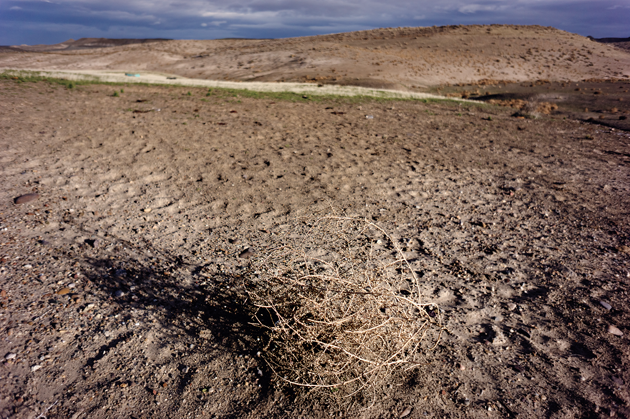
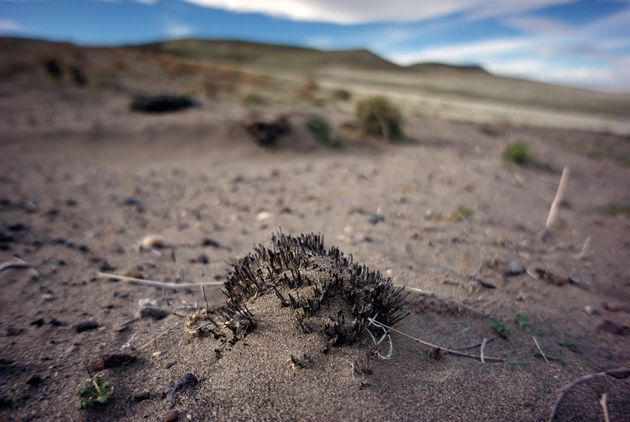
Cattle country today looks like this [0] and this [1], for miles and miles and miles.
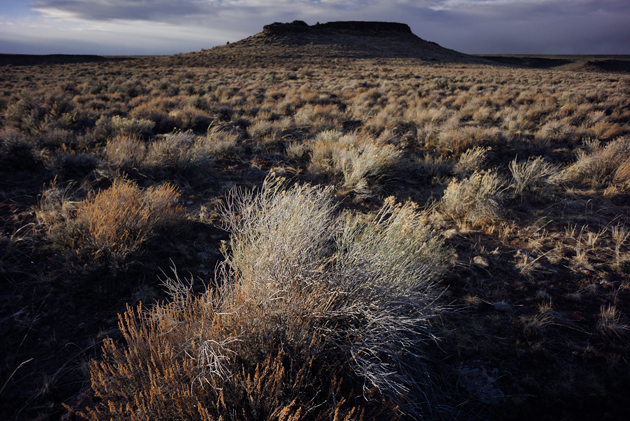
Bison country looked like this [2].
It's hard to see how those landscapes are even approximately interchangeable.
[0] http://harpers.org/wp-content/uploads/2015/02/HA027__1MHK0-1...
[1] http://harpers.org/wp-content/uploads/2015/02/HA030__1MHK0-1...
[2] http://harpers.org/wp-content/uploads/2015/02/HA031__1MHK0-2...
NB. All these pictures are taken from an excellent and rather relevant piece of journalism that ran in Harpers here (paywall): http://harpers.org/archive/2015/02/the-great-republican-land...
And I stole my list of rancher's sins from Ed Abbey.
"Those cattle occupy the same ecological niche as the bison did 150 years ago, with a similar environmental impact. Tearing up the native prairie to grow any sort of grain or vegetable crop would destroy the land."
No. Bison bite off the grass, leaving the roots. Unlike cattle. Some argue that bison were an important part of the ecosystem.
http://www.nature.org/ourinitiatives/regions/northamerica/un...
Joel Salatin, of Polyface Farms here in Virginia, uses this practice to good success.
I don't know if such practices can sustain the volumes of cheap beef production we enjoy now, but if we properly managed large grazing areas this way, we could utilize land/water/feed much more efficiently than we do now.
Just like the water that comes out of my showerhead or toilet, but the state still places big restrictions on each of those.
In the cattle case, most of it goes to the superficial surface of the ground, and since so much of the beef and cattle operations in California don't have the luxury of grass or anything green on the ground, it just evaporates away.
Of course, cattle in California isn't raised on unirrigated native prairie, like they are in Texas or Montana.
I know you understand this: you talk about eating Texas cattle instead of California cattle, but I wanted to emphasize it for others.
Vast numbers of cattle are raised in semi-desert conditions in Texas and Montana without the use of irrigated feedstock. Those cattle occupy the same ecological niche as the bison did 150 years ago, with a similar environmental impact. Tearing up the native prairie to grow any sort of grain or vegetable crop would destroy the land.