The first change was the addition of dedicated bus lanes (right-most lane, painted reddish), complete with violation cameras and automated ticketing. This reduced competition among buses and cars -- in favor of buses, leading to somewhat better bus throughput. Cars now had five lanes -- although with parking in at least the left-most lane, and delivery trucks double-parked adjacent to the cars, more like three.
Then came the big bike lane initiative. In the book Traffic, by Tom Vanderbilt, some of the takeaways are that parked cars can form a buffer between flowing traffic and bike lanes, and that narrowing roads at intersections through the addition of islands with trees on them increases pedestrian safety (in no small part by reducing the speed of turning cars at intersections). To varying degrees they've applied these ideas -- the left-most lane is now entirely a bike lane (painted green, complete with its own traffic signals). Next to that is a dedicated parking lane -- yes, in lane two -- often buffered by concrete islands at intersections, with a tree or two. You can see this here [1]
Cars now have three or perhaps four lanes for general travel. For left turns, the bike and parking lanes are cut by a dedicated left-turn waiting lane [2] (usually with its own left turn signal, so left turners are not fighting pedestrians in the crosswalk).
On some avenues they then added "Select Buses", which work on a "trust-but-verify" honor system so riders can enter and exit quickly through any of three wide doors without queueing to dip a Metrocard.
Finally, they cut the city-wide speed limit to 25 miles per hour, adjusting the timing of avenue traffic signals accordingly.
The result of all this has been much gnashing of teeth and rending of garments, but as a whole it's made the city substantially better for bikers and pedestrians, and in many cases left turns are much easier for drivers.
[1] https://www.google.com/maps/@40.771088,-73.9538,3a,75y,53.97...
[2] https://www.google.com/maps/@40.771088,-73.9538,3a,65.7y,194...
[Edit: clarity]
https://www.google.com/maps/@38.9770719,-77.3149885,438m/dat...
But it doesn't look comical, because the roads are proportionately much more slender and the transitions more gradual.
I haven't played the game, but it sounds like it ended up being accurate here!
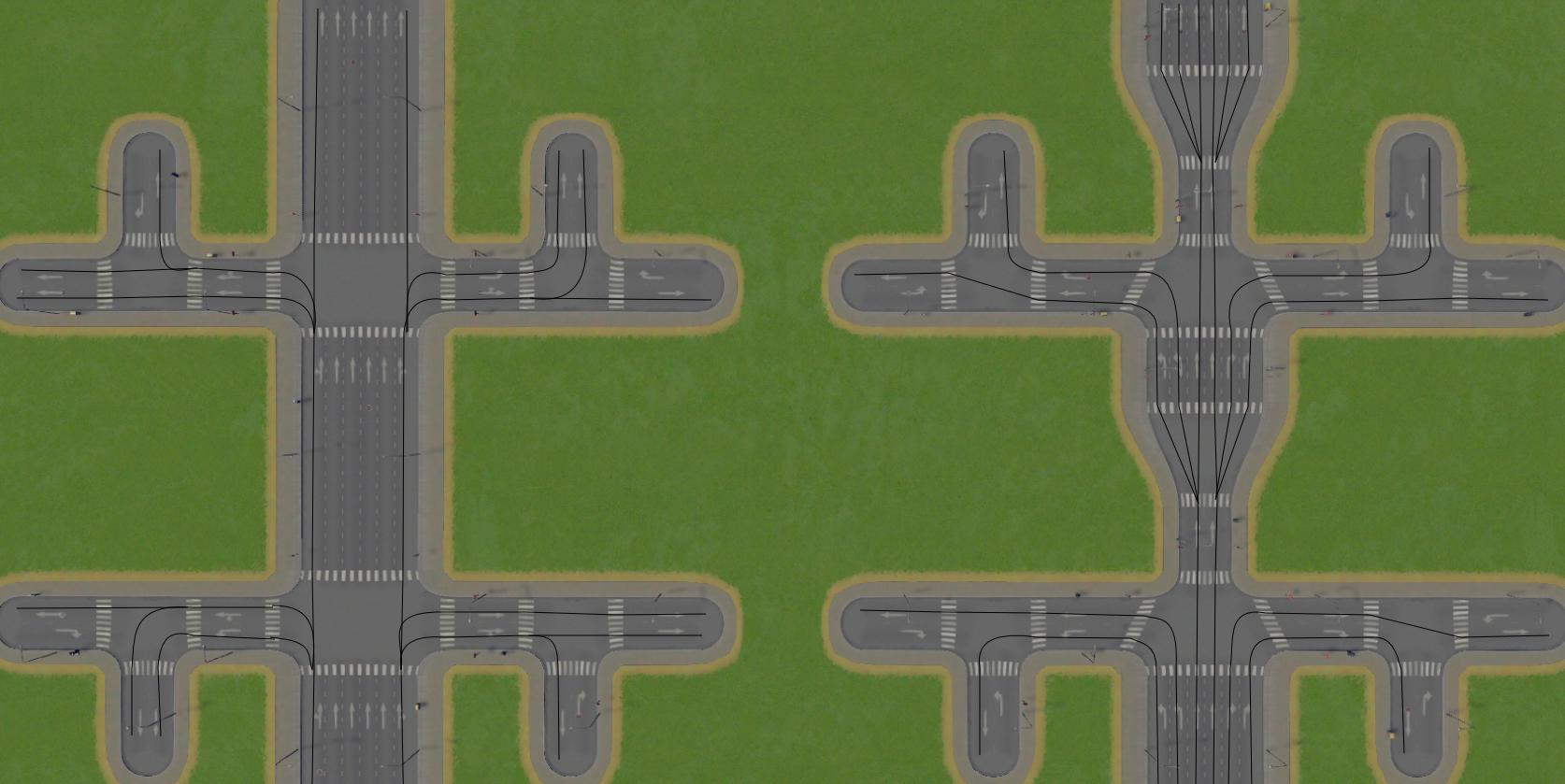
Not that any of these things are completely unrealistic but it is occasionally annoying when your traffic is backed up solely because they're ignoring the adjacent lane.
However, I have no faith that the game itself will ever be finished. It's the epitome of "perfect is the enemy of good", they spend so much time getting little things absolutely perfect. At least it makes for an interesting blog.
All games have failings, how many failings, and the degree people are willing to forgive them is the thing that changes.
I think after the anger of simcity 5, people are willing to forgive a lot of foibles, and despite that, Skylines doesn't seem to have many, it's pretty solid.
http://www.reddit.com/r/CitiesSkylines/comments/2zfx70/if_yo...
Sounds like a good reflection of reality.
It's not selfish to use the road to its full potential. We should all be merging at the last moment, and using zipper merging to allow smooth traffic flow.
Merge at the last moment when your lane ends. Do not merge at the last moment when you need to get into a turn lane. These are different scenarios.
I wonder how regular GPS use has changed real-world traffic patterns?
(Spring break week traffic has been awesome. Next week: Back to 40 minute commutes.)
They later updated the algorithm, apparently, to do path cost routing, making it far more preferable to take avenues over dirt roads, but until then the only way your city could work at all was to create it entirely out of cul-de-sacs.
There was also an issue with the train service, where, when a commuter train came to an intersection, it would randomly choose which direction to take. This meant that if you had a grid of avenues, some of your sims would be waiting for hours for a train, because the train is bouncing randomly around your downtown instead of dropping anyone off.
Moving to a system where there were literally no intersections at all for your trains was the only way to make your mass transit system a benefit and not a liability.
So even if you had a single long train track with no intersections, but multiple train stations, some train stations would receive more traffic than others.
It was incredibly dumb.
I agree! I found this game on Steam last weekend and spent 5-6 hours building a city. It really is the next SimCity city building fans have been waiting for.
For example if you have a 6-lane, one-way, road with intersections cars will get into the right/left lanes as soon as they get on the road, even if that's on the other side of the map from where they're turning. Causing the middle lanes to become useless and the others to be backed up (admittedly this isn't totally unrealistic though). I remember Sim City had similar problems and I'm sure it's a tough one to solve. Especially on a big game world with hundreds, or thousands, of intersections and tens of thousands of cars being simulated at once. Even if they don't solve it I'll still be burning my weekends on this game for a long time.