You might not realize it hanging around on HN, but a huge portion -- dare I say a majority -- of developers don't give a hoot about this.
New languages don't matter. They've already seen a bunch. Their employers aren't interested.
New frameworks especially don't matter. If they ignore the new frameworks, 90% of them will be gone in three years, and most of what's left that's useful will be pulled into .NET or Java.
Name one open source IDE which is superior to Visual Studio. Or an open source database that is better than SQL Server. Not to mention C# which imho is the best language out there (arguably .NET though isn’t that good). I won’t argue that there are aspects of the ecosystem that can’t hold a candle to open source solutions especially in the administration tools area.
As for community, have you bothered to take a look at MSDN? There is an insane amount of free information online for their APIs. In terms of documentation MS is light years ahead of everyone.
Lastly, the “Windows/Microsoft is irrelevant” argument is very prevalent amongst our ranks but only there. MS might be irrelevant in our industry but in the enterprise, where by the way the big bucks are, they’re dominant.
Here's a list in no particular order of open source editors/IDEs I would use over Visual Studios.
1. Vim.
2. Atom.
3. Brackets.
4. LightTable.
5. Codebox.
6. Slap.
> Or an open source database that is better than SQL Server.
Depends on what you mean by better and what compliance you need I guess? MongoDB can provide benchmarks better than SQL Server.
> Not to mention C# which imho is the best language out there...
Language preferences obviously change based on the needs of the developer. I prefer javascript just because I need a language that can run anywhere and I prefer prototypal inheritance over classical.
> In terms of documentation MS is light years ahead of everyone.
What about MDN?
Erm... PostgreSQL?
Or at least on par with.
OK I'll name two: SQLite and MongoDB. I suspect that both of these are better than SQL Server on criteria I care about: ease of deployment on Linux systems, lack of issues around licensing.
Midnight Commander or Emacs is better than SQL Server if those are the criteria you care about.
Have you ever used SQL server and do you know what type of problems it aims to solve?
I'm probably working in different environment than you, because I have never seen SQL Server used, when we want something with support we use Oracle.
Nonetheless, I agree that Nadella made a good start, and that (despite the good impression) it's certainly not enough for now, but - unlike you - I don't think it's a lost cause. Not yet.
The open-source community simply refuses to do the work necessary to harm Microsoft on the desktop. Developers would rather fork another version of open office, create a new Linux distribution, or start a new window manager.
The only way the Microsoft monopoly will be harmed is if Google turns Chrome OZs/Android into a real competitor.
http://www.netmarketshare.com/browser-market-share.aspx?qpri...
Microsoft still gets paid for its 90% market share. Developers still target it, and often release the best versions of their apps for Windows. Office isn't available for Linux. Adobe products? AutoCAD? Games? Nope!
Microsoft makes a lot more money than it did five years ago. The only real difference is that Apple and Google have grown a market and Microsoft has been unable to gain traction. Give them long enough and I'm sure they will. After all, the can afford to because Windows and Office are huge cash cows, and they've got the money to burn.
That's the thing with Microsoft: I doubt they will go out of business or anything; in fact I think they will continue to have lots of success.
But they don't dictate anything to the rest of the computer industry anymore. And that's a big transition because for decades, their business model and culture were built around their ability to do that.
But hey, you feel good because people have smartphones that aren't Windows based.
I work in a corporate job; almost everyone has a Windows PC on their desk. Here are the stats for our Sharepoint intranet:
    IE- 47%
    Chrome - 47%
    Firefox - 5%
    Safari - 1%
Open source doesn't need to dislodge Windows from the desktop. Instead they just used the server/client model to commoditize desktop OS's in general. Heck, Microsoft is the only company still trying to charge money for their desktop OS at all.
There'll be another 5-10% of users who need advanced features. That will not sustain the multi-billion revenue coming from Office products.
Replacing Excel in most large organizations would be like trying to give a human being a skeleton transplant.
http://www.tannerhelland.com/4993/microsoft-money-updated-20...
Edit: The point I was trying to make is that I wonder how important personal use of Office is to Microsoft. Arguably people either want to use what they use at work or they use something other product (in the past one of the competing office suites, probably one of the online offerings these days) - I wonder if the size of the latter category has actually changed over the years?
90% of its users use only 1% of its capabilities. But they all use a different 1%.
At this point in time, MS Office may well be more a RAD than a traditional office suite.
What they have done last week is a massive step, but its just one step and many more need to be taken to catch up on lost ground.
Now, if you start a company and you think you might grow ... which stack will you use?
The thing is, Unix systems (OSX included) are much more developer friendly. Windows doesn't even have a decent terminal emulator yet, you have to resort to things such as conemu.
Now, if Windows can be 'unixified', then I believe the trend may be reversed. As is is, you can't compete with the amount of utilities and server software for all unix flavors.
It can. It has, actually, but Microsoft doesn't want Windows to be a generic unix: http://en.wikipedia.org/wiki/Windows_Services_for_UNIX
If Microsoft can make a POSIX layer like OS X did -- one that ships with the OS and feels like it is part of the OS -- I'd be very, very interested.
I've been on OS X since Apple was nearly dead (still have my 10.0.6 CD somewhere around here). Before jumping on, I bounced from the promise of Linux distro to FreeBSD, to OpenBSD -- trying to find something that worked as a desktop environment. Once OS X was released, I knew I found what I had been looking for. It definitely wasn't because it was from Apple (back then, using Apple was being counterculture, if not somewhat risky as the business wasn't doing so well); it was because there was finally a desktop OS that had a POSIX layer and a GUI that didn't feel like a third arm grafted on to /usr/local/whatever.
I'm hoping that MS catches the drift that DOS is dead & can kill that sacred cow; I'd love to get a Surface tablet & develop for Windows Phone, but having to deal with DOS is like moving out of a house and trying to live in a tent. My experiences with Powershell haven't been all that much better. It's definitely not got the same problems as DOS, but in my experience it didn't implement the paradigm of a pipeable set of simple tools to accomplish singular tasks.
I'd love to see a POSIX compliant Microsoft OS. And to me, these recent changes bode well -- it seems that Microsoft realizes it must be a part of a larger ecosystem. The is the kind of OS I want to work with has this kind of thinking at its core.
Are you sure? Facebook and Google both had thousands of servers when they were three year old (they are in the millions now), and facebook already had sizable databases that would have cost a small fortune had they been MSSQL (or Oracle or DB2 for that matter).
I was under the possibly mistaken impression the BizSpark covers your devtools, not your deployment.
And the costs are just the most easily quantifiable advantage - Google, Facebook and Whatsup have all modified their stack (Linux Kernel, MySQL, Erlang VM) in ways that are simply not available with the Microsoft stack.
Granted, not every business is Google or Facebook - but anyone who dreams big enough sees Microsoft's stack does not make sense .... and even when you are thinking small, there are really few reasons to rely in Microsoft except at the edges.
All I see at colleges and conferences worldwide are Macbooks. How is OS X Open Source? It actually seems to be worse, since it's legally tied to expensive hardware.
Also, Open Source products aren't really technically superior for a number of categories. I am sorry but Photoshop, Office, Exchange etc. are definitely technically superior. Software like Windows Server and SQL Server are competing with free products and still doing very well.
Imagine how much marketshare they would have if they were free of cost and MySQL/PostgresSQL and Linux cost the same as SQL Server and Windows Server now. How many would buy them instead of the free MS products? How many would pay the same as Office costs now for OpenOffice if Office was free? How is this technically superior?
Also, Azure runs Linux and other open source products quite well.
I know anecdotal evidence does not equal real data, but I'm a sophomore/junior (switched majors) in college and I prefer to use Linux over OS X or Windows.
Also, IMO open source products are usually better than their closed source counterparts. I know what is actually running on my computer. I can alter the program how I need. Everyone who contributed to the project did so out of their own enjoyment. Being open source means experts in different fields can make the product better, safer, further optimized.
Gimp does the job for me, I personally use Google Docs because I switch computers a lot. Microsoft Office is just as bad LibreOffice in terms of usability, so I wouldn't call either superior. Don't quote me on this, but I'm sure lots of technically superior closed source products are developed with the help of open source software.
If Linux came at the cost of SQL Server... that's a weird question. How does something open come at cost to the consumer? I can see donations being greatly appreciated, but not required payment. There's to many rabbit holes I could go down here.
But I could be completely wrong, I'm just a 20 yr old dude trying to figure out if Computer Science is even the right degree for me.
It isn't, but a lot of people develop on open source environments running on OS X. E.g. Python/Django. Because OS X is a Unix, moving between it and Linux for web development is easy.
> Azure runs Linux and other open source products quite well
This may be the case, but there is the perception (possibly an unfounded one; I've never used Azure) that Linux will always be a second-class citizen on Azure.
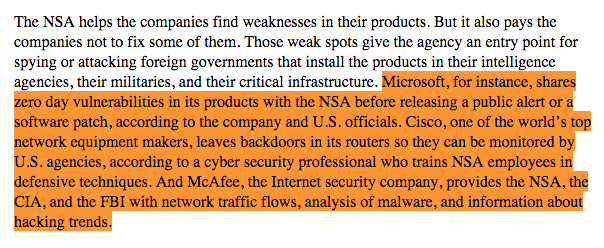
Even if that past is very much part of Microsoft's present? Such as threatening companies with patent lawsuits at a rate that has never been seen before in Microsoft's history, or its continuous collaboration with the NSA [1]? (especially after it bought Skype, and built lawful intercept technology for Skype [2] - before actually buying it).
I'm almost certain Microsoft keeps some vulnerabilities on purpose to the help the NSA, and only patches them when other parties report those bugs. In fact, I think the recent "WinShock" or whatever they're calling it, with the remote execution for its TLS library was known by Microsoft. This sort of thing is so much easier to use as an "effective backdoor", than something nefarious NSA would have to implant into Windows such as a key escrow or whatever (not saying those don't/won't exist in TPMs).
[1] - https://pbs.twimg.com/media/B2mWqX0CQAAqKxP.png:large
[2] - http://www.computerworld.com/article/2509604/data-privacy/mi...
Oh, you mean like Google [1]?
Let's keep the hate aside and forget MS's past. The biggest problem facing MS now is the loss of mind share on the Windows platform. The brightest minds aren't programming on Microsoft platforms if you look at colleges and conferences worldwide. This cannot be reversed; Open Source products are now technically superior, the community is very well organized, and it is free. Interesting research, frameworks, libraries and programming languages spawn on Open Source before they show up (if ever) on Windows. Windows engines have run out; though they will keep going for a while.
MS had a great run for over twenty years because the entire world ran on DOS and then Windows. That gave them enormous influence and power, power to make mistakes, fail over and over, and yet succeed. The real challenge will be in adapting to a future in which Windows is irrelevant. The long-term future of Azure, Windows Phone, Windows Desktop, Windows Server and their overpriced Office Tools looks bleak to me.