This is a case where google wants people to mold the internet according to what their current incarnation of their algorithm says the way it should be.
Rather than google trying to mold its algorithm to understand the internet, natural links vs. spams, and their respective authority and value.
Google here is saying that all links from this site are suspect, even when the link in question is 100% valid, quality and relevant.
Instead of going back to the drawing board and trying to fix the algorithm, google has discovered that since they are so big now, it is easier to play the "benevolent" dictator and dictate to the whole internet, how and what they should be doing.
And to mete out knuckle raps when they get out of line.
Do you see the point now?
The model (google's algo) should fit reality. Rather than forcing reality to fit the model.
I believe this is what the author is trying to communicate by saying "google is breaking the internet" - what he means is that the internet is becoming a 'google' version of itself, rather than what it would naturally be.
I read the article and didn't see any mention of what site the link was on or even what site it was linking to. It's impossible to say if it was legitimately spammy or not, but either way Google never asked him to do anything. Someone who didn't know about the Link Disavow Tool decided on their own to email him about taking the link down.
You would have a good point prior to the Link Disavow Tool, but it has solved this (very tricky) problem.
FTFA:
"In short, the email was a request to remove links from our site to their site. We linked to this company on our own accord, with no prior solicitation, because we felt it would be useful to our site visitors, which is generally why people link to things on the Internet."
"Apparently Google convinced them, via their Webmaster Tools portal, that the link looked 'unnatural', and that they should use the Link Disavow Tool to discredit the link. Furthermore, they thought it necessary to contact us to manually remove the link, which is something I’m not going to do (out of principle)."
It used to be you would get sketchy emails asking you to link XYZ and now a few years in the future the sketchy emails are asking you to unlink XYZ.
it cannot possibly be your responsibility to remove links that other unrelated entities have towards you! (unless it's an obvious link scheme)
The site that emailed to get a link taken down employed an SEO agency to improve their rankings and they created a bunch of spammy links to try to manipulate Google into ranking that site higher than others that probably deserve to rank higher due to their content. If Google did nothing about it we would get some crappy search results.
Also, if you read what Matt Cutts is saying, it implies that if they only had a few unnatural links then they wouldn't have received a webmaster tools warning telling them they had spammy links. They got the warning because their link profile suggested that it was obvious they had been trying to manipulate rankings, not because they had one or two iffy ones.
It's likely that the site then blanket emailed anything and everything that they weren't sure about to get the links taken down. Is it Google's fault that this is how the site decided to deal with the warning? Should Google just make it really easy for them by saying, "OK you disavowed those crappy links, you're off the hook now"? If the consequences are so weak and short-lived, where is the deterrent effect? No, Google doesn't own the internet but they own Google and the site is just trying to provide users with the most relevant results to their searches.
Re, the nofollow aspect. Google didn't "force" sites into using the nofollow attribute by scaring them into thinking that their rankings would drop. Nofollow was in place before there was any notion that who you linked to could harm you. Sites like Wikipedia and others were only too happy to add nofollow to links because it put spammers off from crapifying their sites.
As Google penalizes the best writers and blogs, one of two things happens:
1) Entire sites are being nofollowed - removing links to deserving sites.
2) The site refused to nofollow, so they stay penalized with PR0 no matter how good the site may be or how high the PR once was.
The end result will be that even more black hat spammy MFA sites will rank. Sites that deserved to be written about and linked to will drop and be invisible.
It is high time people stop defending Google when they are destroying small businesses and costing much needed jobs. Now Cutts has declared war on bloggers who often make a living writing.
Google wants to destroy any site that enables advertisers and businesses to connect with sites where their target audience already is by forcing publishers to decide whether they want to risk losing organic traffic and being branded with a scarlet PR0 or to nofollow everything they ever write.
Nofollow = NOT TRUSTED. We do not invest time writing about anything we do not trust. (On the VERY rare occasion we do we do not link to them.) We do not publish content that does not fit our audience.
Every link is a potential risk. Nofollowing links may damage the sites we link to so what is a writer who already cares about what they write about supposed to do?
Google has a monopoly on search because the wealthy elite who own the media handed it to them. People use it because in many cases they do not even know there is an alternative. Many use whatever is installed on their computers without even having any idea what it even is.
People who are trying to clean up unnatural links penalties are not SEO experts. They rely on tools to tell them what links to remove. These tools are not very accurate. I've had them flag DMOZ, Best of the Web, and Business2Community as "toxic". Finally many remove and/or disavow every link in desperation.
How does all that disavowing affect search results and individual sites? How many verify that requests to remove organically given links are from the actual site and not their unethical competitor. (Hint: almost none.)
Many businesses fail waiting for recovery. Others get penalties lifted, but having removed links they no longer get any traffic.
"Google didn't "force" sites into using the nofollow attribute by scaring them into thinking that their rankings would drop." YES, they most certainly DID!
>Google provided a search engine that worked better than any other so people started using it.<
While at the beginning this may have been true, over time that search engine has grown more parasitic in terms of things like scrape-n-displace knowledge graph results, AdWords ads on branded keyword terms where ads with junk bundleware rank above official sites, etc. http://blog.brandverity.com/2738/software-bundlers-target-br...
>People are still using it because it's still better than the others.<
Care to explain why Google is spending over a billion Dollars a year buying default search placement in other browsers like iOS & Mozilla Firefox? Any thoughts on the Flash security updates which hit other browsers and bundle Chrome's web browser in with it? Or how about the Android contracts with default search placement (and other forms of) bundling baked into them?
Google is spending well over a billion Dollars a year on the thesis that your thesis is wrong.
>It's not a monopoly.<
The hell it's not. At least if we use any of the standard definitions.
>You can use another search engine if you want to.<
And while an informed individual may choose to, the majority of people are driven by default settings which are purchased, as per the above.
>The site that emailed to get a link taken down employed an SEO agency to improve their rankings and they created a bunch of spammy links to try to manipulate Google into ranking that site higher than others that probably deserve to rank higher due to their content.<
Are you suggesting there are not false positives, or that competitors do not buy links to torch their competitors? Either such assertion is simply untrue.
>They got the warning because their link profile suggested that it was obvious they had been trying to manipulate rankings, not because they had one or two iffy ones.<
The second they there presumes a competitor didn't do them for it. Only a person ignorant of the field of SEO would presume this to be true in all cases.
>Re, the nofollow aspect. Google didn't "force" sites into using the nofollow attribute by scaring them into thinking that their rankings would drop. Nofollow was in place before there was any notion that who you linked to could harm you. Sites like Wikipedia and others were only too happy to add nofollow to links because it put spammers off from crapifying their sites.<
This is a complete misunderstanding of history, on numerous levels.
Nofollow was introduced as a (ineffective) solution to blog comment spamming. To help aid further/wider adoption, at some point some Googler's even suggested things like pagerank sculpting could be useful, up until some large sites started doing it excessively. They were looking for reasons to justify its widespread use, because Google intended from day one that the tag could then be spread onto paid links & other links they didn't want to count.
And the other level of absolute misunderstanding was that (before Google went on their fearmongering campaign about links) they in the past suggested that you couldn't control who links to you, but you could control who you link to & sites which linked to bad neighborhoods could indeed be penalized for it.
Very rarely is there a comment which is that long & that wrong. Impressive!
In this case the author says he created the link independently, because he thought it would be useful to his users. That's, by definition, a genuine, organic link.
I wonder if a link flagged by the disavow tool and confirmed by the user weaken the Google juice of the source site.
@MattCutts (or another Googler), is it the case?
We haven't been using disavowed links as a reason not to trust a source site. So it wouldn't weaken the Google juice of the author's/source site if the company that sent the email had just disavowed the link.
Genuine organic links can still be spammy. The OP seems to be a genuine affiliate marketer/spammer, it's not inconceivable that his links aren't treated with a ton of respect.
Some entities might try to say it is six of one & a half dozen of the other, http://www.seobook.com/brand-vs-affiliate-vs-spam but those same entities do not view their own affiliate marketing efforts as spam, even when they are pure spam http://www.seobook.com/google-lends-a-helping-hand
Look at the cloaked affiliate YouTube links to iTunes on music videos. And Google has invested in Viglink, RetailMeNot, etc.
In addition to those types of investments, it was Google's ad programs which funded entities like Mahalo & eHow.
There are zero affiliates which have made as much off affiliate marketing as Google has.
You do realize, of course, that Google is part and parcel of the internet, and that much of the way the internet works "in reality" is in response to external perceptions of how googles algorithms work?
Google's early dominance in search was a result of their algorithm's ability to surface relevance. If they had never staked out that Site A linking to Site B means site B has more relevance, then the internet would be an entirely different beast, and SEO would take entirely other forms that do not amount to linkstuffing.
The internet hasn't existed 'naturally' since search engines first came around.
When SEOs break the quality guidelines of all major search engines (not just Google), then they might need to do some work to clean things up if they get caught.
One of the reasons that Google is such a popular search engine is that we do take spam seriously and we take action to counter spam.
This still seems to be missing the point.
As I understand it, sites that are not doing anything in the realm of SEO can get penalized because of the actions of people outside of their control.
If the wrong sorts of sites (however defined), sites outside my control, are linking to my site, why am I penalized, and why should the burden be placed on me to go fix it?
Check the people who try to drop profile links & comment spam links on your blog and such. Are there any websites which have as many spammy inbound links as YouTube does? How many people does Google allocate to cleaning up YouTube's spammy link profile?
There's another factor in that Google may shift what is considered reasonable over time. A buddy of mine got an unnatural link warning where the link cited was a link that has been in place LONGER THAN GOOGLE HAS EXISTED.
Now consider that some websites are bought & sold, change ownership, etc. ... does it make sense to penalize today for something which happened 10 or 15 years ago?
Another factor is that just by ranking you will pick up some scraper site inbound links you do not want. Many of those sites in various forms or fashion are monetized via Google ads. Google continues to run their ads on many of those aggregation sites, yet you may get an unnatural link penalty for having links from the same sites.
Good enough for Google, NOT good enough for you TM
Very well put.
Oh he gets it, it's his job to act like he doesn't and to change the subject "...Ummm...Bing does it too..look I made a video"
Well, if a website was link spamming then it seems appropriate that the site should attempt to clean up the spam they made before they can rank well in Google again. Otherwise it's not fair to the other websites that have been trying to rank fairly and would like a level playing ground.
In general, if you weren't trying to create spam links, then it's very unlikely that any of this is an issue for you and the burden isn't on you to fix it. I made a video about the "what if the wrong sorts of sites link to my site" question here: http://www.youtube.com/watch?v=HWJUU-g5U_I
So if Bing wants to rank Bing.com higher than Google.com on the keyword "Search Engine", all they need to do is to pay link farms to link to Google?
Like everything this could go both ways. If you penalize sites for having links from link farms, what is stopping your competitors from paying link farms to link to your website? or worse yet, some link farm owner comes up with an ingenious idea to hold other websites hostage until they pay up?
It would be more understanding if Google din't have any other resources on hand to make smart decisions but heck you guys have hands on realtime experience with most traffics via Google Analytics, Google Adsense and even DNS. All these resources and can't even distinguish a link farm from a legitimate site? Doesn't sound believable.
The Google webspam team seems to prefer psychology over technology to solve the problem, especially recently. Nearly everything that's come out of Matt Cutt's mouth in the last 18 months or so has been a scare tactic.
IMO all this does is further encourage the development of "churn and burn" websites from blackhats who have being penalized in their business plan. So why should I risk all the time and effort it takes to generate quality web content when it could all come crashing down because an imperfect and overzealous algorithm thinks it's spam? Or worse, some intern or non-google employee doing a manual review wrongly decides the site violates webmaster guidelines?
yup.
>Nearly everything that's come out of Matt Cutt's mouth in the last 18 months or so has been a scare tactic.<
the bizarre thing is the gap in perceptions internal to Google versus external. https://twitter.com/mattcutts/status/449008706655510528 https://polldaddy.com/poll/7916680/
>IMO all this does is further encourage the development of "churn and burn" websites from blackhats who have being penalized in their business plan.<
Absolutely. churn & burn sites, and then some mixed in parasitic hosting on sites which are already highly trusted.
During this "crackdown campaign" Google has been on, I have sat in on meetings at large clients where they've pulled sites that are supposedly link farms (according to google) and put together an ad buy on behalf of competitors meant to cause these penalties to be levied and WMT messages to be sent.
They needed to provide a useful service to begin with to get the traction (good search algorithms for the web-that-is), but now that they are the incumbent, it is more in their interests to penalise website owners and force them to buy ads.
It's sad, but it's normal monopolist behaviour.
The cost of throwing scummy links at a website is under $100.
And if their first $5, $10, or $20 test doesn't work? Then so what for them. They put it on cron job and throw another $20 at it again and again. http://www.seobook.com/images/sape-sape-sape.gif
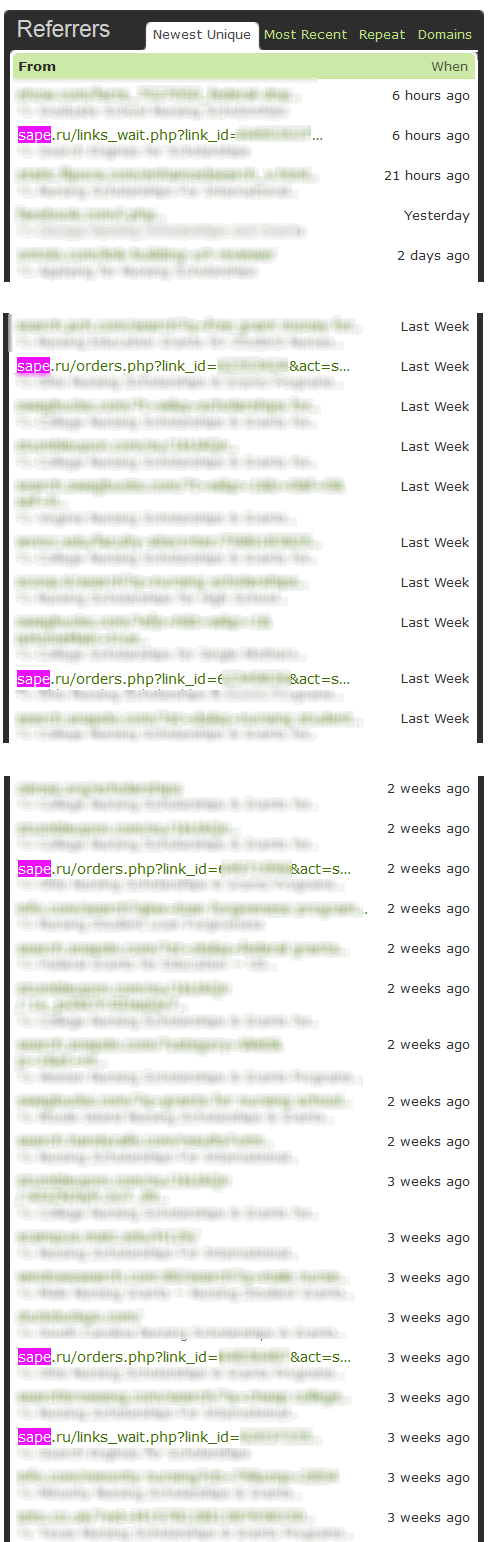
The key point here is that there's a 100X or 1000X gap between 4 figures & 6 to 7 figures. The cost of burning things to a crisp is much lower than building them up. Whenever incentive structures have a 1000-fold difference in outcomes the path of least resistance becomes a popular path.
After a few cases like this, a long list of multiple disavowed domains/networks/fingerprints, where are these negative links going to come from? This anti-SEO tactic you outline can only be used a handful of times before it becomes useless.
Matt Cutts' job at Google involves him making tons of videos explaining how the Google algorithm works. It isn't omniscient, and the guidelines show how to work within its limitations. If you don't care about optimizing your Google presence (as we don't) then you shouldn't care about Google's guidelines either. But if you do comply with some guidelines, then this will probably help your rank in other search engines which also take similar measures to TRY and detect linkspam.
Google's customers are its users. It tries hard to have the most relevant results (or provide value some other way, or just maintain a brand image so people keep coming back). The advertisers come because the users find them and spend real money. And the users want relevant search results, not spam. That's why Google spends a ton of resources on combating the spam.
How do you propose they magically "know" when a link is natural?
No, Google's customers are its advertisers. They're the ones who pay money to Google.
I agree with your general point though, the algorithm isn't perfect and sometimes it goofs. What I think people are having a negative reaction to is Matt Cutts' seemingly obtuse responses, as though he doesn't even understand the issue at hand (Google's actions distorting natural behavior), so he just keeps explaining the anti-spam policies in general terms. It's not a conversation, it's people talking past one another.
Think of some of the stereotypes of engineers. Many can code but struggle to communicate. Matt can code, has his name on many patents, leads a team, makes hundreds or thousands of videos, regularly keynotes at conferences & interacts with thousands of people, was GoogleGuy for years, participates in the comments here, was an expert in some of the past lawsuits against Google ... he has basically had a near infinite number of opportunities to put his foot in his mouth & yet how many times has he ever done it? Almost never, if ever.
About the only times I think he has potentially missed at all was the "breaking their spirits" bit on TWIG, and then two minor bits in a few YouTube videos
http://www.youtube.com/watch?v=muZuX9OaMLo&feature=youtu.be&... "We got less spam and so it looks like people don't like the new algorithms as much."
https://www.youtube.com/watch?v=2jap11IIxfw "the gap between what you can get away with and what google says you can get away with is getting smaller all the time"
---
Who do you know who has as much media exposure as he has had who hasn't repeatedly put their foot in their mouth? For me, that answer is nobody.
---
What makes Matt's performance even more impressive is how scummy some of Google's policies have been, even as he came off smelling like roses. There are endless debates on how reasonable it is for Google to infer intent on links & so on, yet at the same time some of the past Google executive emails have quotes in them like:
http://www.washingtonpost.com/politics/google-faces-new-pres... "As with all of our policies, we do not verify what these sites actually do, only what they claim to do." (for AdWords advertisers)
http://www.theverge.com/2013/1/23/3906310/the-no-hire-paper-... "I would prefer that Omid do it verbally since I don't want to create a paper trail over which we can be sued later? Not sure about this. thanks Eric"
No, Google's customers are primarily its advertisers. Optimizing advertising revenue has some overlap with pleasing users, as you note, but if a decision needed to be made between pleasing users and increasing revenue, there's no doubt about which way it would go.
I suppose any company that works out how to increase revenue while upsetting and alienating it's users could possibly implement said ideas. But if you're smart enough to do that, I would guess you would also be pretty successful at the traditional approach of increasing revenue by pleasing your users?
Rather than these fear mongering tactics, why can't Google just ignore spammy links instead of penalizing the whole websites and all the websites that link to them?
But! You may have hit the nail on the head. if i had to guess i would say that storing exceptions means that suddenly the algorithm had to check part of the corpus for these exceptions. at the scale at which google operates this could probably lead to rather big size and speed implications.
But maybe i'm just fantasizing.
Ask Google engineers how they feel about centralization of power in telecom or finance or politics & they will tell you it is the worst thing ever http://www.youtube.com/watch?v=Ik1AK56FtVc
Yet that same sort of centralization is fine when it is Google.
Those same engineers will admit that any algorithm has some level of false positives & false negatives. They may try to minimize these, but they can't make them zero.
The other thing which gets very little coverage, but is crucially important is that in spite of already having a monopoly market position Google keeps buying search marketshare with: their secret Android partner contracts, Firefox default search placement, iOS default search placement, Flash embedded into Chrome (so security updates happen in the background without sending you to a download site where trash can be bundled in with the update) & Flash security updates that hit all other web browsers coming bundled with Chrome bundleware which sets Chrome as your default browser, etc.
If Google decides they don't like you (for any reason), then you need searchers to use a different search engine in a browser which isn't paid off by Google for default placement. And you need to hope that users are savvy enough to repeatedly say "no thank you" to the automatically bundled Chrome install with their frequent Flash updates.
Google mentions how anything is only a click away or similar, but most people tend to use defaults.
When someone changes those defaults on Chrome users, that's a horrible user experience & the "hijacked" settings must be reset. http://chrome.blogspot.com/2014/01/clean-up-your-hijacked-se... But when those defaults are paid for by Google or changed through Google bundleware it is "a great user experience."
If Google believes their marketshare is a reflection of their superior search offering, they are welcome to stop buying default search placement in other web browsers & stop bundling Chrome installs on Flash security updates. But currently they are spending north of a billion Dollars a year on these activities, which indicates they clearly feel there is significant value to them.
You are suggesting an approach where there are no downsides to link spam. Obviously, players of this game would then ramp up their link spam bots, and run them non-stop. Because it causes no damage to the site they want to rank.
Link spam isn't just a search engine indexing problem, it is also a detriment to the general Web user too. It makes the Web worse, not just search.
Don't like YouTube's copyright claim issues on video game playthroughs? Use Twitch. Oh wait, what's that? Google is trying to buy Twitch. http://kotaku.com/report-youtube-is-buying-twitch-for-1-bill... Oooops.
So then what's the difference between disavows and having the links removed? Getting the links removed costs far more time & money. And it gives Google a data mining stream of feedback they can leverage to dish out further penalties.
Google requires some of the links to be removed not because it improves the web, but rather their goals & interests are aligned with punishment. They want to add cost & uncertainty to SEO in order to discourage investment in SEO from entities not formally connected to Google.
That's a good thing right? Pushing sources of bad links down through the basement, effectively nuking the source/network from the link graph.
You know Google's ranking system is based on information, and adding more information leads to better results for the Web user.
That really depends on your perspective.
If it were impossible for others to throw trashy links at your site in bulk for cheap it could perhaps be a good thing.
If Google didn't change policies overnight & then retroactively penalize you for things which were fine in the past http://searchengineland.com/guest-post-google-penalty-187707 then it could perhaps be a good thing.
Unfortunately, in reality, both of those ifs are hypothetical & untrue. Which means it is absolutely not a good thing.
>You know Google's ranking system is based on information, and adding more information leads to better results for the Web user.<
Quality of information matters as much as the volume of information. Look at Demand Media's current stock price for an example of this.
But in terms of links, you have to think through the impacts here...
Yes if Google freezes some activities they dislike then perhaps that is a net positive for relevancy, however the more they fear-monger about links the less natural linking goes on. Most of the major social sites put nofollow on almost all external links. And with the sea of fear approach to relevancy, in some cases magazines or newspapers will profile a person & not link to the source in spite of the entire article being about that source. I've spent many hours being cited by journalists where in spite of being good enough to be the primary source for their content, there was no link citation.
paraphrasing David Naylor's excellent recent video http://youtu.be/UdflGrCJxYc?t=1m50s "More and more high profile websites are having a no linking policy. Which really is kind of weird isn't it, because if that is a journalistic website and they are writing about your website surely those are the kinds of links Google would want to see. ... It seems kind of weird that the links Google actually wants you to get are the first links to dry up on the web." - David Naylor
The other important factor is the quality of the information created by those who are trying to do disavows and link removals. When people are irrationally driven by fear while in a harmed state, they are NOT acting rationally. Business owners who are selling off assets, firing employees, stalling with creditors, aligning predatory lending to try to keep things afloat, etc. are stressed out & are likely to make many poor decisions in that rushed & panicked state.
Thus some of that more information which is created is junk misinformation.
Consider this email: http://www.seobook.com/images/link-unremoval.png They asked the website to remove the link claiming it was unnatural, and then they emailed again to ask the website to ignore the removal request.
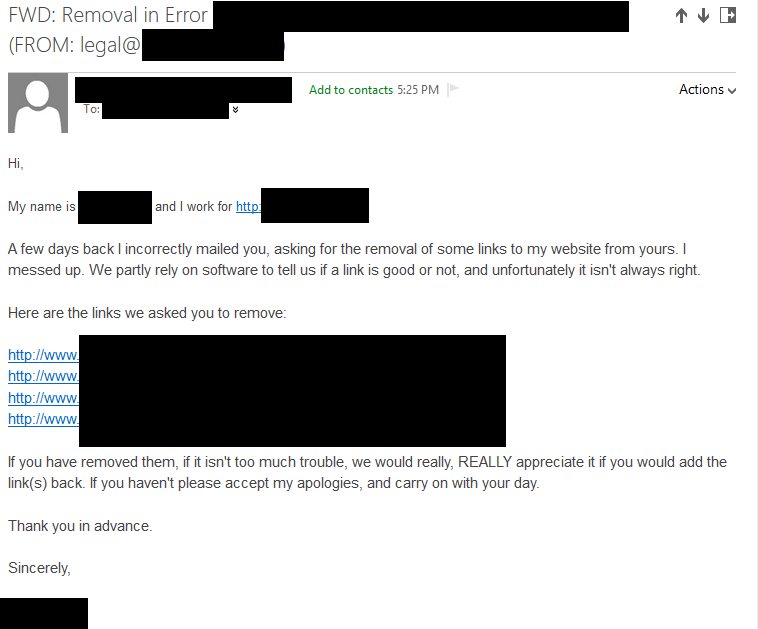
They don't know which links are "unnatural" and so they are using automation to try to sort through it all. Are their automated quick guesses (which are often driven by tools) more useful than all of Google's internal reviews & ratings data which has been built up for over a decade? Color me skeptical.
There's another factor with the disavow data as well. Look at this removal request http://www.seobook.com/images/trampolines.png Our site has about 20,000 unique linking domains referencing it. However over the years we have had well over a million registered user profiles. If only 2% of the registered user profiles were ignorant spammers who spammed our profile pages and then later added our site to a disavow file, we would have more people voting against our site than we have voting for it. And those profile pages were already not indexed & the links were nofollowed anyhow. Those pages are effectively outside the search game, yet those ignorant spammers can still create negative votes against our site based on the fear-mongering.
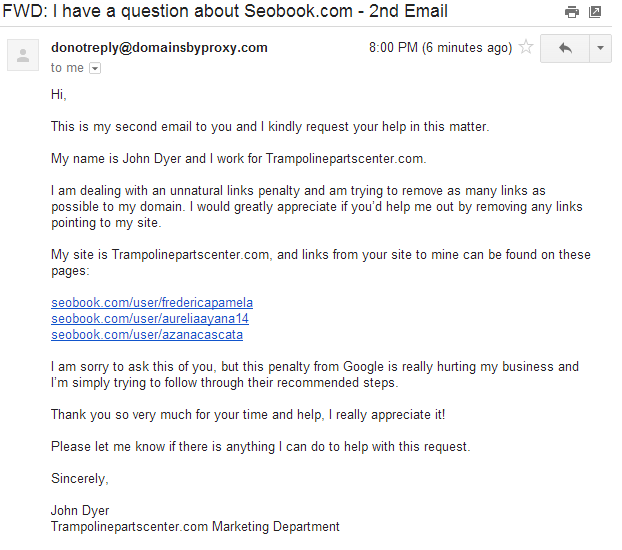
And as bad as that sounds, there's no reward for actually removing the bad links either. At some SEO conferences numerous SEO experts have gave the advice to "just disavow them anyhow" even if the links are removed. Thus this deluge of email spam offers publishers no value whatsoever, just sunk cost & wasted time - time which could have been spent creating useful information.
In such scenario, how does Google determines if I created the links? Does Google have precognitive abilities or it can spy on my communication channels (Gmail, Google Voice, Hangouts etc.) to figure out if I am innocent?
A model is only as good as the information in it. In this case providing details of these spammy links helps you, and every other site targeted through the same sites/networks/fingerprints.
Consider it a reverse no-follow mechanism.
It appears after years and millions spent it is impossible to get the perfect search algorithm.
That is an absolutely ridiculous rule of thumb to follow. What exactly is wrong about doing something like:
1) Having a good article on your site about a certain topic 2) Reaching out to other site owners who have similar content and asking them to link to you as an additional resource 3) Getting that link.
Can you honestly, with a straight face, tell me that's BAD!?
The situation you mentioned can start out as innocuous but quickly become downright shady. Hmm, you're asking them to link to you, but what do they get in return? Oh, here's a thought, you tell them you'll link to them as well if they link to you, that way you'll both get a ranking bump! Totally fair and win-win for everyone except for the people who are trying to get quality information.
That might be the ideal result, but it's hard to see how anyone could achieve it with a purely automated system. To make the kinds of distinction you're describing, in general you probably need some form of manual curation by genuine experts with uncontroversial opinions, assuming such people even exist in the field of interest.
How do you feel about Google sponsoring educational seminars for market regulators where they do not disclose their sponsorship, actively conceal it, and request the entity putting on the sponsorship do the same thing?
http://www.washingtonpost.com/politics/how-google-is-transfo...
It is also worth mentioning that when Google was lobbying against regulation they indeed DID control & manipulate the placement of favorable media masquerading as regular content:
"the staff and professors at GMU’s law center were in regular contact with Google executives, who supplied them with the company’s arguments against antitrust action and helped them get favorable op-ed pieces published, according to the documents obtained by The Post."
---
Another thing with the line of thinking based on pureness...should companies which have repeatedly been caught rigging actual physical markets (e.g. municipal bonds, California energy, LIBOR, interest rate swaps, forex, etc.) in the real world get a penalty by Google for it?
Or is it reasonable that they take their outsized gains from their market rigging behavior & invest some small portion of it into buying out smaller competitors, lobbying & writing regulations to harm smaller competitors, buy some feel good brand ads & do various charity donations to paint a picture of themselves?
---
I also want to quote the following past statement from a Google executive about the AdWords ads Google puts directly in the search results:
"As with all of our policies, we do not verify what these sites actually do, only what they claim to do."
http://www.washingtonpost.com/politics/google-faces-new-pres...
---
and, some icing on the cake, ... ;)
check out the keyword rich deep links to some of Google's affiliate offers on BeatThatQuote.com (for credit cards, car insurance, etc.)
Google bought BTQ & then put a bunch of cross-site keyword rich deep links on it. is that natural? how is that any different than buying links?
"While important as a vote of confidence for the content they point to, there is simply so much link spam these days that it’s tough to know where to turn. Obviously buying links is a dead end, and it doesn’t matter how you split this hair: sharing, encouraging, incentivizing, buying – it’s all the same. You want links to surprise you. You should never know in advance a link is coming, or where it’s coming from. If you do, that’s the wrong path. Links are part of the bigger picture. You want them, but you want them to be natural. If an engine sees you growing tem naturally, you’re rewarded with rankings. If they see you growing them unnaturally, you’re rewarded with penalties."
If you disagree with that, you'd need to take it up with Bing's webmaster outreach team.
Your statement implies both Google and Bing share the same sentiment.
So now, my question still stands: What about that scenario that I laid out is actually bad/spammy/evil? Why should anyone ever be punished for doing that?
This practice has existing long before Internet, and internet has made it easier than ever. Google is essentially telling us not to ask our customers to evangelize for us.
Why such hypocrisy? How about the invites system Google uses for many products including Gmail where users are encouraged and incentivized to invite friends.
According to Google's terms if I link to my Dropbox referral link on my blog, Dropbox should be penalized for it because they incentivize users to do that.
The internet should not work according to Google's algorithm and policies, it should be the other way around.
Every marketing seminar I have ever been to has emphasised that as much as you can turn your clients into fans, in the end you still need to ask them for a testimonial and that you need to tell them that you love referrals.
Under that same logic, Google Adwords should never know in advance where their ad clients are coming from, and if you have someone out there trying to on-board big clients (or increase their spend) that's the wrong path.
You say "if they get caught" when sometimes, there is nothing to catch. You're dinging people who have grinded to forge relationships, in the name of trying to keep spammers out of the index.
It makes it too easy for me to hire a spam company to blast an overwhelming amount of crappy links at my competitors who may or may not be well equipped to disavow those links.
Which, if my company has the budget to hire someone to monitor & disavow, and my competition does not, well... somebody's still gaming the system...just not in the same way...
That's what's wrong with this picture. The link was perfectly valid and yet Google recommended that site's admin to disavow the natural link, simply because Google's algorithm isn't good enough to see what's natural and what isn't. So his suggestion is: if it's not good enough, then don't recommend the wrong stuff to people.
This is pretty typical of 2014 Google.
To be honest these days I pretty much regard Google as one of the banes of my existence, you guys hold so much power and influence so much of the internet the rest of us have to work around you, I'm currently pulling all our customers off Google Apps for Enterprise for a multitude of reasons (buggy code, broken imap implementations, impossible to get an actual human answer) as well as moving myself away from all Google services (including Android).
I remember when you guys where the good guys.
People have not only been complaining about this since Penguin came out (around two years now), before that they were complaining about the opposite: that Google's arbitrary rules were creating spammy links all over the internet. It's completely ignoring the past to pretend this is some new thing to fit a preconceived narrative.
Most of the SEO folks that seem to come out of the woodwork for these threads would agree with me that "This is pretty typical of 2014 Google" ignores years of them complaining about the exact same thing, except they're just happy to have more people on their side.
Then we stared seeing the first indications that real "negative" SEO was possible in certain circumstances and we complained even further. Stop counting links you don't like. Now we are at a point where we see old websites being told to remove or disavow links that may be as many as 10 years old.
Can Matt or Google really stand there and say that it took them 10 YEARS to figure out that not only was that a link that they didn't like, but it was so evil that now it needed to be removed from the internet? The solution has been, and always will be, stop letting things you don't like count as a plus in your algorithm. When in doubt, don't count it.
Instead, we have Google adding thousands of webmasters and site owners as a living part of the algorithm and getting them to remove all those links, plus many they can't see or understand the value of, by the use of fear and scare tactics. Remove these links are we will ruin your website rankings. It doesn't matter if you created or asked for them or not, remove them.
Yes, it most certainly did!
From the article:
> Apparently Google convinced them, via their [read: Google's] Webmaster Tools portal, that the link looked “unnatural”, and that they should use the [Google] Link Disavow Tool to discredit the link.
(emphasis added)
> It's quite likely they noticed a penalty...
Yes, and where would they have noticed that penalty?
In a drop in incoming traffic, so with whatever they're using for analytics.
In all honesty it's probably just a new SEO consultant trying to clean up past sins and move on with whatever the latest grey hat strategy is.
IMO it's a gross overreaction to a form letter that a high percentage of webmasters have received.
The whole point is, Google spreads FUD to paper over its inadequate algorithm. People believe and look up to you as a source of truth. However, you take that trust, and you ask people to do your dirty work. That means more work for them, and not every small business has all sorts extra time money to spend on stuff like that. This is not to mention that there are probably a bunch of other more important things they could be doing. (and I know you know this, your friendly face is the head of FUD over at Google)
With all of your power and authority, you have a responsibility be more honest and straightforward. Not everyone knows better, and when people end up listening to your Google/self serving advice, they are ruining the open and free nature of the internet.
This wouldn't make me so salty, but the complete BS and favoritism exhibited by you and Google is obnoxious. So, sometimes, it might be better if you just shut up.
sorry if there are any typos etc, my (virtual) keyboard is spazzing out.
I suspect neither would be a major issue if Google modernized their algorithm to take into account (mostly/only) which links people actually clicked on rather than what is linked from where. They'd only have to be able to distinguish people from click-bots, which might be easier to do with some confidence than recognizing the intent behind a particular link (spam/SEO or real information for visitors) - I hope they are already able to do this, for the sake of AdWords customers ...
Google's algorithms should reward behaviour that's best for Web users, and penalise behaviour that is worse for Web users.
That way, for people who want to game search engine rankings, they are pushed more towards techniques that benefit web users in the course of trying to benefit themselves.
The problem with models is that they are not accurate simulations of the real world. They have flaws and simplifications, and those give rise to people taking advantages of those flaws. All models and representations have flaws.
It is impossible for Google to exist at its current scale and not influence the Internet.
The tiger is born out of adaptation to the jungle, but in time, the jungle too will adapt to the tiger.
Matt, this is beyond disingenuous. If Bing or Yahoo responded in the same way, I doubt we would hear a ringing endorsement from Google on the subject.
You've indicated in other comments that basically your algorithm is everyone else's problem to deal with. You can use whatever words you like, but the actions are what matter.
At this point, it sounds more as if Google is concerned with "being right" more so than "doing right".
This blog does not indicate some fundamental breaking of the web. It indicates a guy got a random email from a random website, that he is free to ignore if he wants (and in fact should ignore, because the webmasters in question don't even need to contact him, they can use the disavow tool).
No work to do? No problem!
It's reasonably clear to me this email was anything but random. Take Google out of the picture and this communication never happens. Both the sender and receiver are taking actions with consideration of one single point -- how does this affect my Google search ranking?
If Google weren't the literal default entryway into the Internet, your argument would be valid. There is precedence in this scenario as well. Back in the 90s, many people said the same thing regarding Microsoft and attaining placement on the Windows desktop for new shipping PCs. This was a key element of the DOJ trial.
The argument that a powerful intermediary has no effect on the conduct of others is simply choosing to ignore certain facts.
Did you read the article? The reason that site is asking for the links to be taken down is that they believe (apparently based on feedback from the Webmaster Tools) that it will please the Google Gods.
Spammy links and irrational fear of spammy links are both unnatural linking behaviors that result when sites are more concerned with pleasing search engine algorithms than with pleasing human users. That's what the article is talking about.
ForHackernews, we say in our quality guidelines to "Make pages primarily for users, not for search engines." If the SEO whose email was quoted in the article had followed that advice, they wouldn't be in the position of trying to clean up spammy links after getting caught spamming.
The problem with that is that it's not true (in my admittedly very limited experience). I used to believe that until I created a small website and found it wasn't getting listed in Google and I had to try and guess why and carefully read the rules.
Making pages primarily for users means you unthinkingly do things like having duplicate content on multiple pages/subdomains/sites or linking to a site that reviewed your product after you gave them a free sample (a paid link).
I'm sure to any even vaguely experienced webdev they know not to do these kinds of things (use canonical links, nofollow and all that jazz). Somebody just throwing a few pages together who has no experience in this stuff easily falls foul of the rules. The rules may seem obvious to people who understand how search engines work. If you have never heard of pagerank and don't have an understanding of how search engines work and how people try to game and spam search engines, the rules are not obvious at all and certainly the rules are not the same as the natural behaviour of somebody creating a legitimate site with the users in mind.
* Product with a category name in url, or without, or under multiple categories
Both are very useful for humans, but have to be massaged with canonical urls to please Google machines
I don't see how the same product under a variety of URLs, one for each category it's in, is at all useful to me as a human. It actually rather annoys me when the same page has a whole bunch of URLs: I can't tell which is the "real" one, my address bar frecency gets messed up, visited links don't work correctly, etc.
As a consumer, if I came to the website looking for instructions on how to use my [Deluxe] Widget, I would reasonably expect to find the same operating guide on both product pages.
Frankly, I think "spammy link penalties" is an approach that cannot work long term, any negative weight put on links is too easy to game by competitors.
The vast majority of link removal requests I've received do not come from an email address that matches the destination of the link for which the removal is requested.
They still don't really understand the web, and they hired someone who appeared professional to them (and probably cold called them). Only after a while do they realise they're paying a lot of money for something unquantifiable and with no guarantee of hitting the front-page of Google, and so they end that relationship (in fear, as they're told that whatever placement they now have may be in jeopardy).
So starts the merry-go-round, where the smaller merchants constantly jump from one bad SEO company to another. Each one creating mess, whilst claiming they'll clean up the mess before.
I do feel for the smaller merchants. Their business is being eaten by the internet, and they're missing out and have ambition but are being fleeced by sharks every step of the way.
You're Google employee, right? You lot have gone quite cheeky nowadays. You're exploiting the monopoly you hold in the search market, to make people adhere to your standards, instead of adhering the standards the internet community naturally generates. I'd suggest Google engineers to go develop better algorithms instead of telling the internet off.
That's taken straight from Google's webmaster support forums... https://support.google.com/webmasters/answer/2648487?hl=en
Even in situation number #1, Google clearly encourages webmasters to "do as much work as you can to remove spammy and low quality links..."
I happen to disagree with the article, but it's kinds disingenuous to claim that Google had nothing to do with that link removal request.
I don't think Google needs to spend resources to turn around and tell this guy, "got'ya"...
Personally, I don't see the harm in having organic links being asked to be removed. I would never remove a link that sends referral traffic, and I see no reason to keep a link that doesn't send me visitors. I have no problem having someone no follow a link that sends me traffic, because it will send me the same traffic...
so I think the issue here is less about actually breaking the internet and more about how it makes people feel when they thought they were helping you by linking, and then they get accused of destroying your rankings by asking for the link to be removed....
A video from Google would be useful to help explain what is happening here for all parties involved.
I thought I'd made at least one video for sites that have been getting link removal requests. I'll check, and if we haven't made one then I'd agree that would be useful. Thanks for the suggestion.
Yes, Google isn't sending these so you could argue that Google are not directly to blame.
But, the merchants in question who are sending them are doing so because Google has made them believe they are (or will be) subject to some penalty if these links are not cleaned up.
I run forums and all of our links are natural links. For the first year I would look at every link that was asking to be removed and found that, without a single exception, every link was created by a trusted person in the community helping to answer a question by someone else. Every link I checked was natural and high quality, none... literally none... were suspicious or spam.
It may be that these merchants did involve SEO crews who did create a lot of spam links, but those are not on our site.
What's more worrying is that merchants feel so overwhelmed (numerically there are a lot of links to deal with) and in such a state of panic about this (they fear a bad placement could have significant effect on their business) that now they're hiring people to clean up SEO mess, and those people create 4 problems:
1) They have no clue which links were the result of SEO, so they just request every link they can to be removed.
2) They send these removal requests from emails like [email protected] when the links point at www.watches2u.com so it is impossible to verify as a publisher that the person requesting link removal represents the merchant to be de-linked (and #1 means that they don't enter into dialog as they can't, they're sending tens of thousands of requests).
3) The removal notices seldom have enough info to be acted on. One forum I run has several million posts, and the removal request may simply be "You've linked to blah.com, please remove it". OK, more verbose and almost identical to the OP's example, but not a useful pointer to the page or comment that contained the link.
4) If, as a publisher, one fails to remove a link, then their automated removal request scripts will now spam the publisher routinely with the same request.
If you can finally get a conversation that says "Do you represent the merchant, have you got a full URL to where the link exists on our site, and are you sure this isn't a natural and good link?", then every merchant has so far agreed that the link should stay.
But... for all of that, the effect is very real for the publisher: We get spammed evermore, from unaccountable sources that we don't know has a link to the merchant, asking for links to be removed that are actually very good quality and with good context and content.
It's a mess. A mess for which the merchants may be to blame (for originally doing SEO, and now for handling removals so badly), but this mess is definitely due to Google creating the situation.
My policy now: I put link removal requests in my spam folder.
That is how I regard it, this is just a new type of spam that Google has created. We never engaged in SEO or supported anyone doing so, we took an aggressive stance against spam, but as we have content that links elsewhere we are being spammed constantly with these requests and we carry the burden of the problem.
PS: The example cited above was just the top one in my spam folder, the link can be found on this post in the form of an img tag: http://www.lfgss.com/thread17604-52.html#post2119173 , it's the photo of a watch posted on a horology thread within a cycling forum by a long-standing member of the community with high karma. The request for link removal did come from an @web-marketing-group.org.uk address. The request will be ignored. We don't do "nofollow", but it's irrelevant as that isn't valid on img tags.
The main thing I'd recommend for a site owner who gets a fairly large number of link removal requests is to ask "Do these requests indicate a larger issue with my site?" For example, if you run a forum and it's trivially easy for blackhat SEOs to register for your forum and drop a link on the user profile page, then that's a loophole that you probably want to close.
But if the links actually look organic to you or you're confident that your site is high-quality or doesn't have those sorts of loopholes, you can safely ignore these requests unless you're feeling helpful.
It isn't, and never has been.
We operate a nursery period ( https://www.lfgss.com/thread9350.html ) in which the actions of new members are both severely restricted and observed by existing members, and all initial content must be 100% public and observable by members (no private messages, no user profile customisations).
We very aggressively remove content and ban anyone who creates any content that appears spammy and continue to encourage reports of spam even long after they have been registered.
We report those individuals to http://www.stopforumspam.com/ at the same time preventing signups from anyone that SFS reports as coming from an IP recently used to spam.
Comments are run through the Akismet API and moderated if they are flagged as spam.
When a spammer is caught (a few times a year someone does get past all of this - for a very brief moment), then every piece of content of theirs, and any other content from nearby IPs is reviewed and usually removed.
We made profile pages non-public, we even removed the customised profile fields from display (though we do leave them in the form as it helps us spot any scripts that are trying to spam us and we autoban them).
To put it mildly, we are aggressive.
We've made a really poor experience for new members of our community to help ensure the quality of the content on the site and that we're free from spam. We felt that was worth it from day one, we still feel that it's worth it.
Which is why it's hard to feel good about Google when our reward for fighting spam on our corner of the internet is to be spammed by merchants whipped into a state of panic by Google.
Unfortunately, if you look at wider area of forums as a whole, a very large fraction of them are unmaintained, unpatched, or otherwise not kept safe from drive-by spamming. There are entire forum spamming software packages that will register spam users for dozens of different forums in order to drop spammy links. You can even lease the spamming software by the month. :(
I figure already that you'll eventually consider that a valid signal, but I'm sure you could already check my site and that there must already be some disavowed links, yet you personally admit this is a well-maintained forum.
There is a fear that we are being caught in the crossfire, and it's hard not to believe that quite a few of us are going to get hit by that crossfire.
I've added rel="nofollow" as good-enough when trying to help out people throwing too-far of a net.
"Do these requests indicate a larger issue with my site?"
When the truth of the matter is that it's Google's issue. Why does the burden of the cost have to be on the publisher?
This is the 3rd time someone is pointing this out, and it pretty much showcases "Google"'s attitude on this.
At this point the cost of becoming a good source of information has increased greatly to the point that very few publishers with resources can actively manage all the rules and "guidelines" Google decides to throw at the content creators that provide the content that makes the search engine valuable.
I see this everyday in our business as smaller but richer sources of content just disappear on many topics. Blogs, forums and independent enthusiast content sources.
Google has created a one sided ecosystem. That is consolidating traffic to so called "good" sites.
As a long time publisher for a large media company I think it's time to take the internet back from Google. Who care's what Google thinks and does and start building for a better internet.
Google is what it is: trying to sift through all that information algorithmically and using some forms of AI so it can extract what humans think is good information. I agree that a good forum that has good policies is getting hurt by some of google's actions, but it's the larger system, not Google. To make an analogy: almost everybody drives and everybody uses roads, but nobody should say: I'm a good driver or I don't drive, I've never been in an accident, therefore I cannot be in an accident. With all the information and intents behind such information on the Internet, and with google as the self-appointed traffic laws, there is still bound to be some collateral damage, sometimes because of how Google tries to deal with the dreck.
As an aside, one can view Google as a just one way of monetizing information on the Internet, competing and co-existing with many other ways. You can also view it as a giant AI algorithm that gets rewarded (advertising revenue) when it finds the good information that humans are looking for and defends itself against others who have other interests.
If you don't care about what Google's view of the internet looks like, then ignore them, and ignore any emails from people asking you to change things on your site for them. Done. Simple.
This issue crops up because people usually do care what Google's view of the internet is and would like to help make it better. Marking links as nofollow and so on is entirely optional: only people who want useful search engines do it, and others don't care.
Thanks to Google for creating these parasites. The link-spam problem has been caused by Google in the first place.
I don't remember getting such spam in a pre-Google Internet world.
Small website owners like us may not have the technology and human resources to combat such spam. Therefore, we are caught up in the fire and get penalized by Google.
Wouldn't that be like every vBulletin site?
When webmasters are writing to ask for a link to be removed it's because they believe that that link could possibly be one that was made with the intention of increasing their PageRank and manipulating Google. BUT...sometimes it's hard to tell whether a link was naturally placed or whether it was one that a former SEO made on their behalf. As such, it's certainly possible that an email requesting link removal could be sent out in error. If that's the case, then ignoring the request is fine...or even better, writing back to inform them that the link was not purchased, solicited or self made would be really helpful.
I've been working the past two years, from contacting all the webmasters via WhoIs information, creating unique content on a weekly basis, having a good social media following, and still for the life of us, we cannot get ranked well organically on Google.
Could you personally look into this or give me any advice on resolving this issue because I feel like I've done everything possible and we put a lot of work into the website over the years. I would really appreciate it.
How am I as an outsider of Google able to discern any information about what's going on in this situation? I assume this isn't a unique case but there is literally 0 information. I'd like to clear this up - not just for me but for the community. I know this may be the wrong place to ask (I'm not sure where the "right" place would be), but would you be willing to contact me? caudill m at gmail
If you are able to identify problem links, you can just ignore them. Or am I missing something?
You're penalising spammers, and it's being effective. GOOD.
All Google roads and products lead to ad clicks and Adwords. Enjoy it while it lasts.
As you can imagine the process is opaque. I have reported some sub-optimal websites and seen a difference a few weeks later. I have no idea if my comment was read by a human let alone whether any action was taken as a result.
Note that there are two different things to keep in mind when someone writes in and says "Hey, can you remove this link from your site?"
Situation #1 is by far the most common. If a site gets dinged for linkspam and works to clean up their links, a lot of them send out a bunch of link removal requests on their own prerogative.
Situation #2 is when Google actually sends a notice to a site for spamming links and gives a concrete link that we believe is part of the problem. For example, we might say "we believe site-a.com has a problem with spam or inorganic links. An example link is site-b.com/spammy-link.html."
The vast majority of the link removal requests that a typical site gets are for the first type, where a site got tagged for spamming links and now it's trying hard to clean up any links that could be considered spammy.
If you read the original post closely, it's clear that this is a site asking for a link to be removed--the quoted email isn't from Google.