This is incredibly disingenuous because of the high barrier to entry on cellphone manufacturing.
Once they get used to a good soft key board like you get on the iPhone or most Android phones people either don't want (or don't feel they need I suspect) physical keyboards.
I often hear people lament the design of their phone, caused by the preferences of the majority.
Making niche products doesn't work well for consumer electronics in general, unless you can sell that product at a much higher margin. Having a keyboard on a phone just doesn't seem to result in being able to sell it for twice as much.
Another issue with keyboards is they don't internationalize well. So rather than having 1 hardware design worldwide, you now either need a TON of SKUs - one for each country (and you can't move inventory from one market to another) or you need to further limit your target market to just a few regions.
There were Android phones with keyboards. I had the chance to play with a prototype in 2009 (yes, this was after the iPhone)
Not good. Not good at all.
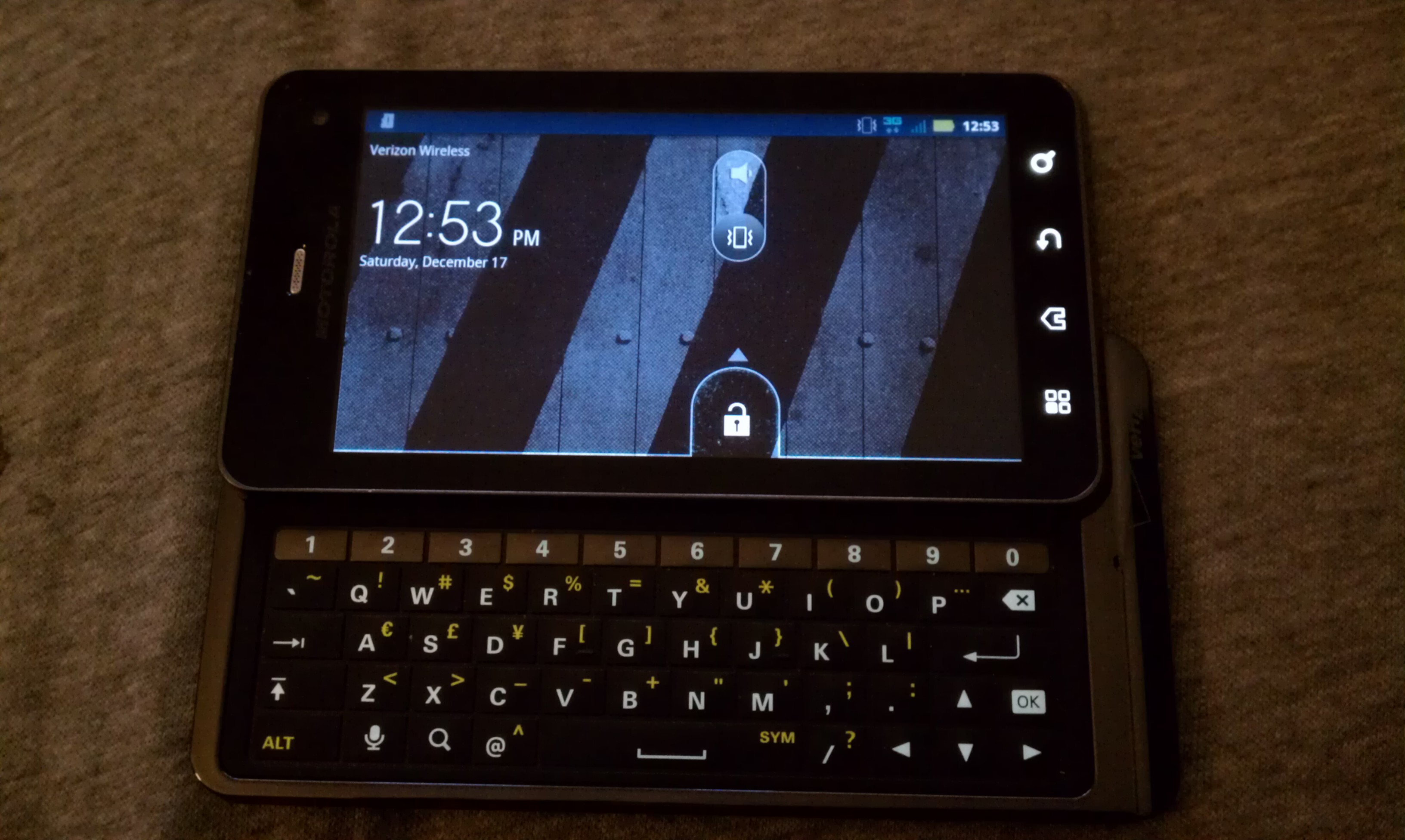
That form factor is fine, although not popular with consumers. I had a Droid 2 for a while, and found myself using the soft-keyboard more and more, particularly while not using connectbot.
But the keys are too small for the fingers (IMHO). And it's a fragile item in the hardware.
1) Depends on the keyboard - the research I've posted showed that against a netbook keyboard, an iPad in landscape mode had greater accuracy.
2) Agree on the autocorrect features and it's something I've noticed this with touchscreen typing.
It's taken me a while to get used to the auto-correct features. It used to be that they were basically a prompt that something was wrong that I'd retype mannually, now my instincts work with them.
They also act as autocomplete when you're used to them - either fully or with edits (it'll often prompt with the right root word but with a different ending - say regretfully instead of regretful - in some cases it's quicker to accept it's suggestion and then delete than to continue typing, once you're used to it).
What this really says is that virtual keyboards have practically no cost, and so utilizing them instead of physical keyboards saves more in marginal (and perhaps per-unit) cost than the revenue from lost customers that require a physical keyboard.
After all I can get a physical keyboard on the $5 electronic address book. Even understanding that that's a very cheap keyboard (though that also includes margins for retailer, manufacturer and all the other costs), you're telling me that that the cost of a physical keyboard is going to be a deal breaker on a $300+ smartphone?
They haven't sold because they've sucked. They had low-quality displays, crappy software, slow SoCs, and barely enough memory to be usable. The only keyboard phone left is BlackBerry, and that's not selling, well, because it's a BlackBerry.
There is a huge market for regular keyboard cellular devices. It's just that nobody's made a half-decent phone along with the keyboard.
If there is a device with a physical keyboard, a tapered, curved design, high quality components, a top-notch display, excellent build quality, the latest versions of Android, and good marketing, and you have a winner on your hands.
It's just that idiotic OEMs like HTC and Samsung would rather follow the fruity status quo than break from the norm. Only BlackBerry seems to have any balls today. Shame they're practically dead in the consumer sector.
Samsung has been immensely profitable with their strategy of 'following the fruity status quo' and have a huge design department and produce dozens of phones and if they thought there was a huge market for a flagship keyboard phone they'd presumably be all over it.
If people want a physical keyboard for their phone there are plenty of case options, e.g.: http://typokeyboards.com/
If there was a market for it, people would be making them, if you disagree with that they what are you doing on here, your fortune awaits...
Also worth seeing kids who've never used a physical keyboard to any great extent. I've seen them doing what must be close to 60 words a minute on a touch screen (tablet rather than phone but still). If you're used to it a touch screen keyboard isn't a massive limiting factor.
EDIT: This is interesting: http://psychology.wichita.edu/surl/usabilitynews/122/ipadtyp...
A study showing netbooks to have a typical typing speed of around 60WPM vs 40WPM for iPad, but interestingly it mentions that none of the participants had used an iPad.
I'm guessing that someone with significant experience on a particular OS / soft keyboard with correction could close that gap pretty sharpish.
EDIT2: http://thinkertry.com/2012/10/30/typing-speed-test-iphone-vs...
Someone testing iPhone, iPad and keyboard two years running:
2011: iPhone: 57 wpm, iPad: 60 wpm, Keyboard: 71 wpm 2012: iPhone: 51 wpm, iPad: 75 wpm, Keyboard: 82 wpm
It seems that practice does indeed close the gap. Given that the total install base for touchscreen devices will exceed that for PCs in the next 12 months (probably next 6), that greater level of familiarity will shortly become standard.