This is SOP (Standard Operating Procedure).
1. Imagine a scenario where an ambulance arrives as a first responder, and the EMTs [1] find that they cannot gain access to the emergency scene, because the home or other structure is locked or otherwise blocked. In this case, a firetruck would need to be dispatched, because it deploys with the correct equipment (e.g., Halligan bar [2], Denver tool [3], etc.) and personnel trained to handle such a situation. Also, ambulances are typically deployed with only two personnel, and that may not be enough in situations where items need to be moved or cleared to gain clear access to the emergency scene.
2. Most firefighters are cross-trained as EMTs. If they are local to the emergency scene, then they may be the first responders, while an ambulance is en-route.
3. Incoming 911 calls can often be confusing, with callers under extreme stress, experiencing situations that they have never faced in their lives. Imagine a situation where a caller is so distraught, overwhelmed, or focused on a life-saving effort, that they cannot articulate that they need firefighting support, in addition to an ambulance.
The bottom line: in an emergency situation, it is better to have more help on-hand than too little.
[1] https://en.wikipedia.org/wiki/Emergency_medical_technician
Interesting anecdotal data: here in Italy you have to call the fire department to get a fire truck out, whereas they're part of the standard package described above in the US. Fires aren't that common here because of construction materials, so while you see plenty of ambulances and police cars whizzing around, fire trucks are a far rarer sight than in the US.
Since being here, I've observed fires are quite common amongst the disaffected youth who enjoy burning cars and motos when they are bored.
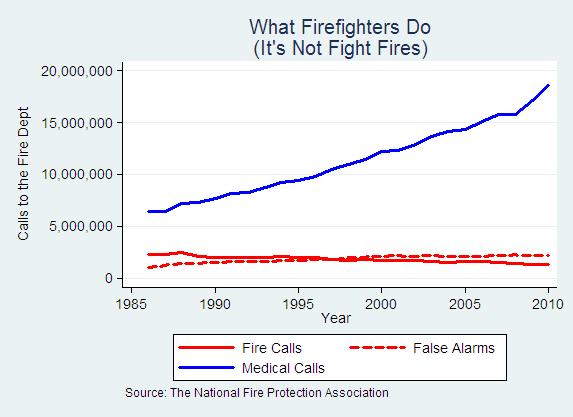
There may even be a happy middle-ground with regards to firefighters. In eastern King County, they don't send out a firetruck and three firefighters for non-lethal medical emergencies anymore -- they just send a single firefighter in an SUV.

And what about an anti-terrorist unit? Imagine a scenario where...
Are there any statistics on the number of cases on which a firetruck was really needed?
Of course, the risk is that if the one vehicle has an accident in itself, there's no others that can fall in right then.
Of course the Feds want as many police as possible because of the laws militarizing them and actually disincentive separete rate fire protection with rigged grant processes.
Because we need firefighters anyway, and EMT's in ambulances are often volunteers or paid substantially lower than a fireman in most areas of the country. Bear in mind, you're also talking about putting additional equipment in what is already a jam-packed ambulance, if you end up needing to dispatch another vehicle it might as well be a fire-truck (you never know when someone forgot to say "my house is on fire" when they called in because their wife isn't breathing after dragging her out of the house).
Because that's very expensive (increasing initial and ongoing costs for training and equipping every first-response unit), and in the many cases where more than the minimal response is known to be necessary from the first call, and in cases where those departments aren't acting as first responders, it doesn't save anything.
> I'm not an expert, but that would reduce overhead and cross-department communication needs.
No, training and equipping EMTs to be adequate-for-most-cases firefighters and cops, firefighters to be adequate-for-most-cases cops and EMTs, and cops to be adequate-for-most-cases EMTs and firefighters would not reduce overhead. Quite the opposite.
In general, the EMTs you see carrying out an elderly woman are people with a few months of training. When people are getting stabbed, shot, or on the brink of life, you sort of need people with better training.
http://dcj.state.co.us/ors/images/Stats%20Images/crime%20rat...

The original argument is in the book. The idea is that children from disadvantaged families are more likely to be aborted, while at the same time, children from disadvantaged families are also more likely to be crime prone. So, logically, abortion reduces crime with a twenty year delay. Personally, I like the lead theory[1] better, but it doesn't matter. It's not about eugenics or genes.
1 http://www.motherjones.com/environment/2013/01/lead-crime-li...
What?! No, I believe criminal tendencies are produced from your environment. Kids in bad homes tend to grow into bad people.
Link: http://www.freakonomics.com/2005/05/15/abortion-and-crime-wh...
Isn't this cause and effect? Crime is lower because we are hiring more policemen. That is certainly one conclusion from Freakonomics.
This is just a digression, because I do think the "Cops as Warriors" model is very scary, as "collateral damage" becomes acceptable in a war.
Also, Levitt did say increased policing decreased crime, but only caused around 5% of the decline ( http://pricetheory.uchicago.edu/levitt/Papers/LevittUndersta... p. 184)
[1] http://www.zcommunications.org/steven-pinker-on-the-alleged-...
Among other things, it argues against the concept of normalizing death tolls of war by population (when the primary variable under consideration is the likelihood of one person to die violently across different times), it tries to cram as much contemporary political rhetoric as it can, and it uses highly pathetic analysis such as "the phenomenon of structural violence, or the kind of violence that is “built into the structure” of social relations" (yes, because past societies based aristocracy that brutally extracts what it can from the majority of the population is so much less structurally violent) and "the increasingly savage global class war of the 1 Percent against the other 99, and the “endemic undernutrition and deprivation”" (conveniently ignoring the fact that endemic undernutrition was the normal state of the world prior to recent times).
It staggers me that someone can actually read that and take it at face value. His entire thesis seems to be "ignore statistics, look at these pretty individual cases" and "look at how bad the world is", completely missing the point that Pinker didn't actually say the world is peaceful, only that it is more peaceful than it has ever been before, and completely failing to make any case against this.
http://m.motherjones.com/environment/2013/01/lead-crime-link...
http://www.telegraph.co.uk/news/uknews/crime/9790009/Was-lea...
Two words: public unions.
Perhaps the word you're looking for is "lobbyists" and "demagogues".
We shouldn't contort ourselves to avoid the simplest answer: the state is getting what it paid for. The US incarcerates its population more than any known state on earth. That isn't unions' fault — other countries with more powerful unions don't jail themselves like this.
If any enemy nation did this, we wouldn't have any illusions. But we refuse to apply the same logic to ourselves, nor conclude as Chomsky did, "Remember, any state has a primary enemy: its own population."
Otherwise, it might be obvious why police are fighting a war, and who their enemy is.
It is, in fact, the unions' fault. The prison unions and police unions are huge proponents of the drug war, longer sentences, etc. It isn't just there fault, of course, America's general Puritan streak helps, but the public unions have really capitalized on that.
> other countries with more powerful unions don't jail themselves like this.
What happens in other countries isn't a good model for the U.S. Sub-segments of the population don't viscerally hate each other in Frankfurt or London the way they do in L.A. or Detroit. It will be interesting to see what happens to the internal social cohesion European countries have enjoyed post-WWII as middle eastern immigration continues to rise. A few more muslim youths rioting in Paris and I think you'd be surprised by what kind of police escalation Parisians will be willing to put up with...
It's already here. Every time there is some discussion of Muslim extremism or immigration we have a few HN members saying things that, in even conservative parts of the US, would leave your jaw hanging.
In the US it's common for the more liberal folks to perceive Europe has some kind of bastion of social enlightenment. This view seems to fall apart once you actually inject some different skin colors into the population.
Nixon declared the "War on Drugs". He also pioneered the "Southern Strategy", and many elements of his campaign are now well accepted to have been used as code words.
It wasn't a personal appeal to the puritan morality of drug users to stop, it was an appeal to the fears of scared whites.
The "War on Drugs" almost exclusively effects poor, minority communities and individuals.
In three decades, the California Correctional Peace Officers Association has become one of the most powerful political forces in California. The union has contributed millions of dollars to support "three strikes" and other laws that lengthen sentences and increase parole sanctions. It donated $1 million to Wilson after he backed the three strikes law.
It's not precisely what 'rayiner was saying, but the prison guard union is definitely pushing for more people in prison.
Give me a break. Unions have a lot of problems but if they were so damned influential, maybe every public sector union except for federal security wouldn't have been losing jobs and hours for the last 10 years.
Of course certain unions see an interest in the security state. Other, bigger unions are generally opposed but don't have skin in the game. Whatever. The security state is much bigger than the police and prison guard unions.
Fundamentally, the issue here is political game theory where there's no upside to fixing things and a lot of upside to painting your opponent as 'soft on terror' or 'soft on crime'. So policy only moves in one direction, and that direction is often stupid. Unions' wishes are just drops in the bucket compared to that.
Belfast still has road barriers that are raised at night blocking roads between the Shankill Road and Falls Road areas - not to mention huge walls:
http://en.wikipedia.org/wiki/Peace_lines
Edit: To be fair, I agree with your point, but there are some very noticeable dividing lines in European cities.
[NB. This is not intended as a criticism of Belfast, please go and visit - we went recently and had a great few days and I want to go back.]
[I agree that these cases are exceptional].
As opposed to regular prisons which are just slave camps? What exactly is the moral difference between the state of living between public and private prisons? (I take it that you were implying a difference exists, but I could be mistaken.)
But whatever perverse incentives and moral hazards already exist for state prisons, they are double when there is a profit motive for maximizing headcount. Moreover, the taxpayer still ends up footing most of the bill for private prisons; in state-run institutions, they at least have a budgetary incentive to moderate sentences, rehabilitate, and reduce recidivism. In a private prison, an inmate who finds Jesus/Buddha/etc and becomes an honest citizen is a blow to the bottom line.
I now understand that you were criticizing the incentive structure of prisons, but it didn't seem that way.
> Moreover, the taxpayer still ends up footing most of the bill for private prisons
I would therefore not call them private prisons. Perhaps, crony prisons or quasi-public prisons?
> In a private prison, an inmate who finds Jesus/Buddha/etc and becomes an honest citizen is a blow to the bottom line.
How can this be true while tax payers are simultaneously footing the bill? Moreover, isn't a large part of the comments in this thread about how there is an incentive structure in public prisons to keep more prisoners? (The correctional officer unions.)
> in state-run institutions, they at least have a budgetary incentive to moderate sentences, rehabilitate, and reduce recidivism.
That kind of makes sense. But when there are unions, and the jobs of union members depends on the number of prisoners, it becomes much less clear.
Very true, and equally applicable to many other "private" companies (Lockheed-Martin comes to mind).
> How can this be true while tax payers are simultaneously footing the bill?
Private prisons (that include inmate labor) charge from both ends: per-head to the taxpayer (ostensibly at a lower rate than if the state handled it in-house), and per-hour to businesses seeking cheap labor. State prisons have only the first incentive, with the countervailing force of finite tax revenue.
Also, the prison guard unions have the same incentive to lobby (and/or support the lobbying of their parent corporation) regardless of who signs their checks. I would claim that union influence and lobbying is a constant in either case.
> But when there are unions, and the jobs of union members depends on the number of prisoners, it becomes much less clear.
Agreed. It is bad policy and a waste of taxes in either case.
Well, actually, prison guard unions did lobby for things like three-strikes laws to increase incarceration rates. [1] And yes, unions in general are weaker in the US, but public employees' unions haven't waned in power anything like their private sector counterparts.
[1] http://caprogressivemessage.com/2011/03/04/the-california-pr...
(I know, I know, "it's a left-wing California site!" But it's well-sourced and one of many articles saying the same thing when you google for who is lobbying for three-strikes laws and whatnot.)
Citation needed.
Too bad we're doing that nation building away from home.
One of the reasons for this is also that fire stations are often far closer to the scene of a call (fire suppression being something that benefits from being distributed vs. centralized hospitals) so the fire truck will often arrive there first, and can render aid until the ambulance arrives.
What you don't want is the $10,000 bill if they send a helicopter out.
If you frequently find yourself in locations where a heli may be needed you may want to invest in a membership with your hospital or regional network (in the northwest US (ID, OR, WA) there is the life flight network, $60 a year covers any costs that your insurance don't pay).
In response to a similar observation that I once made, a friend suggested that police at a non-law enforcement emergency act as ad hoc project managers. "You need what, Mr. EMT? I'll have it for you directly, and I'll have those cars blocking access towed too. ... You lot! Back away!"
Devil's advocate: that shows they are effective and crime would be even lower with increased budgets.
Please don't conflate police looking for make-crime, with generous responses to emregency situations risking irreversible damage to life and property.
Having big budgets but less crime means these swollen budgets end up being wasted on a lot of "fun" things like military gear. (Did you know that Wisconsin has two anti-terrorism centers? One in Madison and one in Milwaukee.)
I think this has something to do with politicians being unable to touch the budgets of first responders.
Tangentially, due to stringent building codes, the number and severity of fires has been dropping dramatically over time. Yet spending on fire protection only goes one way: up. http://www.usgovernmentspending.com/spending_chart_1950_2010...
Today in the US, if you call 911 about an emergency medical condition, they will often send a fire engine along with an ambulance and a cop. It makes me wonder if firemen and firewomen are so underutilized they've ended up with mostly make-work.