Interesting anecdotal data: here in Italy you have to call the fire department to get a fire truck out, whereas they're part of the standard package described above in the US. Fires aren't that common here because of construction materials, so while you see plenty of ambulances and police cars whizzing around, fire trucks are a far rarer sight than in the US.
Since being here, I've observed fires are quite common amongst the disaffected youth who enjoy burning cars and motos when they are bored.
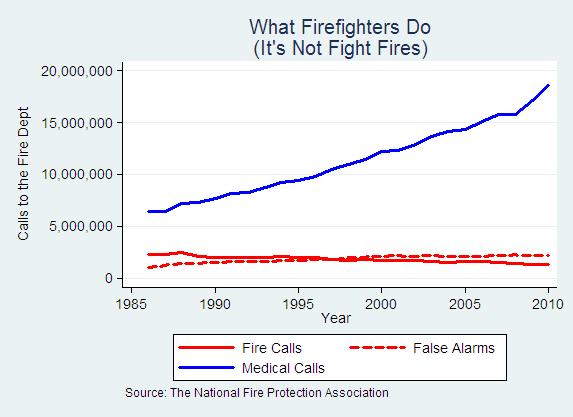
There may even be a happy middle-ground with regards to firefighters. In eastern King County, they don't send out a firetruck and three firefighters for non-lethal medical emergencies anymore -- they just send a single firefighter in an SUV.

And what about an anti-terrorist unit? Imagine a scenario where...
Are there any statistics on the number of cases on which a firetruck was really needed?
Of course, the risk is that if the one vehicle has an accident in itself, there's no others that can fall in right then.
Of course the Feds want as many police as possible because of the laws militarizing them and actually disincentive separete rate fire protection with rigged grant processes.
Because we need firefighters anyway, and EMT's in ambulances are often volunteers or paid substantially lower than a fireman in most areas of the country. Bear in mind, you're also talking about putting additional equipment in what is already a jam-packed ambulance, if you end up needing to dispatch another vehicle it might as well be a fire-truck (you never know when someone forgot to say "my house is on fire" when they called in because their wife isn't breathing after dragging her out of the house).
Because that's very expensive (increasing initial and ongoing costs for training and equipping every first-response unit), and in the many cases where more than the minimal response is known to be necessary from the first call, and in cases where those departments aren't acting as first responders, it doesn't save anything.
> I'm not an expert, but that would reduce overhead and cross-department communication needs.
No, training and equipping EMTs to be adequate-for-most-cases firefighters and cops, firefighters to be adequate-for-most-cases cops and EMTs, and cops to be adequate-for-most-cases EMTs and firefighters would not reduce overhead. Quite the opposite.
In general, the EMTs you see carrying out an elderly woman are people with a few months of training. When people are getting stabbed, shot, or on the brink of life, you sort of need people with better training.
This is SOP (Standard Operating Procedure).
1. Imagine a scenario where an ambulance arrives as a first responder, and the EMTs [1] find that they cannot gain access to the emergency scene, because the home or other structure is locked or otherwise blocked. In this case, a firetruck would need to be dispatched, because it deploys with the correct equipment (e.g., Halligan bar [2], Denver tool [3], etc.) and personnel trained to handle such a situation. Also, ambulances are typically deployed with only two personnel, and that may not be enough in situations where items need to be moved or cleared to gain clear access to the emergency scene.
2. Most firefighters are cross-trained as EMTs. If they are local to the emergency scene, then they may be the first responders, while an ambulance is en-route.
3. Incoming 911 calls can often be confusing, with callers under extreme stress, experiencing situations that they have never faced in their lives. Imagine a situation where a caller is so distraught, overwhelmed, or focused on a life-saving effort, that they cannot articulate that they need firefighting support, in addition to an ambulance.
The bottom line: in an emergency situation, it is better to have more help on-hand than too little.
[1] https://en.wikipedia.org/wiki/Emergency_medical_technician
[2] https://en.wikipedia.org/wiki/Halligan_bar
[3] https://en.wikipedia.org/wiki/Denver_tool