All that aside, I don't see why SF can't move in a more technocratic direction. There was apparently no lack of Google/Facebook/startup engineers and programmers willing to jump in and help out the Obama campaign on a massive scale - do those same people have no interest in local politics?
http://www.sfbg.com/print/2012/11/27/plutocrat
Its ham-handed propagandizing is kind of funny. Look at the rapacious black eyes on the Conway cartoon monster we've drawn! Despite being born and raised in SF, he's a rootless carpetbagger! He's involved in "a long list of other shadowy [investment] businesses, all incorporated in Delaware for its lax tax and regulatory policies"! He supported measure E's tax breaks for tech companies! (Unmentioned: SFBG itself endorsed that same measure.)
1. Affordable short-term housing or hotels? Yeah, you're going to be staying across the bay. 2. Parking is miserable and parking enforcement are total fascists. You can't even refill a meter. 3. Pandhandlers everywhere. EVERYWHERE. I'm not talking about just homeless, I'm talking about scientologists, 9/11 truthers, people raising money for Africa or the cat shelter or whatever. I've never been as harassed on the streets as I've been in SF. Just because I stopped for 3 seconds does not mean I want a pamphlet, dude.
SF loves being a self-imposed alternaculture concentration camp which is fine with me when I don't have to go there on business.
For too long, tech players - in denial - have swept this under the rug.
But how would we apply technology to government? What would we do, technologically, to curb the massive addiction and homelessness problem in the city, and how would you use technology to bust unions down to size?
There are a lot of places technology fits in the world, but this particular one is purely political.
http://www.phillymag.com/articles/busting-philly-unions-pest...
A few days ago, CNN listed Hong Kong, Seoul, Singapore, London, Paris, Madrid, NYC, Tokyo, and Guangzhou as being in the top list of subway systems. At least some of those were started either by the government or by a government owned/funded company.
The US has a long history of preferring business solutions over government ones. Compare to 1800s France where large-scale engineering projects were seen as part of the government's domain. I therefore suspect that your observation reflects a US-centric view, where the default view seems to be that the government is incapable.
Also, there's a possible selection error. If all of the worst systems were "originally built by private companies" and only 40% of the world-class systems were done that way, then wouldn't that suggest that early government involvement leads to better systems?
Without that information, it's very hard to use your observation to make any sort of informed decision.
I suspect the same is true for your other examples as well.. how do you "private sector" build something like a subway? The closest you could conceivably get would still be quasi-public, once you get done with all the right-of-way and eminent domain concerns.
BTW, you "private-sector" build a subway the same way you do an oil pipeline or a transcontinental railway (eg, Hill's Great Northern Line http://en.wikipedia.org/wiki/Great_Northern_Railway_%28U.S.%... )
I wouldn't call the CTA Rail world class. Compared to NYC or London it has limited stops and doesn't touch large chunks of the city.
CTA: http://www.transitchicago.com/assets/1/maps/P19_2012_CTA_Rai...
Tube:
http://www.tfl.gov.uk/assets/downloads/standard-tube-map.gif

Chicago's bus system doesn't really make up for the lack of stops. Lots of people consider a car mandatory here, unlike London or NYC.
The parts of the city that aren't directly served by train are served by a relatively effective bus system. I wouldn't say the CTA buses are beloved of anyone, but they're night and day compared to SF.
The public ends up funding projects that might be valuable to society, but that won't turn a profit. Of course, this tendency needs to be monitored to make sure that the projects actually are of value, but I would say that public transit in San Francisco-- if nothing else, it brings down real estate prices-- is clearly in that category.
I do not intend to say that public projects are always well-managed, because that's demonstrably false. However, there are a large number of badly-managed private projects as well. In terms of turning a profit, though, the private sector almost always has better material to work with, because it takes the projects that are visibly likely to be profitable.
More likely, that's correlated with something else that is the real explanatory variable (history, etc...). John Kay had a good article on a similar topic: http://www.johnkay.com/2013/01/16/london%E2%80%99s-rise-from...
So no, you don't need a flat grid to have great public transit.
Best to compare San Francisco with...Lausanne...or Chongqing (or any city with a bunch of hills that is fairly vertical).
How fast can you get from 4th & King to the SJC?
Nevertheless, comparing San Francisco to Lausanne is unfair. Lausanne provides better infrastructure for a smaller population.
Tokyo is in no way even close to flat. It has some flat areas (e.g. landfill in Tokyo bay), but there are huge numbers of very hilly areas as well (including many popular commercial hubs and densely populated areas in the city center). Not gentle hills in many cases either, but quite steep.
[... and if you go to the outskirts, there are actual mountains within the Tokyo city limits!]
One difference with with SF, of course, is that Tokyo roads don't form a rigid grid that ignores the topography....
> Japan cities spend a lot more money on infrastructure than even American cities
Tokyo mass transit is overwhelmingly private (owned, run, and financed), especially if you're talking about rail.
The Angel's Flight Train is still there.
The worlds oldest Freeway, the 110 goes through a valley.
The 5, 101, 10 and 60 wrap around all kinds of hills within a few miles of downtown LA.
Limited horizons and change make things interesting. You don't want complete chaos, because things also have to "make sense" to some degree (so complete randomness, like a stereotypical suburban cul-de-sac maze, tends to be bad), but variation is a good thing.
[A nice city to look at for interesting approaches to urban structure which are both somewhat regular, but more interesting that a grid, is Edinburgh, which has seen successive waves of fairly successful urban renewal over centuries, resulting in one of the most beautiful and fascinating cities in Europe. In the "new" parts (150-250 years old as opposed to the older and more organic medieval parts), Edinburgh streets have such features as small localized grids, sized as to with care to avoid large-scale monotony, occasional "circuses" acting as focal points, streets in gentle arcs which are practical for transportation, and yet maintain a constantly evolving street view and horizon, terraces along the sides of parks, etc.]
It's a localized example of the effect urban structure can have, not a denigration of the entire city. So, please, don't take it as a dig against Chicago; I rather like Chicago in many ways, and much of my family lives there. I used the above example only because it's one of the more extreme cases I've encountered.
As for the "it's easy to find addresses!" argument in favor of large-scale grids, well, yes, but in my experience this is fairly unimportant for the actual residents of a city. Most people don't spend any significant amount of time travelling to completely random locations, and to the extent they do, every city evolves methods of way-finding that suit it. I think it's much more important for the residents that the city actually be a nice place to live, and part of that is being beautiful / interesting.
[For tourists, yeah, extremely simple way-finding can be a significant advantage, but I don't think cities should be designed for tourists over the needs of those who live there...]
Salt Lake City grid system was also not designed for tourists. It was designed for travelers, yes, and I believe it was part of the vision that SLC would be looked at as a model city, with a strong Cartesian/classical influence. According to Wikipedia, "In these western cities the streets were numbered even more carefully than in the east to suggest future prosperity and metropolitan status."
Also, a grid system made it easier to subdivide the land which was newly part of the US.
So to say that the grid system is influenced by tourists is a bit of an exaggeration.
[I lived there in the '90s, though, and I'm a bit scared to return for fear that the city has been ruined by its new-found position as a seat of "power" (haha); the sharp-suits crowd, "gotta pave over that park and widen those roads for my flash car!", etc...]
I definitely would not trade hilly SF for a flat SF.
Here's a complete system map: http://transit.511.org/static/providers/maps/SF_122220102111...

The equivalent CTA system maps seem to show just as much bus coverage as Muni's bus coverage. (Now, how many of those bus lines keep running after 23:00 is another question, entirely.)
You say you didn't like NYC as much pre-1993, which is when Koch left office after 12 years. But didn't the mayor then have much of the same powers as the mayor now? Doesn't that suggest that the 'benevolent dictatorship' then was the source of the problems?
In any case, and quoting Wikipedia: "Most major and large American cities use the strong-mayor form of the mayor–council system, whereas middle-sized and small American cities tend to use the council-manager system." And yes, San Francisco uses a 'strong mayor' system.
Which seems to imply that a benevolent dictatorship system can also lead to disaster.
(You suggest that the alternative is to leave things up to the market. That is not the case. There are other forms of municipal government.)
Therefore, I don't understand how your observations of recent NYC history can be applied to other large cities in the US.
His train of thought is consistent. The idea is that benevolent dictatorships can either be a great force for good, or wildly incompetent. As compared to a market or ballot-based governments that are practically guaranteed to be incompetent. Lesser of the evils, if you will.
> "(You suggest that the alternative is to leave things up to the market. That is not the case. There are other forms of municipal government.)"
OP specifically cited North Virginia, with a market-based government, as a failure. How does that interpret as an endorsement of market-based government?
Compare: Westchester County to Fairfax County, roughly similarly sized suburbs. Westchester has all these cute little downtowns with grid streets (ish) built around Metro North stations. Traffic is kept under control because a large fraction of people commute to the city by rail. Fairfax County sucks in comparison. No transit to speak of, awful traffic, etc. Its the result of urban planning that basically consists of (mark of a subdivision and let the developers do whatever they want).
Arlington is tolerable, but only because development sprung up around Metro lines. Ditto Alexandria, which at least has a centrally planned downtown core.
The commercial areas are built as far as possible from residential ones
My wife grew up in a town of 2000 people in Iowa. She hates Fairfax County for being so isolated. Her town was small and rural, but it had a walkable downtown with a little street grid. The town planners long ago made it that way in case it ever became a bustling megalopolis.
You wouldn't be saying this if you were a person of color living in the Bronx or parts of Brooklyn, because things have gotten worse for those folks due to policies of selectively enforcing vice laws and programs like stop and frisk that have become popular under Guilliani and Bloomberg.
Of course, why crime rates have generally fallen over the last couple of decades in cities like NYC isn't well understood and no one person or administration can claim that they are responsible. However, we do know that NYPD policies are enforced in a way that promotes racism and class disparity and that Bloomberg has been a supporter of those policies.
It is important to realize that a benevolent dictator doesn't really exist and having balance in government is necessary, otherwise the people who do get shafted by any given administration get even less of a voice and support.
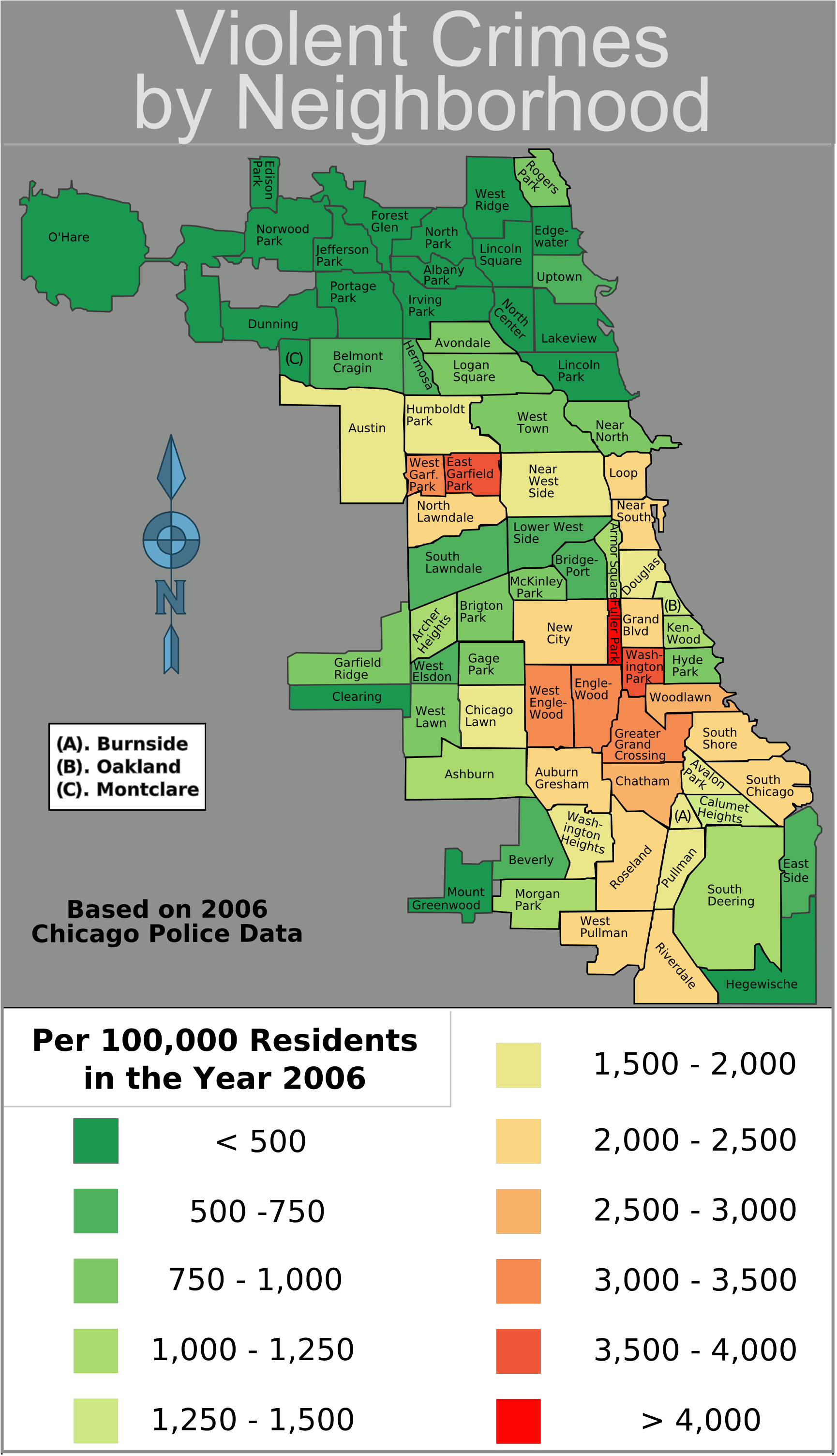
Those neighborhoods are where crime happens. A map of violent crime in Chicago (a city that's 65% black or hispanic): http://upload.wikimedia.org/wikipedia/commons/2/29/Chicago_v....
A map of Chicago by race: http://www.radicalcartography.net/index.html?chicagodots
What do you want the police to do, patrol around Lincoln Park and Lakeview where all the wealthy white people are?
No, but city and state gov't should be responsive to the causes of these issues and be proactive about solving them. Usually that will mean looking at class and race disparity and implementing policy that will provide better opportunities for those people, as well as defeating existing roadblocks that prevent those people from taking control of their lives.
I still am confused how NYC became "escape from NY" in the 1970s and early 1980s.
Perhaps it's a problem with city governments trying to do everything under the moon. Cities that keep to the basics are usually well run and effective.
Oh, and this is a map of the Muni: http://0.tqn.com/d/sanfrancisco/1/0/U/N/-/-/sanfranciscomuni...
This is a map of the CTA elevated line: http://www.transitchicago.com/assets/1/maps/ctatrainmap.png
This is a map of Caltrain: http://www.caltrain.com/Assets/maps/Caltrain+Zone+Map.jpg
This is a map of Metra: http://www.mrl.ucsb.edu/~yopopov/rrt/us/chicago/rr_chicago_m...
I found this quote interesting: "For all its scotch-soaked flaws, the city of yore did not suffer from these problems. While archaic and stridently antidemocratic by today's standards, the system of government cobbled together by a citizens' commission in 1931 largely did what our forebears wanted it to do — mind the store and eliminate rampant corruption."
I think municipal governments should be run by benevolent dictators. If you leave everything up to the market, you get disasters like Northern Virginia. If you go to the ballot for everything, you end up with disasters like San Francisco. No, benevolent dictators are the way to go. I'm a huge fan of Guilliani and Bloomberg's work in NYC. Love them or hate them, you'd rather live in NYC circa 2013 than NYC circa 1993. I have high hopes for Rahm Emmanuel in Chicago. He apparently came up with his last budget using a process for soliciting input from others in the government that boiled down to "fuck you!"