Meanwhile, Apple sold 500+ million HiDPI 4:3 displays on iPads. Do they have a supply chain lock on 4:3 screens?
Hell, Apple shipping millions of 4:3 should keep them reasonable affordable. Same with 16:10 back when those were still a thing (because of the notch Apple now uses 9:5.85 displays to retain a rectangular 16:10 fullscreen).
I remember many eons ago in the last 2000s to early 2010s when I wanted a 16:10 monitor for my PC and the price difference between 1920x1080 and 1920x1200 or between 2560x1440 and 2560x1600 was massive, that it made no sense to get the few extra vertical pixels of the 16:10 unless you were loaded and money was no issue.
Even 4k 16:9 monitors a few years after launch, were cheaper than 16:10 2560x1600 ones which have already been on the market far longer. Crazy.
> old 16:10 Thinkpads with modern displays.
Yes you're talking about the really old 16:10 ones from the mid to late 2000s, right before they switched to 16:9 cause they were cheaper to make due to the HD TV era. Add then today they switched back to 16:10.
So no, it's no BS that scale allows for much cheaper products, but Apple could stick to 16:10 since they never catered to cheap and it would probably cost them more in SW dev and tooling to reengineer their OS GUI and chassis for 16:9 than to keep the production lines as is since their product line back then had like 3 laptops total.
And maybe start with good faith before screaming BS. No need to be rude just because people have different opinions and experiences than you.
Look at how Apple never went 16:9 except for one model, the 11-inch MacBook Air.
It's irrelevant what you believe if you're wrong. Laptop LCD displays can be cut form the same master glass as TV LCD displays more economically if they share the same aspect ratio and also share the same COGs(chip-on-glass) that drive the exact same TV resolutions 1366x768 and 1920x1080.
>Look at how Apple never went 16:9 except for one model, the 11-inch MacBook Air.
Apple never competed on the price war. For them, $5 extra on the BOM didn't matter at their margins compare to the likes of Acer/Asus/etc.
TVs got bigger very quickly after LCD took over-- there were a few years where they had ~22-25" sets as the small "dorm room" size models, but you walk into Best Buy and there's barely anything smaller than 32" now.
Conversely, mainstream desktop screens didn't get much above 27" before you started going exotic, so the typical monitors you're putting on a million desktops are not using the same panels as TVs.
I suppose you could say that a "master glass" could be cut into 16:9 panels for both TVs and monitors, but wouldn't it require the two panel sizes to use the same pixel density?
Also they shared the same COGs(chip-on-glass) to drive the TFT panels. That's why laptops had the same HDTV 1366x768 resolutions.
1080 pixels is too little vertical space to read documents.
I still use 15+ year old Thinkpads with 1366×768 pixel screens (a bit cramped) and a W520 with a 1920×1080 screen. Twisted nematic screens.
For me, given the 20th century laptops I started on, I think they're great. Not perfect, but good enough to put in 2 weeks working 9-5 on one of them, no problem at all.
In the meantime, I’m waiting on a display converter board to show up from China so I can install a modernish 1440p display in my T420.
[1] e.g. https://regmedia.co.uk/2025/07/30/hill7.jpg (the presence of a Break key almost makes me cry)
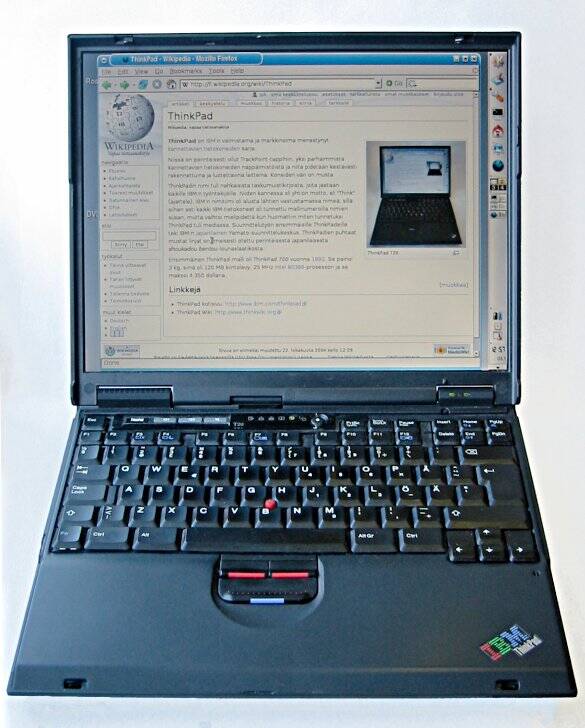
Doesn't this photo show an inverted T?

While half-height arrow keys have become common on laptops, that's probably not what GP (https://news.ycombinator.com/item?id=44769440) meant by "normal".
ThinkPads generally use slightly smaller keys for the arrow keys, but still significantly taller than half-height, like for example here: https://p3-ofp.static.pub/ShareResource/560x450/SSNP/4Y40X49...
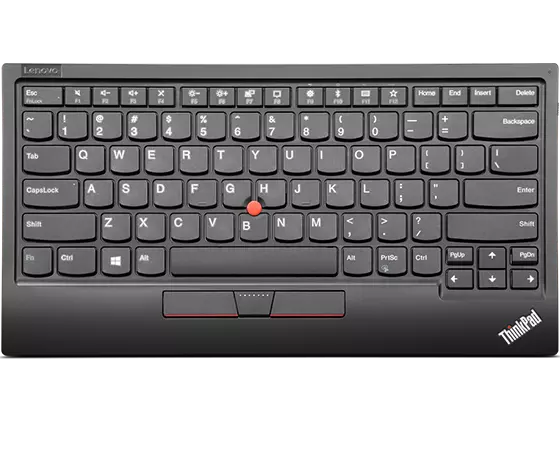
What people really want is a full-height inverted T like on this Lenovo gaming laptop: https://p1-ofp.static.pub//fes/cms/2025/05/21/uft1eixrszoryp...

It’s not a bad keyboard. As far as laptops of the last decade go, it’s even a good one. But the up/down arrows sucked on the MBP and they (though not left/right) suck on the FW13, I expect(?) because a rectangular keyboard ends up cheaper than one with protruding arrows.
Furthermore, my (grandparent) comment was about how vertical shrinkage made the keyboard smaller but the FW13’s taller screen didn’t restore the missing keys, and if half-size up/down arrows just suck to use, Home/End/PgUp/PgDn hidden behind Fn suck to a Pavlovian extent: I didn’t realize how much the MBP trained me out of using them before I had to use an older ThinkPad for a bit that had them on separate keys. I won’t even mention Ctrl-Break except to look in its direction wistfully.
Finally, the Copilot key is of course a distraction. I don’t know what it actually sends on those keyboards, but if I can map that to Compose I couldn’t care less about what’s drawn on it. It’s just sad that, after everything, that distraction is what ended up being the first substantial change to the FW13’s keyboard.
There are talented keyboard makers like Tex that already pulled this off, making better hardware than Lenovo itself, and you could instantaneously win most Thinkpad users over, likely permanently.
Whatcha get instead? Garbage like silly rolling-display laptops. Or even worse, The Homer of the laptop world: these bizarre contraptions with two or three foldout displays. It's just missing a cup holder.
Framework borked it here as well. I just don't understand why you waste time, energy and money on developing and building a substandard machine (Framework 12) in an outdated form factor.
The sad part is, the Framework 13 has a 3:2 display (with a stupidly large bottom bezel, too, for good reasons), but still uses a bog-standard modern laptop keyboard, including (unlike the ThinkPad) the miserable half-height arrow keys. They did bother to make a Copilot key, though. Just not a better keyboard.