> The economists who claim that tariffs will harm normal Americans were also the economists who claimed that sanctions would destroy the Russian economy. They had the opposite effect, for reasons that still remain somewhat unclear.
> It is also notable that Chinese competitiveness has only increased as they have engaged in decades of state economic planning and market barriers. The economists who have told us since Reagan that this is inefficient and stupid might be ... wrong.
You are quite wrong there with all of those three points.
#1. a lot of food items come from Mexico, South America, Asia also. Housing material from Canada and China. A lot of meds come from Asia especially India. Majority of Stationary is manufactured in China as well.
#2. Russia is struggling with economy. But remember it has a lot of help from China, Iran, N Korea, and India. That offset a lot of sanctions. Europe is still buying gas from them.
#3. I’ve to remind you this - China exports in trillions.
#2. It's hard to know what's going on in Russia.
#3. High exports don't disprove GP's claim about "state economic planning and market barriers". In fact, they prove the success of those policies and help China maintain a $1T trade surplus, the very opposite of the US's situation.
Isn't ~10% spending on food like a historical best of any country ever?
The context of this is the impact of tariffs on households' budget, and in that context, invoice value is fine, because that's the value on which tariffs are applied. 30% tariffs don't mean all foods go up 30%, it means it goes up by 6% (20% of 30%).
Russia may now assume the role of the little brother of the East, having poured vast resources into the invasion while China and India have bided their time, watching the US-EU relationship deteriorate. Without getting too ahead of myself, it almost feels like watching the stars align perfectly for China, which could emerge as the “good guy” on top — much like the USA after the 1950s. They didn’t have to go to war, yet they’ve benefitted from a Russian military failure, Trump-related chaos, a possibly weakened NATO, increased exports to the EU and other markets, and more. Culturally, Hollywood may even shift to Beijing, and our grandkids might find it strange that Europeans once idolized the USA. It remains to be seen how China will manage to downplay its repression.
I visited Russia 15 years ago and have long wanted to return — assuming those in power were replaced with a more friendly alternative — but I’m no longer sure I want to. I imagine it will feel similar to the last years of the Soviet Union with widespread alcoholism and child prostitution. Historical significance only goes so far when signs of social despair are visible on every street corner.
That will never happen while China remains a communist nation.
This is _very much_ up for debate. It's been a couple of years since Russia went completely dark on publishing key numbers on their economy. [This was three years ago.](https://www.youtube.com/watch?v=ZRgS6gpiMX0). They had a large war chest ready before they went to war (part of which has been frozen in the west), and there are a lot of signs that they are on their last stretch before things go really bad for them.
Predicting _when_ things go bad is very difficult, so I do not hold that against said economists. The most telling sign is that the first thing the Russians ask for is for sanctions relief before any peace negotiations.
This is a country where its leader/president/dictator/mafia don/caporegime is quite literally a multitrillionaire.
Russia asking for sanctions relief is just relieving pressure for Putin as the people who keep him in power (the oligarchs) need access to the money they've stolen and want to be able to buy more yachts and football teams. Putin and his circle, as well as the oligarch class, don't give a fuck about the average Russian.
They didn’t have the opposite effect. They were ineffective in general, because Russia has large trade partners not aligned with the West and it has been preparing for it, optimizing the government apparatus for 20 years (financial bloc for 30 years). There are plenty of A-players (head of central bank, minister of finance etc), working industrial policy and digitalized processes, and they can make decisions very fast both politically and bureaucratically.
New trade routes and spinning up local production will take time (likely longer five years) so the consumer will pay a price. Question is how high it will be.
To purely imported goods (a lot of tech for example): cost will go up substantially.
To Russia: They are currently in a war economy. You will likely not really see a collapse coming until it is to late. Banks have been forced to give far to cheap loans to the arms industry complex which are unlikely to ever pay them back. This partially masks the true cost of the war.
Let's so how this proceeds.
New trade routes and spinning up local production will take time (likely longer five years) so the consumer will pay a price.
That seems backwards. A trade deficit (more goods coming into the country) should be balanced by a capital outflow (money leaving the country). We've sustained that for decades by printing more money and sending it around the world.
Some people think that's a good deal, because we get real stuff in exchange for money we create for nothing. But what will have left when other countries no longer want our money?
Edit: As the comment below points out, I should technically ask what happens when they no longer want U.S. government debt?
Make no mistake, these countries are getting something in return for the extra goods and services they give to us. It is not for free. One of the big things trade to China to make up this deficit is an investment in the US government (treasury notes) or assets. That is, they are taking the dollars they get and then parking it in the US as investment . The deficit is they're choosing us to invest in rather than themselves!
>The U.S. trade balance has been in a deficit position since the 1970s. This means that the total value of imported goods has been greater than the total value of exported goods. This means the U.S. is a “debtor” nation, running a merchandise trade deficit. However, the merchandise trade deficit refers only to imports and exports of goods and services. It shows that imports are greater than exports, hence the “deficit.” But, think about it for a minute, why does the world keep giving us goods, without getting goods from us in return? Is this a good deal or what? Well, clearly, this can’t be the whole story.
>What is happening is that the people from whom we buy goods abroad are taking our dollars investing in the U.S. economy. They may buy U.S. government debt (securities issued by the U.S. government to finance past federal budget deficits) or other assets in the U.S. For example, they may invest in U.S. companies.
And many other countries, e.g. Canada, won’t just make up with the US after Trump is gone.
If I were to be as generous as possible, I might say that's why Trump is being so chaotic with the tariffs? If you turn everyone against us and no one is willing to trade with us, it may force people's hand to build locally and then 4 years from now, there's still no appetite to resume our normal trade patterns.
It is somewhat unclear to me that sanctions had the opposite effect to destroying Russian economy.
Does that mean it is doing great? I don't think so.
So now you have a lower skill low pay job and paying more than before.
I cannot make sense of it other than as a few others posted here that Trump is preparing for war and wants to soften the blow of the interruption to international trade by making sure we are more prepared for isolation.
Middle class expenses may arise around 5-10% at the very least.
America depends on other countries to supply some part of these materials (like Potash from Canada).
I'm not sure the assertion "food is entirely local" is entirely sound, when we consider the supply chain.
I mean, if American companies had rejected to contribute to Linux/Ruby/Lua because "they are foreign goods, born in Finland/Japan/Brazil", were it better?
I tried finding some number to corroborate your claims.
The proportion of food in the American budget has decreased from ~17% to ~13% between the 60's and now. In fact, it has decreased a lot for "at home food" and increased slightly for "dining out food"[1]. Food seems cheaper than ever - on average. The current price of a calorie sufficient diet is now roughly $0.44/day in the US [2] that sounds very low. Between the 60's and today; the average daily supply of calories per person has increased from ~3000 kcal to ~3800 kcal [3]. People eat more than ever - on average.
[1] https://www.ers.usda.gov/data-products/chart-gallery/chart-d... [2] https://ourworldindata.org/grapher/cost-calorie-sufficient-d... [3] https://ourworldindata.org/grapher/daily-per-capita-caloric-...
I really wanna believe you, but aren't you just looking at the past with rose tainted glasses. And if you are young; aren't you making up a past that doesn't even exist ?
For food prices, look at the most recent 5-year timescale, where price increases are reported to be on the order of 30% for American consumers. [1]
[1] https://www.nerdwallet.com/article/finance/price-of-food
GP comment is cited food as the first item; and decades (not 5 year) as the reference timeframe, so I focused on that. I am sure that by cherry picking both items and timeframe (look at food but only over 5 year; education but only since the 60's; telecommunication but only since the price hike of last week) you can paint a different story, but that's not the point here.
Healthcare spending per capita has gone from $2,151 to $14,570 in the same period in 2023-dollars. [2]
The inflation-adjusted home price index has more than doubled over that period. [3]
Real wages have remained fairly stagnant over these same decades. [4]
[1] https://educationdata.org/average-cost-of-college-by-year
[2] https://www.healthsystemtracker.org/chart-collection/u-s-spe...
[3] https://cdn-0.inflationdata.com/articles/wp-content/uploads/...
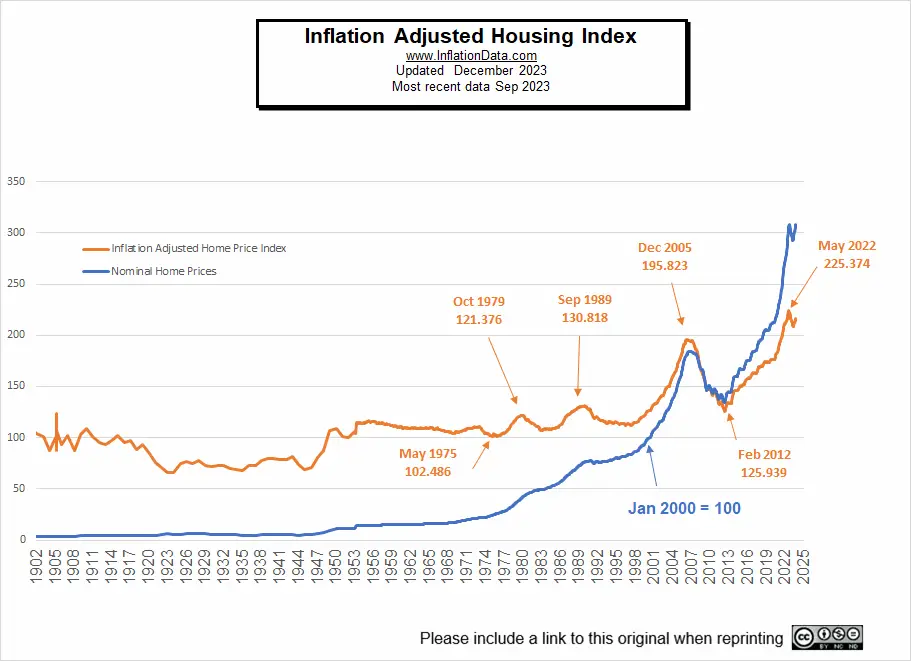
[4] https://www.epi.org/publication/charting-wage-stagnation/
Nobody can predict the future, least of all economists. Having said that I think economists were not wrong on the headwinds that Russian economy would face. They just failed to account for extraordinary measures that dictatorship could take.
And even with said measures there had been a steady deterioration of the economic situation... The real question is what is the state of their mineral (cough gold cough) production rates and reserves. They might just be able to buy their way out of the current situationship.
> The things that dominate middle class budgets: food, housing, medicine, education, are surprisingly local, and have become increasingly unaffordable in recent decades even as economic numbers have gone up.
Really you have to split goods into two categories, stuff that has no geographic ties(alot of these goods manufacture has been outsourced to asian countries and low wage countries) and stuff that is tied to a location, think Mexican tequila or Swiss watches.
The first category is more tied to the middle class and I could alot of the manufacturing coming back to the US due to cost. The second category cannot be made in the US and buyers will bear the brunt of the cost runups.
The stuff in the first category that is going to be hit hard with tariffs is by and large big ticket items like cars and electronics, and conversely the really cheap plastic junk that is ubiquitous at dollar stores. I think the days of 50 inch flat screens for a few hundred dollars are gone. In addition cars sold in the US(US made brands and not foreign companies) have alot of their supply chain in either mexico and canada but the middle class is not buying alot of newer cars - average age of a car is reaching the longest ever due to cars jumping in cost the past few years.
I see this really hurting high income americans alot more, new cars especially European luxury are going to be quite expensive, alot of expensive wines and liquor will jump in price, jewelry and luxury handbags will also be alot more expensive.
On what timeframe did they say that?
There’s a good argument they ARE working to that end, just not as fast as policymakers would like. See the RU economic weakness in September.
One can make a decent argument that the sanctions were insufficient as Russia is effectively a petrostate (now with industry on a war footing) and the sanctions largely avoided RU oil/gas. Also China took up the slack by buying whatever Russia was willing to sell, and in Russian currency which extended their runway.
Lastly, Russia predicted the sanctions as a response to their Feb 2022 invasion because similar things happened before, so they planned ahead and made themselves resilient to The US dollar financial system locking them out (the same way they made their internet resilient to foreign sovereigns potentially cutting them off.
Meanwhile in California, the high-speed rail project is not going so well. There's some serious problems in the U.S bureaucracy, especially blue states. A recent extension of a rail line in San Francisco came in at $1 billion per mile. There are huge amounts of people dependent on the government running inefficiently, vastly overpaying and taking as long as possible to complete work. As we've seen with DOGE, as soon as someone starts to dig into all that, the whole establishment dependent on that inefficiency screams bloody murder. They seem to be adept at developing flywheels where the more money they spend, the worse the problems get, and that justifies spending more money. The $300 million a year homeless budget in San Francisco is a great example of that tendency. Somehow, that needs to get fixed if we want to compete at a world standard level.
How is China's own economy doing these days?
You don't shoot a hole in the bottom of your life raft because the person pleading with you not to was wrong about how many people it could hold.
It's clear that Russia redirected most of its exports. Just look at how much oil India is now buying from Russia — before the war, it was around 5%, and now it's over 40%. They rerouted a large part of their trade, created shadow fleets, and many EU exports still end up in Russia, but through proxy countries like Kazakhstan. (You can see this in the trade statistics between the EU and former Soviet bloc countries before and after the war.)
But the situation here is entirely different. The US has placed tariffs on much of Asia, the EU, and several other regions. There's nowhere for the US to reroute trade in a way that allows it to import the same goods at the same or lower prices.
Anyone else with a proper business background would have been able to negotiate international trade agreements more favorably, including overall increases in tariffs, and if there was going to be unavoidable downward pressure it would certainly be much less than this at this point.
Plus someone with actual useful deal-making experience would have been able to maintain stability on the way to a noticeable if not shocking upturn by now, there was a lot of low-hanging fruit left over after Biden.
Why not do something with that, rather than take it out on the American people? Just because all of them didn't vote for Trump, he can't bring himself to care about the country as a whole, or average citizens hardly at all. Much less legal residents.
If the only way to "sink the liberals" makes almost everyone else go down with the ship, so be it.
The Ruble was on it's way to complete devaluation before Trump propped up the Russian economy by signaling he's willing to give them everything in exchange for nothing.
But it's also true that the west never really fully committed to the sanctions, the fact that you still had Russian oligrarchs traveling around Europe with relative ease was a pretty strong tell.
The US deindustrialized since the 70s. Russia has had 100 years to practice being an independent, self-reliant, sanctioned country. The reasons are obvious.
for example, blocking swift does not make money transactions impossible, makes it difficult for the layman in the first a few times.
nowadays, everyone uses crypto/usdt for the transactions and realizing it is actually cheaper and faster than the swift.
for the europe, they still buy the gas even at a higher price. grounding berlin to moscow flights only benefits turkish airlines and qatar airlines as now they profit from being monopolies (connections through istanbul and dubai)
the reality is that people adapt. i am not a trump supporter, i do not agree with the tariffs but that's what trump is trying to do; force people to adapt local goods
Double digit inflation despite a central bank baseline rate of over 20% is absolutely terrible. GDP numbers are only staying up because their government is spending a massive amount on the millitary and running huge deficits. The situation is very bad and getting worse. Millions of prime age workers have been pulled from productive work to supply the army and serve as assault troops. Hundreds of thousands have been killed or disabled.
The soviet stockpile drawdowns appear to have peaked which will put even more strain on the system. Nobody knows when the system will collapse but it will get there sooner or later without some major changes.
The question that really matters to most people is, "What will these tariffs do to the prices of these things that actually matter?" And that it actually rather hard to predict.
The economists who claim that tariffs will harm normal Americans were also the economists who claimed that sanctions would destroy the Russian economy. They had the opposite effect, for reasons that still remain somewhat unclear. It may be that global trade makes certain classes of society very very wealthy, while not necessarily being such a positive for the middle class.
It is also notable that Chinese competitiveness has only increased as they have engaged in decades of state economic planning and market barriers. The economists who have told us since Reagan that this is inefficient and stupid might be ... wrong.