News for hackers. Stuff that matters.
Re:DOGE's Only Public Ledger Is Riddled with Mistakes by firejake308 on Saturday February 22, 2025 @05:02PM (#43143726)
I know of at least one source arguing that in fact, population health (mainly obesity and gun violence) explain upwards of 70% of the difference in healthcare spending between the US and other developed nations.[1] To me, this seems like the most likely explanation because I believe we have pretty similar diagnostics and treatments to other developed countries, and I don't feel like a British doctor would give me any treatment that an American doctor wouldn't, and vice versa. As for the other 30%, I think it's probably due to inefficiencies in the insurance-based payment system and our patents lasting too long making drugs more expensive.

[1] https://randomcriticalanalysis.com/why-conventional-wisdom-o...

Re:DOGE's Only Public Ledger Is Riddled with Mistakes by silvestrov on Saturday February 22, 2025 @05:19PM (#43143857)
It is very expensive to run the insurance companies, plus all the time the hospitals need to spend to talk/plead with the insurance companies.

When you have the state as a single payer then all those expenses just vanishes.

Re:DOGE's Only Public Ledger Is Riddled with Mistakes by yadaeno on Saturday February 22, 2025 @05:54PM (#43144130)
Even the various single payer models in Europe and asia still have insurance companies.

The difference is that in these systems the government has some stake — whether it’s providing the public insurance fund, or owning the company itself — so that the government is financially incentivized to reduce costs.

In the US case everything is private so all parties are incentivized to increase costs as much as possible.

We really should to copy the Bismarck model. Public owned “public fund”, heavily regulated private insurance and care.

Re:DOGE's Only Public Ledger Is Riddled with Mistakes by llamaimperative on Saturday February 22, 2025 @06:18PM (#43144311)
Competition among insurance companies in most other systems (like the Bismarckian system) is far more constrained and so consumes far less capital. A huuuuge portion of health insurance premiums just go toward spending on ads to pull members from other insurers and otherwise retain your own (especially while they are paying into the plan rather than pulling from the plan, at which point you’re happy to lose them).
Re:DOGE's Only Public Ledger Is Riddled with Mistakes by JumpCrisscross on Saturday February 22, 2025 @06:47PM (#43144553)
> A huuuuge portion of health insurance premiums just go toward spending on ads

Wrong.

"I̶n̶ 2̶0̶2̶3̶ a̶l̶o̶n̶e̶, t̶h̶e̶ f̶o̶u̶r̶ b̶i̶g̶g̶e̶s̶t̶ i̶n̶s̶u̶r̶a̶n̶c̶e̶ c̶o̶m̶p̶a̶n̶i̶e̶s̶ i̶n̶ t̶h̶e̶ U̶.S̶. p̶a̶i̶d̶ a̶ t̶o̶t̶a̶l̶ o̶f̶ $̶3̶.7̶ b̶i̶l̶l̶i̶o̶n̶ t̶o̶ g̶e̶t̶ t̶h̶e̶i̶r̶ n̶a̶m̶e̶s̶ o̶n̶ y̶o̶u̶r̶ s̶c̶r̶e̶e̶n̶s̶" [1] (EDIT: It's less than $30bn [3].) out of $1.5 trillion of premiums collected [2].

[1] https://www.bankrate.com/insurance/car/insurance-advertising...

[2] https://www.cms.gov/files/document/highlights.pdf

[3] https://www.emarketer.com/content/us-healthcare-pharma-ad-sp...

Re:DOGE's Only Public Ledger Is Riddled with Mistakes by llamaimperative on Saturday February 22, 2025 @06:53PM (#43144592)
1. Your $3.7 billion figure is about auto insurers

2. I misspoke and meant "marketing" broadly, not ads in particular. This all fits under administrative overhead which is one of the major sources of inefficiency between private health plans in the US compared to Medicare/Medicaid.

Re:DOGE's Only Public Ledger Is Riddled with Mistakes by JumpCrisscross on Saturday February 22, 2025 @07:08PM (#43144708)
> misspoke and meant "marketing" broadly

Do you have a figure for this?

Re:DOGE's Only Public Ledger Is Riddled with Mistakes by llamaimperative on Saturday February 22, 2025 @09:07PM (#43145608)
Sure: Private insurance overhead is around 15% (up to 20%) while Medicare/Medicaid overhead is around 2%.

They are both insurance programs.

Aside from variations in fraud detection efforts (which Medicare/Medicaid should do more of), what justifies such a gap?

It's various methods by which they grow and retain market share, which Medicare/Medicaid don't need to do.

Re:DOGE's Only Public Ledger Is Riddled with Mistakes by JumpCrisscross on Saturday February 22, 2025 @09:21PM (#43145717)
> Sure: Private insurance overhead is around 15% (up to 20%) while Medicare/Medicaid overhead is around 2%

This doesn't say the difference is in marketing.

Re:DOGE's Only Public Ledger Is Riddled with Mistakes by jay_kyburz on Saturday February 22, 2025 @09:08PM (#43145614)
I believe there should be a government backed, credit union style, non profit operating in every industry as a baseline for companies to compete against.
Re:DOGE's Only Public Ledger Is Riddled with Mistakes by christophilus on Saturday February 22, 2025 @09:55PM (#43145960)
I don’t think that would work. The big insurance companies would find a way to undermine that. But also, the government insurer would end up with the most expensive patients who can least afford premiums, and then the libertarian types will use that to show how the government isn’t as efficient as the private sector.

I have no idea what the actual solution should be, though.

Re:DOGE's Only Public Ledger Is Riddled with Mistakes by gramie on Saturday February 22, 2025 @11:09PM (#43146433)
A doctor I know worked in the US and then returned to Canada. In his US clinic, each doctor had 2-3 employees devoted to billing (patient-paid and insurance). In his Canadian clinic, they had 1 employee doing the billing for 4 doctors.
Re:DOGE's Only Public Ledger Is Riddled with Mistakes by skissane on Saturday February 22, 2025 @07:00PM (#43144636)
> I believe we have pretty similar diagnostics and treatments to other developed countries

I don't know. I remember reading an MIT PhD thesis describing how Kaiser Permanente does autism diagnosis [0] – and comparing it to my personal experience of the same topic in Australia, it seemed significantly more rigorous – e.g. specialist centres that only do autism diagnosis, using the multidisciplinary team diagnosis model instead of the single clinician diagnosis model, use of research reliable examiners for ADOS (the training and validation process required to use ADOS in research settings is much more intensive than that required to use it clinically), etc. Now, the thesis does acknowledge that Kaiser is somewhat of an outlier in this regard compared to the US average (plus it is 10 years old so now so I don't know how things have evolved since), but I still get the impression that this highly rigorous approach to autism diagnosis is much more of a thing in the US than in Australia – and if that's true of autism, maybe it is true of other conditions as well.

[0] https://dspace.mit.edu/handle/1721.1/90070 – the first half of the thesis uses the pseudonym "Allied Health", but I know from other sources that "Allied"=Kaiser; the second half discusses Kaiser without any pseudonym
Re:DOGE's Only Public Ledger Is Riddled with Mistakes by pclmulqdq on Saturday February 22, 2025 @07:47PM (#43145012)
Kaiser is above average in the US, but in the major cities on the East coast you can actually find care that is much more sophisticated than you will get at Kaiser. If I were dying of a rare and aggressive form of cancer right now, I would rather be in Florida (Mayo), New York (Mount Sinai and Sloan Kettering), Boston (Dana-Farber), or DC (Johns Hopkins) than California. Kaiser's big advantage is the whole-life aspect of care, which is pretty appealing as a healthy person, but the medicine available in the US gets much more complicated.
Re:DOGE's Only Public Ledger Is Riddled with Mistakes by jquery on Saturday February 22, 2025 @08:38PM (#43145362)
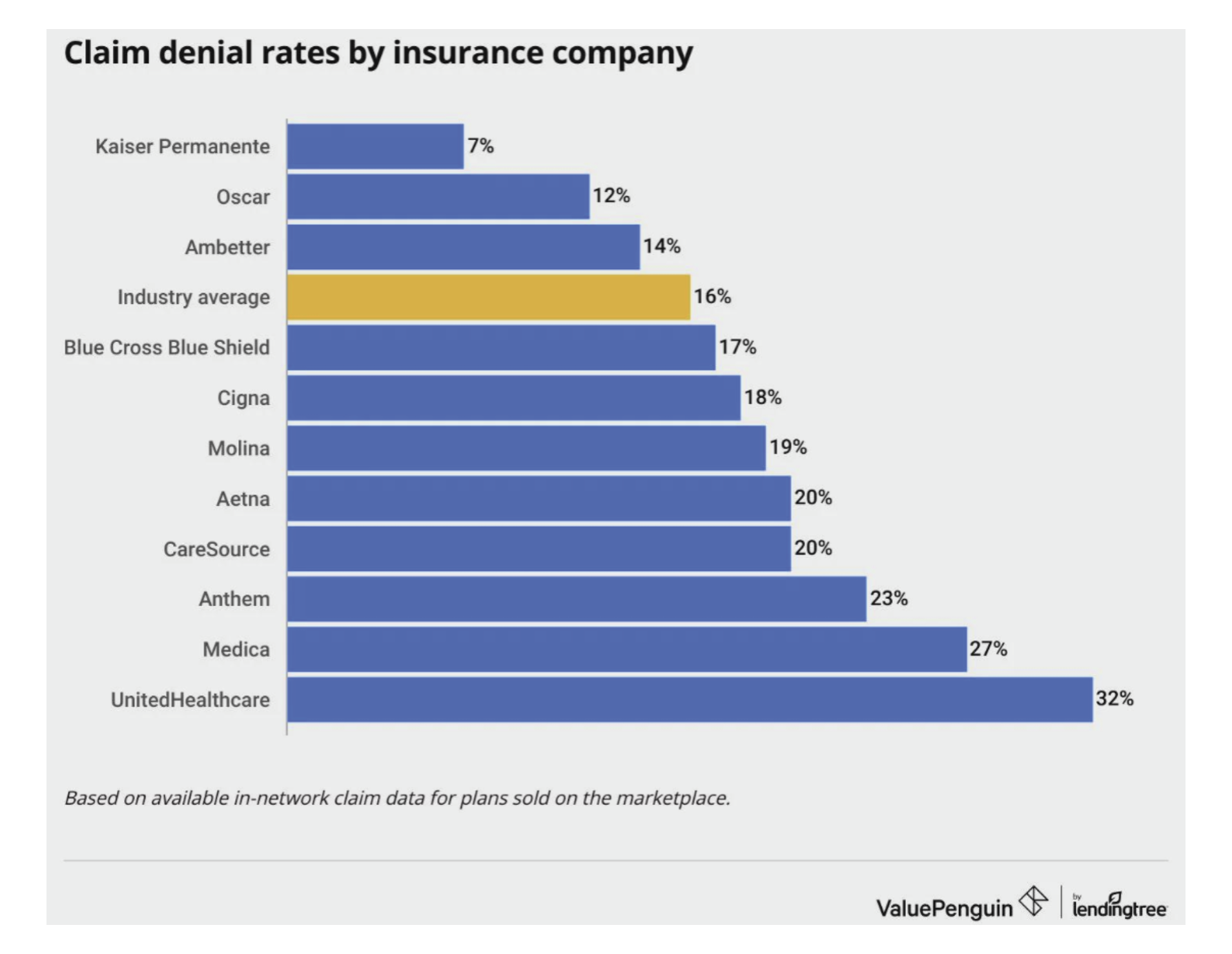
A recent study showed Kaiser had the lowest denial rate of any major insurer, at 7%, versus the industry average of 16%. https://axenehp.com/wp-content/uploads/2024/12/20241218_char...

If you live in an area served by Kaiser and don’t have a very specific health reason to choose a different provider, I highly recommend them. They might not be able to treat that rare and aggressive cancer as well as the Mayo Clinic, but because it’s whole-life care, you’re more likely to find the cancer early.

Edit: Question. Can Mayo expand to cover everyone in Florida? Or is their advantage in hiring the best of the best? What makes their model better than Kaiser?

Re:DOGE's Only Public Ledger Is Riddled with Mistakes by pclmulqdq on Saturday February 22, 2025 @09:14PM (#43145665)
I agree with you that the Kaiser model is very successful and has great outcomes at relatively lower cost. I was just pointing out that if you want to show off the complexity of US Healthcare, Kaiser isn't the best model.
Re:DOGE's Only Public Ledger Is Riddled with Mistakes by apercu on Saturday February 22, 2025 @05:52PM (#43144117)
The U.S. has orders of magnitude of admin costs due to middlemen at every stage in health care. This should be obvious to HN types.
Re:DOGE's Only Public Ledger Is Riddled with Mistakes by llamaimperative on Saturday February 22, 2025 @06:19PM (#43144318)
Also should be noted that health insurers’ marketing costs are part of “administrative overhead.”
Re:DOGE's Only Public Ledger Is Riddled with Mistakes by tzs on Saturday February 22, 2025 @06:07PM (#43144241)
> I know of at least one source arguing that in fact, population health (mainly obesity and gun violence) explain upwards of 70% of the difference in healthcare spending between the US and other developed nations

I have my doubts. Over the last 50 years the ratio of US per capita health care costs and European per capita health care costs (or per capita health care costs for most of the rest of first world countries) has stayed about the same.

In other words, health care costs have risen at about the same rate throughout the first world over the last 50 years. So if in 1970 the US was paying say 3x per capita what some other country paid the US would still now be paying about 3x what they are now paying. Both would be paying maybe 35x now than they were in 1970.

Over that same time both US and European obesity rates went up, but they went up way more in the US. If obesity was a major factor driving health care costs then I'd expect US health care costs to be rising significantly faster than European health care costs.

Re:DOGE's Only Public Ledger Is Riddled with Mistakes by firejake308 on Sunday February 23, 2025 @01:11PM (#43151522)
This implies that healthcare costs in the US were already higher than those in Europe in 1970. Is that a correct conclusion to draw?
Re:DOGE's Only Public Ledger Is Riddled with Mistakes by buckle8017 on Saturday February 22, 2025 @05:50PM (#43144104)
The us healthcare statistics include people paying out of pocket for care that is extremely expensive and literally not available anywhere else.

A number of gene therapies are to expensive for any public health system, so are only available in the us.

Needles to say they're experimental and carry lots of weight in a effectiveness vs cost analysis.

Re:DOGE's Only Public Ledger Is Riddled with Mistakes by sudosysgen on Saturday February 22, 2025 @08:06PM (#43145128)
Experimental therapies do exist in public healthcare systems, the costs are generally borne by the universities with special financing for experimental treatments. Many universities in public systems are run directly by universities which simplifies the process.
Re:DOGE's Only Public Ledger Is Riddled with Mistakes by ted_dunning on Sunday February 23, 2025 @01:08AM (#43147086)
I have an apples to apples comparison here.

I had almost identical cases of cellulitis, one in the US and one in the UK. In the UK, I opted for private hospitalization in one of the fancier hospitals in London. The care was noticeably superior in the UK hospital. The attending doctor was available for a case summary on a few minutes notice, the sterilization and cleaning of the room was vastly better and the nursing staff could recite my case notes and recent test results and vitals at any time. None of these applied for the US hospital.

The bill in the UK was about half what it was in the US and the walk-in price in the US if I hadn't had local insurance would have been nearly double the price I did pay.

The kicker was that the UK hospital was run by HCA, an American corporation.